
There is a strange trend in superhero criticism that has become nearly impossible to ignore. Every new release is expected to reinvent the genre, deconstruct the mythology, deliver prestige cinema, launch the next phase of an interconnected universe, satisfy decades of comic continuity, and somehow still function as a popcorn movie. Increasingly, critics seem to reward ambition over execution, praising films for what they attempt rather than what they actually accomplish. Somewhere along the way, “it’s a really entertaining movie” stopped being enough.
That makes the reaction to Supergirl feel particularly odd.
After watching the film, my immediate reaction was simple: that was a great time. It is exactly the kind of movie people hope to stumble into on a hot July afternoon. Funny without becoming a parody, emotional without drowning in melodrama, visually imaginative without becoming exhausting, and confident enough not to apologize for being an unapologetic science fiction adventure. If your benchmark is whether you enjoyed yourself for two hours, Supergirl succeeds with remarkable consistency.
One of the film’s smartest decisions is also one of its boldest. Aside from a handful of brief scenes, almost none of the movie takes place on Earth. Rather than following the familiar formula of defending another recognizable city from another world-ending threat, director Craig Gillespie sends Kara across the cosmos on what is essentially a space western disguised as a superhero movie (think a more colorful True Grit in space, more or less) . The film borrows some of the freewheeling spirit that made Guardians of the Galaxy such a success without ever feeling like it’s borrowing Marvel’s identity. Strange planets feel genuinely strange, supporting characters come and go like travelers encountered along a long road, and the journey itself becomes far more important than the destination.
Gillespie deserves considerable credit for resisting the temptation to make every scene feel like setup for another movie. There are connections to the broader DC Universe, but they never overwhelm the story at hand. Instead, he trusts his lead actress to carry the film, allowing quieter character moments to breathe before launching back into the action. It gives Supergirl an identity that feels refreshingly self-contained in an era when too many franchise films seem more interested in advertising their sequels than telling a complete story.
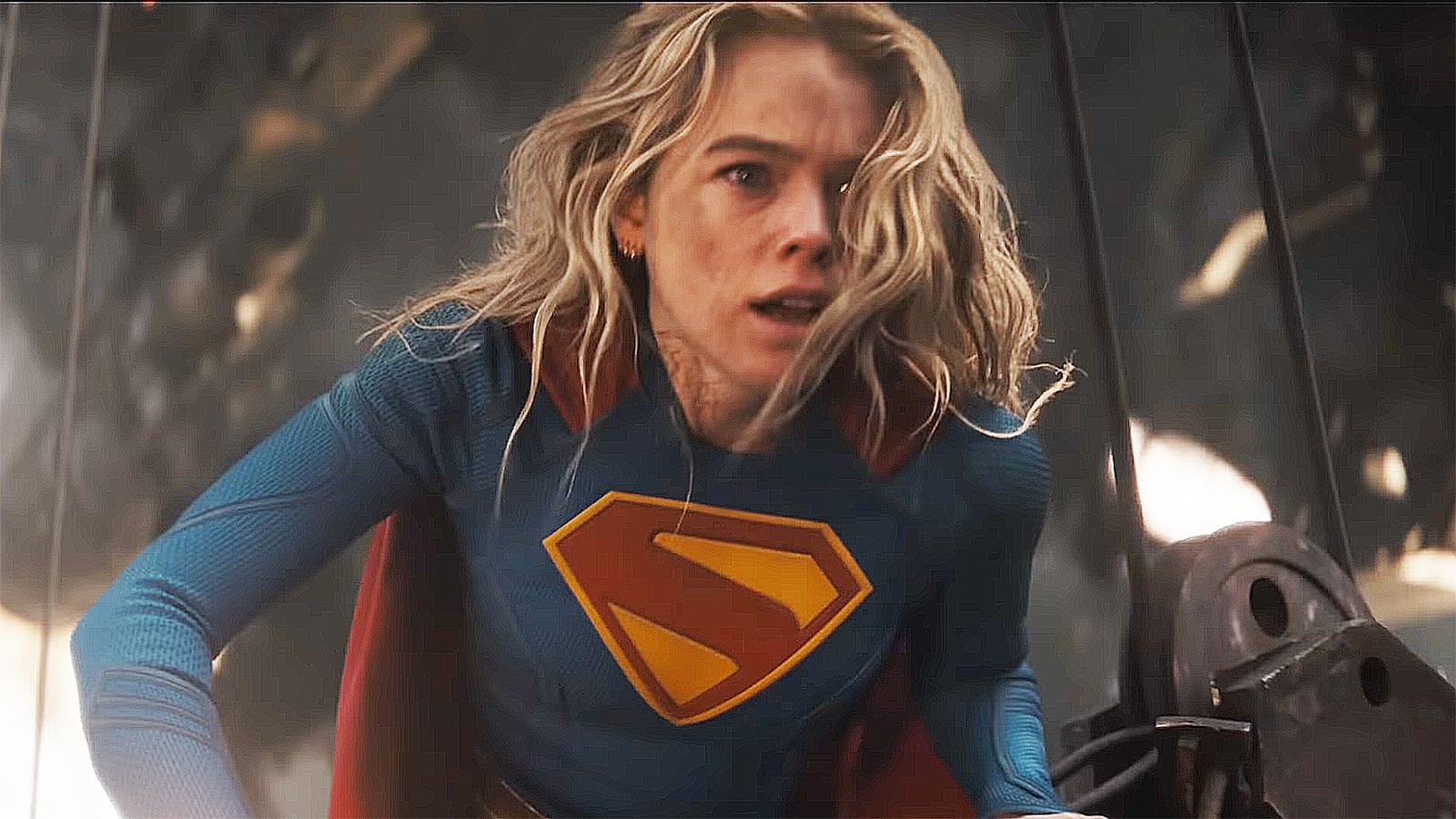
That decision also gives Milly Alcock room to establish Kara as something entirely separate from the version audiences met in last year’s Superman. The contrast is one of the film’s greatest strengths. Superman is hopeful because he knows exactly who he is. Kara is still trying to figure that out. The movies reflect those differences. One feels grounded and optimistic. The other is rougher around the edges, occasionally reckless, and willing to let its hero make mistakes without immediately reassuring the audience that everything will be fine.
Alcock carries that responsibility with remarkable confidence. She has the charisma necessary to anchor a major franchise without ever appearing to chase the spotlight. Even when the editing occasionally feels overzealous, cutting away from scenes that might have benefited from another beat or two, her performance remains the emotional center of the film. She moves effortlessly between comedy, frustration, vulnerability, and determination, making Kara feel less like an icon and more like someone audiences genuinely want to spend time with. If DC was looking for someone capable of carrying future films, the search is over.
Another welcome surprise is what the filmmakers choose not to do with Kara. They never reduce her to a pin-up. That should not be remarkable in 2026, yet it somehow still is. Female superheroes have spent decades being framed through an overtly sexualized lens, including in animated adaptations ostensibly produced for children. Here, Kara gets to be bruised, angry, sarcastic, exhausted, impulsive, and occasionally overwhelmed. The camera treats her like the protagonist rather than an object of admiration. It is a subtle creative choice, but one that quietly distinguishes Supergirl from much of the genre that came before it.
The supporting cast is more uneven, though not without its successes. Eve Ridley brings warmth and sincerity to Ruthye, making the relationship between the two leads believable from the outset. Unfortunately, the screenplay never quite develops Ruthye into the fully realized co-lead the story seems to promise. She remains likable throughout, but there are moments when another draft or another ten minutes of screen time might have transformed her from an effective companion into a genuinely unforgettable character. The chemistry is there. The development isn’t always.
Jason Momoa’s Lobo, meanwhile, is used with admirable restraint. Rather than allowing one of DC’s most outrageous characters to dominate the movie, Gillespie deploys him exactly long enough to leave audiences wanting more. He is funny without becoming a caricature, memorable without becoming distracting, and serves as a reminder that sometimes less really is more.
Matthias Schoenaerts has the less glamorous assignment as Krem of the Yellow Hills. He is not an especially memorable villain, but the film is arguably better for it. Krem functions primarily as the force pushing Kara’s journey forward rather than as an attempt to create the next iconic comic book antagonist. A more elaborate villain might have pulled attention away from the movie’s true focus. By keeping Krem relatively straightforward, the story remains firmly centered on Kara, exactly where it belongs.
The action follows much the same philosophy. The climactic battle stretches a little longer than necessary, but the issue is pacing rather than spectacle. The choreography remains inventive, the geography of each fight stays remarkably clear, and the action never dissolves into the kind of weightless digital noise that has plagued too many recent superhero finales. The violence is also worth mentioning. Parents expecting something as family-friendly as last year’s Superman should know this film earns its PG-13 rating more decisively. It is noticeably more intense and occasionally more brutal, but never feels gratuitous or exploitative. It simply asks a little more of its audience.
That balance is what ultimately defines Supergirl. It knows exactly what kind of movie it wants to be and refuses to apologize for it. It isn’t trying to become the next The Dark Knight. It isn’t trying to dismantle the superhero genre from within. It isn’t chasing prestige or awards season respectability. It wants to tell an entertaining story about an imperfect hero finding her own path through a spectacularly strange universe, and it succeeds far more often than it misses.
Which brings us back to the critics.
Too much modern film criticism, particularly around superhero movies, has become an exercise in grading films against expectations they never set for themselves. Every blockbuster is expected to become a cultural event. Every comic book adaptation is expected to redefine the genre. Every release is judged less on whether it accomplishes its own goals than on whether it fulfills someone else’s wishlist for what superhero movies ought to become.
Supergirl quietly rejects that entire premise.
It is content to be a funny, exciting, occasionally heartfelt summer adventure led by a genuinely magnetic performance from Milly Alcock. It has flaws. Ruthye deserved more development. The finale could lose a few minutes. Some editing choices feel unnecessarily abrupt. None of those shortcomings come close to outweighing what the movie gets right.
More importantly, it’s a well-crafted, entertaining movie that’s absolutely worth the price of a theater ticket.
Sometimes that’s enough.
This time, it was more than enough.
Comments
Nothing yet. Say the first thing.
Sign in to join the conversation.