
Hello, I’m Mandeep. Welcome to my Watch and Learn English substack. My aim is to teach “real-life” English using videos and topics that are in the news.
This week, we look at how very old English still shapes the way we speak today.
The film Hamnet recently won awards at this year’s Golden Globe Awards, bringing new attention to William Shakespeare, not as a famous writer, but as a husband and father.
Hamnet is based on the novel Hamnet, which imagines how Shakespeare and his family lived through the death of his young son.
The story focuses on everyday life, family relationships, love, and loss.
And that connects directly to our language focus this week.
Because although Shakespeare lived over 400 years ago, many of the expressions he created are still part of modern English. You may already use them without knowing where they come from.
This week, we explore what these expressions mean, how they are used in real English, and how you can recognise them when you hear them in conversations, films, or at work.
This week we have:
Video of the week – a film trailer connected to Shakespeare’s life
Vocabulary focus – everyday expressions Shakespeare gave us
Extended listening – a short story using several expressions naturally
👉 You’ll find the answers to all comprehension questions at the bottom of the post.
Let’s get started
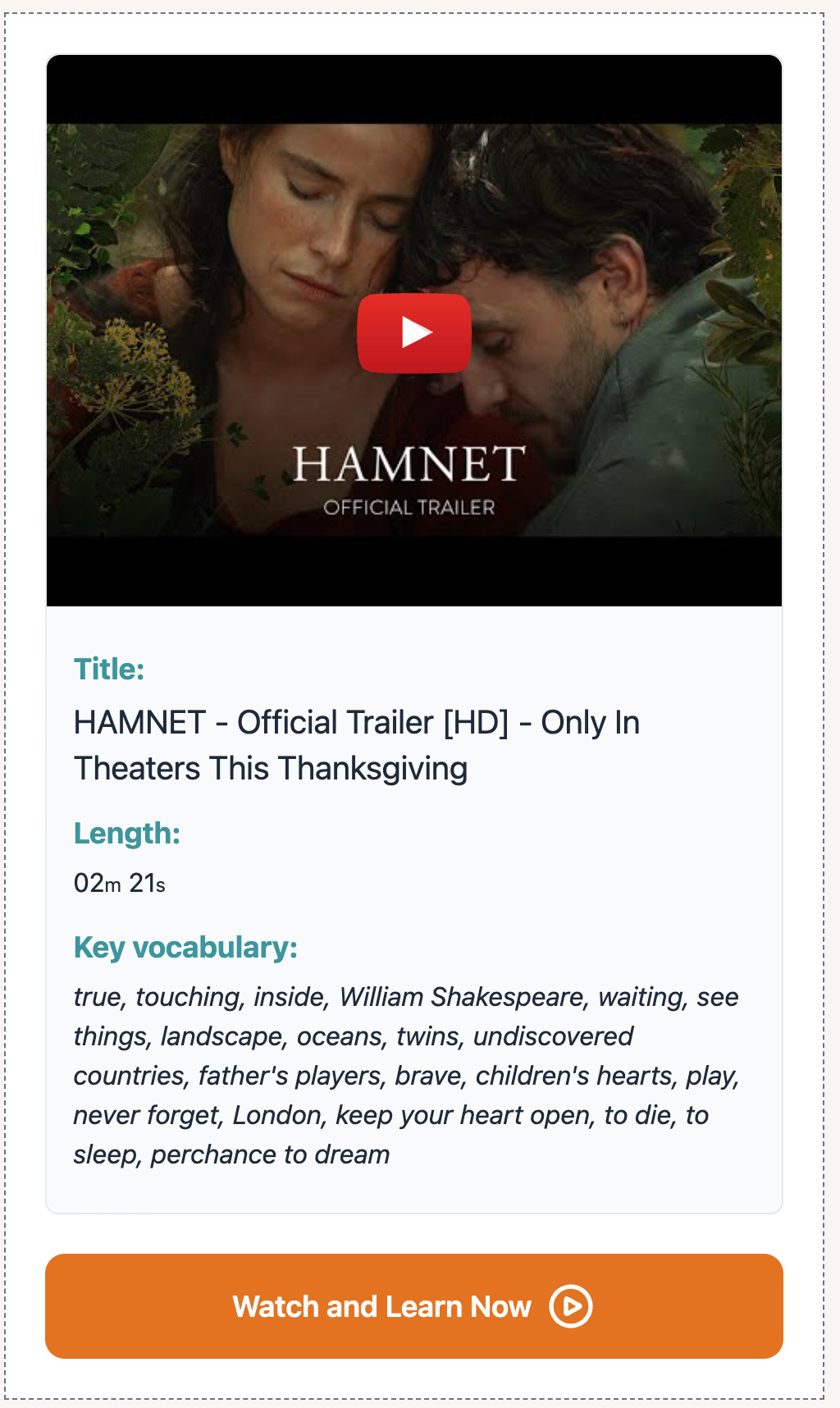
This week’s video is the trailer for Hamnet.
The film is set in England in the 1500s and shows daily life inside Shakespeare’s family.
It focuses on quiet moments, strong emotions, and the impact of loss.
As you watch, think about this question:
How can simple words express very strong feelings?
You can click here to watch the video for free with clear, accurate captions (not auto-generated) and even slow the playback to catch every word.
If you’d like to go deeper, click on any word in the subtitles. With unlimited access (€1.99/month), you’ll get:
Words and phrases explained in context
Comprehension exercises
Mobile-friendly study on your phone
A weekly vocabulary summary to help you remember what you’ve learned
In this section, we look at expressions Shakespeare introduced or made popular, and how they are still used in everyday English today.
Listen to each short audio clip and answer the comprehension question.
(Remember: the answers are at the bottom.)
(from The Taming of the Shrew)
0:00
-0:09
“I didn’t know anyone at the meeting, and everyone was very quiet at first. So I asked a simple question to break the ice and make things feel more relaxed.”
Question
Why does the speaker speak first?
A. To relax the situation
B. To stop the meeting
C. To change the topic
(from Romeo and Juliet)
0:00
-0:07
“I spent half an hour looking for that old email, but it turned out to be a wild-goose chase. It had already been deleted.”
Question
What does the speaker mean?
A. It was exciting
B. It was useless
C. It was quick
(from Henry V)
0:00
-0:07
“He doesn’t talk much and he looks quite serious, but once you get to know him, you realise he’s got a heart of gold.”
Question
What kind of person is he?
A. Kind
B. Strict
C. Unfriendly
(from As You Like It)
0:00
-0:06
“My phone still works, but it’s very slow and the screen is cracked. It’s definitely seen better days.”
Question
What is true about the phone?
A. It is new
B. It is old or damaged
C. It is expensive
(from The Tempest)
0:00
-0:06
“I was in a pickle this morning because I forgot my password and couldn’t log in to my work account.”
Question
What is the speaker describing?
A. A small problem
B. A celebration
C. A surprise
(from Othello)
0:00
-0:05
“She wears her heart on her sleeve, so it’s easy to see when she’s happy or upset.”
Question
What does this mean?
A. She hides her feelings
B. She shows her feelings
C. She avoids people
(from The Tempest)
0:00
-0:05
“Fair play to her, she made a mistake, but she admitted it straight away and apologised.”
Question
Why does the speaker respect her?
A. She stayed quiet
B. She was honest
C. She won something
(from Much Ado About Nothing)
0:00
-0:04
“I’ve been really busy lately, so I’m going to lie low this weekend and just relax at home.”
Question
What does the speaker plan to do?
A. Go out a lot
B. Stay quiet and rest
C. Travel
(from The Merchant of Venice)
0:00
-0:06
“Everyone could see the problems in their relationship, but love is blind, and he ignored all the warning signs.”
Question
What does this expression mean?
A. Love helps people see clearly
B. Love makes people ignore problems
C. Love ends quickly
Now listen to a slightly longer audio.
0:00
-0:39
““Honestly, today was not great. I was in a bit of a pickle first thing in the morning because my computer, which has definitely seen better days, wouldn’t turn on, and I had an important deadline.
At first, I tried to lie low and fix it quietly, but nothing worked. I wear my heart on my sleeve, so my colleague could tell straight away that I was stressed and not having a good day.
Fair play to her, though, she stayed calm, helped me contact IT, and even checked in later to see if I was okay. She really does have a heart of gold.
In the afternoon, I had a meeting with people I didn’t know very well. Everyone felt tired and quiet, so I made a small joke to break the ice. It didn’t fix the whole day, but it made the meeting easier.”
A
B
A
B
A
B
A
B
B
B
Shakespeare wrote about real life, work problems, emotions, relationships, and difficult days.That’s why his expressions still feel natural today. They help us talk clearly about everyday situations. Which of these expressions do you already use?
Try using one this week and share it in the comments.
Thank you for being part of this community of 22,000 English learners around the world.
See you next time,
Mandeep
Please let me know what you think of my post. Your feedback is appreciated.
Loved it | Great | OK | Meh | Bad
We have over 22.000 subscribers in 123 different countries! Please come and say hello to everybody in the comments. I’d love to know what you’re watching this week.
Comments
Nothing yet. Say the first thing.
Sign in to join the conversation.