
Preface: I’ve written about artificial intelligence on a number of occasions, focusing on issues related to computational efficiency in energetic terms comparing the US and Chinese models, the constraints of electricity systems augmentation on American AI ambitions and the paradox of unviable information in AI with American characteristics. This essay takes a different tack. I’ve “rushed it” a little, to bring it to the table on the tail-end of Xi Jinping’s speech at the World AI Collaboration Conference, held in Shanghai a few days ago (full text of his remarks can be found here in English and here in Chinese.) It does not directly respond to Xi’s remarks, or announcements per se, but seeks to explore one aspect of difference between Chinese and US approaches to AI revolving around vastly different approaches at a philosophical level. Whereas American AI revolves around weaker or stronger versions of the “calculable intelligence” frame, in which AI — if sufficiently developed — can emulate human intelligence (even to a point of surpassing human intelligence), Chinese AI tends to focus on a less presumptuous appreciation of AI’s capabilities, which has resonance with a Daoist ontology. I suggest that the west can learn a lot from this latter approach, and that the phenomenology of Heidegger and others who’ve worked in his tradition, can act as something of a bridge. Insofar as Xi’s remarks and announcements, I aim to reflect on them progressively in light of my broader lens and interests around “Digital Westphalia,” thermoeconomics and China as a great enabling power (赋能型大国).
The rapid advance of artificial intelligence confronts us with more than technical questions. It demands that we clarify what intelligence truly is, how we value it, and what role computation should play in human life. In the West, a dominant strand of AI discourse remains oriented around emulation: the ambition to build systems that replicate, match, or surpass human intelligence through ever-more-sophisticated computation. This path, while yielding impressive capabilities, risks a profound philosophical and practical dead end — not because machines cannot become extraordinarily powerful, but because the belief that advanced mimicry constitutes intelligence misleads development, expectations and culture.
A wiser, more grounded alternative begins with Daoist philosophy; or at least, that’s the line of thinking developed in this essay. Daoism offers a cosmology centred on the dao (the Way 道), wu wei (effortless action or non-forcing 无为), and intuitive attunement (直觉 — zhí jué) to contextual flow. Intelligence here is not primarily internal representation or calculation but an informed, embodied capacity to respond harmoniously within unfolding situations. Martin Heidegger’s phenomenology, with its deep resonances to Daoist thought, can serve as a Western bridge: helping critique the limitations of the emulation paradigm while opening appreciative engagement with China’s pragmatic approach to AI. Together, they point toward treating AI as augmented computation that serves human attunement rather than seeking to replace it.
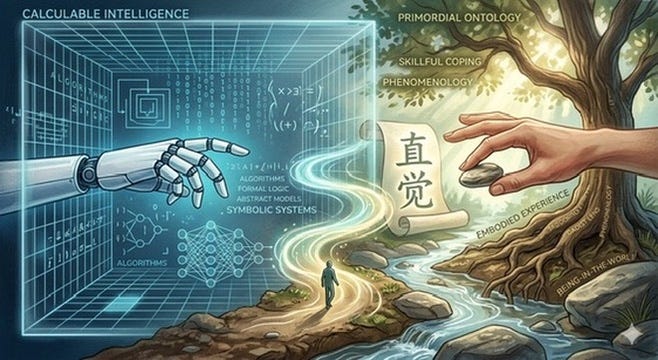
Daoist classics such as the Daodejing and Zhuangzi present a cosmology of dynamic, relational flow rather than static essences or totalising systems. The dao is the ineffable Way that cannot be fully captured in words or models; it unfolds through spontaneous emergence, contextual appropriateness, and the mutual arising of opposites (you 有 and wu 无). True efficacy arises through wu wei 无为 — non-forcing action that aligns with natural potentials instead of imposing external will or abstract schemes.
In this worldview, intelligence is not primarily a matter of internal representations, logical deduction or computational optimisation. It is an embodied, intuitive capacity (zhí jué 直觉) — a cultivated sensitivity to situation, timing, relational dynamics and the unspoken background that allows one to respond harmoniously and effectively. The sage or skilled practitioner does not calculate from first principles but dwells within the flow, acting with a direct, pre-reflective apprehension that feels almost effortless. Tools and technologies are judged by how well they support this flow without claiming to supplant the attuned intelligence that wields them.
Chinese approaches generally treat AI more as supercharged computation (人工智能 — rengong zhìnéng or “man-made intelligent capacity”) for practical enhancement. The “intelligence” in 人工智能 is computational intelligence — powerful, scalable and instrumentally valuable for workflows, optimisation and data-intensive tasks. Policy and deployment emphasise “AI+” integration into the real economy, workflows, governance and industrial systems. The focus is on operational outcomes: accelerating decisions, optimising flows, reducing friction and scaling capabilities across domains. Even pursuits of “general AI” are framed instrumentally — broader application power rather than ontological equivalence to human mind. In short, 人工智能 excels at néng (capacity) but does not replicate the depth of human zhí jué. Recognising this boundary clearly is one of the best safeguards against both hype and the displacement of plurality you warned about. It keeps AI in its proper, useful place — as a powerful servant of human purposes rather than a rival ontology. AI has no intuitive capacity (人工智能没有直觉能力) is a succinct way of understanding the distinctions.
Without labouring the etymological point to excess, we can that note that 智能 compounds zhì (智: knowledge, wisdom or cleverness) with néng (能: ability, capacity, power or function). It leans more toward “intelligent capability” or “informed capacity” — a practical, grounded faculty for effective action and problem-solving. It evokes engineered or augmented ability more than an inner essence of mind. Zhìnéng 智能 is less aligned with deeper terms like 知识 (zhī shí) — knowledge as accumulated information or epistemic content or 智慧 (zhì huì) — wisdom, insight or sagacity (often with moral, experiential or holistic connotations). Thus, zhìnéng 智能 is more operational and results-oriented: the capacity to process information effectively to achieve outcomes. This etymological grounding supports the pragmatic deployment focus — AI as a powerful enhancer of workflows, decision speed, system optimisation and application breadth, without strong implications of replicating human wisdom or consciousness. It keeps the emphasis on the “artificial” (engineered, instrumental) aspect while downplaying mystical or metaphysical claims about intelligence per se.
This resonates with Daoist pragmatism. Technology is seen as a tool aligned with dao (the way), emphasising wu wei (effortless efficacy) and contextual harmony over forceful mastery or emulation of inner essence. There is less cultural investment in anthropomorphic emulation or fears of “machines becoming like us.” This perspective is deeply pragmatic yet ontologically humble. It resists the urge to create artificial duplicates of the human mind, favouring instead augmentation that enhances human (and collective) participation in the greater dao.
The prevailing Western paradigm stands in sharp contrast. Intelligence is largely framed as calculable — something that can be formalised, modelled, reverse-engineered, and ultimately engineered through mathematical laws. This “calculable intelligence” view traces back through Leibniz’s vision of a universal characteristic, Boole’s algebra of thought, Turing’s computability and the symbolic AI programs of the mid-20th century, finding contemporary expression in scaling laws, transformer architectures, probabilistic inference and hybrid neuro-symbolic systems.
Tom Griffiths’ The Laws of Thought provides a lucid recent articulation. Griffiths explores three interlocking mathematical frameworks — rules and symbols, neural networks and probability/statistics — as pathways to understanding and replicating the mechanisms of mind. The book is thoughtful and acknowledges limitations, yet it operates firmly within the assumption that cognition is amenable to formal laws that can be discovered and implemented computationally.
This approach has produced undeniable technical achievements: superhuman performance in games, language modelling, code generation, medical imaging, and scientific hypothesis generation. Its cultural and investment pull is strong because it promises a clean, engineerable path to general intelligence. The implicit (often explicit) ontology is that intelligence is, at bottom, information processing — representation, search, optimisation and prediction. Sufficiently advanced mimicry through data, compute, and architecture will therefore cross into genuine AGI or beyond.
Philosophically, this repeats a Cartesian move: separating mind as a realm of clear, distinct ideas that can be abstracted from body and world. It privileges the present-at-hand stance of theoretical analysis over lived engagement. When AI systems generate fluent, contextually appropriate outputs, proponents often interpret this as evidence that the gap to human intelligence is closing. The very term “artificial intelligence” encourages the slippage: the “artificial” fades as performance improves, fostering the belief that we are building minds rather than sophisticated simulators.
Martin Heidegger’s phenomenology offers a powerful Western counterpoint that exposes the depth of this limitation. Heidegger distinguishes the ready-to-hand (Zuhandenheit) — our primordial, intuitive coping with equipment and situations in seamless flow — from the present-at-hand (Vorhandenheit) — the detached, theoretical stance in which we step back and represent the world as objects with properties. Human existence (Dasein) is always already attuned (Stimmung) to a meaningful world through care, mood and background practices. Explicit calculation and modelling are derivative modes that arise only when smooth coping breaks down.
This framework directly challenges calculable intelligence. AI systems, no matter how advanced, begin and operate in the present-at-hand register: building explicit or learned representations, optimising objectives and approximating patterns from data. They lack the primordial attunement, embodied situatedness and tacit background that make human intelligence possible. There is no equivalent of mooded disclosure, bodily resonance or the silent pull of context.
Hubert Dreyfus made this critique explicit and sustained across decades. In his groundbreaking 1972 book What Computers Can’t Do, Dreyfus argued that symbolic AI’s reliance on formal rules could never capture the holistic, intuitive nature of human expertise. He drew on Heidegger, Merleau-Ponty, and Wittgenstein to show that skilled coping depends on embodied know-how and situational perception that cannot be exhaustively formalised. The 1992 revised edition, What Computers Still Can’t Do, extended the argument to connectionist and early neural approaches, maintaining that they still missed the phenomenological ground.
Dreyfus continued refining this ontological critique until his death in 2017. In All Things Shining (co-authored with Sean Dorrance Kelly), he explored how meaning and attunement emerge from cultural practices and receptivity rather than autonomous calculation. The edited volume Heidegger, Authenticity, and the Environment and especially Mark Wrathall’s work on useful coping (drawing on Dreyfus’s teachings) further developed the idea that skilful action is a form of attuned responsiveness — “coping” — that reveals the world meaningfully without needing internal models. These works underscore that the failure of AI is not merely technical (brittleness outside training distributions) but ontological: it lacks the ground of Being from which human intelligence arises.
In On the Internet, Dreyfus extended this analysis to everyday digital experiences. He examined how search engines like Google create an illusion of contextual relevance. The algorithm aggregates similar past queries and the subsequent browsing behaviour of users who performed those searches, effectively applying a sophisticated regression model: “Users who searched for X also tended to click on Y.” To the end user, the results often feel relevant and intuitively right. Yet this is not genuine context or situated understanding. It is statistical averaging across disembodied data points — a clever simulation that flattens true situational meaning into probabilistic patterns. For most users, the illusion suffices for casual needs, masking the deeper absence of embodied, attuned relevance.
Heidegger’s later thinking on technology as Gestell (enframing) — the reduction of everything to standing-reserve for ordering and control — adds urgency. Calculable intelligence risks enframing both mind and world, concealing the poetic, relational disclosure that phenomenology and Daoism both value. Gelassenheit (releasement) points toward a freer relationship with technology: using computational power without being captured by it.
Heidegger thus functions as a bridge, of sorts. His thought, with its documented affinities to Daoist and Zen ideas (via Japanese interlocutors and translations), allows Western minds to diagnose the limits of their own calculable paradigm while finding resonance with China’s more instrumental, deployment-oriented path.
China’s AI strategy largely embodies a Daoist-inspired pragmatism. Policy documents and industry practice prioritise “deep integration” with the real economy and society. The “AI+” initiative and related plans target embedding AI in manufacturing, agriculture, healthcare, logistics, governance and consumer applications to accelerate decisions, optimise flows, reduce costs, and boost productivity.
Real-world examples illustrate the approach: AI-driven precision agriculture tools used by farmers in competitions, diagnostic support systems in hospitals, smart factory optimisation, supply-chain coordination and consumer assistants integrated into super-apps. A “good enough” mindset enables rapid iteration through massive deployment, leveraging abundant data and hardware integration (especially robotics). Cost-efficient inference and open-source elements in some domains accelerate scaling.
Even frontier efforts and references to “general AI” tend to emphasise broadened application capabilities in data-rich domains rather than claims of replicating human consciousness or wisdom. AI is infrastructure — a utility for systemic coordination and national development — not an independent mind. This instrumental focus aligns with Daoist priorities of contextual efficacy and harmonious contribution to the greater flow.
Ethnologically, this reflects longstanding cultural orientations favouring relational harmony, practical governance and collective benefit over autonomous mind replication. Technology serves modernisation and social order without the Western cultural drama of creating rival intelligences.
The calculable-emulation paradigm has generated genuine breakthroughs in optimisation, generation and narrow-task performance. Yet its deeper limitation is ontological. By treating intelligence as something that can be fully formalised and engineered, it commits to a present-at-hand stance that misses the ready-to-hand ground of human existence. Dreyfus’s decades-long critique demonstrates that no amount of additional variables or architectural sophistication can bridge this gap if the starting point remains detached representation rather than embodied attunement. The result is a sophisticated but ultimately brittle form of intelligence that excels in constrained domains while struggling with the open-ended, contextual, intuitive richness of real-world human life.
This creates a cultural and practical dead end. Resources flow toward anthropomorphic goals and hype cycles rather than targeted augmentation. Human capacities for wisdom, ethical intuition and creative response to the unformalisable are subtly devalued. Plurality narrows as a single computational ontology gains hegemony. Heidegger’s warning about Gestell feels prescient: when everything is enframed as calculable, we risk losing the poetic openness that lets the world disclose itself meaningfully. Everyday tools like search engines illustrate the subtlety of the problem — they deliver statistically probable relevance that feels contextual, yet deliver only aggregated approximations rather than true situated understanding.
A Daoist-grounded, phenomenologically-informed alternative charts a wiser course. It begins by reframing the fundamentals. Instead of speaking of “artificial intelligence” in ways that invite ontological confusion, we can describe these systems more accurately as augmented computation or intelligent capacity tools. This linguistic shift alone reduces hype and clarifies expectations, positioning AI as a powerful servant rather than a potential peer or successor to humanity.
It also calls us to centre attunement and zhí jué 直觉 in design and deployment. Systems should be built to support and enhance human intuitive judgment and flow states rather than attempting to replicate or displace them. Decision-support tools, for instance, can present options and predictions while leaving final synthesis, ethical weighing and contextual feeling to people. Interfaces can be crafted to respect rather than interrupt intuitive expertise. In this way, AI becomes a partner in attuned action instead of a replacement for it.
The path forward further requires prioritising pragmatic integration. Here the West can usefully learn from China’s emphasis on real-world utility, operational smoothing and broad deployment across sectors. Rather than chasing universal human-like benchmarks, efforts can focus on measurable value in specific contexts — accelerating workflows, reducing friction in complex systems and scaling capabilities where calculation provides clear advantage. This keeps ambition grounded and avoids the recurring Western cycle of overpromising on general intelligence.
Throughout, we must maintain ontological humility and a spirit of releasement. Computation has extraordinary strengths in scale, tireless optimisation and pattern processing, but it also has clear limits in domains requiring embodied wisdom, moral discernment and creative breakthrough. Gelassenheit (or wu wei) encourages us to use AI where it naturally fits without forcing it into roles that exceed its nature. This humility preserves space for distinctly human forms of intelligence while preventing technology from becoming an all-encompassing frame. I’ve touched on this application scaffold in the context of language learning previously.
Finally, this approach fosters genuine cross-cultural learning. Western traditions of critical and phenomenological reflection can complement East Asian strengths in pragmatic integration and systemic harmony. Rather than a zero-sum race toward a single model of intelligence, we can cultivate plural ways of relating to these powerful tools, each shaped by its own cultural and philosophical ground.
Daoist philosophy teaches that genuine intelligence flows with the dao — attuned, contextual and harmonious. Heidegger helps Western thought recover this insight from within its own tradition, exposing the limits of calculable emulation. China’s pragmatic path demonstrates what effective, grounded deployment looks like when emulation is not the guiding star.
The West can retain its innovative edginess while reordering priorities: begin from attunement, treat computation as servant and engage other traditions openly. In doing so, AI becomes technology that deepens our participation in the greater Way rather than aiming to or pretending that it can displace it. This grounded posture offers ambition without hubris, and humility without resignation. It may be the most intelligent path forward.
Comments
Nothing yet. Say the first thing.
Sign in to join the conversation.