
“I own the stuff,” Barton said. “So I know more about this history than most of the professors.”
I own a garage full of tools so I know more about fixing cars than professional mechanics.
……………………………..
The Wall Street Journal is out today with a profile of GOP operative David Barton. Reporter Chris Kuo traveled to Aledo, TX to interview him and see Barton’s collection of historical artifacts. He also interviewed me for the article but, as far as I can tell, Kuo and co-author Anyee Bhutani didn’t use any of it (I don’t know if editors killed any of what I present below, I just know none of it appears in the article.).
We are pretty far down the road for mainstream press articles profiling David Barton, as if he was some unknown quantity. There have been so many of these kind of articles, it is willful ignorance not to know who he is and what he is doing to American politics.
This article does one thing well. For those who don’t know how Barton influences policy, it offers examples of how his work is used by Republicans in power. His false history is behind the current push to get the Ten Commandments in schools and the Bible into social studies classes. He helped provide justification to the Trump administration for cuts to foreign aid which resulted in the deaths of thousands of children around the world, and he is advising the administration on history in public museums.
I don’t recall all of the questions Chris Kuo asked but at least one related to why I don’t think Barton is a historian. In my answer, I showed him an illustration of something historians don’t do that Barton did in his 2012 book, The Jefferson Lies. In the WSJ article, Kuo mentioned the fact that Barton’s book was pulled from the shelves by the publisher but he didn’t illustrate why they did it. That would have been useful to readers. I sent the following image to Kuo.
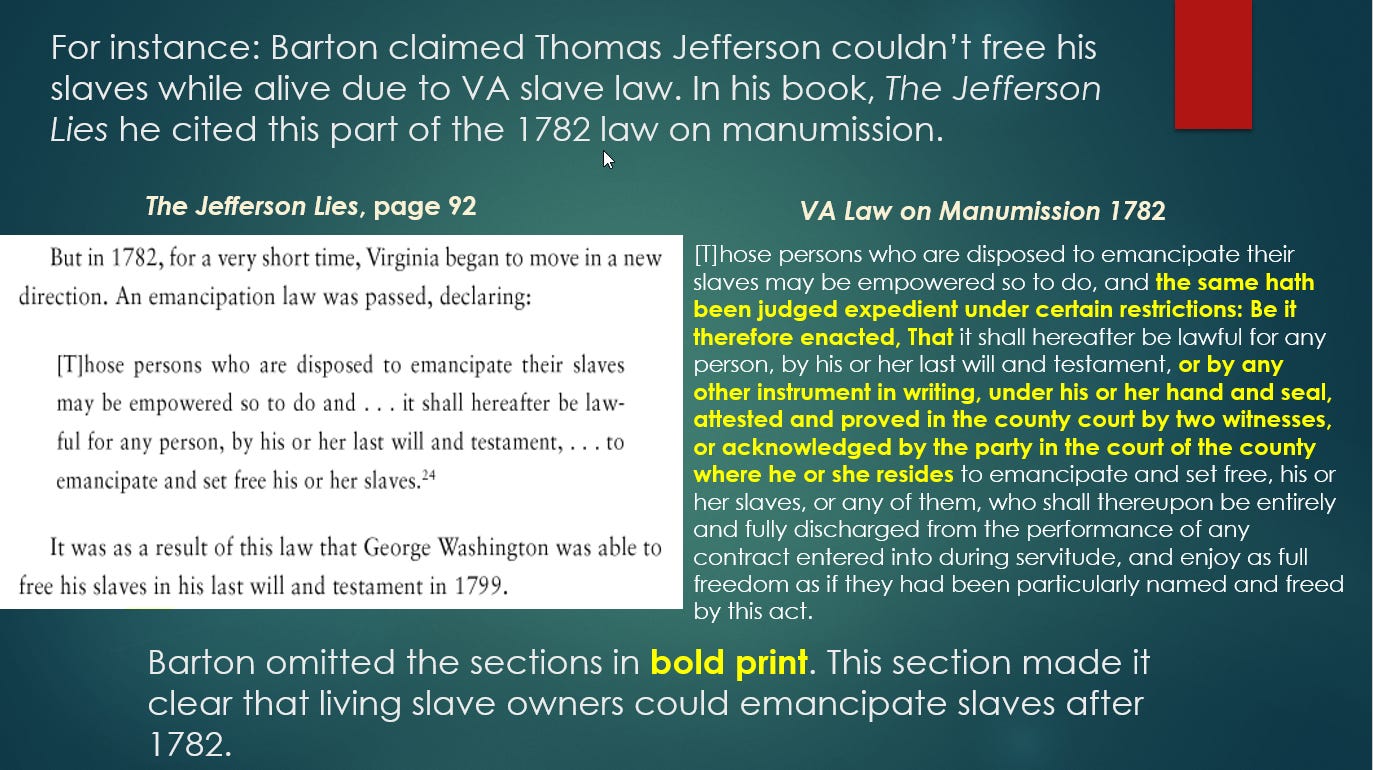
On your left is a section of Barton’s book that was pulled from publication. Note the ellipsis in the quote after “last will and testament.” Barton quoted only part of the 1782 Law on Manumission. In that part of the book, he was trying to prove that Thomas Jefferson could not free his slaves because it was illegal under Virginia law. However, Barton left out the part of the law that allowed enslavers to free those they enslaved. He deliberately omitted a part of the law which didn’t reinforce his false statement about Virginia law. I have the full version of the 1782 Virginia law on the right side of the image in bold yellow print.
Historians don’t omit parts of the historical record that they don’t like. Given the influence documented by the Wall Street Journal, it seems to me that the public should know about this. The WSJ allowed Barton to claim that he knew more than professors, but the paper didn’t document Barton’s shoddy methods to offset that outrageous claim.
I told the reporter about Barton’s claim that the Constitution quotes the Bible verbatim. Given his influence and his claim that he is smarter than the professors, shouldn’t the WSJ tell the public that this collector of historical documents thinks the Constitution quotes the Bible word for word? It seems to me that knowing that might influence a reader’s perception.
I also sent this video to the reporter.
In this video, Barton claims to have an earned doctorate. He says he just prefers not to talk about his earned doctorate. However, the truth is that he doesn’t have an earned doctorate. A non-regionally accredited Bible school called Life Christian University gave him an honorary doctorate a few years ago and he went on social media and said it was earned. He didn’t name the school, he just pointed to a half hidden diploma and said that was his earned doctorate. However, when I pointed out that the piece of paper came from Life Christian and wasn’t earned, Barton took the video down from his social media accounts and never spoke of it again. The WSJ knew this but didn’t tell the public.
I also sent Kuo an excerpt from my book The Christian Past That Wasn’t showing how Christian organizations know that David Barton’s stories are riddled with errors but they don’t stop using them because they are politically useful. The WSJ keeps up the charade that the reason Barton is influential is because of his document collection and his superior knowledge. However, in my book, I document otherwise.
I have case studies of Focus on the Family and Family Research Council in the book and show that key decision makers knew Barton’s history was off but they declined to inform the public. How does it help inform the public to leave that out of the story?
I also sent an article I wrote for this substack titled Who is David Barton? Here is the core of that article:
In the past, Barton claimed that:
he had an earned doctorate until I pointed out it came from an unaccredited school where he attended no classes. https://wthrockmorton.com/2016/09/07/is-life-christian-university-the-source-of-david-bartons-phd/
he played Division one basketball at his college Oral Roberts University; he was never on the team. https://wthrockmorton.com/2021/08/27/david-barton-in-the-news-remember-his-earned-doctorate-and-his-division-one-basketball-stardom/ (scroll down for this one)
he translated for the Russian National Gymnastics Team. This is very unlikely. https://wthrockmorton.com/2015/04/10/experts-dispute-david-bartons-claims-about-translating-for-the-russian-national-gymnastics-team/
Native Americans had to be destroyed by the “white guys” to get the native people to sign a treaty. https://www.huffpost.com/entry/david-barton-justifies-destruction-of-indian-tribes_b_2949050
legal abortion has triggered climate change and all sorts of other weather problems. Oddly enough (sarcasm alert), there doesn’t appear to be an association between abortion and weather catastrophes. https://wthrockmorton.com/2013/11/05/abortion-and-david-bartons-theometeorology/
a vaccine won’t be discovered for HIV because the Bible teaches HIV is the penalty for being gay. Surprise! He then distorted the facts concerning advances in HIV vaccines. https://wthrockmorton.com/2015/04/13/david-barton-again-says-bible-teaches-hiv-vaccine-wont-be-discovered-distorts-vaccine-research/
Virginia enslavers (e.g., Thomas Jefferson) weren’t allowed by Virginia law to free their slaves after 1782. In fact, the Virginia legislature passed a law titled the Virginia law on manumission in 1782 which allowed enslavers to free slaves under certain conditions. https://wthrockmorton.com/2015/03/16/dear-david-barton-virginia-law-allowed-manumission-of-slaves-after-1782/
Robert E. Lee wasn’t racist at all. https://wthrockmorton.com/2017/08/21/david-barton-likens-statues-stalin-confederate/
adolescence is unbiblical. https://wthrockmorton.com/2016/04/20/david-barton-says-adolescence-is-unbiblical-like/
violent crime was down in Las Vegas in 2017 due to biblical principles in use there. It wasn’t. https://wthrockmorton.com/2016/03/17/las-vegas-police-department-contradicts-david-bartons-claims-about-decline-in-violent-crime/
PTSD can be cured with Bible verses and rebuking Satan. That didn’t go well. https://wthrockmorton.com/2013/11/13/david-barton-and-kenneth-copeland-ptsd-can-be-cured-by-bible-verses-and-rebuking-satan/
violent crime in the U.S. has gone up 694% since the Supreme Court ruled on prayer and Bible reading in public schools. In fact, crime went up from the 1960s until the mid-1990s and then declined steadily until recently. https://wthrockmorton.com/2015/02/20/david-barton-again-misleads-a-church-about-violent-crime/
The Bible is quoted verbatim throughout the Constitution. Not so much. https://wthrockmorton.com/2017/05/17/does-the-constitution-come-from-deuteronomy/ https://wthrockmorton.com/2013/07/01/david-barton-and-the-biblical-constitution/ and https://wthrockmorton.com/2013/07/01/david-barton-and-the-biblical-constitution/
William Penn founded the Quakers. Nope. wthrockmorton.com/2011/09/16/william-penn-founded-the-quakers-and-other-tall-tales-from-david-barton/
Unitarians once were evangelical. Again Nope. wthrockmorton.com/2011/09/16/william-penn-founded-the-quakers-and-other-tall-tales-from-david-barton/
He loves to use fake quotes. Here is one he attributed to Abe Lincoln: https://wthrockmorton.com/2018/07/15/david-barton-again-uses-fake-abe-lincoln-quote-on-education-to-criticize-education/
Here’s another one he attributed to Jefferson. https://wthrockmorton.com/2016/03/01/david-barton-praises-the-use-of-primary-sources-then-cites-a-third-hand-jefferson-quote/
I acknowledge that this is a lot and I would not expect all of this to be used, but certainly one could choose something from the list.
As noted, the article does provide some documentation of a bit of Barton’s influence, but that’s about it. On balance, it is free advertising for his work and products.
To get the rest of the story, I recommend
The Christian Past That Wasn’t: Debunking the Christian Nationalist Myths That Hijack History (2026)
Getting Jefferson Right: Fact Checking Claims About Thomas Jefferson (3rd Ed.) (2025)
Telling Jefferson Lies (podcast series about how and why David Barton’s book was removed from publication)
If you like the video podcast format to get information, here is a Faithful Politics broadcast recorded live where I go over much of this same material.
PS - The title of the article is “The Texas Activist Putting the Ten Commandments Back Into American Classrooms.” However, the Ten Commandments as a poster or wall display were never in a majority of American classrooms. Only three states ever required such displays prior to the 1960s, and it hard to find evidence that those laws/regulations were strictly enforced. Some states allowed schools to choose to display them but unlike religious exercises and enforced prayer, Decalogue displays were not widespread in schools.
PPS - David Barton in today’s Wall Street Journal article talking about his collection of historical artifacts:
“I own the stuff,” Barton said. “So I know more about this history than most of the professors.”
My grandsons collect sports cards so they are better athletes than most of the professionals.
I own a lot of tools so I must be a great mechanic, right? I wrote about this years ago.
(Add more in the comments)
No posts
Comments
Nothing yet. Say the first thing.
Sign in to join the conversation.