
Every populist movement in the West - which began over a decade ago as an anti-establishment movement, but evolved into something more reactionary and revisionist - is selling the same product to the public. A time machine - the idea that we can freeze time and turn back the clock to what the given population perceives as a psst golden age.
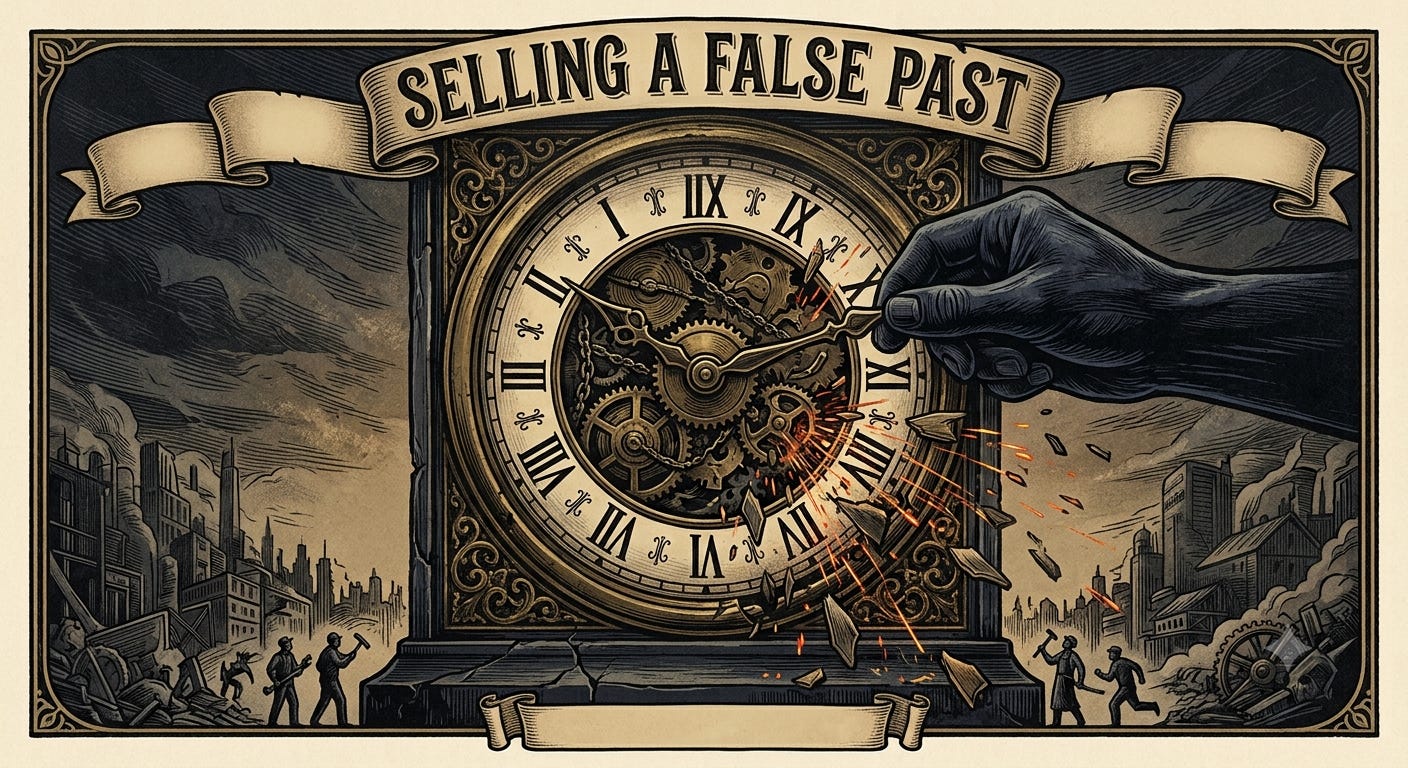
Everyone involved has a golden age in mind. For some it's the '90s - the abundant labour market, the punk scene, the sense that the future was still open. For others it's the '50s, when a steel-factory worker could (supposedly) buy a suburban house and raise 3.5 kids and a stay-at-home wife on a single salary. For another tribe, it is a lost empire, or ethnic homogeneity, or the pre-internet village, where everyone knew their place. Honestly, it depends on who you ask.
Different people, different time periods, yet - the same fantasy: there was a moment when things worked, someone stole it from you, and the right man in power can wind the clock back to a time when things - be it the economy, culture, or politics - made sense.
That’s not how time, nor reality works - not for you personally, not for your town, not for a civilisation as a whole. You might as well rub an oil lamp and ask for three wishes.
The problem is that most of these golden ages were not natural conditions either, but engineered systems. They were built on cheap energy, cheap labour, military protection, industrial capacity, demographic luck, imperial residues, protected markets, Bretton Woods, dollar liquidity, American naval power, and - God forbid we admit it - functioning bureaucracy.
The nostalgia is not the dangerous part - we all miss what we perceived as better, more peaceful times. The dangerous part is the ignorance weaponised by the populists - they will not admit that this low-inflation, low-friction, high-consumption world so many people want back was not created in a vacuum, but engineered. And without that context, they are trying to dismantle every consensus the West built over the last century which led to that golden age. Every institution, every alliance, every boring treaty - without acknowledging that they were all achieved through tidal waves of blood. That is the dangerous part.
Populism is now tearing at all of it without offering, or even vaguely sketching, what is supposed to replace it. A revolution for the sake of it.
The collective good used to mean something specific: an arrangement that works well enough for as many people as possible. Not perfectly for anyone - well enough for most. That is one of the original premises of the EU: a very diverse continent of peoples, cultures and ethnicities figuring out how to live together in a way that satisfies nobody completely and functions for almost everybody. Nationalism - “America First,” and its imitators - evangelises the opposite. Not “how do we live together, in cooperation” but “why should I think about anyone but myself.” Fair enough, if you can make it work. But you can’t. The world, especially now, does not run on that logic anymore. It’s far too complex and far too interconnected.
So populism tells you the resources are too scarce to share, that alliances and treaties are for suckers, that from here on it’s each to their own.
But there’s a big problem with running a civilisation on the premise of zero-sum game. When you actually examine the four things populists swear they’ll deliver - stop immigration, stop inflation, kill the bureaucracy, bring the factories home - every single one collapses on contact with history, economics, and heck - even physics. Not because the grievances behind them are not legitimate - some or elements of some are painfully so. But because the cure being sold is, essentially, an illusion.
Immigration cannot be stopped because migration is not a policy preference per se, but a human constant. It can be filtered, regulated, slowed, redirected, incentivised, discouraged, legalised, criminalised, exploited, or managed. It cannot be abolished.
Human history is, quite literally, the history of people moving. Greeks, Romans, Goths, Huns, Slavs, Arabs, Vikings, Turks, Mongols, Jews, Armenians, Africans, Europeans crossing the Atlantic, Indians, Chinese, Syrians, Ukrainians - the map of the world is a layered record of migration, conquest, exile, famine, war, trade, empire, and yes - opportunity. Every “native” population is usually just an older layer of migration that arrived earlier and then forgot the journey after a few generations.
The modern numbers make the point without any help from me. The UN estimated 304 million international migrants in 2024, almost double the 154 million recorded in 1990. UNHCR counted 123.2 million forcibly displaced people at the end of 2024 - driven out by war, violence, persecution, human-rights violations and public disorder. So migration is not only about “wanting better opportunities.” It’s collapse, hunger, climate stress, demographics, family networks and labour demand, all pushing at once.
This is why the populist promise to “stop immigration” is deeply unserious one. What they actually mean is not stop immigration but stop the visible, politically inconvenient forms of it. Yet, the pressure does not vanish because a politician shouts it at the cameras - be it the labour shortages at home that need to be filled, or the sheer determination of people to move. It migrates - pun intended - somewhere else: into illegal routes, fake asylum claims, smuggling networks, labour exploitation, forged documents, overstayed visas, grey-market employment, and diplomatic crises with your neighbours.
A serious state, or a serious politician, does not promise the impossible, but asks the real questions. Who comes in? Under what conditions? Through which legal channel? With what security screening? Answering what labour-market need? With what integration obligations? With what consequences for crime, abuse, illegal work, or a flat refusal to integrate?
That is the entire difference between controlled immigration and fantasy politics.
A country absolutely has the right to control its borders. It can prioritise skilled workers, genuine refugees, family reunification, seasonal labour, students, people with cultural and linguistic compatibility. It can deport criminals. It can reject fraudulent claims. It can demand language, civic integration, employment and respect for the host society. None of that is the same as pretending you can magically drive the number to zero or near-zero.
So here is the sane version of that populist argument: immigration is not inherently good or bad. Like trade, capital, technology or war, its effect depends on scale, structure, timing, institutions and management. Badly managed, it produces backlash, parallel societies, pressure on housing and wages, security problems, cultural fragmentation. Well managed, it fills labour shortages, renews ageing societies, imports talent, widens the tax base and buys you strategic depth.
“Stop immigration” is nothing more than a populist slogan, not an actual, implementable policy. And yes, that slogan works on people who understand neither history, nor economics, nor geography, nor human nature.
Politicians do what politicians always do - make false promises to win an election cycle. They promise the struggling German and the struggling American that they will “stop” or “lower” inflation. What they are really promising is a return to the old order of permanently cheap prices. They can’t deliver it, even in their fantasies, because that old order, as I said in the introduction, was never natural, but engineered.
For decades, low inflation in North America and Europe rested on a very specific geopolitical machine: cheap Chinese manufacturing, cheap Russian energy, just-in-time logistics, low tariffs, free capital flows, and above all the U.S. security umbrella over maritime trade. A product could be designed in California, assembled in Shenzhen, insured in London, financed in New York, shipped through Suez and sold in Europe - with almost no one in the West sparing a thought for the military, diplomatic and logistical architecture that made any of it possible.
That architecture is now breaking down, so it should be to no shock to anyone paying attention that the prices will go up.
Shipping carries over 80% of world trade, and UNCTAD reports that maritime trade now faces rising costs, fragile growth, political tension, rerouted lanes and chronic port disruption. Ships that once crossed the Red Sea now sail around the Cape of Good Hope; by May 2025, tonnage through the Suez Canal was still 70% below 2023 levels. Longer routes mean more fuel, more ships tied up, more insurance, more delays, more inventory, more working capital - and, eventually, higher prices.
The WTO warned in April 2025 that the outlook for global trade had deteriorated sharply on the back of tariffs and trade-policy uncertainty, with world merchandise trade now expected to contract by 0.2% in 2025 rather than grow. Under a broader tariff-uncertainty scenario, the fall could reach 1.5%. The IMF puts it more bluntly still: geoeconomic fragmentation can impose large, permanent losses, and supply-chain adjustment gets especially expensive when the fragmentation happens fast.
This is why the promise to “stop inflation” is mostly bullshit. It treats inflation as a purely domestic failure - greedy supermarkets, immigrants, green policy, Biden, Trudeau, Sunak, Macron, Brussels; pick your villain. But much of the pressure is actually structural. War raises energy and food-security costs. Sanctions reroute trade. Export controls destroy efficiency. Tariffs make imports dearer. Re-shoring and friend-shoring are not cheap - they are, explicitly, the decision to pay more for security, redundancy and political control.
That doesn’t make central banks powerless, just to be clear. They can raise rates, crush demand, and stop a supply shock from spiralling - assuming they want to, which is its own question in an order that increasingly resembles cartel infighting with the financial sector as one of the cartels. But the central banks and private equity firms cannot print oil, reopen the Red Sea, stop China from embargoing its rare earths, conjure a merchant fleet overnight, or make secure domestic manufacturing as cheap as hyper-globalised offshore production.
So when a politician says “we will lower inflation,” the only honest response is: how?
If the answer is tariffs, border walls, trade wars, mass deportations, energy nationalism, industrial policy and “bringing everything home,” then they are not lowering inflation. They are raising the structural cost of the entire economy. They are choosing resilience over efficiency - and then pretending you can have both, at 2015 prices.
To be clear: I am in favour of resilience, especially nowadays, as long as we talk about critical industries - energy, defence, agriculture, etc. We don’t need to mass produce our own t-shirts, but we need to be able to produce the components for our energy grids, satellites, missiles, and agricultural equipment.
That is the central contradiction of populist economics: they want de-globalisation prices with globalisation logistics. National sovereignty without the national bill. Domestic industry without higher wages, higher energy costs, higher input costs, higher taxes, higher deficits or higher shelf prices. It is fantasy economics for people who think a supply chain is a moral preference, and not a physical system.
The old low-inflation order was the dividend of Pax Americana. The new inflationary pressure is the tax of its decay.
For honesty sake, inflation can be managed, but it cannot be wished away. Governments can invest in energy abundance, ports, grids, housing, defence-industrial capacity, anti-monopoly enforcement, strategic reserves and smarter trade blocs. They can cushion households, clear bottlenecks, prevent profiteering, and - radical idea - avoid stupid self-inflicted tariffs. What they cannot do is return the West to a world where China builds everything, Russia provides cheap energy, the U.S. Navy secures every lane, and geopolitics is polite again.
That world is gone.
So the next time someone promises to “stop inflation,” ask which piece of the broken order they intend to repair - the war, the shipping lanes, the energy system, the trade blocs, the industrial base, or the trust. Because the rest is…bullshit.
“All bureaucracy is bad and the Deep State is an evil entity run by globalist elites.”
Okay. A modern state cannot run on good wishes, let’s start there. You need people who know how to administer borders, aviation safety, food standards, customs, taxation, public procurement, sanctions, energy regulation, banking supervision, intelligence, emergency response, nuclear safety and infrastructure. That is bureaucracy. The question is not whether bureaucracy should exist, the question is whether it is competent, accountable, limited and useful.
The so-called “Deep State” is, most of the time, just the permanent civil service doing exactly what it was built to do: preserve institutional continuity between political cycles, not some shadowy organisation. Ironically, it is the Deep states in Europe, Japan, and to some extend - the United States - that are trying to salvage some workable version of what we used to know until yesterday as the rules-based order. Politicising the professional state feels satisfying to populists, but the public-administration research points the other way: more politicisation tends to reduce government performance, administrative capacity and accountability.
The same logic applies to the EU. The EU is not “undemocratic” because you personally didn’t vote for every official. That isn’t how representative democracy works anywhere. You don’t directly elect your national ministers, central bankers, judges, ambassadors, regulators or senior civil servants either. Democracy is not a referendum on every appointment, but a chain of legitimacy - elections, appointments, oversight, and dismissal mechanisms.
The European Parliament is directly elected by EU citizens and seats 720 MEPs.
The Council of the EU is made up of ministers from elected national governments, and it adopts laws jointly with the Parliament.
The Commission President is proposed by the European Council, has to reflect the European election results, and must be approved by the Parliament - which then vets and approves the full Commission before it’s appointed.
Call it indirect democracy, technocratic democracy, annoying democracy, committee democracy. It is not a dictatorship that the populists are trying to portray.
The bigger scam is national politicians pretending “Brussels” did something to them. Most EU law is passed through the ordinary legislative procedure, with Parliament and Council as co-legislators - roughly 95% of EU legislation goes through this route. Which means your national ministers were in the room. Your national government negotiated it, amended it, and often voted for it. Then it went home and blamed “Brussels,” because a faceless bureaucracy is easier to blame than your own compromises.
Now, a caveat - with that said, is there a competition between national governments on EU level? Yes. Are there states - such as Germany and France - that have enough influence to pressure or outright bully smaller national governments? Also yes. Again, remember - I am not pretending here that everything is perfect for everyone, nor that our institutions lack flaws.
And the famous “Brussels bureaucracy” is not some imperial machine either. The European Commission has around 32k permanent and contract staff. Across all EU institutions, agencies and bodies, the total is about 60,000 officials - serving roughly 450 million citizens. That is the administrative footprint of a mid-sized German city trying to coordinate an entire continent.
None of which means the EU is beyond criticism. The opposite. Its worst instinct is to regulate before it understands how markets, startups, capital and technological adoption actually behave. Europe claims to want innovation while piling on regulatory burdens that fall hardest on SMEs and digital firms - more than half of European SMEs name regulation and administrative burden as their single biggest obstacle. The Commission now says it wants to cut administrative burden by at least 25% for companies and 35% for SMEs by 2029. Translation: even Brussels knows Brussels has a paperwork problem.
It also struggles with scale. The single market - free movement of goods, services, capital and people across hundreds of millions of people - is one of Europe’s genuine achievements. Yet it still remains fragmented in precisely the areas where future power will be decided: capital markets, defence procurement, energy, telecoms, AI, cloud, deep tech, industrial financing. Draghi warns that this fragmentation pushes high-growth companies overseas and starves European capital markets.
And then there’s the legacy-giant problem. Europe adores its national champions — Airbus, Thales, Leonardo, Rheinmetall, Dassault, Safran. Important companies, yes, but also companies with decades of procurement relationships, lawyers, lobbyists, state access and political cover. Startups may be faster, cheaper and more inventive, but they don’t have direct contact with ministries, and unlike the legacy-giants - they cannot burn through cash forever. That is not purely an “EU problem.” it is more often than not a national-government problem.
So the correct argument is not “bureaucracy bad.” It’s this: bad bureaucracy is bad; competent bureaucracy is civilisation.
The EU is not an institution of revolution, but one of evolution. It began as a coal and steel community among six countries after WWII - designed, explicitly, to make another European war materially harder to start. It grew into a common market, then a single market, then a legal order, then a monetary union for many of its members, a freedom-of-movement zone, and now - slowly, painfully, imperfectly - an attempt at becoming a geopolitical actor (not by its’ free will, more out of necessity if it wants to survive this century).
Too slow? Yes. Too legalistic? Constantly. Too deferential to incumbents? Absolutely. Too fond of red tape? God, yes. But the point of the EU was never perfection. The point was to be good enough that Europeans stopped slaughtering each other every few decades and started trading, travelling, studying, investing, and suing each other in courts and arguing in committees instead of in trenches.
The Brits are learning the bitter version of this. Leaving the EU did not liberate Britain into frictionless global competitiveness. It pulled Britain out of the single market and customs union, raised non-tariff barriers, and left UK goods exports to the EU in 2025 still 14% below their 2019 level in real terms.
So, no. Bureaucracy is not inherently bad. The Deep State is not automatically tyranny. The EU is not undemocratic because its democracy is layered and indirect. The real enemy was never bureaucracy. It’s bureaucracy that forgets its purpose -which is to make society function, not to make productive people beg for permission to function.
De-industrialisation was itself a kind of industrial revolution. Products got made faster and cheaper - and never quite as good. People stopped expecting quality and started expecting cheap prices. And there is a point in that equation where the trade stops working, because eventually you if you can’t find work outside finance or tech (or any other higher paid service sector), you can’t even earn enough to afford the cheap goods that were supposed to be your consolation prize for quality.
Globalisation was never an equal good for everyone. We’ve now lived with it long enough to score it honestly.
Start with the geography of it. It turned entire regions into ghost towns. The small town where your parents worked the same industrial job for 40 uninterrupted years is now depopulated and crumbling - while you took on college debt to earn a degree that bought you a seat in the service sector (the last one with any money in it), and now you live in a €2k-a-month one-bedroom in a major city, in permanent low-grade fear of the next layoff, when your service job gets outsourced to India or automated by AI. And because we’ve hit a point of genuine elite overproduction - most people never had access to private schools, Ivy League networks, or the accident of being born near the right hub: New York, San Francisco, London, Brussels, Zurich, etc. - they simply can’t compete with those who did.
You were sold the fake dream that all of you could make it. That a loan and a degree from a second-rate college was a ticket into the elite. It wasn’t. No wonder there’s now a countertrend of some people fleeing to the countryside to rebuild it - the “make it big” dream turned out not to be worth the rent or the burnout. And the loudest examples are the ones who did make it, landed at a MAG7 firm or a Big Four partnership, and walked away after two decades to take up carpentry or goose farming (real cases).
Then there’s what it did to the things themselves. It trained you to accept lower quality in exchange for a lower price. Years ago my mother drove a Mercedes - a second-hand import from Germany, a ‘90s build. An absurdly robust car. She drove it for years and sold it at around 280,000 km. A while back she ran into the man who bought it. He still drives it. It still runs, with the odd fixable fault. One car, built in some German factory in the ‘90s, changed several owners, crossed two countries and two road systems, and is still going at what is probably close to half a million kilometres. Nothing like it gets made now.
That used to be the standard - German and Japanese manufacturing, cultures with an almost pathological obsession with getting it right. Outsourcing to China dropped the price and dropped the quality with it, and over a few decades we quietly got used to worse, but cheap. This is not a dig at China; I don’t buy the “dollar store of the world” line - they build genuinely complex things now. But the quality ceiling the Germans and the Japanese set for cars, electronics and machinery isn’t coming from China, because it’s a matter of manufacturing culture. And we accepted the trade because it was cheaper. Cheaper at what cost? The cost of replacing everything sooner - and of making the actual quality producers uncompetitive. Oh, and of course - raising the GDP. If we all have to change our cars every 5-8 years, of course the GDP would be going up.
And here’s where the populist walks in and tells you he’ll fix all of it. He’ll bring the factories home, he’ll rebuild the forgotten towns. Yeah, right. And this is the cruellest populist fantasy of the four, because the diagnosis is right and the cure is a lie.
The factories didn’t leave by accident, and they won’t come back by decree from some populist talking head that couldn’t locate a factory if he was standing right in front of its doors. They left chasing cheaper labour, looser rules and higher margins - and the same forces still apply. You can rebuild an industrial base. Serious countries do it deliberately, over years, with capital, energy, skills and patience. But every input on that list costs money: higher wages, higher energy bills, higher prices, higher taxes to fund it. Which is to say - re-industrialisation is the exact bill the same politician swore, one speech earlier, that he would keep low. The populist - whether he’s on the left or right end of the political spectrum - doesn’t actually want to re-industrialise. He wants to sell you the feeling of re-industrialisation - the ribbon-cutting of a new data centre - while the structural causes sit exactly where they were before he opened his mouth.
The honest version - the one no politician would ever campaign on - is this: the correction after decades of deindustrialisation will be painful. It will be very expensive. It will lower living standards for the foreseeable future. But in the long run, rebuilding industrial capacity will be a net positive for society.
The real question is very simple: do you want the freedom to own your own upstream, or do you want to remain a vassal of the Chinese one?
We have a saying back home: nobody can give you what I can promise you. I’d argue that should be the dictionary definition of populism.
When I was about 9 years old, my father sat me down and told me to never, under any circumstances, trust politicians or the state. This is a very Balkan pathology, and a rational one - we never had state institutions that functioned well enough, for long enough, for anyone to build trust in them. Distrust wasn’t necessary cynicism - that’s something many of my Western friends struggle to understand about us- it is just pattern recognition.
But I’ll be honest: our scepticism blew past the healthy threshold a long time ago and swung to the opposite extreme. Meanwhile our Western counterparts - generations raised under institutions that mostly worked and were trustworthy - still have faith in their competence. In a few places, a couple of Nordic countries, that faith is earned. In plenty of others, it isn’t. And that’s the fault line running through the middle of Europe: too much faith in institutions on one side, none at all on the other. As with most things, the resolution is somewhere in the middle.
I spent my whole professional career in software, so I will put it in those terms. The East can play QA. We are excellent testers. We find the bugs, the vulnerabilities, the flaws in the system, because we grew up watching systems fail and learned to expect it as a default setting. Are we good at refactoring? At engineering a better version? No, not really. We don’t have the track record, and pretending otherwise is its own kind of populism. But our Western counterparts have generations of experience building institutions and rebuilding them after they break (problem is, they are blind to the flaws, which is why they end up rebuilding them from scratch). So the division of labour here writes itself: we flag the flaws, they refactor them - provided they can swallow enough pride to admit the bugs are real, and provided we can learn to file the report a little more diplomatically.
That’s the whole thing, really. Populism is what happens when a society stops doing either job - stops testing and stops building - and starts believing a man who says he’ll skip straight to the golden age, as if it didn’t take the Dark Ages to give rise to the Renaissance. Nobody can give you what he can promise you.
Do not underestimate the power of consensus, it is what builds civilisations. Populism destroys them.
No posts
Comments
Nothing yet. Say the first thing.
Sign in to join the conversation.