
Waronomics is free to read, but entirely reader-supported - if you find this work valuable, you can support it by becoming a paid subscriber or buy me a coffee.
To understand how to move forward in this increasingly chaotic world, you first have to understand how we got here. Without that context, nothing about the present makes sense - and the future looks like even more random, instead of what it actually is: the predictable output of decisions made decades ago.
The trap most people fall into is that they anchor on one variable. Today, that variable is Donald Trump. He is the elephant in the china shop - loud, visible, rude, obnoxious. It is comforting to believe that once he’s out of the Oval Office, we will return to some form of normalcy. Problem is, that normalcy ceased to exist back in 2008 - way before Trump emerged onto the political scene. Trump is the accelerant of the decline that started nearly 20 years ago. Being stuck on one variable makes it impossible to analyse everything else that preceded it, and in a way - it only opens the door for future populists to rise to power.
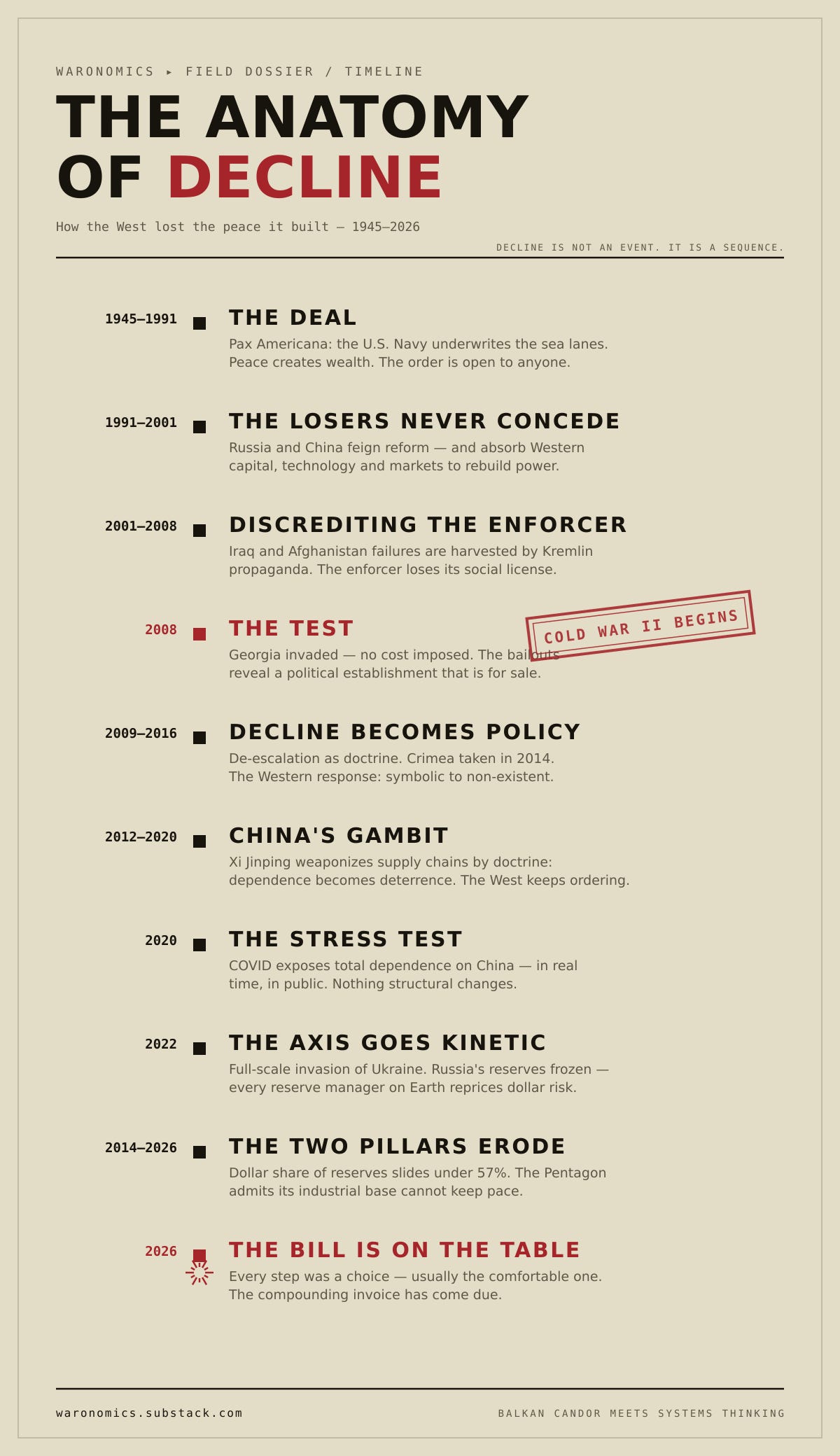
In the following article, I have tried - to the best of my abilities - to present you the timeline of Western decline that didn’t start with one event or one election, but a sequence of steps, and each step was a choice.
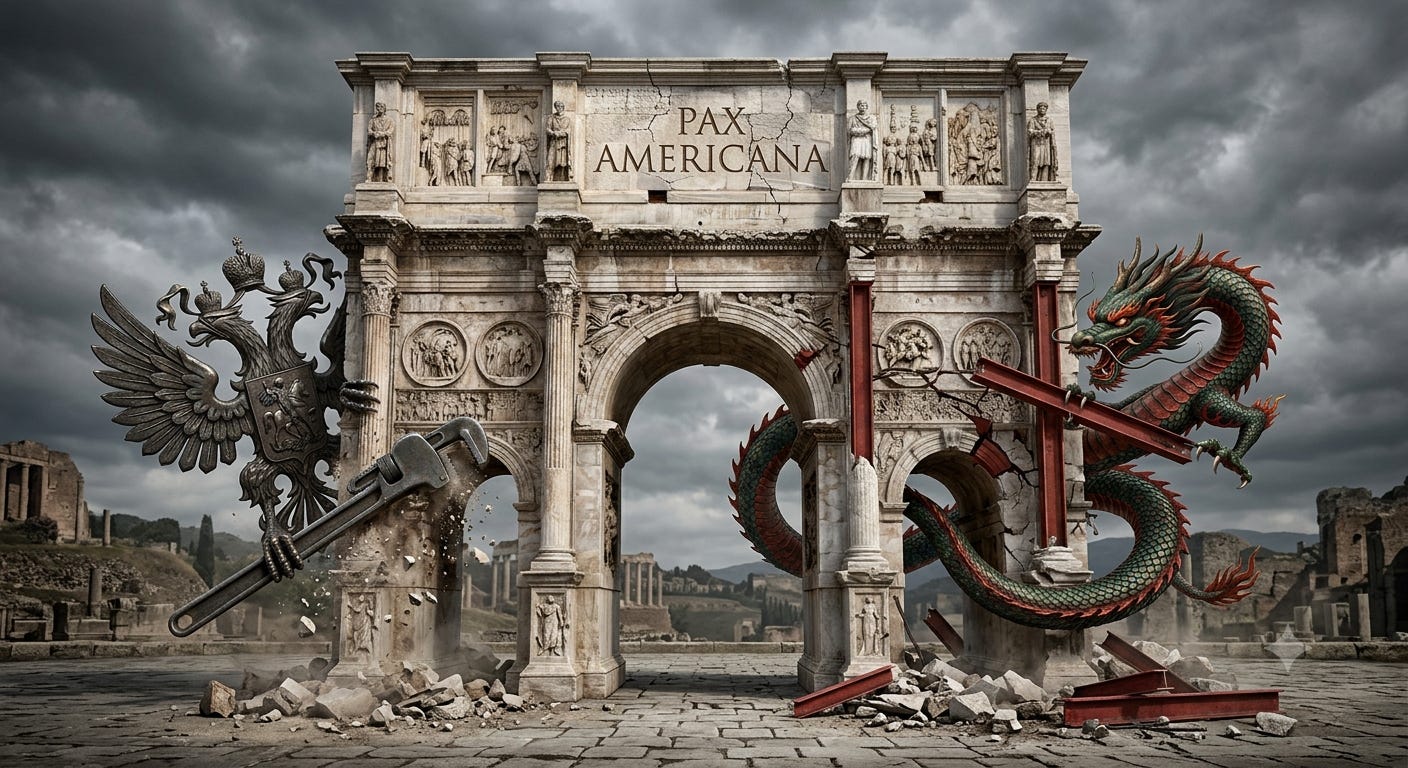
In the aftermath of the Second World War, the United States assumed a role history had seen once before at that scale: Pax Romana - the long stretch of relative peace, stability, and economic growth that Rome imposed by securing the Mediterranean trade.
The mechanics of that deal were simple in theory - the U.S. Navy defended the sea lanes, trade moved freely and securely, globalisation was born, and with it came a period of prosperity without precedent in human history - above all for America, as it should be for the global guarantor of order, but also for much of the world. Hundreds of millions were lifted out of extreme poverty. Entire nations - Germany, Japan, etc. - were rebuilt from rubble into industrial powerhouses. International institutions emerged to maintain what we knew, until yesterday, as the rules-based order.
The deal was open to anyone willing to participate: join, follow the rules, and gradually begin to prosper. The axiom was simple: peace creates wealth, war destroys both.
Unfortunately, peace and prosperity breed complacency and very soon everyone forgot that maintaining that order required the American military to occasionally use force against regimes capable of - and interested in - disrupting it. The security umbrella provided for the past decades was the load-bearing wall of the entire structure of globalisation.
And nobody likes paying for load-bearing walls. Wars are unpopular with electorates, and inconvenient for the financial and business sectors, who would always rather trade with disruptive authoritarian regimes than confront them. So the deal began to erode - slowly, gradually, and then all at once.
Two of the biggest losers of the Cold War were Russia and China. Both consider themselves powerful and superior civilisation-states, and both were humiliated - and I mean that literally, not figuratively. At the end of the Cold War, your average American single mother on food stamps had more purchasing power than most of the communist elite. What emerged from their post-Cold War reality was poverty of a kind the West had forgotten existed, underdevelopment, incompetence, and utter humiliation.
This is where the operational software of East and West diverges - a distinction I keep coming back to because it explains so much. The Western empires - be it British, French, Dutch, Portuguese - licked their wounds, swallowed the humiliation of losing their imperial grip, and moved forward. Granted, some more begrudgingly and less gracefully than others, but they moved forward. Why? Because the prosperity mattered more than avenging the imperial ego.
That is not how the East operates. You can still see the residue of this in Europe today, and Serbia is the finest example. Bulgarians and Romanians older than me will tell you how, back in the day, they looked up to Belgrade - Yugoslavia had far better living standards than communist Bulgaria or Romania. Yet today, Bulgaria’s GDP is larger than Serbia’s and North Macedonia’s combined. While Croatia, Slovenia, Bulgaria, and Romania moved forward - at varying speeds, with varying amounts of dysfunction - Serbia is still reminiscing about its regional imperial past instead of grasping for the same prosperity its neighbours are building. They can’t let go.
Neither can Russia, nor China - they never accepted the Cold War verdict. They pretended to reform, gained access to Western capital, technology, and markets - and used all three to rebuild their power. While the West slept comfortably on the assumption that trade produces liberalisation, Moscow and Beijing were laying the architecture of a new Axis.
It is worth being pointing out when the West got duped, because it wasn’t uniform. The CCP is a highly centralised entity - and when it was run by technocrats in the tradition of Deng Xiaoping, it was genuinely more inclined toward the rules of prosperity: trade, cooperate, grow. Yes, industrial-scale IP theft happened throughout, but it was never Deng Xiaoping’s project to turn China into a nationalist, wealth-destroying world power.
That is Xi Jinping’s project these days. Unlike his predecessors, Xi Jinping broke the succession rule - no stepping down after ten years, no anointed successor. I joked at the time, while being entirely serious, that when Russia removed presidential term limits and Xi Jinping shattered the CCP’s succession norm, we were now facing a new Tsar and a new Emperor in the East - and we had better prepare for what that entails. I was right, even in my dark humour. These two men, and the ideology they subscribe to, lit the fuse of the new Cold War.
Before you can dismantle an order - in this case, the American-led rules-based order - you have to delegitimise it first, and especially its enforcer. This is one of the oldest rules in the influence-operations playbook, and it works because you never have to defeat an army in a kinetic fight, you only have to convince the society behind it that its’ own army is an illegitimate force. Do that, and the army defeats itself - through budget cuts, recruitment collapse, political paralysis, and a generation of leaders who treat the use of force as inherently shameful.
The Middle Eastern wars of the 2000s did half the work for free. Iraq was a genuine self-inflicted wound: planned with a staggering arrogance and lack of depth in understanding the local dynamics of a very tribal-oriented Middle Eastern society that never truly adapted to the top-down enforcement of the 19th century idea of a nation-state. Afghanistan metastasised from a punitive campaign into a two-decade attempt in nation-building without a nation. These were real failures, and I am here to launder the strategic mistakes of the U.S. military and its’ allies.
But what happened next was that this legitimate criticism was harvested and weaponised into something else entirely. There is a critical distinction between “this war was poorly conceived and/or poorly executed” and “the institution that fights wars is itself illegitimate.” The first is a healthy democratic accountability, the second is the strategic objective of your adversaries. The West produced the first in enormous volume - and the Kremlin’s information apparatus worked tirelessly to convert it into the second.
The propaganda also performed a complexity reduction exercise that proved to be very successful - 60 years of the U.S. Navy protecting the sea lanes that carry your food, your medicine, your phone, and the fuel in your car - invisible, unthanked, taken as a law of nature. What people saw was Abu Ghraib, Fallujah, and the highlight reel of failures. So the entire enterprise was compressed into a bumper sticker: War is bad! It only benefits the rich! Peace through weakness and good intentions!
The sad part is that many powerful constituencies inside the West were delighted to agree with this narrative. For the financial and business class, the American military was a problem and its’ failures in the Middle East provided a convenient conclusion - it morally laundered doing business with Moscow and Beijing, because what’s the alternative? More endless wars? Why confront disruptive authoritarian regimes when you can do business with them? Sure, you’d have to sacrifice a nation or two (say, Georgia, Ukraine, Taiwan) on the alter, but it’s a worthwhile sacrifice to keep business as usual.
For politicians, promising withdrawal from conflicts became a reliable vote-winner on both the left and the populist right. The Kremlin didn’t have to buy this consensus either, it merely had to fertilise soil the West had already tilled itself.
It is crucial to understand what this means in systems terms: by 2008, the security pillar of the entire global order had lost its social license. Not its capability - not yet; the hollowing-out of the industrial base came later. Its legitimacy. And legitimacy, once spent, is the hardest currency in the world to reacquire. As a friend of mine (@atidjon) once said: could you imagine what the world would look like today if we didn’t have the Middle Eastern wars to de-legitimise the NATO alliance? Because, let’s be frank, it did. In the mind of the average voter in Europe (who bore the brunt of the immigration waves that came out of these conflicts) and North America, the past 20 years in Iraq, Afghanistan, Syria, Libya, etc. were destructive for the legitimacy of the U.S. military and the wider NATO alliance. That de-legitimisation was done in a hybrid approach - real, defensible criticisms were unfused with a tidal wave of propaganda.
I am firmly in the camp that says the new Cold War did not start in 2014 with the annexation of Crimea, and not even in 2015 with Made in China 2025. It started in August 2008, with the first real stress test of Western resolve: Russia’s attack on Georgia and the annexation of 20% of its territory.
At the time, the West was consumed by the opening act of the biggest financial crisis of the century (so far!) and exhausted by “endless wars” it no longer believed in. Russia invaded a European state that had been publicly flirting with NATO membership. The Western response? A ceasefire brokered by Nicolas Sarkozy, which Moscow proceeded to violate without consequence. No serious sanctions, no meaningful costs for breaking international law, redrawing the map, and killing innocent people. Business as usual resumed within months.
The signal to Moscow, Beijing, Tehran, and every Axis-adjacent capital was sent: aggression carries little to no cost for the aggressor.
And 2008 delivered a second signal, one that gets far less attention in geopolitical analysis these days. When the financial system imploded, Washington chose to rescue the financial and business elite - on the backs of American taxpayers and everyone else on the planet plugged into dollar-denominated markets. The deal of the free market capitalism was that it was a game of profit and loss - the decision to bailout the losers put an endless cost that we are paying to this very day.
Whatever you think of the bailouts as crisis management, the geopolitical read from Beijing and Moscow was likely as follows: the American political establishment is for sale, and the financial sector can afford the purchase. Which meant the path to neutralising American power did not run through the Pentagon, but through Wall Street. Get the money on your side, and the politics follows.
In 2008 the American public elected Barack Obama - for many, a saviour figure after the chaos of the Bush years. What too few people are willing to reckon with, even now, is how directly that administration’s choices produced the outcomes we live with today.
Obama pursued de-escalation as doctrine. His Russia policy followed the academic-realist playbook - the John Mearsheimer school, an academic with one of the most reliably wrong track records in the field - almost to the letter: accommodate the great powers, offer off-ramps, and treat the buffer states as negotiable. He offered Vladimir Putin a reset after Georgia - a literal red button, which in hindsight was the most honest artifact of the entire foreign policy of that administration. Business continued as usual, and most of Europe, still playing the happy vassal, asked no questions.
The results of that policy weren’t delayed for too long either - in 2014, Putin attacked Crimea and launched the war in Donbas. The Western response ranged from symbolic to non-existent - it took the shooting down of MH17, with 298 civilians aboard, to produce even serious sanctions. And Ukraine, the country that had handed over the world’s third-largest nuclear arsenal in 1994 in exchange for security assurances on paper, discovered exactly what those assurances were worth. For two decades the West had treated Ukraine’s vast Soviet-era arsenal primarily as a proliferation risk to be dismantled - the largest demilitarisation program in NATO’s history was busy destroying its surplus ammunition and weapons right up until the eve of the war - rather than as the foundation of a state that might one day need to defend itself. Eight years after Crimea, that bill came due in the form of the largest war on European soil since 1945.
Meanwhile, in the West, the decline metastasised - not equally, not for everyone, and not visibly for casual observers. But severely enough that millions of Americans went to the ballot box in 2016 to punish an establishment that had ignored their plight. The culture wars - some rooted in legitimate grievances, all artificially amplified by social media and by bad actors in Moscow and Beijing - split the country into camps, and both parties began catering to their most fringe factions.
This matters strategically, not just domestically. Whether you are promoting officials as diversity theatre or firing them as anti-diversity theatre, the message transmitted to the rest of the world is identical: the United States is consumed with itself and can no longer lead.
And the rest of the world began acting accordingly.
While the West was busy arguing with itself, the CCP - no longer led by pragmatic technocrats but by an ideological nationalist and his army of loyalists - spent a decade doing three things with remarkable discipline:
Weaponising supply chains. China embedded itself in the upstream of everything: critical minerals, rare earth processing, precursor chemicals, components, magnets. Not by accident - oh no, it cost China a lot to get there, since all of these industries are entirely state subsidised - but by doctrine. In an April 2020 speech, later published in Qiushi, the Party’s own theoretical journal, Xi Jinping stated his strategy openly and plainly: China must tighten the international industrial chain’s dependence on China, forming “powerful countermeasures and deterrent capabilities” against foreign parties who might cut off supply. They weaponised dependence as a weapon. The West’s response was to keep ordering, because what else can you do since you spent half a century hollowing out your industrial base? You see, this is the biggest quarrel I have with my Western friends - and I love the Western world and want to see it succeed and prosper - you just never believe when your adversaries tell you what they plan on doing to you.
Building the industrial power the West chose to lose. While Western economies financialised - services, asset inflation, quarterly earnings - China expanded manufacturing, subsidised strategic sectors, and pushed Western competitors out of global markets one industry at a time. Today China accounts for roughly 30% of global manufacturing output and climbing. Its shipbuilding capacity is estimated at over 200 times that of the United States. Can you imagine that? The United States - a maritime empire - losing its’ shipbuilding capacity to a continentalist?
Buying insurance in the Global South. China invested heavily in creating a global nervous system of ports, transport corridors, mines, and commercial networks across Africa, Latin America, and Central Asia - infrastructure that now allows China, Russia, and Iran to route around Western sanctions through barter, local currencies, and direct exchange of energy for machinery and goods. It also locks in many nations in the Global South into a dependency grip.
For years, China was treated as the dollar store of the world. All the cheap junk we love to consume would be produced there, and they gladly handed the baton to them. But the product mix kept climbing the complexity ladder, and with each rung China captured more of the board - resources, IP, components, entire industrial ecosystems. They play Go, while we thought we all played chess. Why waste ammunition when you can engineer weakness in your opponent and capture enough of the board that he cannot prosper without your permission? Sun Tzu would recognise this strategy - win without actually fighting.
There’ uncomfortable symmetry in this equation too - Western sanctions worked against Iran’s nuclear program ambitions because building something that complex requires 100% of the components, not 99%. China understood that the same logic can run in reverse. No critical Western industry today - defence, healthcare, energy, telecommunications, agriculture, etc. - is fully independent of Chinese supply chains. Not. A. Single. One. Beijing holds the missing 1% or 10% or 30% for a very long list of things we cannot build without their output.
And China identified the most human, most gaping vulnerability of the West: the greed and delusion of its elites. No banking executive or tech oligarch wants to decouple from China. Ever. Forget it. The labor is cheap, the market is massive, the margins are absolutely magnificent. They can live inside that bubble, divorced from the physical world, for the rest of their lives. Beijing is banking on the delusion - literally.
When COVID arrived and stress-tested the whole system in public - every crack was exposed at once. The world discovered, in real time, how dependent it was on China for... everything. Masks. Antibiotics. Precursors. Chips. Everything.
By 2022, China was a decade ahead strategically, and it backed Russia’s full-scale invasion of Ukraine because both powers benefited: Russia sought imperial restoration - the Russia–Belarus–Ukraine “Slavic trinity” of Putin’s historical imagination - while China wanted the West divided, weakened, distracted, which made it even more dependent.
Within the West, exactly one institution understood the scale of the danger early: the military. Much of the political and business establishment either did not understand or chose not to, because cheap trade with Russia and China remained profitable right up until the tanks rolled. Germany’s energy policy alone is a monument to that willful blindness.
This is why the new Cold War has multiple fronts, and only some of them are kinetic. There is Ukraine, then there’s the Middle East, and the shadow front over Taiwan. And then there is the domestic front, running straight through Western institutions: between those who want to rebuild industrial and military power for a long confrontation, and those who still want business as usual. That second front is the one that will decide the war, not the first.
It is crucial to understand that American power rests on two pillars: military prowess and the U.S. Treasury market. Everything else is commentary. And both pillars have been eroding - not collapsing, eroding - for over a decade.
For 50 years, the United States traded away its industrial power in exchange for the financialisation of its economy. An elderly Bulgarian academic and a well-respected geopolitical analyst who lived in California in the early 90s described it perfectly: the ports were clogged with cargo ships full of goods, sailing home with U.S. Treasuries. Goods in, paper out.
The dollar is a tool, and tools can be used in various ways. Sanctions are one example. And sanctions genuinely work (I, for one, have been a supporter of sanctions against russia). But every use of the dollar as a financial weapon teaches the rest of the world the same lesson: it makes economic and strategic sense to depend less on it.
Before you reach the wrong conclusions of what I am saying here, let me clarify: the dollar is not collapsing today or tomorrow. It still remains dominant because U.S. financial markets are deep and liquid, global trade is heavily dollar-denominated, and no alternative offers the same combination of scale, openness, and trust. The euro is fragmented, the yuan is not convertible, and gold is ill-equipped to handle the level of economic complexity we have today (the times of the Roman empire are long gone, folks). Bitcoin - I am not even going to talk about it.
But dethroning the dollar was never the goal per se - the goal is building enough alternative channels that Washington can no longer completely isolate you. And that is exactly what is happening:
Bilateral trade increasingly settled in local currencies, with Russia–China trade leading the way;
A thickening web of currency-swap agreements;
Central banks diversifying reserves - the dollar’s share of global FX reserves has slid from roughly 71% at the turn of the century to under 57% today, a three-decade low, while central banks have bought over 1,000 tonnes of gold per year since 2022;
Commodity pricing experiments outside the dollar, including de facto barter: oil paid for in goods, infrastructure, and services.
Remember, this is a gradual process - but gradual is not the same as harmless. It is already reaching the standard of living of the average American: imported inflation, rising financing costs, bills piling up. Nobody will tell them the root cause, because too many people have a vested interest in keeping the narrative of the invincible dollar alive. Including, ironically, the adversaries.
The second pillar took a double hit: reputational and industrial.
Reputational: since the late Bush years, the U.S. military has been the target of the sustained delegitimisation campaign described above - designated as bloodthirsty warmongers, the complexity of its wars flattened into cartoon narratives, its standing systematically tarnished at home and abroad. While Barack Obama’s de-escalation doctrine institutionalised the retreat, Donald Trump humiliation rituals made it worse: like any other branch of government he touches, the military is being repurposed as an instrument of personal enrichment (I joke that he’s your first Balkan president) - which corrodes the one thing a fighting force cannot function without: the belief that it serves something larger than one man’s ego.
Industrial: decades of de-industrialisation hollowed out the arsenal of democracy. The Pentagon’s own National Defence Industrial Strategy admitted in writing that the U.S. defence industrial base “does not possess the capacity, capability, responsiveness, or resilience required” to meet military production needs at speed and scale. The bottlenecks run all the way down to black powder and artillery propellant. Rare earths and magnets sit under Chinese export controls. Rebuilding this cannot be done by printing dollars and throwing it at the problem - it is a decade-long project requiring exactly the kind of political patience the current establishment does not possess.
The recent war with Iran cemented the view of the weakening American military prowess: the United States of 2026 struggled with asymmetric warfare in ways the United States of 1976 would not have - burning through precision munitions and interceptors faster than its industrial base can replace them, with replenishment timelines measured in years, not weeks or months.
Do not, under any circumstances, believe that those were not clear signals and that they remained unheard. In Beijing, in Moscow, in Tehran - and in every capital currently deciding whether to bet its future on the American security umbrella or hedge toward the Axis.
The Western world - Europe, North America - is now attempting to reverse 50+ years of strategic negligence. The militaries understand the stakes, but much of the political class remains populist, short-termist, and allergic to painful decisions. Big business still prefers access and stability to confrontation. And the current U.S. administration has little interest in preserving or rebuilding Western industrial power for the next generation - which is why the national-security establishment increasingly works around its own political leadership rather than through it.
None of this was inevitable, every step was a choice - usually the comfortable one, the path of least resistance . The bill for those choices is now on the table, and the one thing we cannot do with it anymore is pretend it isn’t there.
A Ukrainian reader responded to my summary of this timeline with the timeless classic: hard decisions, easy life; easy decisions, hard life. I could not have compressed eighty years into eight words better myself. That is the entire timeline above - the West picked the path of least resistance. Now comes the Herculean task of rebuilding what was lost with however many years of hard decisions it takes.
But I did not write this assessment so you could despair over it, far from it! As I told a friend recently: to see the stars, it has to get properly dark first. It took the Dark Ages to produce the Renaissance. It takes the misery of illness to force the discipline of health care.
Just understand what the choice actually is: enduring the dark to see the stars is hard - but staying in the light and never once witnessing them is hard too. The Dark Ages were hard; never arriving at the Renaissance would have been harder. Being ill is hard; getting healthy is hard. Pick your hard. Nothing in life is ever easy - least of all the good part.
So when you next exercise your democratic right to vote, do not fall for the cheap promises of populists. Seek out the rare leaders who - counterintuitive as it sounds - promises you sacrifice. Marcus Aurelius wrote in the Meditations about the pig at the sacrifice, kicking and screaming all the way to the altar. His point was not that suffering is noble, but that the sacrifice happens either way - the only choice you get is whether you make it willingly, with dignity, or get dragged to it screaming. The West will make its sacrifice, mark my words; the timeline above guarantees it. The open question is which kind of animal we choose to be.
Do not sacrifice your principles to protect your comfort. Sacrifice your comfort to fulfil your principles.
Atlantic Council, “The 2008 Russo-Georgian War: Putin’s green light”
U.S. Army War College War Room, “The Enduring Impact of the 2008 Russo-Georgian War”
Xi Jinping, “国家中长期经济社会发展战略若干重大问题” — speech of April 2020, published in Qiushi / Xinhua, October 31, 2020
China Leadership Monitor, “China’s Move to Greater Self-Reliance”
Jamestown Foundation, “PRC Shift Signals ‘Reverse Constrainment’”
U.S.-China Economic and Security Review Commission, “Chained to China: Beijing’s Weaponization of Supply Chains” (2025 Annual Report, Ch. 9):
S&P Global, “Saudi-China ties and renminbi-based oil trade”
SCMP, “Saudi Arabia ‘open’ to petroyuan, closer China ties, minister says”
NATO, “Largest ever demilitarization project launched in Ukraine” (2006) — the PfP Trust Fund program destroying 133,000 tonnes of ammunition and 1.5 million small arms.
No posts
Comments
Nothing yet. Say the first thing.
Sign in to join the conversation.