
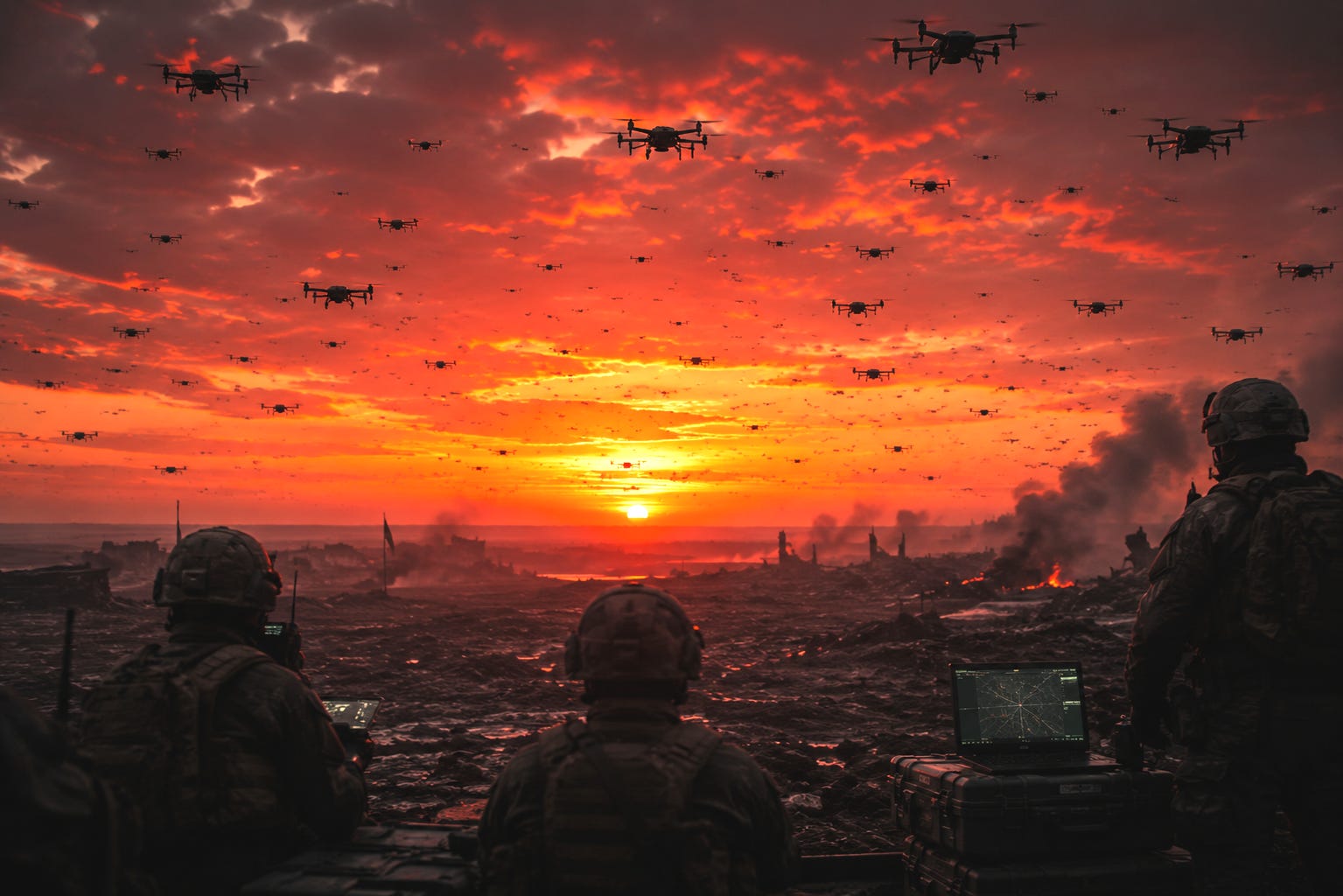
As discussed in our last article, “Hidden Dangers of Autonomous Systems and the Counterintelligence Connection,” and reinforced by Wes O’Donnel’s real world example of Ukrainians apparently hijacking a Russian Surface to Air Missile (SAM) to shoot down a Russian Su-57, autonomous systems and digitally networked weapons suffer from a critical vulnerability. In short, the more weapon systems become autonomous and networked, and the more humans are “out of the loop,” the easier it becomes for an adversary to digitally neutralize or hijack the weapons en masse, leaving the “out-of-the-loop” humans helpless to do anything about it.
However, the warriors of the future have no choice but to find ways to live with and mitigate this vulnerability because human-controlled unmanned systems will likely never be able to deploy on the scale needed to achieve dominance in a large-scale engagement. As we will argue, scale will likely become the most critical factor in future battles between precision-guided munitions and the interceptors designed to shoot them down. In some ways we are now witnessing the maturation of a trend that began when the Soviet Navy first decided to focus on missiles instead of aircraft carriers.
Since the early days of the Cold War, many courageous naval leaders have dared to risk professional exile by questioning the dominance of the aircraft carrier. This is not to say that carriers are not a critical component of our military machine. Rather, it is simply difficult to explain the mathematics and economics of how a carrier might defeat a true “saturation attack” consisting of hundreds or even thousands of hostile projectiles.
The Soviet logic of focusing on missile ships and missiles rather than carriers and planes was simple. Even the most advanced air defense systems (like the AEGIS Combat System) inherently have limited magazine capacity when it comes to actual interceptors. Guided missile destroyers and other escorts can carry only so many SM-2 and SM-6 missiles and their Close-in-Weapons-System (CIWS) guns can each engage only one target at a time. At a certain level of saturation, the battle is no longer about whose missiles and sensors are better or which crews are more skilled. It is simply a question of numbers. If the defender’s magazines are empty and there are still hundreds of missiles inbound, the battle is likely over. This is the logic of a saturation attack.
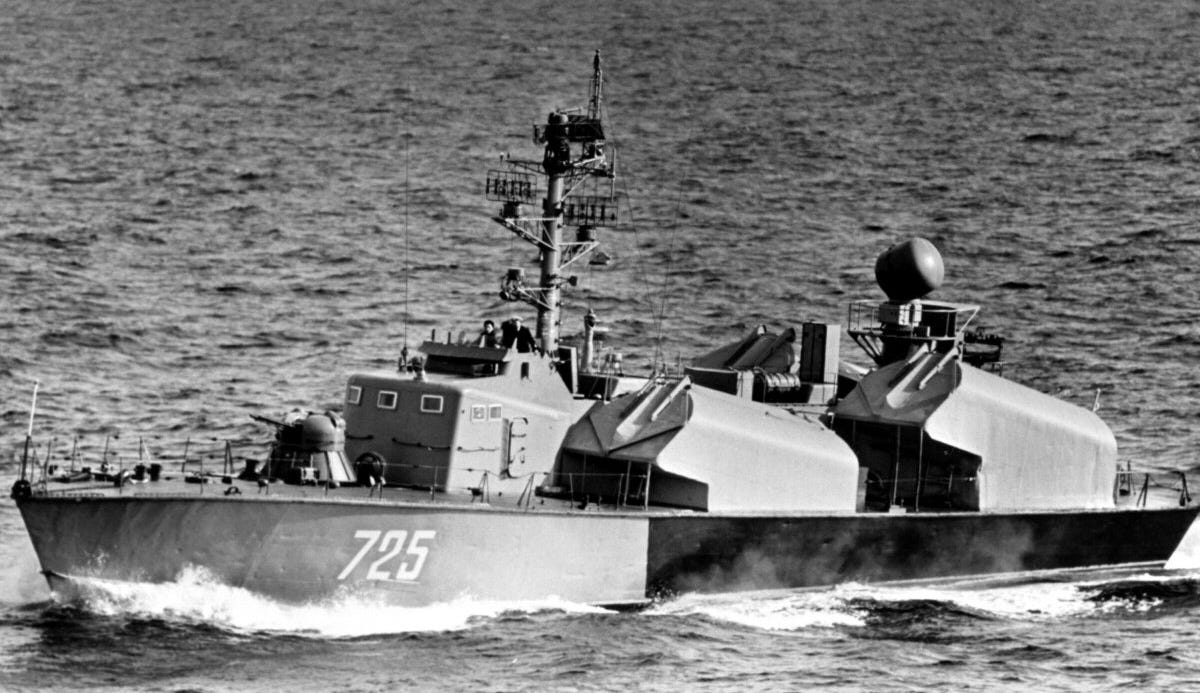
The true effectiveness of saturation is rooted in economics, a topic we will explore further in the next article but that we can briefly mention here. Using some rough, unclassified numbers, even if all of the VLS (Vertical Launching System) cells across the carrier battle group were loaded with air-defense missiles, the total magazine capacity would be around 700. If a lower-end Russian anti-ship missile costs around 1-million dollars, the Russians could potentially deplete all the battle group’s air-defense missiles and still have 300 more, heading for the now defenseless carrier, all for a price of only 1-billion dollars in missiles. This is a small price to pay for sinking a 20-billion dollar carrier. This is a gross oversimplification of the larger calculus of a modern sea battle, but it highlights a critical point that in the missile age, quantity has a quality all its own.
As CUAS (Counter-Unmanned Aerial System) technology improves, the drone-counterdrone equation will likely start to mirror that of the Cold War saturation attack. The “drone swarm” is a modern expression of the saturation attack, the logic behind the swarm being that sheer numbers will overwhelm a defender’s ability to detect, track, acquire and intercept incoming threats. This means that the essence of an effective drone swarm depends at least in part on the scale at which drones can be deployed.
Scale also becomes necessary when considering how to employ drones in a large-scale tactical engagement. We are used to touting the effectiveness of drones based on Telegram videos of several, human-controlled FPV (First-Person View) drones crashing into a single Russian tank or tank platoon driving down a road. How would a force employ drones in a contemporary “Battle of Kursk” scenario where formations of thousands of tanks are facing off against each other and conducting aggressive, offensive maneuver en masse with extensive supporting artillery and air assets?
Indeed, employing drones in the next incarnation of the Battle of Kursk might look quite different from the current drone engagements in Ukraine. Here are a few obvious concerns that emerge if each drone is piloted by a human as opposed to being autonomous…
Airspace Deconfliction and Targeting - Airspace deconfliction and identifying the correct ground target on the battlefield is hard enough when you’re just dealing with a few formations of fixed and rotary-wing aircraft. It would likely be significantly more complicated trying to coordinate thousands of human-controlled drones in conjunction with aircraft, artillery and missiles. Formation flying alone, especially in bad weather, is difficult for a pilot with a neck and a bubble canopy. A large, dense formation of drones would prove even more difficult to control and mid-air collisions might be common.
Pilot Location - If you’re only employing a few drones, pilots can put on their FPV headsets and hide out in the brush or a bunker. If we need to employ thousands of drones, that means we need thousands of pilots. That mass of pilots then becomes a target. Where do you put them? Co-locating them in a bunker or underground simplifies the digital network equation (we will cover that next) but increases vulnerability. A well-placed GBU-57 or equivalent could vaporize the drone pilot population.
Digital Network Complexity - When discussing digitally networked weapons, one of our senior team members often comments, “If Verizon or AT&T can’t always figure out a way to make my cellphone work in a permissive environment, with countless cell-towers, no jamming and no one trying to kill me, how can we expect that our digital networks will be reliable in combat?” The answer is that they won’t be and never have been. Even simple radio communications have caused calamities in countless historical battles. If humans are controlling drones remotely, every one of those digital connections becomes a potential point of failure. The more you disperse your drone pilots (see last comment) the more complex that network architecture becomes.
Large Formation… Large Target - If a force managed to employ drones at a scale to achieve saturation, the resulting formation might prove vulnerable to new, area-engagement weapons, perhaps similar to the dense walls of VT fuze shells employed against bombers in World War II. Conversely, employing drones as harassing weapons in “penny packets” would likely make their impact against a large formation only marginally effective.
If the goal is to use a drone swarm in a saturation attack, it is likely that the only realistic option is to connect all the drones in a mesh network that allows them to communicate laterally and coordinate their movement and actions autonomously. At that point the weapon system is no longer an individual drone or drones but rather the swarm itself. That swarm becomes much easier to control and presents a less complex problem when it comes to targeting and airspace deconfliction. However, as mentioned in the last article, what is to stop an adversary for finding a way to digitally neutralize or hijack the swarm, taking hundreds or thousands of drones out of the battlefield equation in an instant?
The next article in our “Future War” will discuss the economics of modern precision-guided weapons such as drones, cruise missiles and ballistic missiles. It is likely that real future battles will be won or lost through production and logistics, not the calculus of actual weapons employment on the tactical battlefield. Special thanks to our partners at Special Tactics, LLC who inform our analysis with real-time data they collect while serving overseas (in an unofficial capacity) in high-risk conflict zones where such weapons and tactics are being employed and tested.
Comments
Nothing yet. Say the first thing.
Sign in to join the conversation.