
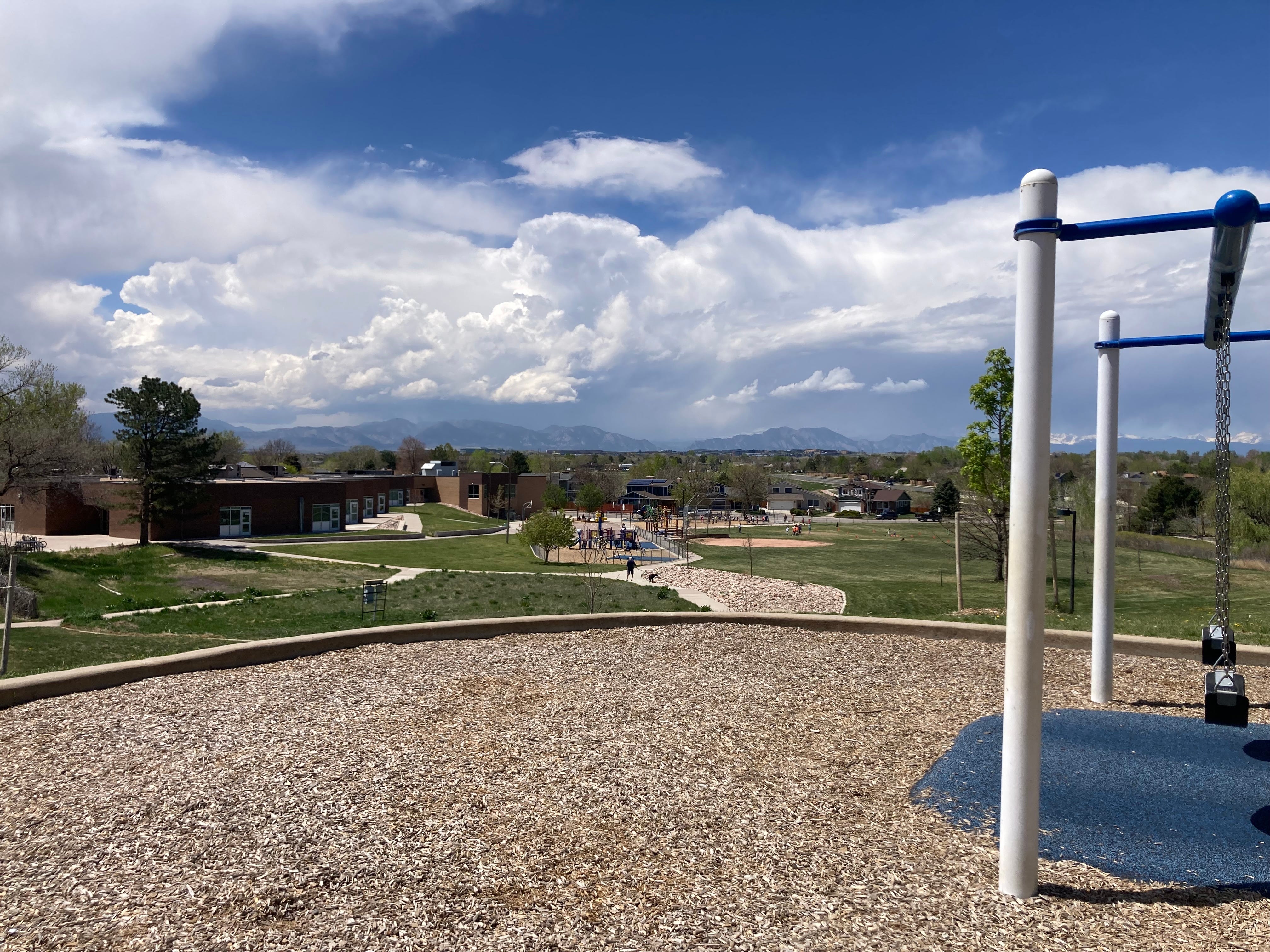
Last month, I sat at a playground with my 9-year-old, high on a hill overlooking a school. The Rocky Mountains stretched wide in the distance under a sky of rolling clouds. The air was cool and crisp, the shifting sky taking the edge off the sharp Colorado sun.
We drove RC cars along the bumpy, mulched paths and played hide and seek in the twisty slides and tubes — me contorting my adult-sized body into the meager hiding places. As we played, we watched the kids below. Groups spilled out in lines, then scattered across the separate, fenced-off playground. Shrieks and chatter filled the air. Then, at the ring of a bell, the lines re-formed. The kids tumbled back inside. A few minutes later, another bell, another line. The same dance, repeated.
My young person looked down at the scene and called out, “Look at the prisoners!”
These moments come up a lot, either through observation in the world or in books. Most children’s lives and stories are inextricably intertwined with school. I try to offer some nuance.
“Some kids really like school.”
“School can be a safe place for some kids.”
But, I don’t try to argue too much. That was my experience too — as an unidentified Autistic kid, school felt like a prison. Or maybe more like a long, slow, boring conveyor belt I was stuck on, with just a few blips of actual interest, and a constant background hum of sensory overload.
Childhood Recollections
·
December 15, 2023

I wasn’t exactly labeled as a gifted child in my early years. There were a lot less labels for kids in the late 80s and 90s and a lot less understanding as well.
This kid has never been to school, so these aren’t personal reflections. It’s more of a conceptual revulsion - Most kids do what?! Go to one building, with that many screaming swarming children, banded up into groups of twenty, where adults tell them what to do all day long - EVERYDAY? Heck no.
I get it. In the early years of our homeschooling, I felt so lucky to be able to spend all day with my kids living wild and free. I still do.
And.
As they’ve gotten older, with disparate interests and a PDAer who won’t engage with many of the homeschool opportunities, there are days now where I fantasize about sending them all to different wonderful schools that could meet all of their needs so that I wouldn’t be pulled in so many directions at once.
I know from friends with kids in school that this is a pipe dream. But a tantalizing fantasy nonetheless.
It comes up again later that night while we’re reading Calvin and Hobbes and I pause to explain the concept of needing a “Hall Pass” to go to the bathroom. Instant revulsion.
I’d make up a bunch of them and sell them for $100 each, then escape through the vent system.
School rules and culture do sound strange and dystopian to young people who have never lived inside them. When I reach back to my own school days and share stories about what it was like for me, my children are incredulous.
I woke up too early, always out of sync with my body, but without space to reflect on that. I rode the bus for hours every day, always with a book in hand, though the noise made it hard to read. In high school, the shop teacher told such a gory story about a thumb dangling by a tendon that I passed out cold in front of the whole class. I’d hide out in the library or sit on the floor next to my locker just to escape the lunchroom. Thankfully my mother was generous with mental health days.
I remember almost nothing about middle school except staying up half the night and sleepwalking through classes, probably the first time I experienced burnout from the lack of autonomy.
There were bright spots too.
Other kids I connected with. Inside jokes. Teachers who shared things that sparked new interests, or ideas that stuck with me — often sarcastic critiques of school, now that I think about it.
I can still recite Jack Prelutsky’s Homework! Oh Homework! that I performed on stage with my third grade class. There was a wry middle school teacher named Mr. Brundage. I don’t remember what he taught, maybe history, but I know he made a difference offering sparks of humor in otherwise bleak days. Maybe he was the one who handed me a copy of Lies My Teacher Told Me, an irreverent classic that criticizes how history is taught in America.
My high school math teacher became a true friend, supporting me in all kinds of ways, including helping me apply to college early in 10th grade. Mentors made a huge difference in my life.
School is complicated. I try to convey to my kids that yeah, there are many reasons we chose to do life differently, but there can also be really good things about school.
Over the past few years I have really grappled with the reality that we need more caring adults in our kids’ lives. In the early years of homeschooling we were enveloped by community in a way that has been hard to maintain post-pandemic and with busy teenagers.
And so I’ve spent the past year putting more supports in place.
The almost-teen who loves certain kinds of structured activities with friends now has full-day programs built into their week. One of those programs is a one-day-a-week enrichment program run through the public schools for homeschoolers that they have long attended and loved.
The teen who doesn’t thrive in those settings and prioritizes sleeping until 11am has weekly mentoring, a couple of carefully chosen community college classes, and may add a teen naturalist group this fall.
For the PDAer who rejects all structured activities that don’t involve candy (and even then, there’s no guarantee), I’ve finally figured out some things that work, at least for now. Super flexible speech and OT, plus college-age mentors who come to the house a couple of times a week.
School hasn’t yet been the right fit for any of the young people in our family, though we keep that possibility open. Unschooling isn’t perfect either. It can be hard to find the kind of support kids should ideally have access to in school, like dyslexia support, and we’ve had to piece it together with sheer will and a lot of trial and error.
I still love the tapestry we are weaving together, and feel like we’re doing the best we can for these particular kids, in this particular season.
Exciting news! This week I’m launching a new podcast PDA: Resistance and Resilience with my good friend Dr. Chris Wells, where we’re talking more about our experiences of PDA and also interviewing others with perspectives to share. The first episode will be available on Tuesday. You can subscribe for updates:
No posts
Comments
Nothing yet. Say the first thing.
Sign in to join the conversation.