

Over the last weeks of releasing a several blog posts, most of which were polemical against common philosophical positions that I think are deeply mistaken, I was somewhat surprised about the extent to which some people took extreme offense and responded with insults. Why would someone treat a harsh attack on a philosophical or even ethical point of view as a personal attack? Isn’t it obvious that one should decouple attacks on people from those on views? Or are polemical essays more popular, on average, because they are seen as insulting people?
I think something interesting is going on here that people haven’t really thought about.
Admittedly, terms like ‘polemic’ and ‘polemical’ have acquired a new association over the years, used more often as an insult of a writer or text than a neutral description of a style of writing. But that negative connotation is not strictly part of these terms, otherwise it would be very strange that anyone would willingly express support for polemics.
Here is a definition of ‘polemic’ from The Oxford Dictionary of Literary Terms:
A thorough written attack on some opinion or policy, usually within a theological or political dispute, sometimes also in philosophy or criticism. Notable polemicists in English are John Milton, whose Areopagitica (1644) attacks censorship, and H. D. Thoreau, whose ‘Slavery in Massachusetts’ (1854) berates upholders of the Fugitive Slave Law.
Polemic writing was once incredibly common. And yet, the professionalization of intellectual discourse in journals and books has gradually led to the decline of polemical writing. Those engaging in it, by attacking positions too harshly, are frequently attacked for being ‘offensive’ or ‘insulting.’ But is that an essential part of a polemic?
The late Brian McClinton, once the director of the Humanist Association of Northern Ireland, offered a defense of the style, arguing that its art form was only really detested when people disagreed with it:
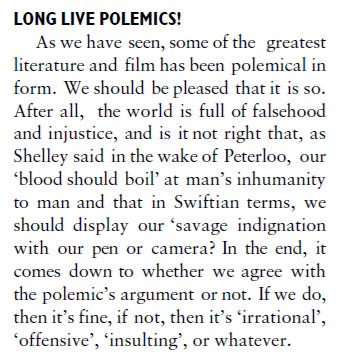
And yet, I don’t think this is quite right. While this may explain parts of the opposition to polemics, I don’t think it explains all of it.1 After all, why is it that some people express vehement distaste to polemics, not just when they attack their own cherished beliefs, but in general, whereas others have no issue with polemics at all, with some even celebrating it? How could people have such different attitudes to a genre?
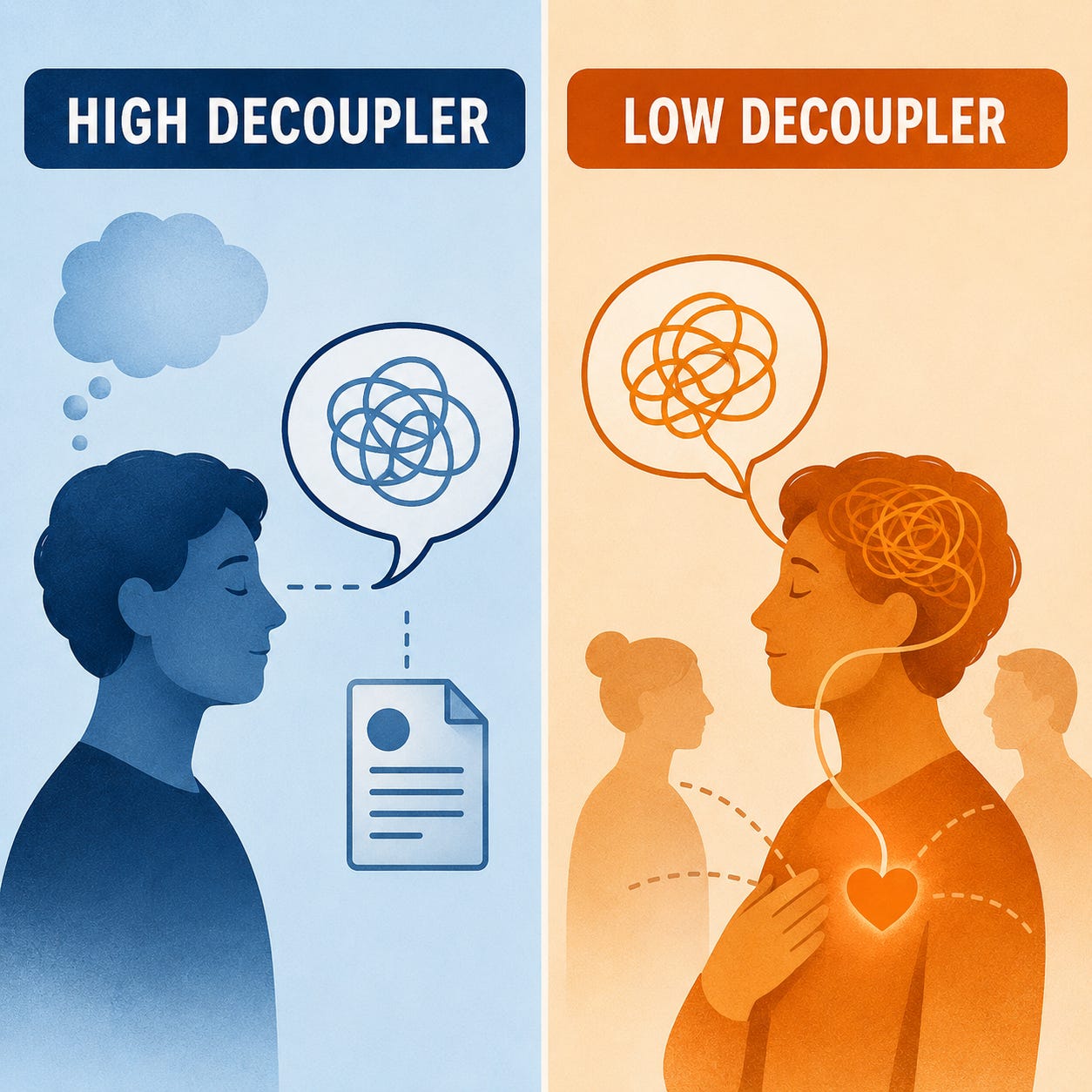
That puzzled me until I remembered a distinction between two cognitive/communication styles, which I first heard about from one of my favourite philosophy bloggers Richard Y Chappell, between high and low decouplers:
A high decoupler evaluates a claim in virtue of its literal truth.
A low decoupler tends to think of the subtext in which such statements might usually be made.
I think this dimension of cognitive diversity largely explains the difference between those who take no issue with polemics and those who are vehemently opposed to them.
As a philosopher working on the diversity of minds, whether that’s in animals, humans, or more recently AIs, I have long tried to push against the very common tendency of philosophers and the general population alike to assume that their own mental states and modes of thinking reflect how others see the world. One of the central goals of my first book was to explicate what I called ‘phenomenological complexity’, recognizing many dimensions and gradations of consciousness as a multi-dimensional phenomenon across the animal kingdom in order to replace the common conceptualization of consciousness as an all-or-nothing property. But even in our own species, minds vary alongside a huge number of dimensions, aka neurodiversity, which can frequently lead to misunderstandings. As I wrote in the final pages of my book:
Other future applications of the framework may also extend to the explanation of disorders and varieties of consciousness in humans. Since my being on both autism and aphantasia spectrums has informed my awareness of the phenomenological diversity of minds, I hope to expand into this area in the future.
And expand I shall. Let’s use some examples to illustrate the differences between how high and low decouplers may respond to polemical sentences.
Ironically, how one uses the word ‘polemic’ itself can be used to distinguish the high decoupler from the low decoupler. Some treat ‘polemics’ as a thick concept with an inherently negative evaluative component. Polemics are seen as always bad, perhaps because they are intrinsically insulting or too destructive in their usual subtext or more generally because violations of politeness norms are usually associated with bad people. Obviously those endorsing polemics don’t endorse a style of writing that they think of as intrinsically bad.
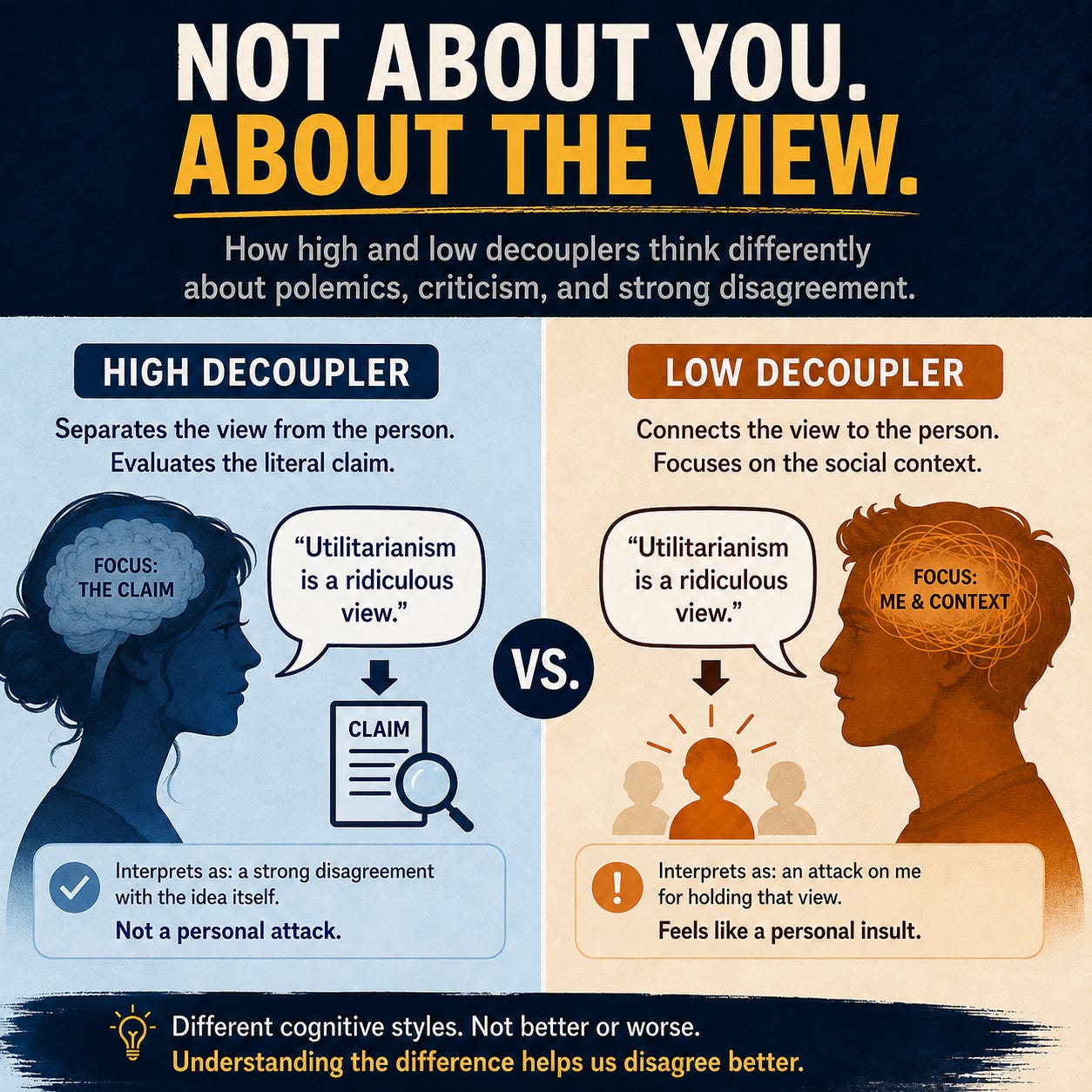
For the high decoupler, a statement like “utilitarianism is a ridiculous view” carries about the same connotation as the statement “utilitarianism is a really really badly mistaken view.” But for a low decoupler, the first statement amounts to little else than the statement, “You are a ridiculous person for believing in utilitarianism.” It doesn’t matter to a low decoupler that one adds clarifications that a harsh attack on a view is not meant as an attack on the people holding it. Or that one clarifies that people holding mistaken views are just as intelligent. The statement is treated as little else than a veiled insult. The clarifications are not believed to be honest. To the low decoupler, it sounds a bit like saying: “This is not meant as a personal attack and I think you’re intelligent and I respect you, but you are a ridiculous person.” That is to say it sounds even more offensive to a low decoupler.
To turn this difference into a cute neurodiversity advocacy poster:
I am very much a high decoupler, probably on the far end of that spectrum.
But I don’t think that being a high decoupler is superior or inferior. “Low” does not mean worse and “high” does not mean better. High decouplers, for instance, may fail to notice problematic political dog whistles. Each cognitive style has its advantages and downsides depending on the situation and as a society we benefit from having a neurodiverse population. But to reap those benefits, we are better off becoming aware of these differences in cognitive styles. Otherwise misunderstandings and conflict are inevitable. Given the awful history of discrimination against human differences, we should be especially careful not to declare a dominant way of thinking as ‘right’ and all others as ‘wrong’ or ‘pathological’.
As a high decoupler, I’m not insulted if someone declares one of my philosophical views to be “ridiculous,” though I’d of course prefer it when others share them and am naturally a bit saddened that they aren’t taken more seriously, e.g. animal liberation. To me, declaring a view “ridiculous” is treated more like a shorthand way of emphasizing that one disagrees with a view very very very strongly. I wouldn’t treat such a statement as a personal attack, unless the uttering person makes it clear that they think that I, as a person, am ridiculous for holding them. No doubt, this may sound strange to low decouplers, who almost automatically treat such comments as personal insults.
A low decoupler may ask what could be the point of a polemic, if not to insult the people holding a particular view?
Ironically, one’s use of the term ‘polemic’ itself may reflect whether one is a high or low decoupler. Today, it is common to use terms like ‘polemical’ or ‘polemicist’ in a pejorative sense to dismiss a criticism or to imply that they constitute personal attacks as a matter of fact. No doubt, polemics can and did historically occasionally include ad hominem attacks. But are they conceptually part of them? I don’t think so. Even if ad hominem attacks are common in politics or the common subtext in such political discussions is one of veiled insults. Again, we can decouple these subtexts. Historically, polemics referred to sharp and biting criticism that did not hold itself back to adhere to strict norms of politeness that owe all views respect, such as slavery.
To me, polemics is more like a fun literary genre that allows itself some freedom from the stale and regulated prose one might encounter in journal articles that enforce equal respect to all views, by mocking what are perceived to be deeply mistaken and harmful ideas. To illustrate the thought to a low decoupler, take a philosophy comic that pokes fun at some philosopher’s ideas:

Even as an admirer of Dennett’s naturalistic philosophy, I can’t help but find the comic hilarious. And I suspect most low decouplers would do so too. I don’t think most people would treat it as a personal attack on either Chalmers or Dennett and be offended by it. Now some extreme low decoupler might fail to disassociate comedy from personal attack. But even that is not always wrong. Some comedy, after all, is quite vicious and uses the guise of “just being humour” to launch mean-spirited attacks on individuals or minorities. But comedy is probably a good test case for checking where one falls on a high-to-low decoupler spectrum. Think of where your own boundaries lie if someone tells increasingly critical jokes about your philosophical views before you’d consider it offensive/a personal attack.
Before I thought about that distinction between high and low decouplers a bit more, I was quite surprised by some of the extreme discrepancy between those who took no issue with polemical essays and those who felt deeply insulted by them. No doubt, some who celebrate polemics may do so precisely because they think of them as veiled insults of people, not just views. They may celebrate them in the same way they might celebrate the kind of veiled backhanded compliments in the movie Mean Girls. But to be charitable, we shouldn’t just assume that others share the same cognitive styles.
I suspect that many people who enjoy polemics are high decouplers dissociating ideas from people, since people who actually celebrate personal attacks are rare.
Interestingly, Richard Y Chappell speculated that we may be better off by sorting ourselves into high and low decouplers to avoid conflict:
I wonder how much better discourse would be if high and low decouplers could more easily filter each other out. (Seems rare for interactions between the two cognitive styles to be productive.)
Evidently, communication between people of these different cognitive styles can quickly turn hostile and unproductive. But rather than separate ourselves into our own echo chambers, I hope we can learn about each other’s cognitive and communication differences — and become more tolerant of and sympathetic towards each other. After all, we probably can’t change our psychological position on the high to low decoupling scale all that much. It’s a simple fact about the neurodiversity in our own species.
If high decouplers were in the majority, there might not be a communication problem, since the usual subtext of attacks on views would be attacks on views, not persons. There would be no subtext to be misunderstood if everyone just used language in a literal way. As someone on the autism spectrum I can certainly only dream of that. How nice would it be if everyone meant what they said! (I am not sure if autism necessarily comes together with a high-decoupling style of thinking, but it’s probably correlated. The vast majority of high decouplers are not autistic, however.) Living in Britain, which is infamous for its passive-aggressive subtext that, can easily create communication problems for foreigners. Who came up with the idea to use “That’s interesting.” to mean “That’s bollocks!”? Sigh.
But high decouplers are evidently in the minority and so I hope to have given some insight here into what it’s like to be one.
As a result, I’ll moderate the tone of any future polemics. While it seems like a mistake to a high decoupler like myself not to decouple attacks on beliefs from attacks on themselves, I don’t cherish making people feel insulted, especially if this is simply how low decouplers will inevitably read polemics. If this comes down to a different way of thinking and communication, we shouldn’t really think of either side as making a mistake at all.
I also don’t enjoy seeing retaliation to polemics perceived as insulting in the form of actual insults. While I love to debate philosophical views for hours, I don’t really understand people who like to spend their time insulting each other. Some polemicists may enjoy actually insulting individuals and thriving in controversy, Friedrich Nietzsche may be the most obvious example here, making statements like this:
“Is Wagner a man at all? Is he not rather a disease? Everything he touches he contaminates.”
But these kind of insults have probably given a bad reputation to the polemics genre as a whole. Indeed, with all the rage bait that algorithms push today, the subtext of polemics may have unfortunately been ruined forever.
In a world where high decouplers were the majority, harsh polemics would probably be unproblematic and cherished (as long as they only attack ideas, not people). But we don’t live in that world. In a world of high and low decouplers, polemics frequently backfire and offend, rather than convince people to change their minds, and so high decouplers may well recommend to each other to police their tone a bit more because of the subtext low decouplers will read into it. Dan Dennett was probably right after all, when he called for gentle pressure:
I’m all for keeping a very gentle pressure on, not overdoing it—because it’ll backfire.
But I hope low decouplers can also learn to show some appreciation for the fact that polemicists need not be edge lords or trolls purely in it for the sake of insulting people by attacking particular views. Milton’s attack on censorship and Thoreau’s polemic against slavery demonstrate the value of polemics nicely.
Perhaps high decouplers are even essential to challenging bad ideas that have become culturally ingrained and are considered offensive to even challenge. This may have been slavery or monarchy in the past and factory farms today. Sometimes people associate ideas so closely with their own identity that any criticism of those ideas becomes a personal attack. This is why Charles Darwin has received much hate from theists (to this day). High decouplers may be in the minority in our neurodiverse world, but humanity is better off for having them, breaking the ice on taboos about which ideas are allowed to be criticized.
Finally, whenever you attribute mental states to others based on what it would take for yourself to communicate a certain way or to have certain beliefs, pause at least for a moment and consider whether different people may have very different cognitive and communicative styles. That goes for both high and low decouplers, but also for all the other dimensions of neurodiversity in our species. We’d all get along much better.
There may well be many who enjoy polemics only when they target opposing viewpoints and decry them as unfair when they target their own, but that form of tribalism isn’t philosophically very interesting or defensible and so I won’t discuss it here. One can probably think of it as a case of low-decoupling + tribalism (which may well be correlated).
If you enjoyed reading this essay please like, share, and subscribe. It helps a lot to reach a wider audience. I am also interested in reading your thoughts in the comments, regardless of whether you agree or disagree. I try to respond to all.
Comments
Nothing yet. Say the first thing.
Sign in to join the conversation.