
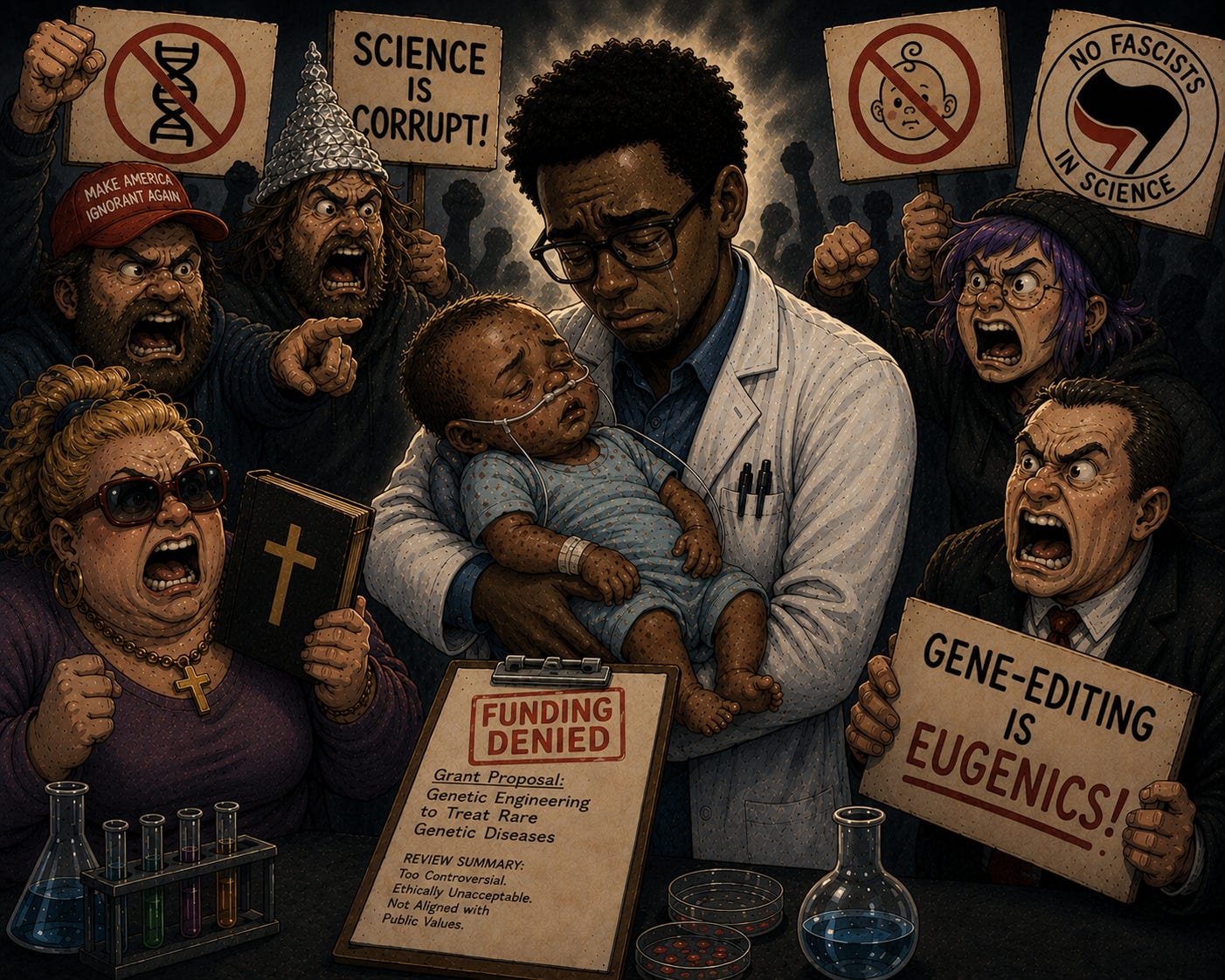
Let me apologize proactively for the provocative clickbait title and image I have chosen for this essay.
The reason I have done so is that there are actually thousands, no, hundreds of thousands of lives at stake, yet their deaths and suffering receives almost no attention at all. While this essay will do little to change that in the great scheme of things, I am naively optimistic that I can at least raise the problem here in a way that might reach and change the minds of a wider audience who otherwise only come into contact with poltical issues that make it to the top of increasingly sensationalized and polarized news.1 (Those are not the only ones we should prioritize!)
The issue I am talking about concerns children born with genetic diseases that cut their lives short and/or massively reduce their quality of life, but which could have been cured through gene editing.
This problem is entirely neglected in the current culture war between the Left and the Right, which shifts media attention and public concern almost entirely towards other topics, while issues such as this one do not make it onto the political agenda of either party. That this is problematic can easily be seen in the case of animal welfare, which, despite cross-party support for welfare improvements on factory farms, does not make it onto the agenda of either party. In the case of gene editing, of course, things are even worse, since both sides of the political aisle are united in their opposition to the gene editing of humans, which has largely thwarted research that could save hundreds of thousands of lives in the future.
The tendency in the culture wars to use terms like ‘fascist’ or ‘eugenics’ indiscriminately to describe one another has also brought ordinary scientists who are merely trying to cure diseases into the crosshairs, inundating them with similar terms and personal attacks. No doubt, to anyone who does not spend more than a few seconds thinking about genetic engineering, the practice may seem morally suspect. After all, could this be a veiled return of Nazi ideology?
It is not. No one wants that. Okay, let me rephrase that. A tiny minority of the world’s population may be interested in Nazi-style eugenics.
But opposition to giving parents the option of curing embryos of awful genetic conditions that would cut their lives short or give them an awful quality of life, merely because even a Nazi might agree with doing so, is no more rational than opposition to animal welfare laws because the Nazis also implemented them, or refusing to invest in national military defence because military ‘defence’ can, for some, mean expansionist war, as in Nazi Germany or Russia’s attack on Ukraine.
The supposed slippery slope towards a return of coercive and racist Nazi-style eugenics is entirely fearmongering.2 People are so vehemently opposed to genetic editing in humans that it is hard to see why a widespread adoption of gene editing to cure genetic disorders would suddenly cause people to become Nazis.
One of the most common distinctions made in bioethics in this debate is between curing and enhancing. Whereas the former restores health, the latter attempts to go beyond average human capacities. While the former receives broad support, ethicists and the general population are far less enthusiastic about the latter, making it incredibly unlikely that people would attempt to genetically engineer a ‘new and improved race’.
Now, as it happens, I do not think the distinction between curing and enhancing should carry much weight in ethical decisions. If someone can live a longer life because we find ways to genetically improve their immune system beyond ‘normal’ levels, I do not think that is ethically more suspect than doing so by removing a gene that is likely to cause cancer.
If many decades of genetic engineering have passed, successfully treating genetic health conditions, I do not see why we should oppose further genetic alterations likely to improve a human’s immune system, disease resistance, and perhaps even cognitive traits beyond what is statistically normal in human populations. But all these things are so far removed from the editing of deleterious genes that they require a wholy separate discussion and one that should likewise not be confused with a slippery slope towards Nazi-style eugenics.
Critics sometimes envision a dystopian world in which we create two entirely different breeds of humans, one of which controls and oppresses the other, but these are utterly absurd scenarios that can be seriously envisioned only by those who have watched too much science fiction and have little to no understanding of genetics.
At best, ‘improvement’ beyond average population health would initially be fairly minor, perhaps reducing your risk of certain types of cancer by a few percentage points. Now, that is nothing to sniff at. With millions of people on this planet, that could mean thousands of lives saved, but it is nothing like the images of Nazi eugenics that people envision when they hear about genetic engineering. It has nothing to do with declaring that some lives are worth more than others. It is simply about things on which we could universally agree, regardless of our views about the good life, such as preventing our children’s lives from being cut short by cancer.
Funding is always limited. And there is no reason to think that we would reach this stage unless we dealt with all the highest-payoff scenarios first, namely genetic conditions that lead to premature death or extremely painful conditions, of which there are many.
But even if we want to restrict ourselves to curing, we should not fear the common slippery-slope arguments, which are generally despised by philosophers as a faulty mode of reasoning. We can always choose to wear better footwear. We can implement a wide variety of precautionary measures to prevent such outcomes. These would be vastly superior to simply letting children die or suffer from awful diseases.
Even if you are religious, I do not think there is a good argument for why God would not want us to engage in gene editing to cure harmful mutations, even if God would not want us to pursue further ‘enhancements’. After all, helping those who are suffering because of an unlucky draw in the genetic lottery is presumably a restoration of ‘God’s intended design’ rather than an affront to it.
Opposing genetic engineering research is a little like allowing homeless people to starve to death or opposing aid to starving children because one thinks that providing such aid might slightly reduce the chances of a communist revolution in the distant future, leading to a utopia in which starvation no longer exists.
Unfortunately, gene editing of human embryos remains illegal or restricted from receiving public funding in many countries. I am not talking about actually bringing gene-edited babies into existence. I am talking only about research. Pointing out unforeseen genetic risks should be a call to conduct more research, not a veiled political attempt to stop it in its tracks.
If we really care about the lives of hundreds of thousands of children, research into curing terrible diseases through gene-editing should become a political priority. This has nothing to do with being left, right, or anything else. Saving the lives of children should be something on which any rational and compassionate human can agree, regardless of their political views. Both sides of the political aisle have blood on their hands for preventing research that could already have saved thousands of lives. Not to mention the suffering of parents whose happiness is frequently destroyed by having to watch their children suffer and die. But I hope we can admit our mistake.
Future generations would thank us.
If you made it to the end, please consider to like, share, and subscribe. It helps a lot to reach a wider audience and create discussions, even if you strongly disagree. Please also let me know your thoughts in the comments, regardless of whether you agree or disagree, I’m keen to read the feedback of my readers. I try to respond to all.
Social media algorithms also play a large role in this worsening of the discourse.
I’ve published on the ethics of genetic engineering in the past, which may be of interest as further reading:
Veit, W., Anomaly, J., Agar, N., Singer, P., Fleischman, D.S., & Minerva, F. (2021). Can ‘eugenics’ be defended? Monash Bioethics Review. https://doi.org/10.1007/s40592-021-00129-1
Veit, W. (2018). Procreative Beneficence and Genetic Enhancement. KRITERION – Journal of Philosophy 32(1), 75-92. https://doi.org/10.13140/RG.2.2.11026.89289
Comments
Nothing yet. Say the first thing.
Sign in to join the conversation.