
Donald Trump’s attempt to engineer a $1.8 billion taxpayer-funded slush fund for the benefit of persons and groups that got in legal trouble promoting his interests is one of the most notable legal stories of this or almost any year, so let’s dive in.
*
There were early warnings. “Months before the $1.8 billion “anti-weaponization” fund was announced, Ed Martin predicted Capitol rioters would get millions, even if it took until 2028,” reports NBC News.
*
Legal journalist Roger Parloff was among the first to dig into the language of the purported settlement. He writes [see screenshots for backup on three points]:
“The Trump/Blanche ‘settlement’ fund purports to be challengeable only by those who colluded to create it.
“To help themselves to nearly $2B of our tax dollars, claimants present evidence to the (wink-wink) ‘settlement’ fund that they were victims of ‘Lawfare’ or ‘Weaponization,’ terms that are nowhere defined.
“The fund is administered by 5 people chosen by Acting AG Todd (’I love you, sir’) Blanche, and are removable at will by Trump.
“The identities of those given our tax dollars, and how much, will be kept secret from us, and known only to Todd (’I love you, sir’) Blanche.”
“The procedures for processing these claims can be as secret as Blanche’s appointees choose to make them.”
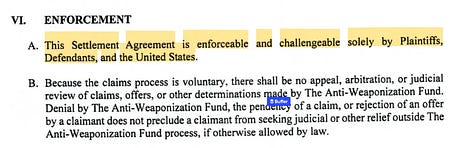
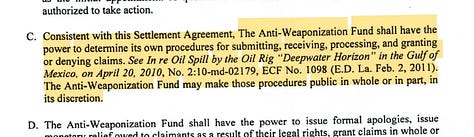

Two other provisions of note: under IV - G, H the fund must wrap up operations and liquidate by December 2028, ensuring that later administrations cannot get their hands on it (or more to the point, I suspect, its records.)
It has a second, longer section purporting to exclude judicial review. From VI - B: “there shall be no appeal, arbitration, or judicial review of claims, offers, or other determinations.”
The sum transferred is to be $1.776 billion, a number that is cute but reveals the arbitrariness at work. (There is a baldly mendacious recitation that it is the sum expected to be paid had claimants gone through regular legal process.) At any rate, no judge had anything to do with that cute number. Trump had sued the federal government claiming that his own IRS appointees had failed to prevent a rogue actor from unlawfully leaking part of his tax returns. U.S. District Judge Kathleen Williams had expressed skepticism as to whether the parties were genuinely adverse, since Trump appointed and could fire the officials charged with defending the U.S. Treasury against him. Trump dropped the suit, forcing the judge to relinquish her jurisdiction, and then within hours unveiled the “settlement,” which at that point could proceed without judicial supervision.
*
Under an addendum to the supposed settlement the Internal Revenue Service is “FOREVER BARRED and PRECLUDED” (capitals in original) from asserting civil or criminal claims against Trump, his companies, and his family over any misconduct or deficiency connected with tax returns filed up to the present date, whether known or unknown. At least so the Acting Attorney General, Trump’s former personal attorney, has agreed.
Nice deal if you can get it! Maybe you can get it if you’re “negotiating,” adversely or otherwise, with someone who serves at your pleasure. And Trump does seem to have at least one high-exposure dispute with the feds over his taxes, per this NYT account from 2024.
At least there’s one consolation, economist Justin Wolfers observes: "He promised to release his tax returns as soon as there were no more audits pending, and now there are no more audits pending."
*
My Cato colleagues Tad DeHaven and Molly Nixon make many useful additional points in this post.
They note that in his order creating the fund, Acting AG Todd Blanche “cites as precedent several cases in which the USDA resolved discrimination claims brought by Native American, Hispanic, and female farmers, stating that those cases were ‘settled on similar terms.’”
No, they weren’t. “Those cases did indeed tap the Judgment Fund, but the eligible claimants for those funds were generally within the category of those whose cases had been settled [and] for the same USDA discrimination alleged in the lawsuits.” This new slush fund, by contrast, is not structured to assist victims of improper tax disclosure.
Instead, the level of generality as to offense committed and injury suffered is set high enough to give the fund broad discretion to reward friends and turn away foes. No neutral third party administration, no appeal, no public accounting, and of course zero court supervision from the get-go, the whole thing having been engineered to escape scrutiny by any judge. Not much of a comparison to the Clinton- and Obama-era USDA discrimination settlements (which indeed deserved the vigorous criticism I and others directed at them at the time).
It’s also true, of course, that the persons and groups given money in those settlements had not been prosecuted for crimes, often violent, meant to prevent the peaceful transfer of power following an election.
*
Harvard professor of government Ryan Enos calls this “the most brazenly corrupt action in US Presidential history.” I’m not prepared to pronounce either way on that, although it seems fair as applied to the presidents I’ve followed over my lifetime.
I’ll close by quoting Nick Catoggio for The Dispatch (paywalled alas):
“It’s simple theft packaged in the argle-bargle of ‘weaponization’ and ‘compensation’ to make it palatable to populist dimwits searching for a way to excuse it morally. Even the mechanism is postliberal to the core: Trump’s habit of using flimsy lawsuits to squeeze money out of parties that he knows won’t dare refuse him reduces law—ostensibly an instrument of justice—into a vehicle of extortion.
“How does he get away with it? You already know that, too.
“The president behaves with impunity because he believes most of his party will unthinkingly defend anything he does, and he’s correct.”
No posts
Comments
Nothing yet. Say the first thing.
Sign in to join the conversation.