
I read almost nothing but Fantasy novels from age 13 to 20; inevitably, I often pondered the nature of the genre, and what exactly distinguished Tolkien from the rest. I think it’s fair to say that Tolkien created the genre, there were precursors but they seem to have left little or no impression, unlike Tolkien’s legendarium. Tolkien faced an immaculate snowscape and ventured out as he willed, without constraint; later writers headed out and found Tolkien’s giant footsteps in the snow, and inevitably followed his path. After Tolkien, any writer was immediately beset with: castles, magic swords, a dark lord, elves, dwarves, orcs, magic rings, large battles, wizards.
Every Fantasy writer I’ve read is either copying Tolkien’s tropes, or reacting against them. There’s also an undeniable qualitative gap, e.g. it seems ridiculous to even try and compare Tolkien and George RR Martin — I read the first of the Game of Thrones novels, enjoyed almost nothing, began the second 900-page ordeal, and round about page 300 realised I hadn’t enjoyed a single page, and gave up.
So what exactly is the difference between Tolkien and the rest? Firstly, there’s the sheer depth of backstory: Tolkien began inventing elvish languages as a teenager, then wrote what would become The Silmarillion in his 20s, a good two decades before The Hobbit.
Later writers do not invent; they merely borrow: I remember reading Robert Jordan’s Wheel of Time books in my 20s, and noting that the names were either meaningless or outright purloined from Celtic mythology (e.g. the aes sedai); and that much had been taken from Dune. This is common in the genre.
Secondly, as I said above Tolkien was one of the first Fantasy writers, and so he had virtually no models, he had to rely on his own genius & learning, rather than just copying other writers. There is a kind of dizzying freedom in certain moments of literary history — I think of Shakespeare in the late 16th Century, Milton a little later, TS Eliot after the war — where a writer creates or exploits a largely untouched creative seam.
Tolkien was drawing on his deep knowledge of European myth, from Beowulf to Icelandic sagas; later writers drew largely from…Tolkien.
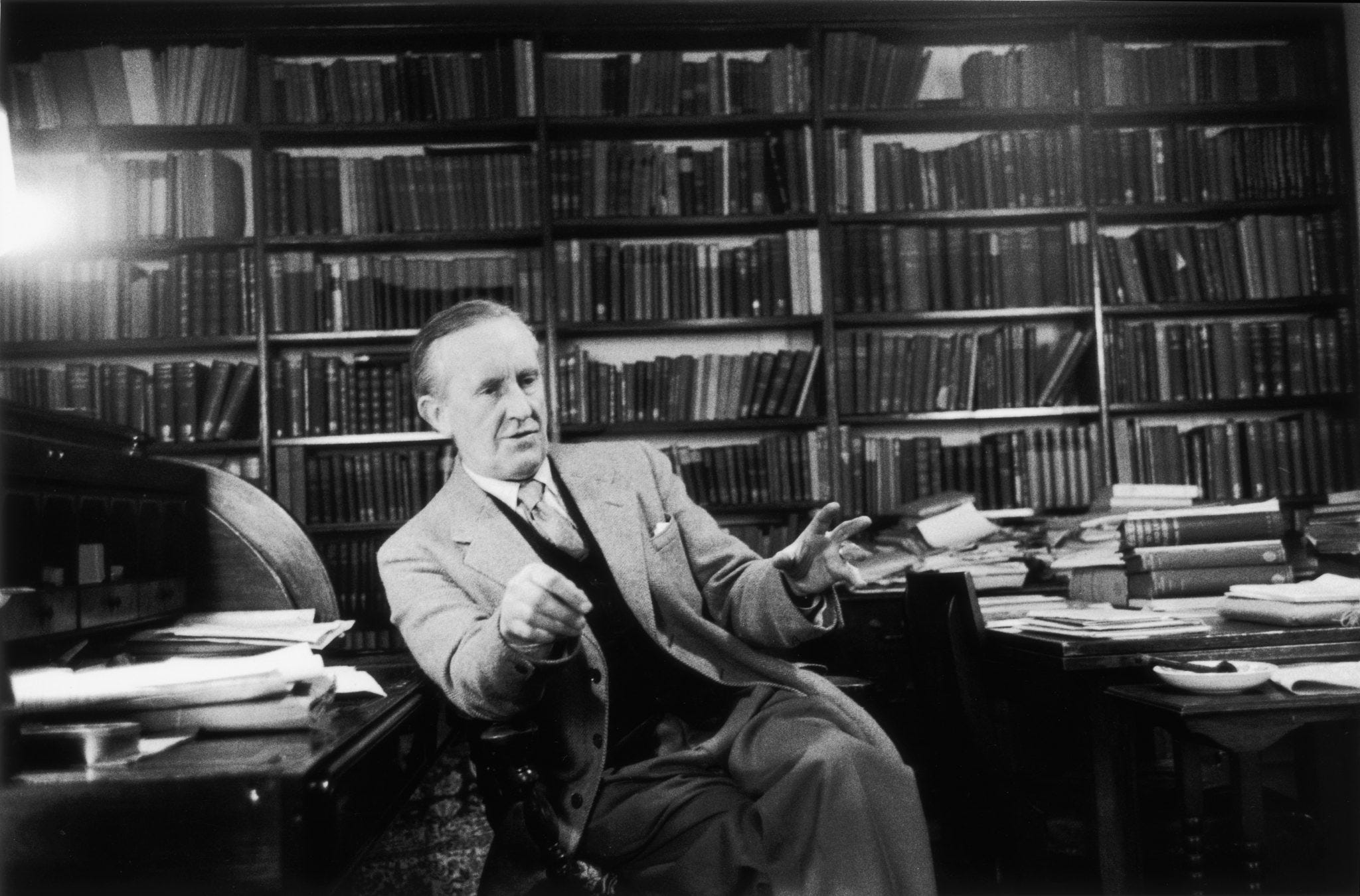
Most Fantasy is of course crap, but here are some exceptions:
Ursula Le Guin (1929-2018), or rather the first of her Earthsea novels (A Wizard of Earthsea), the rest tend to an arid & dispiriting Feminism. Le Guin manages to avoid elves/dwarves/orcs, dark lords, magic swords, and crafts more of a psychological thriller about initiation, knowledge, self-mastery, with beautiful prose.
David Gemmell (1948-2006): One of my favourites, as he is avowedly just a writer of exciting masculine tales, with no pretensions to literary merit or depth, yet his prose is pleasingly taut, his characters well-drawn, and profundity does indeed manifest. My favourites: the Waylander trilogy; the Jon Shannow trilogy; the Stones of Power series. Very little influence from Tolkien!
Katharine Kerr (1944-): Her Deverry series, set in a kind of Dark Age Europe, uses reincarnation as a plot device. She takes elves and dwarves from Tolkien but otherwise seems free of his influence. Incidentally, her presentation of reincarnation is quite accurate, with the larger personal themes and the curious little motifs which occur across lives.
Susan Cooper (1935-): The Dark is Rising Sequence is very much its own thing, I would say it owes nothing to Tolkien, it begins as something like a children’s adventure and then takes on mythic depth. Very powerful.
Margaret Weis and Tracy Hickman (1948-/1955-): This duo are the only good writers I came across from the Dungeons & Dragons milieu; their books are largely developed from D & D campaigns and so often bear the impress of the gaming mechanics. Their Dragonlance and Twins books arise from D & D but take on a life of their own, largely through the character of Raistlin, a pleasingly twisted magician who is the stand-in for every gamma-male reader (such as I was, though to be generous perhaps I was more of an omega).
Stephen Donaldson (1947-): A genuinely disturbing talent, I came across the first of his 6-volume Thomas Covenant series when I was maybe 14 or 15, and threw it down in disgust, only reluctantly taking it back up because there was absolutely nothing else to read, nothing on TV, and all my computer games were crap. The first volume, the unfortunately-titled Lord Foul’s Bane, is by far the weakest, though it interestingly recasts Tolkienian themes into a Dostoevskian drama: the protagonist, in our world, is a leper; drawn into a Fantasy world (Narnia-style) he thinks he has gone insane & refuses to believe any of it is real. The second book, The Illearth War, is for me one of the best Fantasy novels I’ve read, and indeed the original 6 books are all somewhere between good and superb. He then wrote another quartet, many years later; I read the first with absolutely no enjoyment and decided to skip the rest so as not to spoil my memories.
Good as these all are, Tolkien seems of a different calibre altogether. It is not merely his originality, the depth of backstory; over the years, I’ve increasingly found something prophetic in his works, on both a cultural/political level, and in my personal life. For example, a Jew-obsessed friend, or rather ex-friend, reminded me strongly of Denethor, with his pride, his mental rigidity, his spiritual despair, the sense of a mind wrecked by monomania & hatred. Just as Denethor turns on Gandalf and even his own son, so he turned his bile on me, accusing me of "loving the Jews” and snarling “maybe your island should be sunk” merely because I don’t spent every waking second raging against the Jews. The palantir did not lie to Denethor: it merely presented things in a certain light, and his haughty vain spirit then worked its own destruction.
Another example: I lent my LotR to Bob the Coward, an apple polisher I knew at university; in the ‘Council of Elrond’ I had annotated “idiot” next to Boromir’s dismissal of the hobbits; Bob then wrote a letter to me, angrily explaining how Boromir as a skilled administrator & leader of men is no idiot but rather a canny, prudent political operator. After graduation, Bob embarked on a career in “Communications” and even ran for political office. Naturally, he would take Boromir as a role model, though he probably disapproved of his physicality & courage.
On the larger scale, ‘The Scouring of the Shire’ chapter seems uncannily prescient today, with the gentle Shire under the thumb of a tyrannical bureaucracy, enforced by an alien race. There are many occasions where I find myself likening our struggle to passages in the legendarium, and indeed my self-initiation into Germanic paganism came after reading of Turin: I dozed and had a hypnagogic vision of a land ruled by racial enemies and orcs, and of Wotan stalking & slaying these vermin.
Or this passage, which seems eerily prescient as our rulers fantasise about the eradication of the white race, a glorious multiracial world ruled over by an unaccountable “elite”; Gandalf confronted by Saruman:
“For I am Saruman the Wise, Saruman Ring-maker, Saruman of Many Colours!’’
‘I looked then and saw that his robes, which had seemed white, were not so, but were woven of all colours, and if he moved they shimmered and changed hue so that the eye was bewildered.
‘ ‘‘I liked white better,’’ I said.
‘ ‘‘White!’’ he sneered. ‘‘It serves as a beginning. White cloth may be dyed. The white page can be overwritten; and the white light can be broken.’’
‘ ‘‘In which case it is no longer white,’’ said I.
Well, there it is. The elite class whereto Bob the Coward aspired would find little strange in Saruman’s worldview & ambition:
‘He drew himself up then and began to declaim, as if he were making a speech long rehearsed. ‘‘The Elder Days are gone. The Middle Days are passing. The Younger Days are beginning. The time of the Elves is over, but our time is at hand: the world of Men, which we must rule. But we must have power, power to order all things as we will, for that good which only the Wise can see.
A little light editing and this would pass in Davos.
Comments
Nothing yet. Say the first thing.
Sign in to join the conversation.