
I have two cats, Ilse & Riggs: mother & son. Ilse is obviously the more intelligent but both are largely untrainable. Ilse is a very sensible cat, wary of strangers but able to adapt; Riggs may as well be a PTSD-haunted Vietnam vet as per his namesake, he is not merely terrified of strangers but of anything remotely new or different. They have both seen The Viking, star of my great novel (BUY IT NOW) half a dozen times, Ilse recognises him and even curled up & slept by his huge uncoordinated feet; for Riggs each Viking-visitation is a new & terrifying event, but then he was also struck senseless with horror the first time he saw me coming back to the house from a walk — previously he had only ever seen me inside the house, and obviously couldn’t grasp that I was the same person. Likewise, when Ilse found me reading or rather trying to read Heidegger in the back garden, she merely made one of her burbling noises by way of greeting, then curled up by my deckchair; Riggs saw me and miaowed hesitantly, obviously recognising me, then ran off anyway, just in case I suddenly transformed into a monstrous badger.
Several times, I have tried to calm Riggs by pointing to his calm mother, and saying, “Look you little psycho, your mother is fine, why are you so scared?” To no avail. Whereas most human beings would think Well if my mother is okay with him, and nothing bad is happening to her, I guess it’s okay, the cats seem incapable of transmitting useful information to each other. And just try pointing at an item of interest, e.g. food: where a dog would immediately follow your finger to the indicated object, cats will just stare at you.
I was reminded of this recently, recalling a story my mother told me about 30 years ago: she and my stepfather were on the Pennine Way, he crossed a makeshift bridge and warned her it was rickety, in her words “I thought Well it looks okay to me!” and then sure enough she confidently stepped on it and was sent plummeting into a muddy ditch while my stepfather looked on, no doubt chuckling at female nature. I would guess my mother’s IQ is about 70-80, maybe lower; it’s difficult to be sure as her low cognitive capacity is paired with almost total lack of interest in others, and a pronounced disinclination to endure hardship or discipline, so she has always shied away from learning anything — for all I know she’s a genius who just happens to be too lazy and self-obsessed to ever think, a kind of Mycroft Holmes.
I wondered if higher intelligence correlates with an ability to learn from others. Obviously, complex information would require higher intelligence but perhaps even simple concepts, e.g. “this bridge isn’t stable” require higher intelligence. It’s not that my mother couldn’t understand the concept, it’s rather that she is largely incapable of receiving information of any sort. There may be a minimum cognitive level, below which people simply can’t learn from others, but rather have to experience everything themselves.
Human civilisation requires advanced knowledge transmission; otherwise the wheel would need to be invented from scratch every few years and we would all be living as were Africans when Europeans arrived on the so-called dark continent. Who knows, perhaps many supposedly European inventions had also appeared in Africa, it’s just that instead of rapidly spreading throughout the continent these innovations were limited to the inventor & his immediate family, and when he died everyone just shrugged and went back to smashing rocks together.
When average intelligence exceeds the transmissibility threshold, lore and technology can accumulate. There would be evolutionary advantage to not merely intelligence but the capacity to learn from others: under Darwinian conditions, people like my mother would be more likely to die out, from stepping on one too many unstable bridges, or eating the wrong berries; and those with the bare minimum intelligence and personality type would benefit from the innovations & experiences of others. My guess is, it’s a combination of intelligence and personality type, though there is probably a correlation between higher intelligence and the most adaptive personality type.
It should be possible to test this hypothesis, e.g. give test subjects a task and have one subject indicate a better technique; it could also be done with animals, since I presume there are methods to evaluate animal intelligence.
There are two ways to receive information: rational calculation, and instinct. The former requires what I shall term “cold intelligence”, the latter “lukewarm intelligence”, i.e. more of a sense for the social context, it would be more about who guarantees this information. I can imagine an Isaac Newton or Wittgenstein as exemplars of cold intelligence. For lukewarm intelligence: that Science Guy on tv said that eating glue is good, and then Timothy Chalamet was seen eating glue, so eating glue must be good!
Most knowledge-transmission is via social cues, and so requires lukewarm intelligence: one must as it were “read the room”, pick up the prevailing trend of public opinion and follow suit without bothering to evaluate, to sift & sort the data. If cold intelligence is essentially autistic, lukewarm intelligence is the opposite, and since autism is (per diagnosis) 80% male, 20% female, I suggest this heuristic: men are more prone to cold & objective analysis, women to pick up on social cues & go with the prevailing trends. So if Zendaya drinks a cup of sulphuric acid every morning, and some guy in a lab coat says sulphuric acid is full of nutrients, most women will rush to Amazon to purchase their very own sulphuric acid; where men will be more likely to pedantically dissect the data and form their own conclusions. Obviously, most human beings are highly conformist, so probably the vast majority of both sexes would be consuming sulphuric acid; but probably more women than men.
Those of lower intelligence would be largely impervious to received opinion, and so wouldn’t be drinking the acid. In times where societal authority is of value, the less intelligent would lag behind, they would be mud-encrusted peasants; in a wicked and corrupt age such as ours, they would be shielded from the worst of things, relying instead on centuries of tradition.
As for those doomed to higher intelligence in a wicked age, prospects are bleak: those who escape the propaganda tend to exceed a certain intelligence threshold, and to have autistic personality traits. They are filtered out of managerial roles, too autistic to pick up on social cues, too likely to focus on the truth. At best, they will be relegated to roles of very minor import; at worst they end up as janitors or homeless. Those a corrupt society holds up as “intelligent” will be the compliant, some for sure may be highly intelligent — but also highly feminine, highly compliant. Most will be midwits: glib, superficial, desperate for social status & approval, apple polishers of the first water.
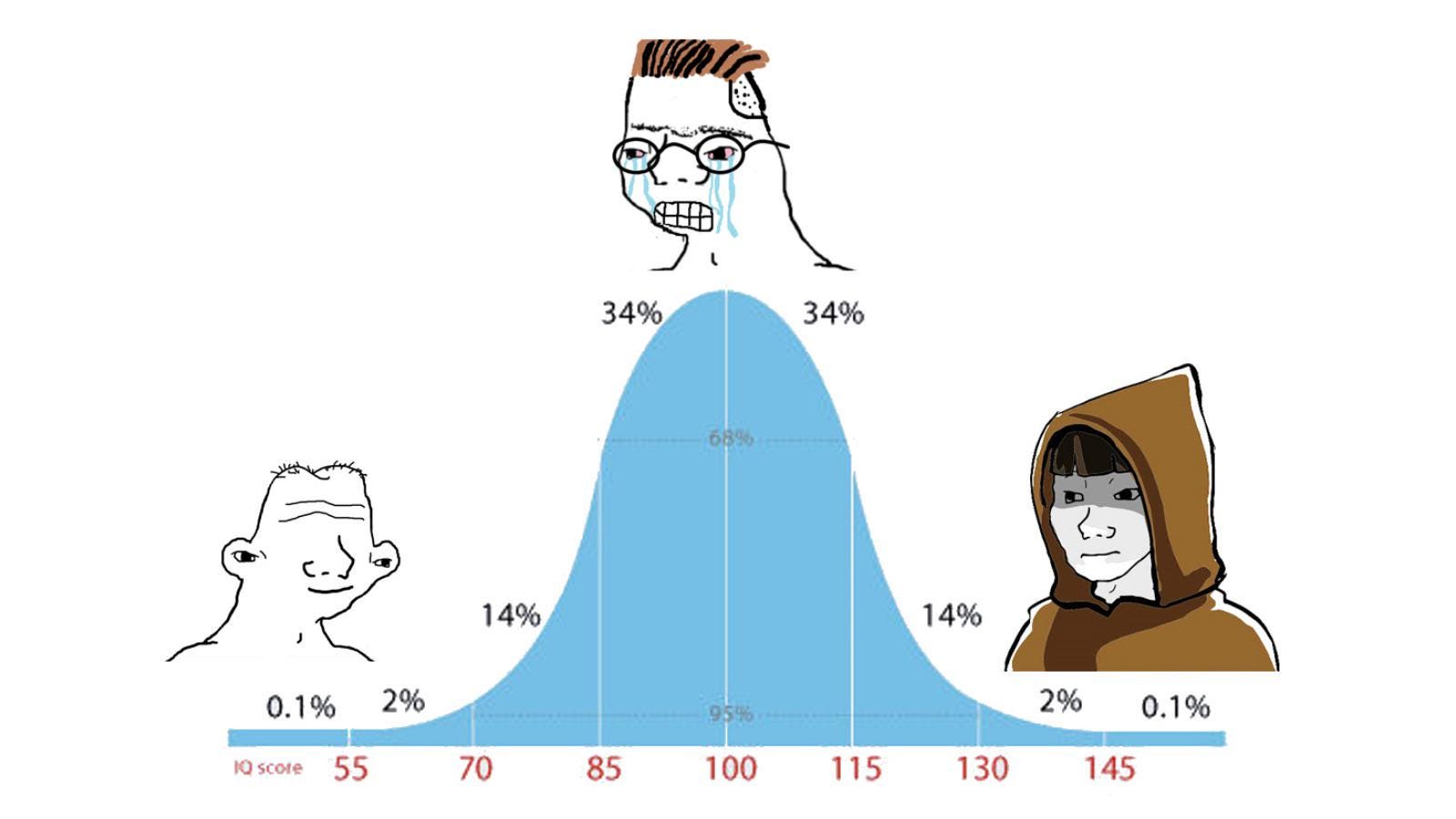
In our age, it comes as no surprise that the more intelligent, especially women, are very silly. We are, after all, living in wicked and silly times.
Comments
Nothing yet. Say the first thing.
Sign in to join the conversation.