
Schools make hundreds of design choices every day. Which tools they use, which metrics they record, and which software they license are all pedagogical acts. This piece asks what surveillance technologies teach students about what their schools believe about them.
“Trust men and they will be true to you; treat them greatly and they will show themselves great.”
Ralph Waldo Emerson wrote those words in 1841. Nearly two centuries later, trust remains an essential element of any healthy community, which is why I was concerned to read about the rise of AI-enabled “emotional surveillance” technologies in The Atlantic. These products monitor people’s disposition, affect, and concentration during screen-based work. They can tell you if someone appears interested or impatient, agreeable or skeptical. They surveil to produce insights about performance and productivity. And they’re being marketed to schools.
This technology arrives at a moment when societal trust has reached a nadir, which is a problem because “[trust] is key to building and maintaining social cohesion, as it promotes cooperation between groups of people.” Surveillance produces the opposite effect. When people feel they are being watched, they report feeling more stress and anxiety, they feel pressured to work longer and accomplish more, causing burnout, and they explicitly report feeling that their trust is being violated.
So why surveil people? In a word, data.
As is the case for all digital technologies, data is king. The more information one has, the better they can “optimize” for a preferred outcome. Want to maximize productivity? Wonder how your students feel about this activity? Interested in knowing if an employee is a “good fit” for your corporate culture? The answer is always data. And the best way to collect data is to measure everything.
But measurement requires observation, and sometimes that comes at a cost. The consequences of disaffection can outstrip the benefits of what we decide is worth optimizing.
Schools can’t afford to engender feelings of mistrust in their students. At a time when children already feel alienated from their schools and young people are phenomenally pessimistic about the future, sowing distrust is inadvisable.
Instead, schools can be sites of institutional trust. They should be places where young people feel hope.
Two distinct technologies have arrived in schools from different directions, but they share a single underlying logic.
The first is Emotional Surveillance, as described above. Sometimes called “emotion AI” or “affective computing”, these platforms monitor schoolchildren’s attention and emotional state. Students complete tasks while the platform accesses their computer’s camera to watch and record them.
“On completion of the learning task the learner gets a summary of their attention and an optional reward,” per one such product called Focus Pocus. The company’s pitch proceeds from the premise that “Learning online can be hard for kids because it’s so easy for them to get distracted from a screen.” Its solution is to surveil them and incentivize sustained attention with rewards rather than to simply offer children learning activities that don’t require distracting screens in the first place.
Another product, MorphCast, focuses on student engagement. “You keep shipping content that doesn’t change behavior,” their website states — as if your students’ disinterest in the civil rights movement means you might consider ‘shipping’ another historical event to them instead. But MorphCast goes further: “Rolling out programs without proof of performance across cohorts makes ROI impossible to link to next-step actions.” Yes, because teachers design their lessons primarily concerned about whether it will yield a good ‘return on investment’ from their students. Most revealing of all, the following image takes centre stage on their website:

What these platforms share, beyond surveillance, is an impossible promise: that a camera can tell you something true about what’s happening inside a child. According to Lisa Feldman Barrett, a neuroscientist and psychologist interviewed by The Atlantic,
“Your movements, whether it’s on your face or in your body or the tones you emit, don’t have inherent emotional meaning. They have relational meaning… There are — I mean, literally, at this point — hundreds and hundreds of studies involving thousands and thousands of people to show that when it comes to emotion, variation is the norm.”
In other words, emotions and their expression are so irreducibly diverse and context-dependent that these products simply can’t work the way they say they do. The instrument doesn’t reveal a student’s inner life; it simply produces a number where the inner life used to be.
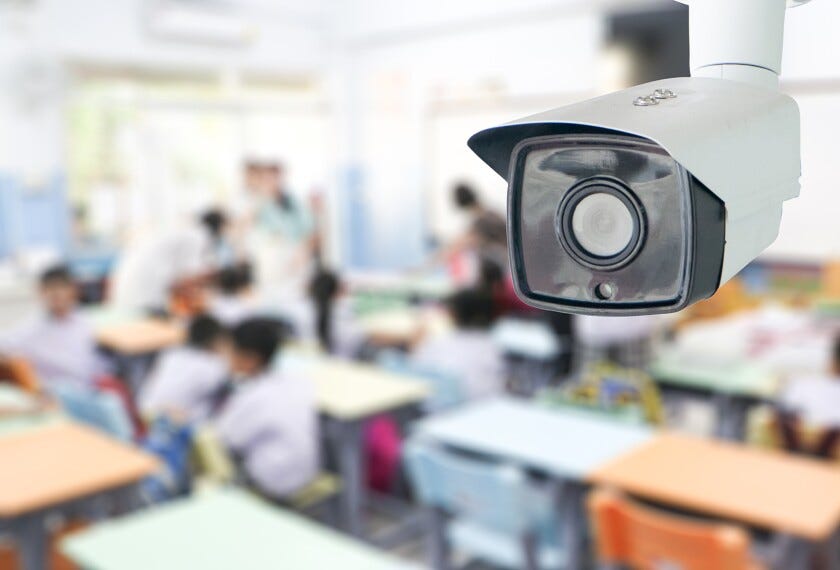
The second technology is Integrity Surveillance. These products have emerged as a direct response to AI-assisted cheating. Rather than assess writing after the fact, like AI detection tools attempt to do unreliably, these platforms require students to complete assignments inside the software. They log keystrokes, record pauses in workflow, and track browser activity. The student is being monitored at all times.
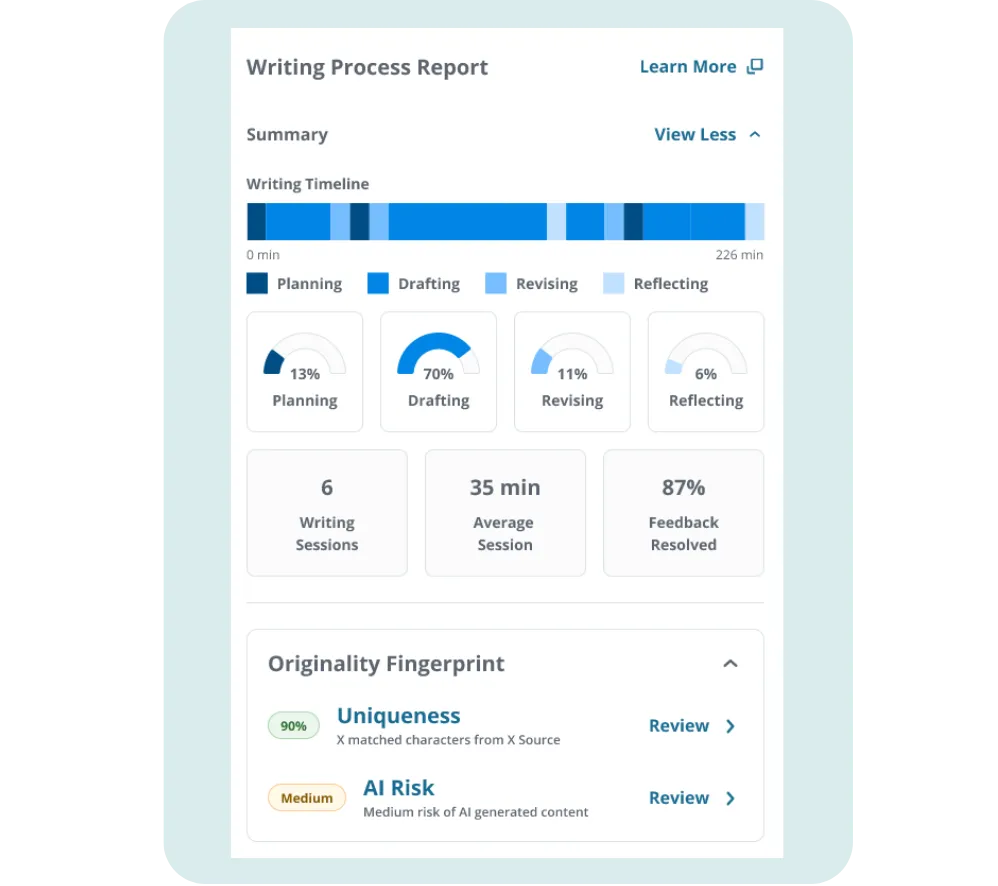
One such example is Packback, a platform that offers both students and instructors a range of features from research aids to grading assistance. But it also tracks how long students spent planning, drafting, refining, and reflecting on their writing. It produces a report that reveals how many writing sessions went into producing the work, how long each session was, and an “originality fingerprint” that estimates the likelihood that AI may have been used. Ironically, the platform itself is powered by AI.
In contrast to my own education, I can’t help but wonder how awful it must feel to try to learn anything from within a digital Panopticon. Surveillance stifles trust, but it also reduces education to a box-ticking exercise. When someone — when some-thing — is looking over one’s shoulder at all times, there’s no space left for curiosity, let alone the slower work of genuine inspiration.
Whether we monitor emotion, attention, or integrity, we can’t forget that the very choice to measure those things exacts a penalty on students. That data, faulty as it may be, is gathered through means that are extractive, invasive, and mistrusting. Any teacher can tell you that there is a hard limit on how much their students can learn — and how they feel about their learning — when they don’t trust that you trust them.
These two technologies look different on the surface because the first concerns itself with wellbeing and the second with honesty, but they’re both expressions of the same institutional reflex: the Marketplace Mirror’s response to the illegibility of genuine learning. Genuine understanding can’t be photographed. You can’t ask an instrument to capture something that can’t be measured. And when you try, you erase the dignity of learning.
This is explained by the philosopher C. Thi Nguyen’s idea of “Value Capture”. The basic premise is that when we attempt to capture an immeasurable complex value, like one’s passion for learning, we inadvertently reduce it to a simplistic and measurable proxy, like engagement. A passion for learning and mere engagement are not the same thing. When we begin to measure the proxy because the complex value is impossible to capture, we slowly start to optimize for the proxy instead.
In Nguyen’s framework, the surveillance technology that measures attention displaces the thing we actually care about: developing students’ genuine passion for learning. We can feel, intuitively and relationally, when our students are developing a passion for what they’re learning, but we can’t measure it.
Value Capture, to the person doing the surveillance, feels like achieving clarity. But that’s precisely what makes it dangerous. If we care about the fullness of educational experience, we have to accept that we won’t be able to measure everything, nor should we.
The strongest argument against surveillance in schools is not unreliability — though that’s real enough. It is what surveillance models. Our core objective as educators is not to ensure compliance toward an easily measured goal; it’s to assist in the formation of young people so that they may become trusting, caring, and capable members of a healthy society.
The philosopher Onora O’Neill draws a distinction between trust and control. Trust requires vulnerability and the acceptance of risk. She says, “Where we have guarantees of proofs, placing trust is redundant.” In other words, if a system uses watertight monitoring to ensure that someone performs perfectly, you aren’t actually trusting them; you’re just managing their compliance. Trust only exists where we give up control.
Surveillance produces compliance, not character. If we wish for someone to be trustworthy, we have to, as Emerson suggested, open up the space for trust to take root. A student completing an essay inside keystroke-monitoring software isn’t learning to be honest; they’re learning to perform honesty for the system. This is a different skill entirely, and it’s not one that schools should be teaching. A classroom that surveils its students teaches them that they are suspect, that their inner processes are a liability, and that the school’s relationship to them is adversarial.
O’Neill’s characterization of trust and control is amplified by Nguyen’s thesis. A student whose behaviour is optimized for an integrity score develops the capacity for score-management, not integrity. A student whose emotions are measured continuously develops performance awareness, not self-awareness. Ironically, surveillance produces convincing imitations of the qualities we hope young people develop while stifling their actual formation.
A camera or an algorithm can’t replace the relational — and immeasurable — knowledge that a teacher develops about a student over time, through repeated observation, exchange, and authentic care. As Barrett explains, trying to measure and analyze a student’s emotions actually displaces the opportunity to build relational trust that only occurs between people, not people and machines.
The Walled Garden’s answer to the illegibility of genuine learning isn’t surveillance, but redesigned conditions. Artifacts of Attention — handwritten drafts, annotated sources, and in-class work periods — don’t monitor students for compliance; they create the conditions under which authentic student engagement becomes more likely and more visible. A teacher who reads a student’s essay outline, subsequent drafts, and their final product doesn’t need a keystroke log to know whether thinking and growth occurred. They created the conditions that made thinking possible, and with it, genuine interest in the process.
There is a stark distinction to be made here: assessment that reveals process versus surveillance that monitors compliance. The first treats students as trustworthy learners. The second treats them as untrustworthy liabilities. Both can produce a document. Only one produces a student.
Consider what young people are inheriting:
According to the 2025 Edelman Trust Barometer, an annual global report, only 36% of people believe things will be better for the next generation. 61% believe that government and business make their lives harder and serve narrow interests. And 53% of 18-34 year-olds approve of hostile activism: “attacking people online, intentionally spreading disinformation, threatening or committing violence, damaging public or private property.”
According to a UN DESA Policy Brief from December of last year, “more than half of the world’s population reports little or no trust in their government.”
Young people in classrooms right now are forming their foundational sense of what institutions are, what they do, and whether they deserve engagement. They’re forming those opinions through their lived experience, not through civics lessons.
The good news is that schools, among institutions, are in a unique position. According to Edelman’s 2026 report, teachers are trusted by 70% of people, second only to scientists. Their 2023 report noted that 64% considered teachers “a unifying force”, higher than any other profession. If we do the math — eight hours a day, across twelve years — it’s clear that what schools model through their practices, rather than their stated values, shapes civic dispositions at scale.
The AMP State of Global Youth Report (2025) reinforces this claim: “the thread that runs through all of these is that the youth trust people they know or people that work directly with individuals far more than they trust systems, platforms, or any political structure.” This makes sense when we consider what we know about trust — that it’s built through relational experience: through fairness, by being heard, and through small acts of consistent care. This is what good teachers do.
Schools, and the professionals who work within them, need to remember that they aren’t passive mirrors of social conditions. Their design choices, the metrics they record, and the software they license are pedagogical and civic acts. Fashion assessment in a humane manner and watch trust grow. Outsource surveillance to an algorithm and watch it erode.
If we want students who will grow into citizens capable of trusting and being trusted, that capacity has to be practised somewhere. The surveillance classroom can’t produce it. The Walled Garden can.
If this piece resonated with you, please consider sharing it with the educators, administrators, and parents in your network. The question of what schools model — not just what they teach — deserves the widest possible audience. And if you’re not yet a subscriber, the Walled Garden grows through exactly this kind of conversation. Join us.
Interested in reading more?
Comments
Nothing yet. Say the first thing.
Sign in to join the conversation.