
Recently, a well-meaning Gen Z friend of mine made me feel old as shit when he innocently asked me, “What was Brooklyn like in the ‘00s?” He couldn’t believe I’d seen with my own two eyes all the things he’d read about on Pitchfork as a teen: Animal Collective, TV on the Radio, the Silent Barn, Dirty Projectors, Todd P., Death by Audio, Real Estate, Vivian Girls. “That was like, the golden age,” he told me. “It must have been incredible back then.”
It was. Every generation’s underground makes its own magic in response to the world it inhabits, and the one I experienced in my twenties serendipitously emerged at time when the still-fun internet made obscure music more accessible than ever, empty industrial space was still relatively cheap and plentiful, finance bros stayed in Manhattan as god intended, the 2008 financial crisis slowed gentrification’s roll just enough to keep the party going, phone cameras and surveillance tech had yet to fully erode everyone’s privacy, and social media and streaming hadn’t reduced all the world’s art into amorphous, context-free “vibes.”
That’s not to say it wasn’t also a profoundly flawed reflection of greater societal ills. The scene was mostly comprised of middle- and upper-class white kids, overwhelmingly male-driven, at times flagrantly sexist and racist, and inadvertently responsible for displacing untold numbers of low-income families from the once-sleepy neighborhoods they’d long called home.
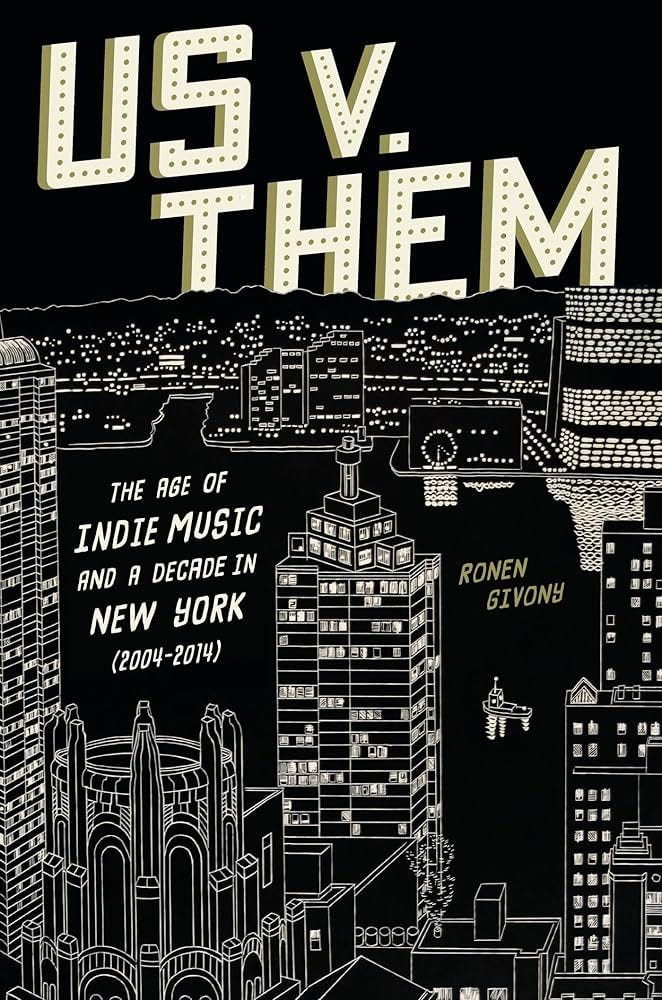
I wrote a chapter in This Must Be the Place about the DIY scene in and around Williamsburg, but so much amazing music emerged from the NYC indie ecosystem in the ‘00s and ‘10s, and its socioeconomic impact was so complex, that the era clearly demanded and deserved a book of its own. Thankfully, author and concert promoter Ronen Givony has given us just that in his insightful and incisive new book, Us v. Them - published by Abrams this week and presumably named for the song by that band from the Starlink commercial.
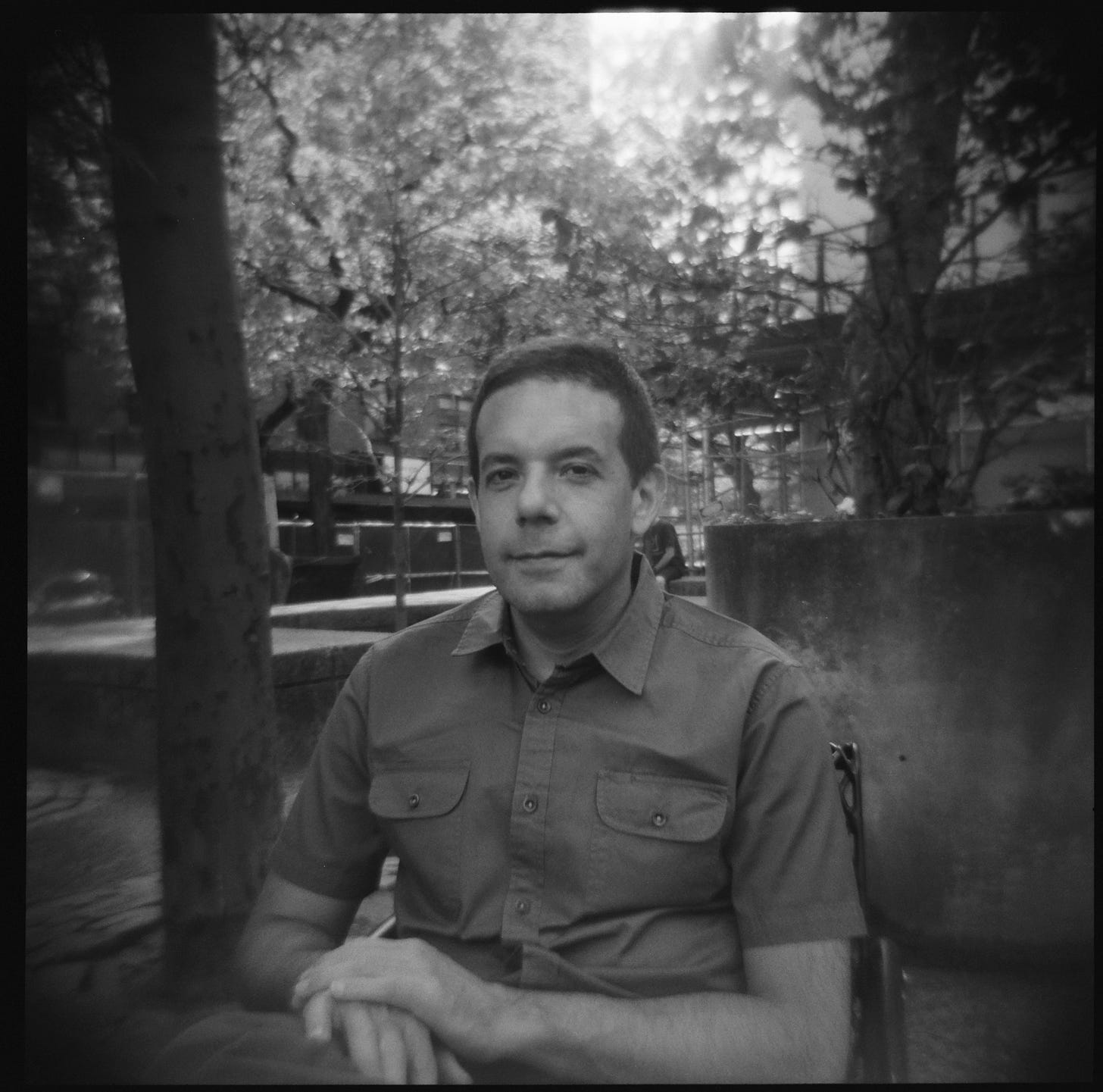
Ronen Givony. Photo by Jem Cohen.
Givony, who founded the indie-meets-classical Wordless Music concert series in 2006 and became a booker at Le Poisson Rouge when it opened two years later, approaches the narrative as both an insider and a fan. Rather than shine yet another spotlight on breakout acts like Vampire Weekend and Grizzly Bear, whose backstories are as bland as their records (shots fired), Givony instead focuses on the behind-the-scenes promoters and venue staff who made shit happen and brilliant artists like Parts & Labor and Gavilan Rayna Russom who never broke through to a mainstream audience. He doesn’t shy away from criticizing his subjects when deserved, and the whole story is presented within its larger historical, cultural, and geographic contexts.
Just ask this guy:
Givony and I spoke over Zoom last week.
What drew you to New York, and what were your initial experiences of finding the scene?
I moved to New York to avail myself as much as I could of the city. I got to Brooklyn in July 2004, which I believe was a week or two before BrooklynVegan went up and Bowery Presents did their very first shows at Webster Hall. At the time, my girlfriend and I would peruse concert listings, and most of the shows we went to see were at Mercury Lounge, Bowery Ballroom, Northsix - places like that.
One day there was a listing on BrooklynVegan for a show with the singer-songwriter Carla Bozulich and the band Amps for Christ at a place called Woodser on [141] South 5th in Williamsburg, which we had never heard of. We went there, and I think we circled the block five or six times just looking for this place, being like, Where’s the bouncer? Where’s the neon sign in the window? And it was somebody’s apartment. That was our introduction.
You would go to the Boat Bar on Smith Street and overhear people debating whether they should go see Animal Collective play at Mighty Robot, or they’d probably be playing again next week so you could see them then instead. It was that kind of thing. It’s no coincidence that just by seeing shows at Woodser and places like Glasslands and Zebulon, I thought, this seems to be something that people are doing, and I’m sure they know more than me, but maybe [I could do it] as well.
I started the Wordless Music series and orchestra, which is now in its 20th year. I call it a half-classical, half-indie/electronic series. It started out as a very DIY venture when I was working as a grant writer at the Chamber Music Society of Lincoln Center, and it was envisioned as a way to bring young people into classical music by presenting classical and chamber groups alongside bands like Explosions in the Sky, Do Make Say Think, Andrew Bird, and A Hawk and a Hacksaw. It grew into an orchestra that came together to play music by Johnny Greenwood of Radiohead and [contemporary classical composers] like Arvo Pärt and Gavin Bryars, and that now has happened in multiple cities and multiple countries.
Through that, I met David Handler and Justin Kantor, who went on to open Le Poisson Rouge [in 2008]. Along with Brice Rosenbloom, I was the booker for that place for the first 6 or 7 years it was open. During that time, I also worked for a couple of years at Nonesuch Records. I started out doing things that were in the process of rapidly becoming obsolete, such as liner notes and physical production, and I ended up working in a very, very minor A&R capacity with a handful of artists like Timo Andres, Tyondai Braxton, and Rhys Chatham.
How much of your music life was lived in Brooklyn versus Manhattan during that period?
For the first few years I lived here, I was probably not as aware of what was going on at the time in Brooklyn as a lot of other people were. What I’d do a lot was go see a concert uptown at 7:30 at Carnegie Hall or Lincoln Center, and then run and catch something at Mercury Lounge or Bell House. The DIY thing did take me a little while to get clued into, and it was a little bit more sub rosa at the time. By the time I found Glasslands and Death by Audio, those folks had already been doing their thing for a couple years.
Was there a turning point, both in your own experience and for the scene as a whole, where things decisively shifted away from Manhattan and to Brooklyn?
I’ve lived in Brooklyn for the last 22 years, and when people ask me where I’m from, I say Brooklyn [rather than] New York, but I’ve always had one foot in both worlds. Le Poisson Rouge is in the West Village, and I remember having a lot of conversations with Dave and Justin about what kind of club they wanted it to be, what they wanted to charge for tickets and drinks and such - this would be 2007-2008. My preference was always to go out in Brooklyn, where it was cheaper and mellower, and they would say, “We’re going to have a lot of Brooklyn artists, but we have to pay Manhattan rent, so it can’t be like the bar at Death by Audio” - which I totally get.
Similarly, most of my first Wordless Music shows were all in Manhattan, largely because those were just places I had access to. Andrew Bird played a little church called Good Shepherd Church on West 66th Street, and that just happened to be a place where a person I worked with gave me a phone number, and I could walk over, and it was easy for me to set up a DIY thing.
Because I lived in Carroll Gardens - I never lived in Williamsburg - I considered myself a Brooklyn resident and a Brooklyn partisan, but I didn’t feel ideological about it. The reason I put it that way is because, even at LPR when we were a few years in and had a pretty good reputation, there were certain bands that I would ask to play and offer them decent money, and they just didn’t want to do it. They were like, “If we’re going to play locally, it’s going to be for Edan [Wilbur at Death by Audio] or Todd [P.]. We love you, but we’re not in a big rush to play Manhattan.” That took me a minute to get my head around, but I see where they were coming from.
When did you get the idea for the book, and why did it feel like the right time to do it?
It came in two stages. Almost everyone I know read Meet Me in the Bathroom [by Lizzy Goodman] as soon as it came out. I read it covetously and devoured it because it’s such a delicious read. It wasn’t until maybe the second time I went through it that I realized that Brooklyn itself, just as a landmass, isn’t even mentioned until like, page 100. There’s more space given to the Killers or Kings of Leon than anything that happened around Kent Avenue. So I did feel this weird pang early on where I thought, she’s obviously writing about something different, her scene and her time and her experience. I’m younger, and I just wasn’t here for any of that, much to my chagrin. So that was my first sense that maybe there was material here that had not been covered.
When I sent out my book proposal, the vast majority [of people I sent it to] told me the same exact thing: “This book has already been written. It’s called Meet Me in the Bathroom.” That was discouraging, but I didn’t think it was right. The person that I ended up going with, a young agent named Leah Petrakis, the first thing she wrote to me was, “This is the book I’ve always wanted to read,” specifically about this scene.
My second book, which was about the ‘90s and fandom specifically through the lens of Pearl Jam, came out in the fall of 2020, and I wasn’t looking to start something new. But as the pandemic went on and live music receded from daily life, just for the sake of my sanity, I would sit down every day at my computer and write about whatever memories came to mind. I wrote about the time I saw the Boredoms play one afternoon, or the first couple of months at LPR. I did this every morning for four or five months.
After I had 120 pages or so, I thought, Let’s put this in some semblance of an order and see what the whole thing looks like. I started looking up dates and putting it into a timeline. It was only then, after six months of doing it, that it dawned on me that all of these events were clustering between 2004 and 2014. These were the 10 years where everything was happening in culture in Brooklyn.
My first thought was, these are the Bloomberg years. The Bloomberg years are known for this kind of Sarah Jessica Parker/Marc Jacobs/Magnolia Bakery version of the city. If you asked 100 people what the Bloomberg years were like, I don’t think a cultural utopia would be high up on the list.
I started kind of reading a little bit about this decade, which bridges the Bush years and the Obama years. It occurred to me that within the first month of my moving here in the middle of 2004, the Republican National Convention happened in New York. Just by chance, I was working at the time at a nonprofit on 7th Avenue and 27th Street, and I would take the F train to Herald Square and literally, to pass a certain street, you had to have a letter on letterhead allowing you to pass a certain point. That was my introduction to New York.
That whole time, and that election in the fall as much as anything, was the starting gun for this scene in my head. It was not only [a time for] young people moving to New York and taking advantage of the last gasp of affordability and converting industrial space into room to make art, it was also a dress rehearsal, in a way, for Donald Trump in 2016. For America to see the invasion of Iraq, the photos from Abu Ghraib, and four years of nothing but lies, and then want to double down on that, was the first or second real heartbreak of that era, and it colored a lot of what was to come.
I knew that that was where I wanted to start this book. And then 2014 was when three really important venues here in town closed within the space of a couple months.
Three venues in the same building!
Exactly. 285 Kent, Death by Audio, and Glasslands all being evicted, essentially because of Vice Media moving into their new headquarters. 2014 was also when, after 12 years in office, Michael Bloomberg stepped down and Bill de Blasio took over. It was also the year that Eric Garner was murdered in Staten Island and Michael Brown in Ferguson. There were a lot of things going on, both in the city and in the country, that I felt encapsulated these 10 years and made it an interesting backdrop to talk about what was happening musically.
Did you have any reservations about inserting your own memories into the narrative?
It was always very important to me to make this book not about me, but about other people. When I open up a magazine or a book review or something, and the first word I see is “I,” I get bummed out. But I myself am a concert promoter and producer [who was working at that time], so I know a little bit about what it takes for someone like Brooke Baxter or Rolyn Hu [both at Glasslands] or Edan Wilbur to commit their lives to it on a non-capitalistic basis. I tried to make the vast majority of the book about other people, smuggle in a little bit about myself and move on as quickly as possible.
When people ask me what Wordless Music is, I usually say it’s like a DIY, punk rock orchestra. But it’s true that, for better or worse, we have never had nonprofit status. We’ve never had a board, we’ve never applied for grants. I never wanted to be in a situation like a lot of my colleagues in Europe, where if they don’t get funding for one year, they can’t do it. Being a DIY person in New York, to me, meant you have to keep things lean and affordable and be nimble. You have to look after your artists and audience, and not just have an eye on kicking everyone out at 10:01 pm. That’s part of what I think is missing a little bit, at least at the moment.
I wouldn’t say that there isn’t underground DIY activity in New York. If you look at any weekly issue of Dada Strain, you’re spoiled for choice. I think the difference is more on the ground and on the institutional and venue level, where it seems like there are slightly fewer places where world class musicianship happens on a very artist-friendly, not totally commercial way. That was what I wanted to pay homage to.
I’m curious how you chose the artists that you highlight in the book, because they aren’t necessarily the biggest names from that era or the most intuitive choices. Like, I was surprised by how little Sufjan Stevens showed up compared to, say, Dragons of Zynth.
This book could have very easily been ten white indie rock bands, and I don’t think anyone is well served by that. One big difference between Brooklyn and Manhattan is that, for better or worse, in Manhattan, almost everyone agreed on who the big names were. Everyone agreed that it was the Strokes and Interpol and maybe the Walkmen and folks like that. In Brooklyn, if you asked ten different people to name their five favorite artists, you’d probably get a list of around 30 to 35 names. I think that that speaks to the breadth of what was going on, from Americana to math rock to electronic music to ambient to classical to weird jazz.
A charge that is leveled often about [the] Brooklyn/Williamsburg [scene] is that it was white, male, and straight, and there’s a lot to be said for that argument. But that also leaves out a lot of people who were part of this, and I wanted to write about them as well. It would have been easy to write a book with all the usual suspects and make it about Grizzly Bear and the Dirty Projectors. I think that that book should still be written, because that’s a book a lot of people would like to read, myself included. A band like Sea Ray is not as well known, but to me [they’re] a lot more representative of what it was like to be a band at that time than, say, the National, with whom they played many times.
For a lot of people who were not there, and even plenty of people who were, there’s this idea that everything was taking place in Williamsburg. I think you make a really good case for that not being true.
Williamsburg was the nucleus of that, but to me, those years were just as much about Southpaw [in Park Slope] and Magnetic Field [in Brooklyn Heights] and Brooklyn Masonic Temple [in Fort Greene]. Part of the fun of being a concert promoter, especially as a New York transplant, was walking down the street and seeing a cool, old church, and it was almost a challenge to find out who booked it. There was always a new stone to turn. So it really was about a lot more than Williamsburg. But at the same time, you go now to where Death by Audio and Glasslands and 285 Kent were, and it’s there that it’s most hammered home how [things have changed]. You walk around there and you’re like, I swear there used to be something different here.
I’m sure that if I had lived in Williamsburg or Greenpoint, it would have probably been a different book. But to me, I always kind of came home to this semi-conservative part of Carroll Gardens. In my neighborhood, I walk down the street and I’m one of the more casually dressed people, but then I’ll go take the L train to the Jefferson stop, and I look like a Republican. It’s a different world, and that’s just a funny quirk of where I ended up with an apartment. But I think that Williamsburg gets overused a little bit as a kind of synecdoche for this moment.
Were there people you wanted to talk to for the book that you ended up having to write around because they said no?
I thought when I started reaching out to bands or music industry people, that because Meet Me in the Bathroom had not covered a lot of this, people would want to get the story straight. There were a surprising number of people I reached out to who, partly because of that book, maybe for other reasons too, respectfully declined. A couple of them you’ll find in the introduction, where I mentioned that another version of this book might have included these people.
You can write about an artist without interviewing them, but I thought I might as well do with people I have access to. At the same time, there’s a lot of weirdly bad feelings about this era. I think you captured a bit of it in your own book, where there are people who feel like they didn’t get the credit that they’re owed, and they’re right. But it was a lot more fraught than I would have guessed. That told me that people really cared deeply about what happened, but more to the point, that it was important just to cast as wide a net as I could and know that not everyone was going to say yes. I wanted to at least try to make it not only the women who started Glass House and Glasslands, but to talk to a bartender or a security guard or to the bands that played there.
To me, a lot of those people were quite heroic. Noemie Lafrance, she’s not a person who would ever describe herself in these terms, but you listen to her talk about the kind of naivete and romance [she had] where it was never a possibility to her that she wasn’t going to do a dance piece at McCarren Pool. It’s only because of her that hundreds of thousands of people had these experiences and the scene came together how it did. There’s a lot of people like her, and at a minimum I think [we can try to] do right by them and set the record straight about who was responsible for these things coming together.
What do you see happening in the city now, and where do you think things are going?
I take a lot of comfort every week when I open up Dada Strain and Steve Smith’s newsletter, and there seem to be a lot of venues and bookers and really cool artists. Where I get bummed out a little bit is that I get something like six or seven different newsletters about listings in New York, and I always think to myself that in a just world, these people would be paid a decent salary under the umbrella of one place, instead of this kind of atomized thing. I’d like to think I’m about as motivated as it gets to have my finger on the pulse of what’s happening in town, and yet you can’t really do it.
I remember getting a newsletter a week or two ago [that mentioned] a performance of Julius Eastman’s “Femenine” happening at somewhere in Manhattan; I instantly went to buy tickets and saw that it was already sold out. At first it was a bummer, like maybe I could have seen this listing weeks ago and planned properly. But if New York is still the kind of place where there’s a random performance of Julius Eastman and there’s 150 weirdos who bought tickets ahead of you, we’re doing just fine.
I trust that, me being 47, I just wouldn’t know about things happening the same way I would if I were younger. But I see enough of it to know that you don’t bet against New York, and you don’t have to worry about this stuff going anywhere. I wish that the people who were behind the people on stage had a little bit more of a hand with this, because it does seem like there’s a lot of people working, endlessly and exhaustingly, and I don’t know that they’re even breaking even doing it. They’re doing it for the love of it, but I don’t know that that can go on forever. That’s part of what this book is about.
This interview has been lightly edited for clarity, brevity, and context.
Buy Us v Them here
Follow Ronen on Substack and Instagram
Buy a signed copy of my book This Must Be the Place here
Book a walking tour here
And of course, if you haven’t already…
Comments
Nothing yet. Say the first thing.
Sign in to join the conversation.