
This is the third part of a series of posts on food and life. This part takes us to 1984. Links to the two previous posts can be found at the end.
Home and comfort go together. I suppose that’s where the idea of comfort food comes from: meals that sustain, nourish and comfort you, that give you that sense of belonging somewhere, of familiarity and love. Hearty breakfasts full of calories and comfort. Hot, tasty suppers that encourage you to linger at the table, share your day and set down your burden. Moving into my first home - one that I actually owned - brought about a change in how I cooked: a shift towards comfort. And that owed much to occasions early on where I was trying to create a small island of comfort for those navigating the choppy waters of hardship.
It had been arranged by the fireman who lived across the road from me. He was organising places for the men to stay while they were in Coventry. I said I could take three - four at a pinch - so he’d dropped off a couple of lilos the day before. Mine was a standard two up, two down. Front door led straight into a small front room, and another door led from there into a back room with a kitchen that led straight off from that.
It was only when the strike started that I realised Coventry actually had a mine. Located in Keresley, a village just to the north of the city, the colliery employed around 1,200 miners. Unusually for mines in the Midlands, support for the strike was solid and the village of around 700 houses - all built by the Coal Board - had organised themselves effectively to withstand the privations of a long, drawn out dispute. But it was far longer and far more bitter than the miners and their families had expected.
To keep the mine working, the Coal Board bussed in strike breakers from the East Midlands, and brought police up from London to get them through the picket line. The men from the Met were clearly given free rein in using whatever violence they wished. That was why pickets were coming from other coalfields to support the Coventry mineworkers. There was no shortage of support from the city itself, with regular collections helping to support the families at Keresley, and folk opening up their homes to welcome the so-called ‘flying’ pickets.
They didn’t actually fly, they came in vans, although flying would probably have been easier. Police set up roadblocks, especially on the M1, which ran between the rock solid striking coalfields of South Yorkshire, and the largely non-striking coalfields of Nottinghamshire. Any vehicle of working age men had to prove they weren’t miners to avoid being turned back, arrested, or having their vehicle impounded.
When the knock at my door came, I knew who it would be. I opened it to see four burly men, one of whom introduced the group.
“Hello, you must be Mike. We’re your flying pickets.”
Hands were shaken, bags dumped in the front room, I led them through into the back and put the kettle on. The men worked at Hatfield Main Colliery, just to the north of Doncaster, and over the days they stayed with me were easy company. I took on the role of their cook. Full English at 5.00 am before the van came to collect them for their picket duties. A couple of mornings they came back early having been beaten by the bobbies. But otherwise they were out until late afternoon, when I had their tea ready for them.
The men were always complimentary about my cooking. After their first meal, one of them grinned and said, “Proper tasty, that. Mind if we call you Ken?” I asked why, and he laughed. “You know, Kenwood—like the food mixers.” For the next four days, they all called me Ken.
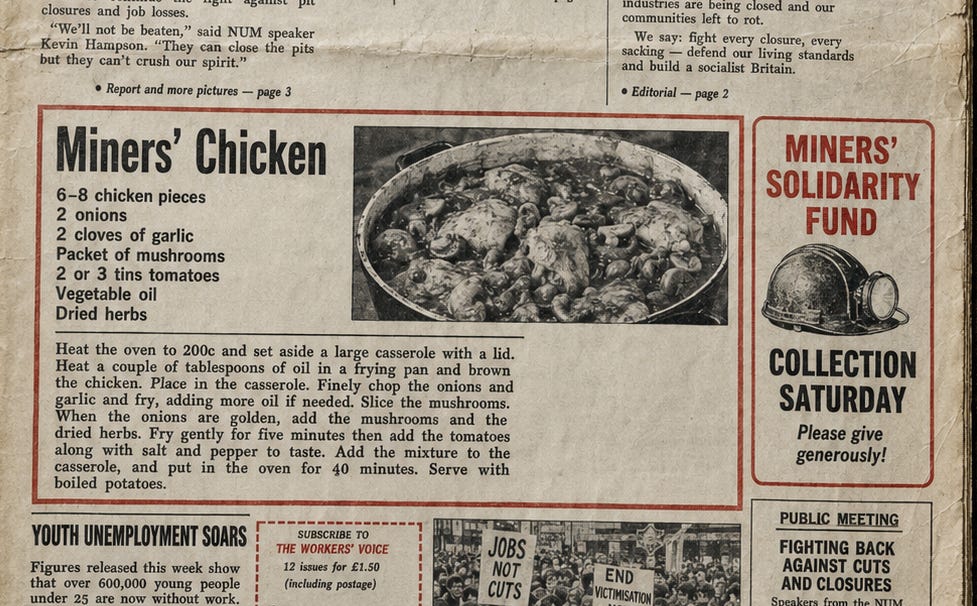
I’d never really done casseroles before. Stir frys, the odd stew, curries galore, but hot, steaming, filling casseroles were not really my thing. This chicken casserole was what I cooked for them on the first night, and variations on this theme continued throughout the week.
One night, after the others had turned in, the youngest of the group stayed up with me. Over cups of tea, it all spilled out. He had two young kids at home, no money, and a wife on the verge of breaking under the pressure. He was desperate to go back to work. “Don’t tell them,” he begged, his voice barely above a whisper. “For fuck’s sake, don’t tell them. They’d fucking kill me.” He laughed after he said it, but we both knew the truth: if he went back, he’d be branded a scab. Solidarity would flip to hatred in an instant, and his family would be shunned by the very community they depended on.
Throughout the coalfields of Britain, families were struggling. Gas and electric were being turned off. Bailiffs came for TVs. Some miners were forced back to work, not because they wanted to, but because their cupboards were empty. Horrible divisions were opening up in mining communities. The fight was slipping away, and everyone knew it.
A few weeks later, another knock at the door, and three men greeted me. They were from Tredegar, South Wales: two men in their forties, who were brothers, and the nineteen year old son of the older man. Tredegar has a history, and a reputation. It is the birthplace of both its former MP Aneurin Bevan, who created the NHS, and of Neil Kinnock who at the time was Leader of the Labour Party. His predecessor as leader was Michael Foot, who was the current MP for Tredegar. It was a town that appeared to make and attract people of vision, passion, wit and humanity.
Those were qualities also evident in the three men who shared our house for a week in 1984. Again, I’d cook and we’d talk late into the night about the strike, and about the future, about hopes and dreams. Some evenings, we’d head down to the local: the Freemason’s Arms. One night, the landlord declared a lock-in with free drinks on the house. There must have been twenty of the Welsh miners there, packed into the pub. At one point, they all huddled together, whispering. Then, they began to sing.
So, there’s something else about Tredegar, something else about its reputation. The town was also known for the Tredegar Orpheus Male Voice Choir, and most of the members of the choir dug coal for a living.
It started low and soft, a harmony so deep it seemed to vibrate through the building itself. And then it grew, swelling into something quite extraordinary. Their voices lifted as one. It was more than music, very much more. This was solidarity you could hear. This was comfort created as harmony. They sang not just for themselves but for each other, for their families back home, and for everyone who was with them. Even the pub dog started crying.
My time in North London had introduced me to cooking, and how I could use it to find my place in a community, in a household. In Amsterdam food became a map to help me understand the world better, and cooking as a means of beginning to explore it. In Coventry I was more conscious of food’s capacity to provide comfort, to welcome strangers, to give them a sense of home and hope. But I was also becoming aware that cooking was becoming a part of my identity. Although I’d not go as far as Ryan Gosling in saying “I’m just Ken”.
But I felt that there may be life as a cook that was beyond our Ken. The nineties lay ahead, and in many ways things could only get better.
So what does food mean to you? Are there memorable events in your life associated with food and cooking? What food do you associate with comfort? Please feel free to share your thoughts in the comments.
No posts
Comments
Nothing yet. Say the first thing.
Sign in to join the conversation.