
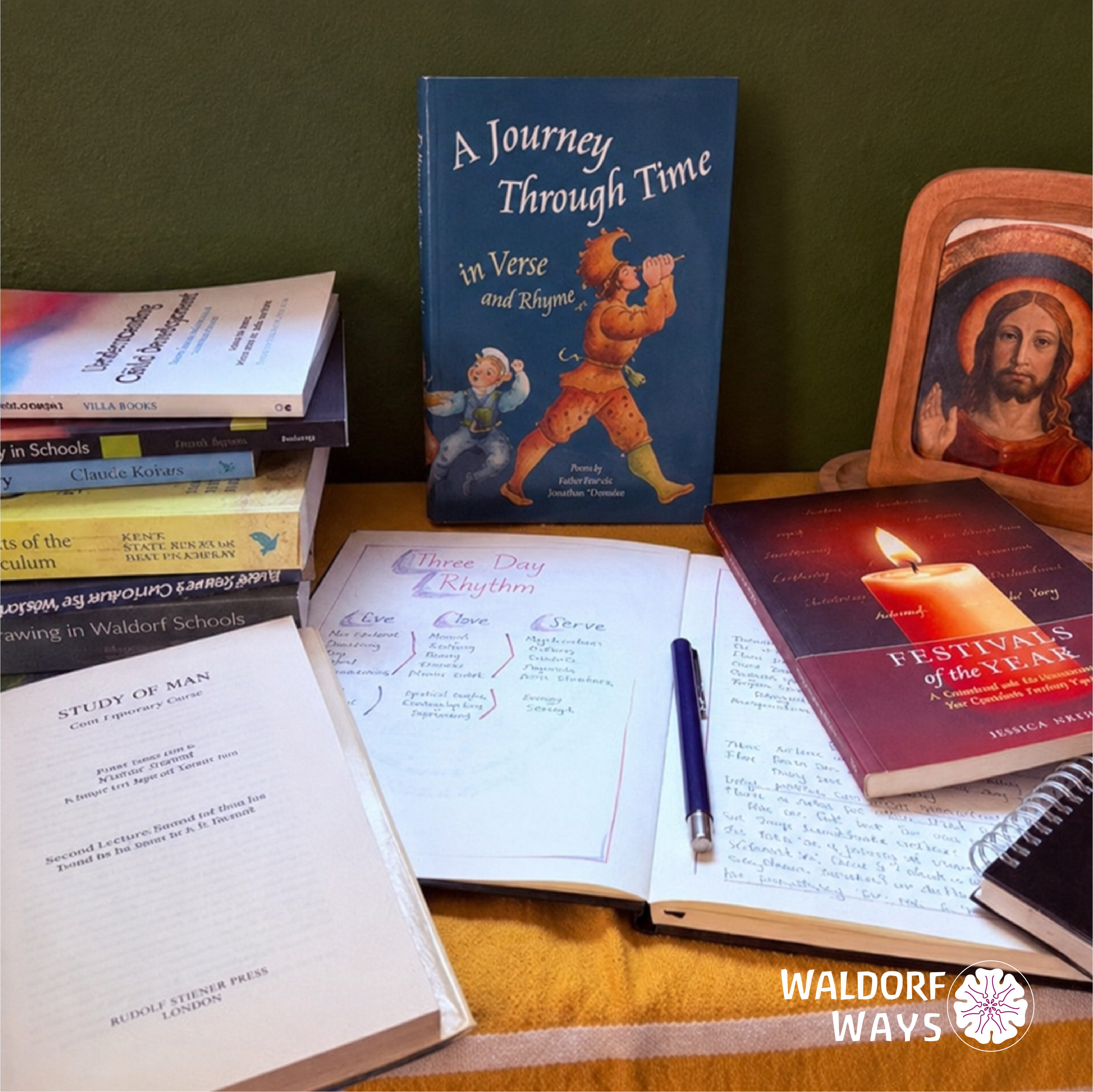
My own preparation materials from this week.
I do love preparing, but August can all too easily become a race, extending myself well beyond what I need to do.
The love of being ready and prepared can sometimes bog me down in the small details that eventually hold me back. I know, ridiculously, every year I dream of finding the perfect planner that will hold all the things I need to do and remember, and that will give me peace of mind. After a few weeks of endlessly looking, I never find it, I just dive in and start.
Through the summer I have worked with enthusiasm on the practical things that need doing and once they are done, I have to delve into the lessons and preparing myself. The painting of the classroom, the curtains, sanding desks, ordering and packing away materials are the simple things really. Once they are done, I need to start preparing the blocks and the lessons, but to be fair those have been forming since I started the physical work. My mind looks ahead and starts thinking of stories and ideas and structures etc.
As much as I love preparation, it’s that moment when I sit down at my desk and am faced with the blank page I dread. It’s silly really as my head is filled with ideas and inspiration.
Then the lists begin, the page fills quickly with all the things I can think to do to get ready. The more I write down, the more things I think of. It’s a start for me to see the whole lot and then stop and reassess. I put the long list aside and start simple, not grand plans filled with details but just the order of the blocks. And I’m off.
Then I’m in my happy place, sorting, sifting, reading, drawing, collecting, building the year ahead. I love this part of the work as, although it can be daunting, it’s really all about hope for me. It’s all about possibilities and opportunities that lie ahead.
I have been known to sit in my prepared classroom and just quietly imagine the year ahead, filling the room with children and the lessons I might bring to them. My desk is piled with books covering lesson content, grammar, maths, crafts, festivals etc, all the things that I will need to know for the upcoming year. I read and think and imagine, then read again and draw or plan. Slowly things begin to coalesce and the year starts taking on a structure and form.
At this point I need to be very conscious of my progress as, if not, I end up following the to-do list and things start to become a rush. Every item ticked off gives me another task to add and then suddenly I have to do a million things in not enough time. The tendency to rush is real and can become consuming. I work hard to avoid this as the rush, in my experience, gets you nowhere you want to be. A completed list is not adequate preparation and often leaves you with something lacking or missing.
I consciously carry the sword to cut that list monster’s head. I have learned over the years that preparation can look different each year. But the core thing for me is understanding what enough preparation is.
For me the easy preparation is the things that are simply completed, like the ordering of books, arranging the desks, ordering paints etc. These all don’t need more than doing and then you’re done. Even sketching out the year of blocks is easily done or completing the list of grammar or maths outcomes you have to cover in the year ahead. These are easy.
Some things take time, need more, have to live with us before they get anywhere. A block may need more consideration after a preliminary outline. It may need reading several stories, checking historical information. These things need to live in you for a while before you try to turn them into a fixed lesson or detailed plan. The main lesson morning rhythm time can have a preliminary plan but it can’t really be locked down until you have the children start doing it, to identify weaknesses and strengths and make adjustments. A story needs to be reread several times so that you know it inside out, so that you can find the right way to tell it to your class.
Some things need time to mature in us, to develop, to become really living in our own beings before we commit them.
When I have worked for a period of time reading, researching, taking notes and planning something, I deliberately walk away from it. I go and walk the dogs, do some gardening, make bread, anything to literally break away from the head work. I do this because what I have learned needs to settle in me, find a place to rest, so to say. I don’t rush to turn it into a plan, I leave it. A long walk in nature is excellent as it really allows this transformation to happen in me. It’s NOT a break from preparation, it’s a vital part of it. It is, in my opinion, a required part of the process.
I think it’s important to name the magnitude of what we are doing in August. We are forming the overall shape of roughly 36 weeks of teaching and this is a huge task. This being said, I can very easily fall again into the trap that I need detailed planning for every element of the upcoming year, that this will give me security and confidence in all I do. But these over-prepared plans can become a noose around your neck. The imagined security becomes a list of criteria I must meet and so all that security simply transforms into stress. I am also easily drawn to over-planning when I feel less confident about a block or section of the curriculum and feel that when I get very detailed planning done, I will find confidence. This exposes a real dilemma for me, where my experience can be cast aside and I feel I have to be absolutely prepared so I have control of what is coming.
Experience has taught me so much about preparation, most importantly that it can change dramatically from year to year depending on the curriculum, the age of the class and my own strengths and weaknesses.
What really comes to the fore for me when I plan is experience, it is so important. It’s taught me about myself as a teacher, how I can work most effectively and exactly what I need my preparation to do. As a new young teacher, I had nothing to fall back on, training can’t give you experience. That new teacher me, filled with ideas and plans, fell short more often than not, and thankfully so. It humbled me and it made me learn about who I was as a teacher.
That experience now guides my planning: which lessons need more concrete plans and which can be freer and more open. So, some blocks I will plan daily and others I will build the shape of the block but not concentrate so much on everyday prep. That comes the night before.
The most wonderful thing experience has taught me was that with all the prep you do, sometimes the best and most wondrous ideas happen in the moment while you are teaching. All that preparation, research and additional reading all sit waiting for that moment when it sparks into life and you use it there and then in the moment. This does not happen daily at all, but it happens often enough for me to be ready for it.
What is preparation really for? Not for the school records or inspectors, but for the teacher!
It’s most definitely not, in my experience, about being able to control what will happen but the opposite: it makes me ready to meet what happens in the classroom. Preparation includes everything that needs to be done before the first day of the block, from practical things through to the deep inner work. It gives us a solid understanding of what we are about to teach and grounds us in that knowledge and, most importantly, it means we start grounded and present and not secretly frantic about what we are about to do.
That preparation allows us to be ready and yet still allows space for the children, as they really are my guides in many ways. When we have all the preparation done, we have confidence and the capacity to be free with the material. When underprepared, we don’t have the confidence, so we can’t leave space for the children to give us the lead, we rely on our plans only.
So that’s me, someone who makes the lists but also lets go of them. I make sure the room is just right, the materials all sorted, paints ready but I also let go of the tightness and live into the preparation in a much looser way. I still do the work, but I don’t try to capture it word for word in plans, I let it live in me, it needs time to settle, mature and spring forth when needed.
It comes down to learning over the years that it’s ok to let something not be resolved, not listed, not planned in detail. Trust in the process and the very act of what it means to be a Waldorf teacher: we are not just working with information and plans, we are working deeply in ourselves, with the angels, with sleep, with meditation so that ALL these things coalesce into what and who we are when we stand in front of our class on the first day of a block.
August is not about being ready for every eventuality, but about being ready for what arises after all the preparation and inner work.
No posts
Comments
Nothing yet. Say the first thing.
Sign in to join the conversation.