
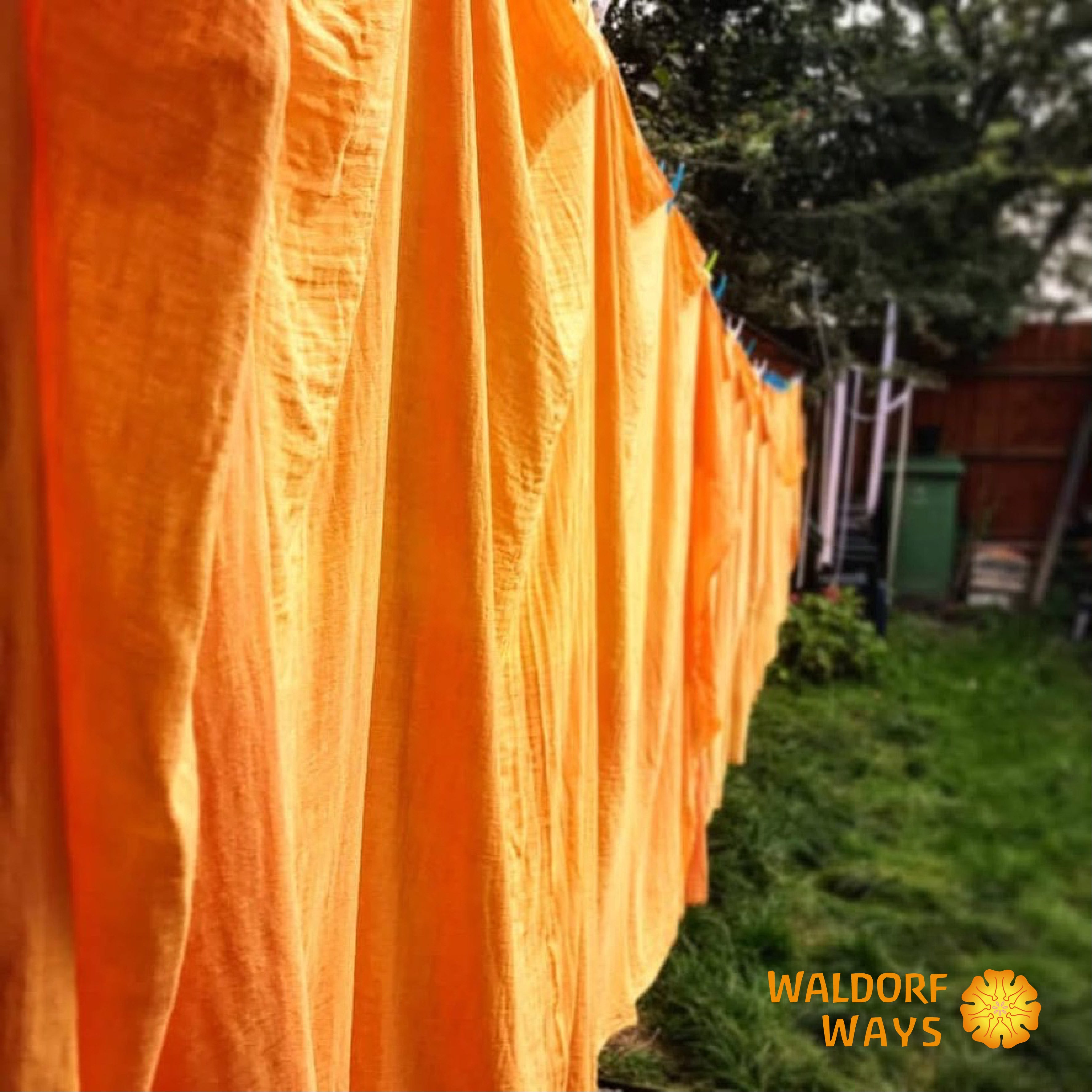
I march out into the summer sun, arms laden with metres of wet, freshly dyed muslin. I take the time to hang each piece so it can dry in the warm breeze. I watch the fabric drying and make sure the colour is what I wanted for the year: a warm radiant orange or a soft welcoming pink. Each year has a colour and I try to build this into all I do in preparing the classroom.
And then there are the noisier, messier tasks, like being outside in the sun with a sander, dust everywhere and the sun burning my neck as I start on yet another desk. Once they are all sanded, I dust them off and carry them back into the classroom, ready for a coat of varnish to protect them for another year.
Like so many of my summers over the years, I have spent many hours, days and weeks preparing for September. Some of these jobs are wonderful and enjoyable, some more practical, but all need doing and all have their place in my preparation for the coming year. These practical tasks need doing just as much as the lesson preparation. August is a very busy month.
Getting the classroom, the actual physical space, ready is as important as preparing the lessons. The classroom will hold the class for the year and needs to be ready to receive them, to hold them, to nurture them quietly and to be a safe and calming space.
This summertime task of preparing the classroom has been there for me right from the start. I took my time preparing my very first classroom so many years ago, learning how to do things like change the colour of the paper ball light fittings by bleaching them in the sun and then gently dabbing on watercolour with a sea sponge, building up subtle layers of colour.
These things have always been important to me because I have always known that it is not just the lessons I teach that matter, but also the classroom the children inhabit for the year. It must have an atmosphere that is suitable for learning. Children notice everything, although they do not always acknowledge it in words. They know when a teacher cares for the room, when things have been thought through and placed carefully. There is a different quality in a space when the teacher is orderly, not necessarily fastidious, compared with a classroom that feels neglected and uncared for. Over the years, I have noticed the difference when I enter a classroom that is cared for and one that is not, and there is definitely a subtle effect on the children and their learning. The classroom is as much a part of the children’s education as the lessons they receive.
Creating beauty in the classroom is a skill I have learned over many years and I have seen that there is a huge difference between a beautiful classroom and a decorated classroom. A classroom may contain all the “standard” Waldorf things, like wooden desks, a nature table and Waldorf prints, and yet still have an emptiness about it. With the plethora of monetised Waldorf things now available, I have seen classrooms filled with stuff that still lack the warmth and presence I strive for each year. I have realised that outward appearance alone does not create the beauty I am looking for. There is a vast difference between a classroom that copies the familiar Waldorf aesthetic and one where the teacher has invested time and effort into preparing the room the children will enter in September.
For me, the purpose is not simply to make the classroom look Waldorf. It is a deeper objective, one I carry inwardly as I consider everything I do: does the classroom support the life of the class and what I plan to do this year? It is not about filling the room with things because they are Waldorf or beautiful, or overworking everything to achieve some perfect idea. It is about doing what you know the class needs to be surrounded by, both practically and aesthetically.
So how do we create beauty in the classroom? What is it that actually creates the environment we need?
Well, I’d say first and most importantly that it is not about perfection. It is about trying to get it right and accepting that a little rough is okay. It is also not about expense. I have never really had a budget for preparing my classroom each year, so much of what I have done has come from my own pocket. Being thrifty and clever about how I achieve things has therefore been a great advantage. How do I get as close as I can to what I want within the constraints? This has also been a blessing in disguise, as I think that if I had had a large budget, I might easily have ended up with overkill.
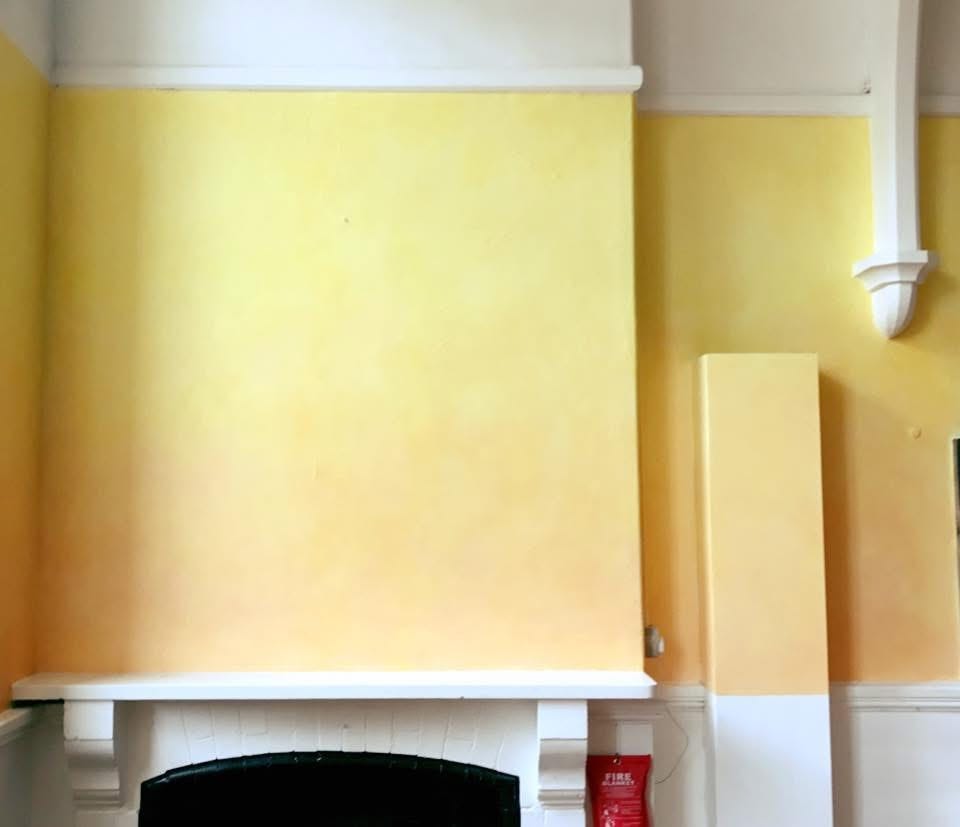
There are many things that, although time-consuming, can make the greatest difference. I always begin with a fresh coat of paint. For me, this lifts the space and gives it a sense of something new, a fresh start. Colour on the walls has always been important to me and if I am not moving to a different classroom, I have to recolour the room. I have followed the colour suggestions at the back of the Stockmeyer Curriculum book. They are suggestions rather than rules, but I have a strong connection to them and they have always been my starting point.
A new colour has always meant painting the walls white first and then applying the colour. I have had no training in lazure painting and have simply muddled through over the years, gradually becoming better at adding colour to the walls. Some colours, such as red, are much easier to apply evenly, while blue requires patience and dedication. From there, I look at the window coverings, taking the muslin curtains down, bleaching them and redyeing them at home in the washing machine.
Then there are all the practical things: the classroom layout and the arrangement of supplies such as main lesson books, paints and paper. It is important to think all these small things through carefully. Does the blackboard need sanding and repainting? Where will the nature table be this year and how large or small should it be for the age of the children? Is there a class sign on the door? Does it need redoing or is there already one that can be used? What images are appropriate for the walls, depending on the class and the age of the children? Do I want to add something whimsical for the year?
One year, I dragged in a large dried branch, wired it to the ceiling and hung it over the centre of the classroom. I then spent many hours cutting leaves from coffee filters, painting each one and glueing on a piece of wire so they could be attached to the branch. There were autumn leaves, spring leaves and blossom and summer leaves. It was a great deal of work, but I did it happily and willingly.
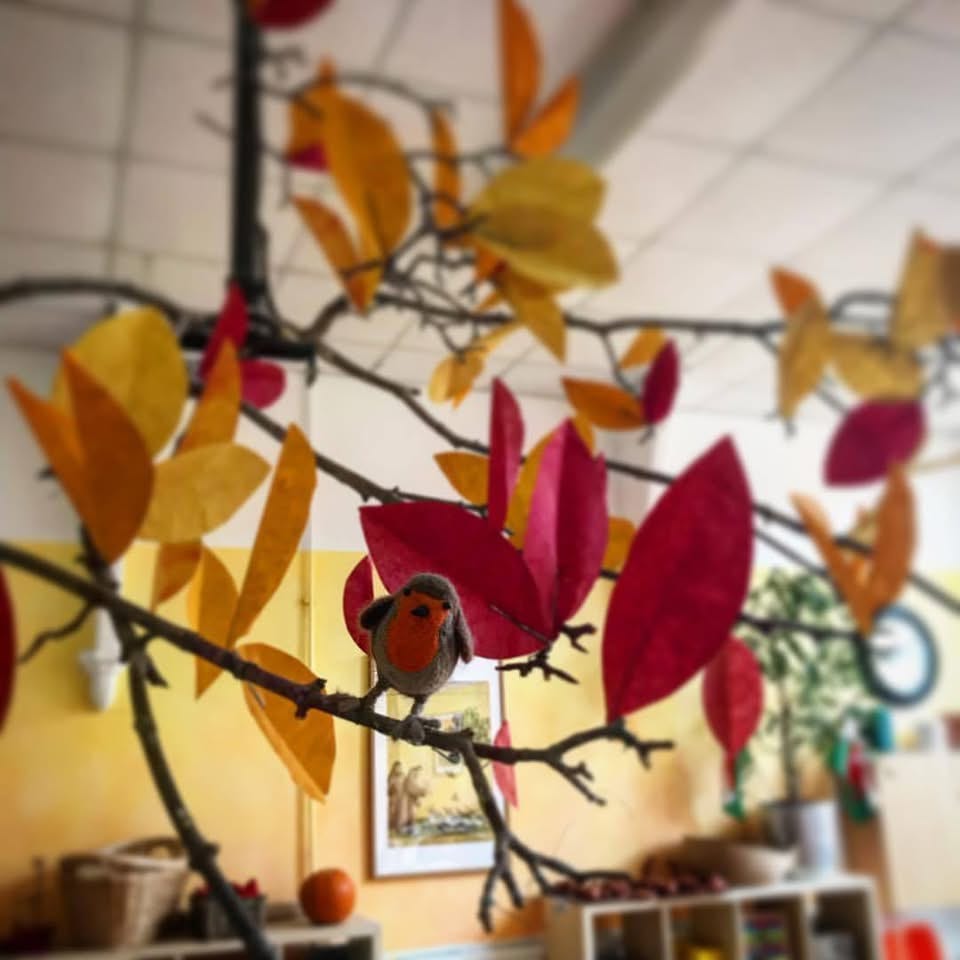
I don’t attempt large things like this very often, but every now and then an idea comes into my mind and I follow it.
The classroom should be a usable, practical space that enables learning and adapts to your needs for the year. Remember that, first and foremost, it is a classroom, a place for learning. It is not a display to impress children, parents or colleagues. It is your space and it needs to work for you and your class for educational purposes.
Then the artistic element comes in. I can’t say this strongly enough: no teacher needs to be an artist. When we do our blackboard drawings, it is not a competition or a comparison. It is you doing your work and striving to achieve your best, and that is more important for the children to see than a perfect drawing on the board. So do your board to the best of your ability and in a way that suits you, rather than trying to copy something you saw on the internet.
Your artistic presence is throughout the room: in the wall painting, the layout of the classroom, the choice of images and the arrangement of the seasonal table. Each of these reflects something of you and that has importance in the classroom. The children see it and although they may not say anything, it works upon them.
Never underestimate the importance of your class seeing you strive or even fail a little. Take the blackboard, for example. I have done some great drawings that I am very proud of and others that have been a total flop, and that is okay. I have done drawings and the children have let me know that they were not my best. But they see me strive, sometimes rub something out and try again, learning from my mistakes. Sometimes I am not happy with a drawing, but they are. So have the courage to draw in front of them. Chalkboard drawings do not have to be perfect things completed away from the children. Our artistic endeavours carry something of our relationship with the children, the subject we are teaching and ourselves, so be open and free in the classroom.

I have heard of teachers spending days perfecting a drawing on the board outside class, teachers who get others to do their drawings and some who simply buy posters or images to hang up for the class. For me, all of these approaches fail to recognise something essential about the purpose of chalkboard drawing.
Preparing a beautiful classroom is not merely an exercise in making it pretty. It goes much deeper. It is about putting yourself into the classroom. Every brushstroke, every placement of furniture, every curtain and every candle represents your active involvement in preparing the space. Most importantly, it is not for you. It is for the children.
For me, it shows as much respect for the children as preparing a good lesson. It is not about how many hours you have put into the work or having your contribution acknowledged. It is about really connecting with the space on behalf of the children so that they are surrounded by what they need and, hopefully, by something beautiful.
The children may never know how much time or effort you put into creating their environment, how many layers of watercolour are on the walls or how many times you had to redye the curtains to get the shade right. But what they do know when they walk into that classroom is that it is for them, filled with care, compassion and love. They walk in and live into the atmosphere you have created for them. And without saying it, they appreciate it.
When it is all done, on the night before they return, the walls are coloured, the curtains hung, the floors clean, the desks placed with name tags and fresh flowers on the seasonal table and my desk. It is peaceful and ready. It is a new room, full of potential. It is not even empty because the children have been the driving force behind all of this, so they are already there in spirit. The classroom is ready, the children are ready and I am ready.
Beauty in a classroom is not an added extra; it is part of the fabric of the classroom. It is one of the many ways in which we tell the children that both they and the year they are about to share with us are worthy of care.
No posts
Comments
Nothing yet. Say the first thing.
Sign in to join the conversation.