
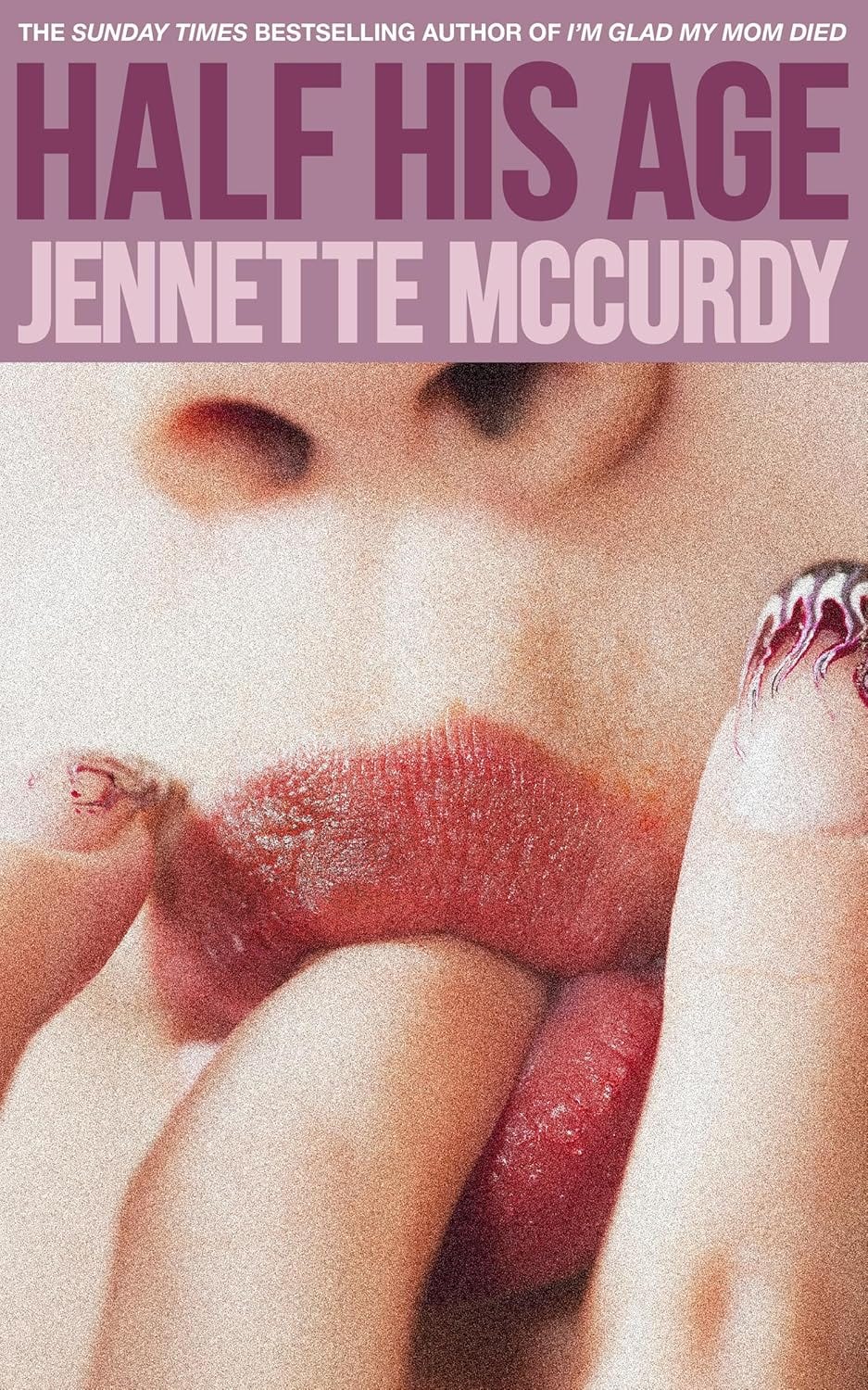
After being impressed with Jennette McCurdy’s writing and storytelling in her heartbreaking and hilarious memoir, I’m Glad My Mom Died, I was excited when she announced that she had written a fictional novel. Less so when I discovered the subject matter was an age-gap relationship between a teenager and her middle-aged English teacher. Tired of these stories, I was still intrigued to see what McCurdy would do with it, feeling her writing and past experiences—though unpleasant and even traumatic—would elevate it. Unfortunately, I was left feeling underwhelmed.
Half His Age follows 17-year-old Waldo who becomes infatuated with her 40-year-old creative writing teacher, Mr. Korgy. Waldo is horny, blunt, and impulsive—when she’s not working at Victoria’s Secret, she loses herself in online shopping binges for products she thinks will make her prettier, or in sexual fantasies that earn her Mr. Korgy’s approval. Soon graduating from high school, Waldo has few friends and little sense of where her life is headed. She wonders if her relationship with Mr. Korgy could fill what’s missing—though really, she is trying to fill the gap left by a mother too consumed with her own tumultuous love life to truly care for her, and a completely absent father. It’s clear that Mr. Korgy sees Waldo when no one else does.
McCurdy’s writing here is very simplistic, which is something I typically like, but it makes this book—which is supposed to be adult fiction—feel very much like a young adult novel. The biggest problem with Half His Age is that it’s too self-aware. It feels like the story wasn’t told to us, it was explained to us. There’s too much explanation of everyone’s motives or what Waldo thinks they are, and a lot of the time this replaces actual story action that is supposed to be showing and not telling. We even get told what characters Waldo doesn’t even know are thinking. And for what? Perhaps it’s more a reflection of what Waldo believes people are thinking about her, but it’s not very effective. Waldo projects her inner world and desires onto Korgy: onto what he says, what he doesn’t, the glances and the silences between them, and how she interprets it all in her favour. This paints a realistic picture of how infatuation can consume us to the point of erasing reality, but it at times reduces Korgy to a one-dimensional character which creates emotional hollowness within the story. At no point do I understand why Waldo even finds Korgy attractive.
McCurdy shows the agency Waldo has as a character. She is about to graduate high school, she has a job, and has had to mature sooner than her peers due to her mother’s behaviour, and she pushes Korgy into an affair. Obviously, the crux of the book is that Korgy is an adult and should never have allowed this in the first place. The grey areas are what make the book interesting because real life is just as complex, if not even more so—but it’s difficult to engage with a book like this when it’s all so heavy-handed.
While it often feels too much, McCurdy does well in exploring Gen Z culture through Waldo’s broad access to the internet—including her impulsive shopping habits and having a deep awareness of emotions, trauma, and what’s expected of men and women. Waldo fortunately does possess some naivety, but she is too self-aware in areas that don’t make for an interesting protagonist—especially when her classic teenage traits already make parts of her “unlikeable.” Waldo clocks on early to what could be happening: “If [Korgy is] able to manipulate his own emotions so well, what might be able to do with mine?” There is something to be said about how young people today are self-aware, and how they would navigate a situation such as Waldo’s. McCurdy does at least demonstrate teenagers misplacing or misunderstanding their online-learned knowledge, such as people not forming their own beliefs and just regurgitating what they’ve read on Instagram. Waldo used what she saw online to convince herself and Korgy that their being together would be fine and who cares what people think. Waldo thinks of herself as an empowered woman with this progressive and mature outlook.
Ultimately, the book’s themes feel shallow and obvious. Rage is there, but it’s not explored well enough for McCurdy’s entire book tour to be centred around that emotion. The most interesting part of Half His Age was the exploration of the mother-daughter relationship between Waldo and her mother. There’s clear abandonment issues that Waldo tries to fulfill with over-consumption and sex. Her mother is the same, due to her own abandonment issues, and fills her own emptiness with toxic love and sex, not realising she is repeating and reproducing the same patterns in Waldo. This part of the story was mirrored really well and wasn’t spelt out for us (unlike Waldo’s relationship with Korgy), which made it feel more organic. Its one fault, however, is that it’s too similar to McCurdy’s own experiences with her mother, and therefore hard to separate if you’ve read her memoir. The exploration of Waldo’s relationship with Korgy is most effective when it gets to show and not tell, such as in one striking scene where Waldo is hiding in his bedroom closet when his wife comes home unexpectedly. If only there was more of this kind of writing.
The sex scenes are intentionally written in a very uncomfortable way, but they feel too contrived and over the top. It’s like McCurdy is trying to make sure you know you’re supposed to be repulsed by this! God forbid it turns you on a little reading about sex in a taboo structure, we couldn’t have that! It’s written bluntly to keep the audience always privy to the disgust that Waldo eventually catches up with—an interesting but not entirely effective narrative device as it creates a disconnection with Waldo, a teenager obsessed with her teacher who clearly doesn’t view sex with him in this way (yet). Especially when the writing is similar to when Waldo has sex with a boy her own age during the book’s opening scene. This, then, suggests Waldo’s relationship with sex overall is not good, that it’s all a performance where she wants validation and denies her own pleasure. But McCurdy doesn’t actually do much with this information.
Half His Age contains some great themes, so it’s a shame that McCurdy doesn’t examine them all with the thought-provoking insight they deserve. There are some striking passages, nonetheless, and the final scenes where Waldo discovers her self-worth do genuinely feel rewarding to read after what came before it. McCurdy knows exactly how a book is supposed to unfold, but she leaves the plot and characters feeling too polished. You know exactly where the book is going and you are told exactly how to feel, to the point where McCurdy doesn’t seem to trust her audience to come to their own conclusions. I trust she will improve her storytelling skills if she writes another novel—which she should. Despite how I felt about this one, I am glad she wrote it and am happy to still follow her writing career. It’s clear that McCurdy has a gift that needs further honing when it comes to fiction, and I believe she will get there.
No posts
Comments
Nothing yet. Say the first thing.
Sign in to join the conversation.