

What does “ethics” in tech really mean?
Someone recently asked me this, and at first I thought the answer was obvious. Of course we all know what ethical tech is... right? But then I had to check myself.
If it were obvious, we wouldn’t still be having this conversation. We wouldn’t need to be advocating for it.

The truth is, we’ve let some of the most powerful platforms in the world be controlled by people who prioritize profit over people. And that comes with real consequences – consequences we all feel, every single day. From the products we buy to the information we consume, to the systems that determine who gets hired, who gets healthcare, and even who gets policed.
So, when we talk about ethical tech -- no, it's not to be trendy, and it’s not just some buzzword. We’re talking about the real need to build technology that actually serves society, and not just a select few.
I can't help but think about how one of the most dangerous aspects of companies eliminating their DEI programs is that we are now living in the age of AI, where diverse perspectives and voices are not just valuable — they’re absolutely essential.
You might recall the ‘racist soap dispenser incident’ — the one that failed to recognize a man’s hand simply because he had darker skin. It wasn’t until he covered his hand with a white paper napkin that the sensor finally responded. That wasn’t just a malfunction. That was a failure of design, a failure of consideration, and ultimately, a lack of a diverse team in the development process.
Because had there been a person of color with darker toned skin present (during the development process), these sorts of things could have been tested for from the start. Instead, these are exactly the kinds of blind spots that emerge when diverse voices are absent from the table.
And as AI continues to shape our world — continuously powering everything from hiring algorithms to healthcare diagnostics to policing systems — bias in technology doesn’t just create inconveniences; it reinforces systemic inequalities on a massive scale.
The more digitized and AI-driven our society becomes, the more inescapable these issues will be. This is exactly why companies should be expanding their DEI efforts, not eliminating them. Without inclusive perspectives guiding technological advancements, we risk embedding discrimination into the very systems that will define our future.
And this issue isn’t limited to the latest AI systems – bias in technology has a long history. One example comes from the early days of photography: the Kodak Shirley Cards.
The Shirley Cards were part of the film exposure methods used to develop film photography using an image of a White woman as the example to standardize the process. And because the image of a White woman was used as the norm for the development process, darker skinned people would consistently be underexposed in photographs.

There is one very important thing to take note of here: the failure to capture dark skin wasn’t a technical issue, it was a choice. Which also implies that we can choose otherwise.
In fact, photographers and parents of Black children had long raised concerns that their children’s faces appeared blurry in yearbook photos compared to their White classmates. Yet the photographic industry ignored their complaints. It wasn’t until chocolate and furniture manufacturers began objecting that film companies adjust their processes so their goods would be depicted with “enough subtlety” (pg. 105, Race After Technology).
This shows how design choices that center whiteness weren’t technical oversights – they were systemic decisions. Ethical tech demands that we choose differently, because if bias can be designed in, it can also be designed out.
Of course, these kinds of biases didn’t end with film photography. They simply evolved into digital form, now showing up in the very technology that we use today.
During the summer of 2020, TikTok appeared to block hashtags related to George Floyd and Black Lives Matter protests. The company later apologized, blaming a “technical glitch.”
But as Safiya Noble explains in Algorithms of Oppression, so-called glitches aren’t random accidents in otherwise ‘perfect’ systems – they reveal the underlying logic of how these systems are built.
Take Google, for example. In 2015, its facial-recognition software tagged photos of Black people under the label “gorilla.” Around the same time, if you searched Google Maps for the N-word during Obama’s presidency, the results gave you directions to the White House.
These weren’t harmless errors; they were racist outputs embedded in widely trusted platforms.
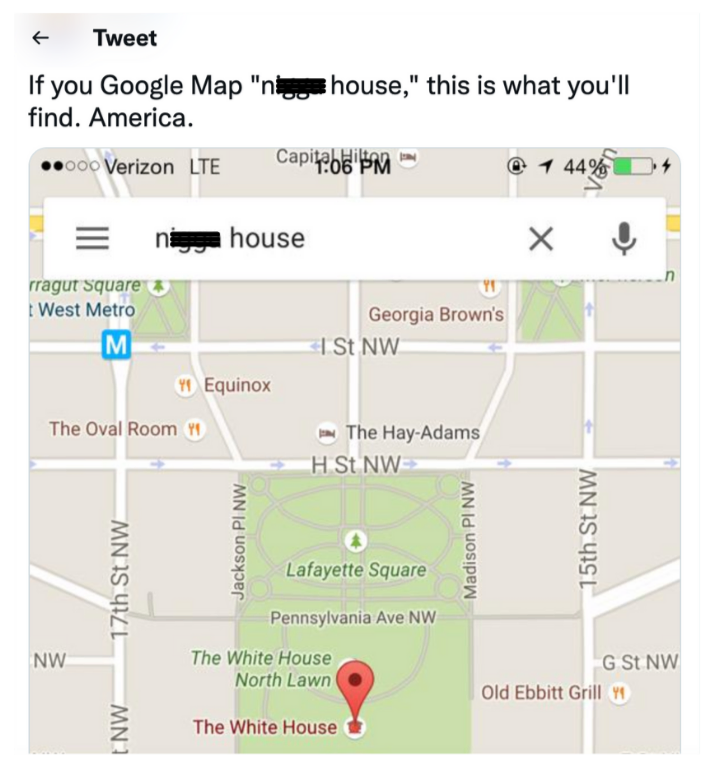

Google apologized and promised to “fix the glitch” but that framing is misleading.
As Noble points out, these aren’t one-off mistakes. They’re symptoms of larger design choices — where bias is written into the very algorithms that we rely on daily.
And because Google is one of the most trusted information sources in the world, when these systems reproduce stereotypes, they don’t just reflect bias — they normalize and reinforce it.
In tech, we often dismiss glitches as simple mistakes — but what if these so-called errors are revealing the biases embedded in the very systems we trust?
And while it might be easy to dismiss these incidents as rare or unusual, the reality is bias shows up more in subtle ways too. Not just in search results gone wrong, but in the daily decisions that algorithms are quietly making for us.
The increasing reliance on AI and social media is not only changing how we think and communicate — it's also shaping how we interact with information and make decisions, often without us even realizing it.
AI tools promise us convenience by filtering through vast amounts of information on our behalf. But in doing so, they don’t simply inform us, they also guide us. They limit what we see, narrow our choices, and often reinforce beliefs they hold about us.
For example, ten years ago search engines worked more like digital phonebooks. They were powered by data mining rather than by machine learning. So, if a person searched for “gourmet restaurants,” and then for “clothing,” their search for the latter would be completely independent of their search for the former... [providing] the inquirer with options – something like a digital phonebook or catalog of a subject.” (pg. 25, The Age of AI and Our Human Future).
But today, search engines are powered by models shaped by human behavior. That same sequence of searches (“gourmet restaurants” and then “clothing”) might now lead to designer clothing results, instead of affordable alternatives even if designer clothing may not be what the searcher is after. And this is simply because the machine is preemptively shaping the options based on data it collected from the previous search of “gourmet restaurants.”
On the surface, this may appear helpful and harmless. But the difference is now, you’re no longer choosing from a broad set of options – you're now choosing from a narrow set of options pre-selected for you by an algorithm based on demographics it decided to assume you’re in.
And this doesn’t just apply to shopping; it applies to the media we consume, the politics we follow, the worldviews we adopt, when we’re searching for healthcare services.... the list goes on.
So, when I say I’m advocating for ethical tech, here’s what I mean:
First, we need to bring back and strengthen DEI programs. Diverse voices aren’t just nice to have – they are essential to building technology that actually works for everyone. Without them, we’ll continue creating systems that harm the very same people they claim to serve.
Second, big tech companies need to be transparent. We deserve to know how algorithms work if they are going to continue to shape our lives and decision-making. We deserve to know what data they collect, and how they use it. That’s the only way we can all make more informed decisions about our digital lives – from our screen time to age-appropriate usage (parents have the right to know these things to make better decisions for their children), to the decisions we make when we interact with these platforms.
Finally, we need accountability. “Glitches” that reinforce bias and racism aren’t accidents — they're consequences of choices. If companies aren’t going to hold themselves responsible, then regulations, standards, and public pressure must.
Because ethical tech isn’t about creating perfect systems. It’s about creating fair ones. Systems that are designed with intention, care, responsibility, and the understanding that technology impacts real people’s lives every single day.
If you want to dive deeper into the intersections and issues of bias, race, and ethics in technology, here’s a few books I highly recommend:
Algorithms of Oppression by Safiya Noble
An Ugly Truth by Sheera Frenkel and Cecilia Kang
Automating Inequality: How High-Tech Tools Profile, Police, and Punish the Poor by Virginia Eubanks
Brotopia by Emily Chang
Careless People by Sarah Wynn-Williams
Race After Technology by Ruha Benjamin
The Age of AI and Our Human Future by Henry Kissinger, Eric Schmidt, and Daniel Huttenlocher
Our work is free but if you’d like to support us and our writing, you can consider buying us a coffee :)
No posts
Comments
Nothing yet. Say the first thing.
Sign in to join the conversation.