
You probably hear it (and see the cute stickers) all the time, the familiar phrase of, “Support Small Business!” or “Shop Local!”
Personally, I’m posting about it all the time and it really can feel like just shouting into the void. But the thing is, most people don’t fully understand why it’s dangerous not to.
And so, being that today is Small Business Saturday, I wanted to share some food for thought.
A quick sidebar:
a local business is simply a business operating in your local community; it might also be a ‘small’ business but not always
a small business is defined by size (under 500 employees, according to the Small Business Administration), but can exist anywhere (online, across the country, your community, wherever)
And they both deserve our support.
As of 2024, Alphabet (Google’s parent company), is sitting on a $1.8 trillion market cap. Apple hit $2 trillion; and Amazon and Microsoft hit around $1.7 trillion and $3 trillion (source: Supremacy: AI, ChatGPT, and the Race That Will Change the World by Parmy Olson).
Globally, Google controls 92% of the search engine market, and about 1 billion people use it every single day. Facebook logs around 2 billion users per day, and around 1.5 billion people own an iPhone.
At this point, it’s fair to ask: wtf happened to anti-trust laws?
In 1911, Standard Oil Company controlled about 90% of oil business in the United States – before regulators came in and broke it up. And “at its peak before being broken up in 1984, AT&T had a market capitalization of around $60 billion” (Supremacy: AI, ChatGPT, and the Race That Will Change the World).
Sooooo… if regulators intervened and dismantled these monopolies when they were:
controlling 90% of oil business in the United States (meanwhile Google controls 92% of the search engine market GLOBALLY),
being broken up when they had a market capitalization of around $60 billion ($150 billion in today’s money; meanwhile, Apple’s valuation is currently sitting at 2 TRILLION)
…then where are they at now?
Rhetorical question.
(also, if you haven’t seen our video ‘Peter Thiel & How He Helped Shape Silicon Valley’ check it out here on Instagram or TikTok)
The thing is, these companies didn’t become monopolies by accident. They became monopolies by countless acquisitions.
Look at Facebook (now Meta) for instance: they didn’t magically out-innovate every other social media platform, they just bought or copied the ones that were gaining steam:
acquired Instagram in 2012
acquired WhatsApp in 2014
launched “Instagram Stories” in 2014 (directly copying the Snapchat format)
attempted to acquire DeepMind (one of the most advanced AI labs)
For Meta, the easiest way to kill competition is to acquire it.
Meanwhile, Google has acquired countless companies including YouTube, DeepMind (a move that positioned them at the forefront of the AI hype), Waze, Android, FitBit, and many more.
Or look at Jeff Bezos who owns Amazon, Whole Foods Market, The Washington Post, Audible, Goodreads, IMDb, Ring Doorbells, Alexa Software, and the list goes on and on.
And once only a handful of powerful companies (or people) control the platforms, the data, the distribution channels, the communication tools, and the search engines — then they pretty much control everything.
This is a cause for concern.
This isn’t just about “yay small business, cute candles, handmade earrings, shop small :)”
This is about what happens when we don’t support them.
Let’s take books for example.
Amazon started as an online bookstore before it started selling everything ever created in human history. A few months ago, I read Danny Caine’s book, How to Resist Amazon and Why, and in it he gives a good break down regarding Amazon’s business model for books and publishing:
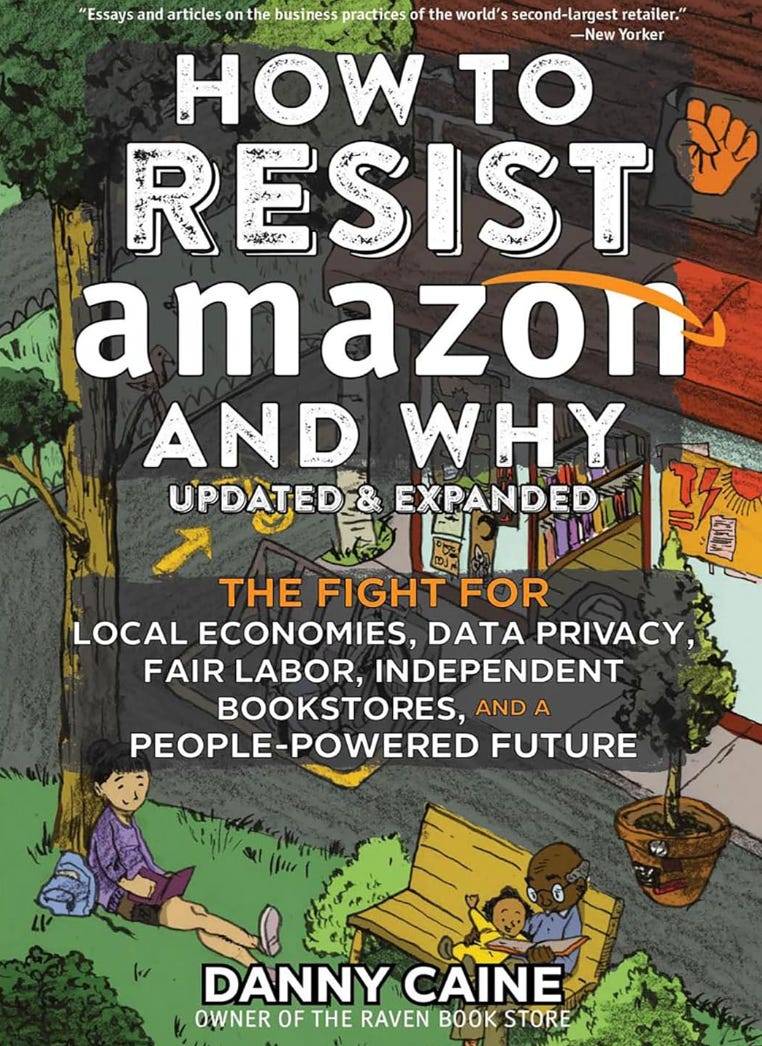
first off, Amazon does not make a profit on book sales
they intentionally price books lower than your local bookstore
because they know you’ll go for the cheaper option
and once they’ve capture the market, they can control the entire pipeline
Amazon has even established their own publishing company; and some authors like Dean Koontz have signed exclusive Amazon publishing deals (meaning, even if you buy the book at an indie store, Amazon gets the cut).
This is intentional. This is an attempt to control the entire market (and even the narrative — if they eventually control publishing).
This is corporate colonization.
Let’s just say that Amazon does get everything it wants and eventually controls 100% of the books and publishing market. Here’s what will happen if that happens:
your local, indie bookstore disappears
independent publishers collapse
third-party sellers disappear
choice eventually evaporates
prices begin to skyrocket
Right now Amazon uses low prices to lure people in, but once there’s no competition left — that $9 paperback on Amazon becomes $35 because there will be nowhere else to buy it.
This is how monopolies work. They give you convenience in the short-term to eventually take advantage (and full control) in the long-term.
Every time you click “Buy Now,” you’re casting a vote (and yes, it is that deep).
If we want independent bookstores, small shops, real makers, real creativity, real competition, people who actually give a shit about their community — then we have to support them NOW, not when it’s too late.
And while there’s no denying that it can be difficult to not choose convenience or affordability (especially in today’s economy), but even making small changes can make a big difference.
Here’s some things that you can consider:
buy local whenever you can
learn more about the shops (and resources) available in your community
have these conversations with your friends and family
be intentional with where you spend
practice delayed-gratification
use alternatives to Amazon
look up the product on Amazon and then buy directly from the seller/maker’s website
re: books: GO TO THE LIBRARY, use Bookshop.org, Thriftbooks, Half Price Books, etc.,
Companies like Amazon are betting on our laziness and on our convenience addiction, but we can prove them wrong. Supporting small businesses isn’t just some cute slogan (although some of the stickers really are cute, lol).
This isn’t just about books or bookstores. It’s about protecting the culture of our communities and preserving them. It’s about economic survival. It’s about keeping money out of the hands of trillion-dollar monopolies that already own (and control) too much.
Small businesses aren’t just average “businesses.” They’re families, best friends, late nights, early mornings, taking risks, chasing dreams, building up courage; people who are genuinely trying to make an impact in their communities.
And when you choose to support a small business, you are quite literally:
fueling someone’s dream
helping oppressed groups (like women and minorities) grow
contributing to real families, not just billionaire pockets
investing in genuine craftsmanship, care, and intention
keeping creativity alive
keeping communities alive
reminding founders that their work matters
supporting your local economy
So, I’ll continue to shout into the void because it is necessary.
Shop small, shop local, shop with intention. Because the world we end up with depends on the choices we make today.




Our work is free but if you’d like to support us and our writing, you can consider buying us a coffee :)
Sources:
Supremacy: AI, ChatGPT, and the Race That Will Change the World by Parmy Olson
How to Resist Amazon and Why by Danny Caine
No posts
Comments
Nothing yet. Say the first thing.
Sign in to join the conversation.