
The question of privatization has a now all too predictable life cycle. When disasters happen—oil spills, financial collapses, environmental devastation, systemic abuse—the debate returns to a well-worn fork in the road. One side insists that private ownership is the root of the problem and that the answer lies in transferring assets to public hands. The other replies that markets, if properly regulated, remain the best tool we have. The argument loops, decade after decade, as if the terrain itself were fixed. This was true when I was a young student in the UK amidst controversy surrounding the privatization of the publicly funded NHS as it is now in the debates about “privatizing” the GLCs (government-linked companies) that form the bedrock of Malaysia’s economy.
But what if both sides are arguing on the wrong map?

Marxist analyses are often at their most compelling when they diagnose how profit-seeking incentives deform social priorities, externalize harm, and detach decision-makers from those who bear the consequences. The critique of commodification, alienation, and surplus extraction still bites. The problem with Marxists is not with their diagnosis. It’s their stupid prescriptions to the problem. Marxists—like a broken broken record player that hasn’t been updated to play the latest Taylor Swift album that will push her into the billionaire class—reach reflexively for a solution inherited from an earlier phase of capitalism: change who owns the firm, and the moral problem dissolves. Replace private ownership with public or collective ownership, and exploitation will be curbed. But this is the outdated thinking of early modern corporate structure.
The difficulty is that many of the most egregious contemporary failures—BP after Deepwater Horizon, PG&E and the California wildfires, airline bankruptcies that strand workers while aircraft remain safely ring-fenced, financial institutions that implode without taking their asset pools down with them—are not primarily failures of private ownership. They are failures of responsibility tracking. Harm occurs here, value is protected there, and control sits somewhere else entirely. You might be tempted to redeploy the old Marxist bromides: “the state is accountable to the people but private companies are not!” But consider the Brazilian state-owned enterprise, Petrobras. Petrobras was the parent company that held numerous subsidiaries and project vehicles. This partitioning between holding company and operating companies had the effect of partitioning liability for the state to engage in corruption. Corruption fines and project failures were channelled through specific entities. Brazilian state exposure was politically managed but legally filtered. The key insight here is that the state uses liability partitioning just like private firms so nationalization is not the cure-all that Marxists pretend it to be.
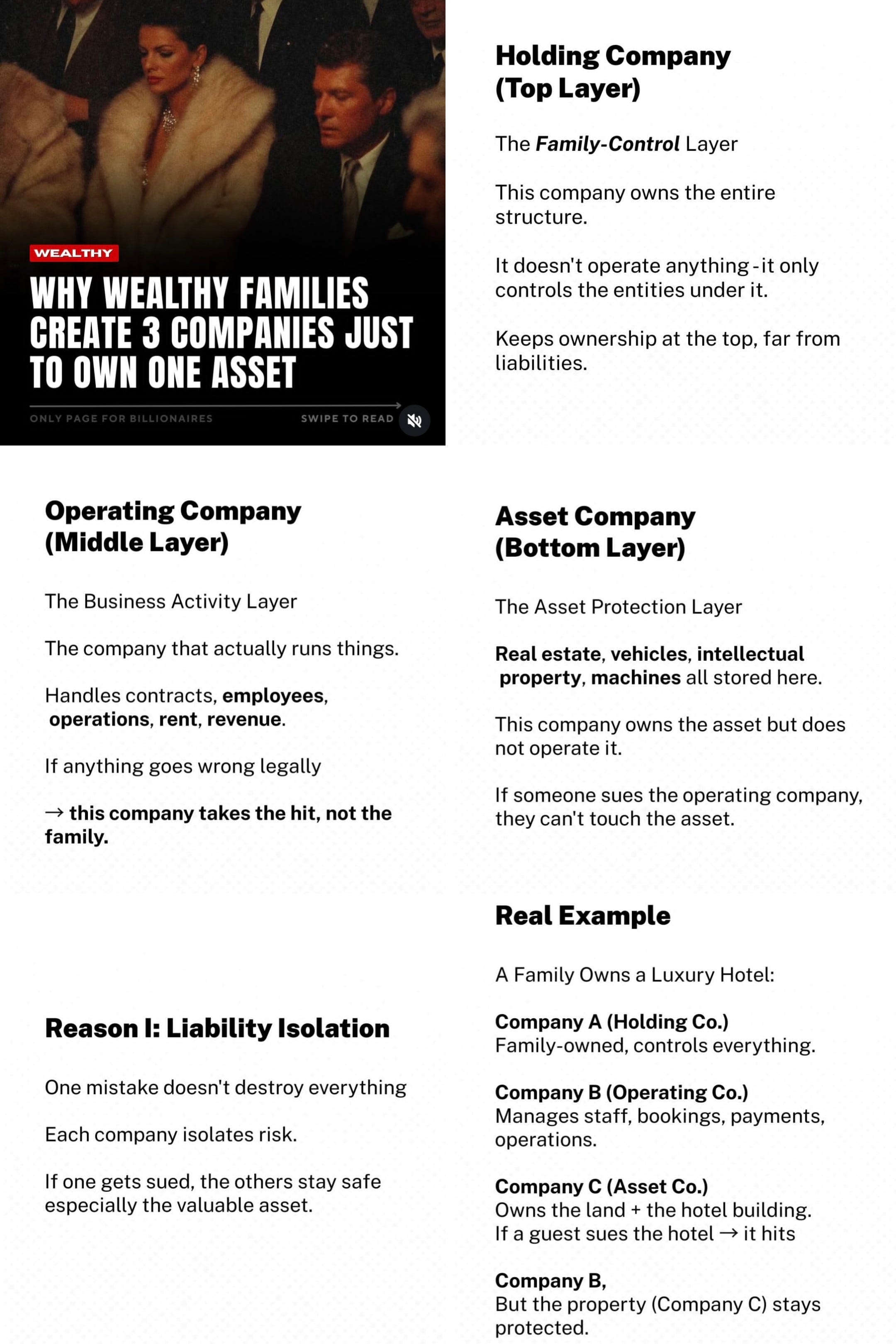
What these cases have in common is not privatization but structure. Rather than being single moral agents, modern organizations are constellations of legally distinct persons, stitched together through ownership and cleverly crafted contracts that partition responsibility in cunning ways. Operating companies take on risk, generate harm, and face lawsuits. Asset companies quietly hold land, planes, patents, or infrastructure, insulated from operational exposure. Holding companies centralize strategy and control while remaining several legal steps removed from the sites of damage. When something goes wrong, liability is absorbed locally, value remains protected elsewhere, and control continues uninterrupted. Evil but genius.

Changing the shareholder from a private investor to the state does not undo this machinery. Nationalize the firm, and the subsidiaries remain subsidiaries. Publicly owned enterprises continue to use special-purpose vehicles, asset-holding entities, and bankruptcy-remote structures. Losses are still localized and assets still remain shielded, while accountability is also still fragmented. In some cases, public ownership even deepens the problem by adding political reluctance to impose genuine failure on entities deemed “too important” to collapse.
The underlying assumption that makes the Marxist remedy seem sufficient is that control follows ownership. This was never entirely true, but in the era of vertically integrated firms and relatively simple corporate forms, it was at least a reasonable approximation. Today it is demonstrably false. Control is exercised through boards, contracts, financing arrangements, and group strategy, while ownership functions as one instrument among many. Responsibility, meanwhile, is allocated not where decisions are made but where the law permits it to land most safely.

This is a conceptual blind spot. Marxism, forged in an age before multinational corporate groups, securitization, and bankruptcy remoteness, theorizes ownership relations but not liability architectures. It asks who owns the means of production but not how legal personhood is multiplied, nested, and deployed to ensure that harm never reaches what matters most. It treats the corporation as a unitary actor rather than as a deliberately fragmented field of moral exposure.
If the problem were simply private extraction of surplus, public ownership would address it. But the deeper pathology lies in the systematic misalignment between agency, benefit, and responsibility. Wherever decisions are centralized to protect rewards while localizing harms in disposable subsidiaries, it doesn’t matter that a public body takes over a private one. As long as that pattern remains intact, the moral failures persist regardless of who holds the shares.
Addressing this requires moving away from the privatization-versus-nationalization debates and toward interventions that operate at the level where the real work is being done: organizational form. One approach would be to impose enterprise-wide liability for group harms, so that a corporate group answers as a group when damage is caused anywhere within it. Another would involve allowing courts to pierce the veil not merely between parent and subsidiary in cases of fraud, but across corporate groups as a matter of structural responsibility. Asset–liability coupling could be mandated, preventing firms from parking value in entities that are legally immune from the risks that generate that value in the first place. Joint and several liability across subsidiaries would ensure that harm cannot be isolated in thinly capitalized shells. Bankruptcy remoteness, currently treated as a financial virtue, could be restricted where it functions primarily as a device for moral evasion. Directors and boards could be made answerable, in concrete legal terms, for group-level outcomes rather than entity-level bookkeeping.
None of these proposals depend on abolishing markets or privatizing the state. They are compatible with a range of political economies, from social democracy to republicanism to post-capitalist experimentation. What they share is a refusal to mistake ownership labels for accountability structures.
The enduring temptation is to ask whether something should be private or public. The more urgent question is how our legal system allows responsibility to be avoided through clever structuring, multiplied personhood, and carefully placed firewalls. Until that question is faced directly, we will continue to argue about who should own capital while leaving untouched the mechanisms that ensure no one is truly responsible for what capital does.
The punchline is simple, even if its implications are not. The problem is not who owns capital, but how responsibility is structurally avoided through legal personhood and liability partitioning.
No posts
Comments
Nothing yet. Say the first thing.
Sign in to join the conversation.