
SUBSCRIBE FOR FREE
1. THE ISSUES
1.1. Cayman, Hedge Funds, Repos and the Basis Trade
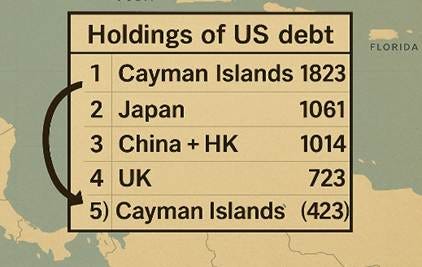
Last week, the FED published a surprising Note explaining that there has been a huge underreporting in the TIC (Treasury International Capital) regarding the foreign holdings of US debt: “…the TIC data appear to severely undercount Cayman-domiciled hedge funds’ holdings of U.S. Treasuries by around $1.4 trillion as of the end of 2024”! [i] . In another marvel of world finance and tax evasion, the Cayman Islands, a country with a $7 billion GDP, is now the first holder of US debt and its main creditor. Well, in reality, it is about American entities, mainly hedge funds, registered in the Caymans with a negligible physical presence there.
The FED Note explains that the mismeasurement was caused by the explosion of the Basis Trade since 2018 by hedge funds, an activity associated with repo borrowing. Usually, hedge funds buy Treasuries in the spot market, finance it with a simultaneous repo, then short the Treasuries futures price to earn the difference with the spot price. Significant leverage (up to 100%) must be used to make it profitable (see below for more). For the purpose of the TIC, hedge funds did not have to report the “repoed” Treasuries. The FED Note illustrates the issue.
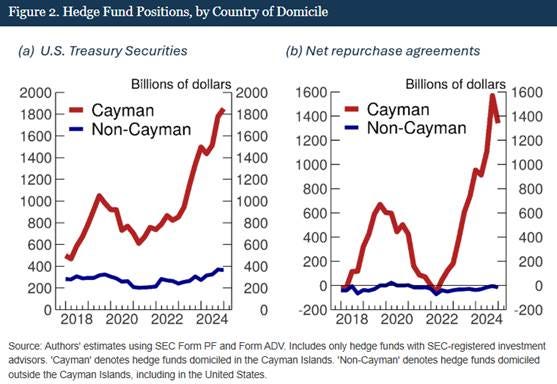
From 2022 to December 2024, the Cayman Islands hedge funds bought practically half of the U.S. debt new issuance. In the words of the FED Note: “Our findings suggest that Cayman Islands hedge funds are, increasingly, the marginal foreign buyers of U.S. Treasury notes and bonds.” Don’t forget that these hedge funds finance their holdings with 24-hour maturity repurchase agreements (repos), and the purchases are highly leveraged. A bit spooky, isn’t it? Could crises, like the ones in September 2019 and in March 2020 happen again?
1.2. Declining FED liquidity
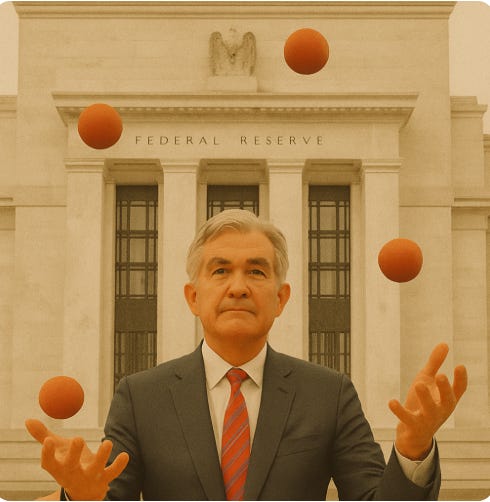
The potential consequences of the sudden discovery of the large basis trade in the Cayman’s hedge funds could be worsened by the FED’s ongoing liquidity shortage in the money markets. Several indicators point to this situation: the overnight repo rate (SOFR) has surged, and the spread with the FFR (Federal Funds Rate) has widened; the FED Standing Repo Facility (SRF), which provides liquidity against securities, has been utilised recently, while the FED overnight Reverse Repo (RRP), which absorbs liquidity from the market, remains at zero; banks’ reserves at the FED have decreased and may be insufficient. Could this lead to a repo market crisis similar to September 2019, when the overnight repo rate spiked, prompting significant emergency FED intervention? It is possible but avoidable if the FED takes pre-emptive measures, such as ending the Quantitative Tightening (QT) programme of shrinking its balance sheet. Jay Powell mentioned last week that the time to end QT is “nearing”. Other indicators suggest that the FED’s liquidity support may decline until the end of the first quarter of next year. If left unchecked, it could negatively impact asset prices... Ending QT alone will not be enough to reverse this trend. Might we see some form of Quantitative Easing (QE), whether disguised or not? And what effect would that have on the Fed Funds rate if the current “floor system” of monetary policy implementation is abolished, as recently proposed by Michelle Bowman, a Trump appointee to the FED Board? How can the FED balance its dual mandates of controlling inflation and fostering high employment? These are intriguing questions for an overstretched FED already juggling many issues.
In the rest of this post, I will explain the details of the two issues I mentioned and what they could mean for financial markets.
2. BASIS TRADE, REPOS, THE TREASURY MARKET AND THE MARCH 2020 CRISIS
The Basis Trade is a form of risky arbitrage involving Treasury spot and futures prices. Since the price differences are typically very small, the operation must be highly levered (20X, 50x, or up to 100 times) by using the repo market. One common transaction involves buying Treasuries on the spot at price P0 and financing this through repo borrowing (where the trader pays the repo rate r), then short selling the futures, where at delivery time, the investor receives FT, the futures price in the contract for time T. Thus, the potential profit from this transaction is equal to

The value of r that makes this expression zero is called the Implicit Repo Rate (IIR). Therefore, two scenarios may occur: A) when the actual repo rate is below the IIR, the trader buys Treasuries on the spot and short sells the futures, meaning he “buys the basis”; B) when the actual repo rate exceeds the IIR, the trader performs the opposite operation: “sells the basis, “ i.e., sells Treasury spot (securing them through repo lending, receiving a repo rate), and goes long (purchases) in the futures market.ells Treasury spot, (secures them through repo lending, receiving a repo rate), and goes long (purchases) in the futures market.
The operation is not purely arbitrage because it involves several risks. Firstly, there is Rollover-Risk, as the Repo market operates with overnight maturities. Repo rates can become significantly higher and more volatile when rolling over repos becomes difficult due to a loss of market liquidity. This characteristic of the Repo markets is very dangerous and should be avoided when repos are used to fund long-maturity assets or highly leveraged positions.[ii] Repos boost liquidity in good times, but this liquidity can suddenly vanish during stress, especially when the value of assets used in repos declines. The creation of internal liquidity through repos played a key role in funding the housing bubble leading up to the 2008 crisis. That is one reason why Gary Gorton described the financial crisis as a “run on repo”.[iii] The second risk involves margin calls or higher haircuts when the underlying securities’ prices fall. The third risk arises from the amplification of losses caused by highly leveraged positions turning sour.
What happened in March 2020, at the start of the pandemic, when liquidity became scarce (the “dash for cash”), were three other things: first, the repo rate increased significantly and became volatile, leading to the unwinding of the basis trade, i.e., selling Treasuries spot and buying futures; second, the Treasuries market became illiquid, and prices started to decline when many wanted to sell; third, the Chicago Board of Trade, which is responsible for the futures markets, increased margin calls. Hedge Funds were forced to sell Treasuries for liquidity (they sold $426 billion in early March) and faced the risk of large losses from the repo rate increases that exceeded the IIR. The overall situation prompted the FED to implement extensive market interventions to support Treasuries prices and, in turn, save the Hedge Funds from substantial losses. The list of those FED interventions is quite impressive, highlighting the severity of the collapse that could have occurred.
1. Interest Rate Cuts: • On March 3 and March 15, 2020, the Fed reduced the federal funds rate by a total of 1.5 percentage points, bringing it to a range of 0%-0.25%.
2. Quantitative Easing (QE): • On March 15, 2020, the Fed committed to purchasing at least $700 billion in assets ($500 billion in Treasury securities and $200 billion in mortgage-backed securities). This program became unlimited on March 23,
3. Treasury Market Intervention: • The Fed purchased over $1 trillion in Treasury securities during Q1 2020 to address liquidity shortages and stabilize yields.
4. Lending Facilities: • Primary Dealer Credit Facility (PDCF): Relaunched on March 17, offering collateralized loans to primary dealers without a set limit. • Money Market Mutual Fund Liquidity Facility (MMLF): Launched on March 23 with $10 billion in Treasury backing, aimed at stabilizing money market mutual funds. • Municipal Liquidity Facility (MLF): Announced April 9, with capacity to purchase up to $500 billion in short-term notes issued by states and municipalities.
5. Repo Operations: • The Fed made $1 trillion in overnight repos available daily and $500 billion in longer-term repos weekly.!
The episode exemplifies the dangerous mechanism that progresses from sudden illiquidity in the repo market (shortage of liquidity, higher repo rates) to the sell-off of the underlying securities, in this case, Treasuries.
Can it happen again this time? As I mentioned, it is possible but unlikely, because not all conditions that existed in March 2020 are present now, and the FED will act. An indirect indication of this possibility is highlighted by a recent academic paper (Hashyap et al, March 2025) which states, “We have identified the cash-futures basis trade as a potentially critical source of instability in the Treasury market. Data suggest that hedge funds currently hold around $1 trillion of highly leveraged long positions in cash Treasury securities tied up in this specific arbitrage trade—positions that are at risk of being quickly unwound if these hedge funds are hit by any of several possible shocks”. The authors propose a solution involving a new FED facility to be “…implemented with a standing facility that acts to create a cap on the Treasury-futures basis and thereby eliminate the most extreme spikes. For example, if the cap was set at 25 basis points, the Fed could simply intervene whenever the basis threatened to breach this cap, purchasing the required amount of cash bonds through a conventional open market operation, and shorting the equivalent amount of futures via a transaction with a futures exchange. Indeed, such a facility would be closely similar to a standing repo facility aimed at capping spikes in repo spreads.”.
The idea of managing a cap to the basis (FT-P0) is a highly intrusive market intervention that American economists would only recommend for very serious reasons. This emphasises the importance of the subject but also suggests that the proposal is unlikely to be implemented. Instead of controlling the “basis,” the Fed can rely on the SRF (Standing Repo Facility) to perform the task by stabilising repo rates. It was used last week, but it is considered a last resort; its rate is above market conditions, and it carries a stigma similar to the old discount window. This stems from the perception that using institutions may be in trouble. Additionally, the facility is not available to all types of financial institutions. These features may limit its effectiveness, but it is intended to cap the repo rate, thus preventing crises like those in September 2019 or March 2020. The current situation will serve as a test of its effectiveness, though the associated stigma may hinder its success. If that happens, the Fed will need to explore other means of increasing liquidity in the money market, such as purchasing T-Bills as it did in September 2019, which was criticised for engaging in “disguised” QE, a charge it firmly denied.
An illustration of the present liquidity tensions can be seen by comparing the spread between the repo overnight rate and the FED Funds rate, now and in March 2020. In fact, the situation was much worse on the morning of the 17TH September 2019, which is not shown in the chart because the FED intervened heavily during the day to reduce the initial huge repo rate.
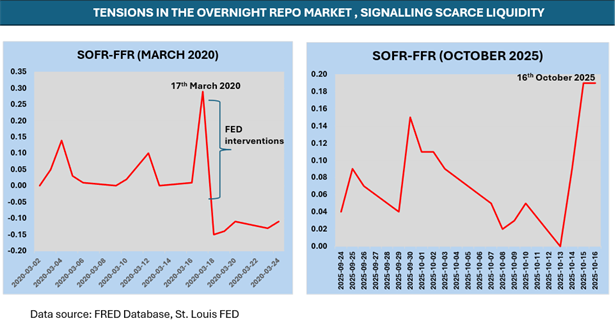
The current spikes and volatility in that spread are not, on their own, sufficient to cause a sell-off of Treasuries by the Cayman Hedge Funds. What could trigger it would be either a drop in Treasury prices (higher yields), regardless of the reason, or a sustained lack of money market liquidity that consistently drives up the SOFR, because institutions are hesitant to use the SRF.
This illustrates how the potential reversal of the basis trade, along with the subsequent sale of Treasuries spot, is naturally linked to liquidity conditions in the money market. Another indication of the current stressful situation is the decrease in bank reserves at the Fed, driven by QT. Powell and other officials have previously stated that a level of bank reserves around 10-11% of GDP would be normal. They are just below 10% and could fall further. In September 2019, bank reserves stood at 7.5% of GDP, and, combined with other factors (such as tax payments, a large settlement from a Treasury auction, and recent regulatory liquidity demands), this caused a sharp rise in the repo market and a series of FED interventions. This led to a programme to purchase $60 billion of T-Bills each month for a period, which the FED distinguished from QE. Later, in 2021, the noted SRF (Standing Repo Facility) was created and is now being tested to see if it can prevent similar situations.
3. WHAT SHOULD THE FED DO?
The FED faces, therefore, the complex task of properly managing liquidity supply and guiding the monetary policy that can balance the two current conflicting objectives of controlling inflation and achieving “maximum employment”.
That´s how I sum up what it should do in the near future.
a) End QT immediately, stopping to shrink the balance sheet.
b) In case the Standard Repo Facility (SRF) is shunned by financial institutions and does not stabilise the repo rate, be prepared to purchase T-Bills as in 2019
c) Keep the floor system of monetary policy implementation with “abundant reserves” as it said in the 2019 decision defining the future of the floor system.
d) Implement another 25 bps cut in the policy rates but stay on hold until sufficient clarity about inflation prospects.
I have already outlined the arguments regarding the first two items, but the other two warrant further discussion.
3.1. The FED version of the floor system.
Previously to 2008, both the FED and the ECB had as a monetary policy target an overnight money market rate, the FED Funds in the US, the EONIA in the EA , now called €ster Euro short-term rate. The CBs tried to steer that 24-hour market rate, by forecasting what would be the demand for reserves by their counterpart commercial banks and attempting to hit the target by supplying or absorbing market liquidity through open market operations (buying or selling securities, usually via repos, in the case of the FED, or by organising auctions for banks to bid for CB primary liquidity or doing liquidity absorbing operations, in the case of the ECB. The ECB also kept two standing facilities, one to lend to banks against collateral, and another to allow banks to deposit their excess reserves in the central bank. The two facilities defined a corridor within which the overnight market rate would have to be contained (the corridor system). The FED had a lending facility (the Discount Window), but was not legally allowed to remunerate bank reserves, so it had no floor for the FED Funds rate. For both CBs, forecasting banks’ demand for reserves was inherently fallible and, consequently, the target for the overnight market rate could be easily missed, leading to volatility.
The 2007/2008 financial crisis changed everything in the implementation of Monetary Policy. The substantial provision of liquidity by the CBs, via QE by the FED or through the use of a fixed rate and the full allotment of banks’ bids by the ECB, created a situation of excess reserves in both jurisdictions. In 2008, the FED was authorised to remunerate reserves with interest on Reserve Balances (IORB), the name it got in 2021, unifying the previous two rates (one for excess reserves, IOER, and another for normal reserves, IORR). The situation of excess reserves led in both cases to a close alignment of the overnight rate with the rate on remunerated reserves (the ECB DFR or the FED IORB and the ON-RRP, since 2013).
This occurs for two reasons: a) banks with excess reserves will never lend them at rates below the remuneration rate; b) borrowing banks in the interbank market can shop around among many banks with excess reserves, ensuring they don’t have to pay much more than that rate to obtain funds. The floor system was then created, meaning that: i) by fixing an administrative rate, and ii) by creating excess reserves, the two central banks could ensure that the targeted overnight market rate could be achieved with a high degree of certainty, avoiding unnecessary volatility. This is the first major advantage of the floor system, which has been in place since 2008. The FED formally decided in January 2019 to continue operating a floor system by maintaining “abundant reserves” for the future. Regrettably, the ECB decided last year to abandon the floor system and to continue shrinking its balance sheet until it only supplies the reserves that banks demand. The new system is complex; it is not a complete return to the old “corridor system”, and in my view, it will have negative consequences and will need to be revised again, but I do not have space in this post to go into details. Opposition to the floor system relates to the fact that it requires a larger balance sheet than what would result from reserves demanded by banks. The floor system requires that central banks keep a structural programme of purchases to inject that excess liquidity into the system. However, to achieve the result of collapsing the overnight market rate to the reserves remuneration, it is NOT necessary to reach the high levels of the balance sheet seen with Quantitative Easing (QE). A relatively small excess above the reserve level strictly demanded by banks will be sufficient to enable mechanisms a) and b) to achieve that objective. Therefore, ideological opposition to QE is not a valid criticism of maintaining a floor system.
The second major advantage of the floor system is that it separates the primary liquidity provision from the monetary policy stance by setting the administrative remuneration rate for reserves. This creates a new policy tool—the CB balance sheet size in providing liquidity to the system—which can be utilised for temporary financial stability emergencies (e.g., September 2019 or March 2020) or for quantitative easing, without impacting the policy-targeted interest rate. Do not forget that, with a system of bank reserves close to being scarce in a small-balance-sheet policy, any increase in CB liquidity for financial/market stability reasons will necessarily affect the monetary policy stance by moving the policy target, either the FED Funds rate or, in the ECB case, €ster.
Jeremy Stein et al. (2016) [iv] at Jackson Hole mentioned a third significant advantage of the floor system, namely that maintaining a somewhat larger CB balance sheet is beneficial for financial stability.
The FED framework became more complex in 2013 when a new method of remunerating excess reserves of certain non-bank financial institutions—major players in the money market—was introduced, thereby impacting the targeted overnight market rate. The IORB, like the ECB’s DFR, is available to typical Central Bank counterparts, mainly banks and other similar institutions such as credit unions. For non-bank institutions that are not counterparties to standard FED operations, a Reverse Repo (RRP) facility was established, allowing these non-banks to deposit their excess liquidity at the FED and earn an administrative Overnight Reverse Repo rate (ON-RRP), set below the IORB. Additionally, in 2021, the FED introduced another administrative rate—the Standing Repo Facility (SRF)—permitting designated institutions to borrow overnight from the FED at a rate equal to the IORB plus 5 basis points. A table might help clarify this array of acronyms and facilities.
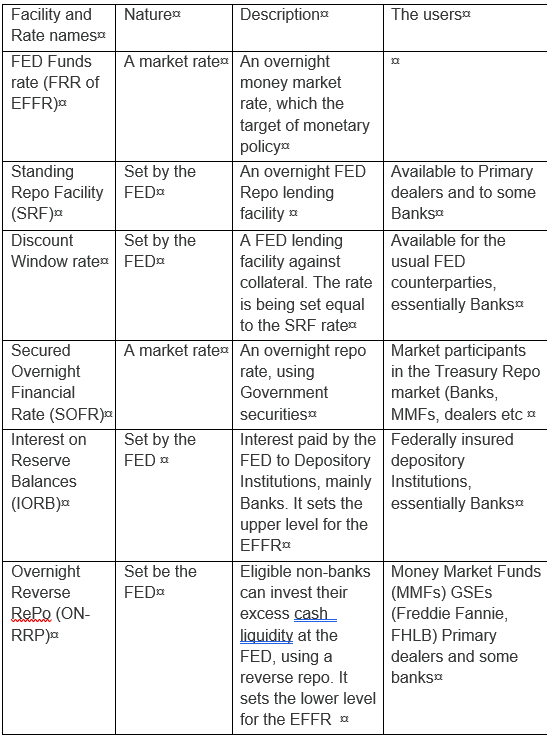
A chart with the recent levels of these rates may also help to understand the system
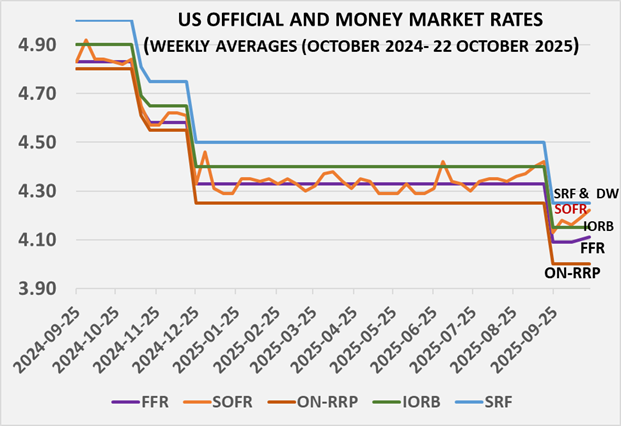
Since 2013, with the introduction of the Overnight Reverse RePo rate, the FED’s floor system implies a range for the FFR rather than a single value. A range of rates defined by the IORB and the ON-RRP rates. The chart shows that SOFR usually stays within the same range as FFR, but it can rise during stressed liquidity, with the possible outcomes I analysed above.
What is important to emphasise is that, despite the existence of two different set rates to remunerate excess liquidity placed at the FED, the floor system has worked perfectly, with all the benefits I already mentioned. Recently, FOMC member Michelle Bowman expressed the view that, over time, the Fed should aim for “… the smallest balance sheet possible with reserve balances at a level closer to scarce than ample”. The FED should dismiss such proposals that would revert to more volatile money-market outcomes and the loss of a new policy tool to address financial instability.
3.2. Monetary Policy and the US Economy.
The real economy is hard to interpret at present, and this is not due to missing recent data caused by the Government shutdown. Currently, it resembles a dual economy, divided between an ultra-buoyant tech sector, which is investing enormous sums, and other sectors such as manufacturing and construction, which are in recession. Exports of goods and manufacturing employment have been falling since April, reflecting the failure of Trump´s tariff policies. A third of the States of the Union are either in recession or close to it.
Inflation is not easing, and some private indices of goods prices, from PriceStats or Openbrand, indicate significant rises in September, while the Cleveland FED nowcasting estimates CPI inflation at 2.97% and PCE at 2.78% for October. Overall employment, according to the private ADP survey of 460000 firms with 25 million employees, shows another 32000 job loss in September. The stock market is in an AI bubble and could experience a crash correction soon. It is, therefore, no surprise that the Trump Administration is eager for further FED policy rate cuts. With inflation approaching 3% and facing an uncertain outlook, alongside an unemployment rate of 4.3% , it is difficult to justify the series of cuts markets anticipate. Another 25 basis points cut before the year’s end may occur, but I believe the FED should pause there and wait for more clarity on the economy.
[i] FED Notes (October, 15, 2025) “ The Cross-Border Trail of the Treasury Basis Trade” at https://www.federalreserve.gov/econres/notes/feds-notes/the-cross-border-trail-of-the-treasury-basis-trade-20251015.html
[ii] See Bayoumi, T. (2017) “Unfinished Business: the unexplored causes of the financial crisis and the lessons still to be learned” Yale U.P. page 73.
[iii] See, for instance, Gary Gorton (2010) “Slapped by the Invisible Hand: The Panic of 2007” Oxford U P
[iv] Jeremy Stein et al (2016) “The Federal Reserve’s Balance Sheet as a Financial-Stability Tool” Presented at the Jackson Hole Meeting 2016
Comments
Nothing yet. Say the first thing.
Sign in to join the conversation.