
SUBSCRIBE TO GET ALL POSTS BY EMAIL FOR FREE
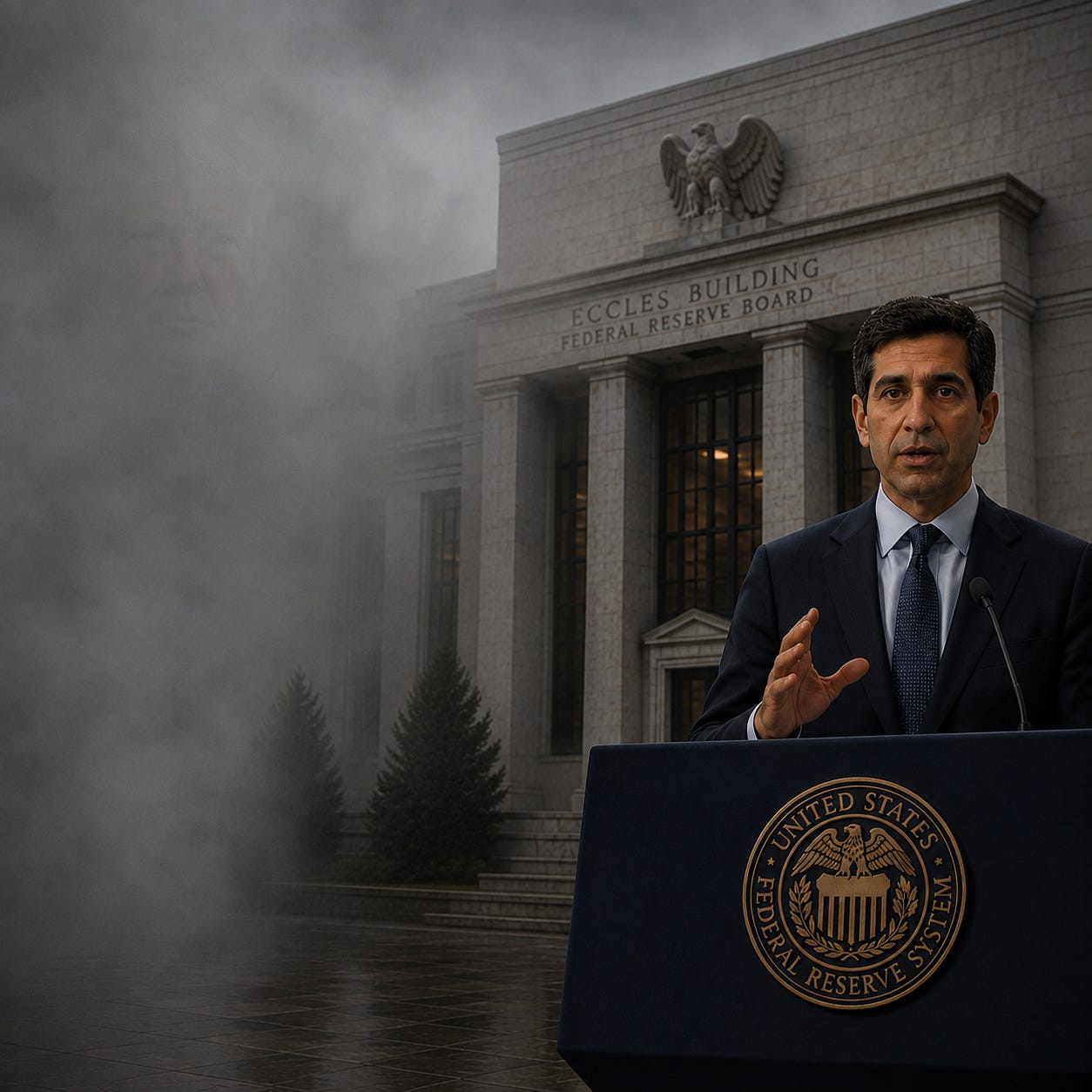
From the immediate market reaction to the verdicts of pundits and market literature, almost everything has been said about the disastrous press conference of the new FED Chairman, Kevin Warsh, on July 29th. The dollar and stocks went down; 10-year and 30-year Treasury yields rose, whereas 2 Year yields, usually following policy rates, fell. Bloomberg even wrote, with manifest exaggeration, about the return of “sell America” ( at https://www.bloomberg.com/news/newsletters/2026-08-06/bonds-dollar-weighed ). It is true that the press conference was full of evasion, obfuscation and drivel. However, considering Warsh´s speeches and op-eds over the past few years, as well as what he said at the press conference, it is possible to identify his vision for the “new chapter” in the Fed he would like to implement. His preferences outline a significant change in the Fed´s policy framework, implying, in my view, a controversial attempt to go back in time to an unsuitable policy framework. Therefore, this long post will have the following structure:
I. INTERPRETING THE CURRENT EVASION, OBFUSCATION AND PROCRASTINATION
II. A CONTROVERSIAL AND INCOMPLETE POLICY FRAMEWORK
II.1 NO GUIDANCE AND WRONG RELATIONSHIP WITH MONETARY AND FINANCIAL MARKETS
II.2. A CONFUSED OBJECTIVE FUNCTION
II.3. AN UNCLEAR REACTION FUNCTION
II.4. QT AND THE END OF THE FLOOR SYSTEM OF AMPLE RESERVES
I INTERPRETING THE CURRENT EVASION, OBFUSCATION AND PROCASTINATION
Great damage was done by Warsh's failure to respond to the simple question about the reasons for keeping rates. Asked three times in slightly different ways, he always dodged the question: Examples: 1) “ KW- So rates are higher today than they were 42 days ago. Markets have made decisions because we stepped back in part from trying to influence those…. So I think it’s a mischaracterisation to say that markets haven’t reacted because we didn’t move today. Markets are reacting in real time.” ; 2) “ KW- So I wouldn’t characterize what we did as anything like a pause. I would characterise what we did as a rigorous review of the economic situation. I would characterize what we did as a review of the big hard questions. And I’d characterise it as a view of what our own homework is, to try to resolve those questions in the period ahead.” 3) “KW- We have spent an inordinate amount of time in the last two days/two weeks looking at our monetary policy strategy, evaluating our tools, thinking hard about the sources of data that we have at our disposal and we wish we had. We’ve also thought hard about the period ahead: What among these questions will be answered with more clarity? Certainly not certainty. So the decision we’ve made today, the discussion we had in that room, was the farthest thing from inertia I can imagine.”
Jointly with obfuscation came also a sense of deliberate procrastination. The FOMC was discussing what the best policy framework is, and that takes time. For instance: “KW -… this discussion was far more robust, and our thinking about how best to achieve that target is advanced. And over the coming months, I expect it to be advanced much more significantly. ”. And the plea for patience: “KW- …I hear from you what I hear more broadly from households and businesses: impatience. Deliver it already. This is not a -- this is not an excuse, this is a fact, this FOMC, this Board has been in business for eight and a half weeks… We are on the job, we will deliver, we are focused like a laser on making sure we can do it. But the suggestion that we’re going to be able to do it with our magic wand is one I want to disabuse you and everyone else of. “
On the other hand, the 5 Task Forces created to examine all the relevant questions regarding the FED´s policy regime will deliver their conclusions by the end of the year…
This inevitably raised suspicions that the FED would keep rates on hold until the early November midterm elections. In fact, there will be two FOMC meetings before that, on the 16th of September and the 28th of October. The second is just a week before the elections, and certainly no rate move will happen then. That leaves the September meeting, where it all may depend on oil prices and inflation numbers for July and possibly for August. If a deal, a memo, or an arrangement emerges with Iran, or if hostilities are simply kept on hold, it looks possible to reach a reasonable path for inflation. There will be two CPI readings before the September decision, on August 12th for July and September 11th for August. Considering all this, lo and behold, market expectations for the September 16th decision shifted from a 70% probability of a hike last week to a 56% average probability of a hold since last Friday.
I- A CONTROVERSIAL AND INCOMPLETE POLICY FRAMEWORK
What I addressed in the previous section is not the most important part of the present Fed situation. Much more relevant is what Warsh hinted about the new policy framework he intends to apply going forward. Let us look at its different elements:
ii.1. NO GUIDANCE AND WRONG RELATIONSHIP WITH MONETARY AND FINANCIAL MARKETS.
Warsh has always been against forward guidance by CBs on policy, arguing that it contaminates the information that wise and efficient financial markets can provide about the economy. All central banks abandoned specific forward guidance since at least the pandemic, and for good reasons in my view. Forward guidance was a tool used during the 2008- 2014 crisis. Three types were used: 1) a promise about policy rates until a fixed date; 2) a promise on rates state-contingent on quantitative values for future inflation and/or future unemployment; 3) a promise about rates in qualitative terms (e.g.” …for an extended period “). The FED used all forms since 2008, whereas the ECB started only in June 2013, using only a qualitative type. All forms of forward guidance were, meanwhile, abandoned, and the consensus was that fixed dates or state-contingent quantitative thresholds were not successful. Only the FED has kept a form of quantitative guidance with the disclosure of the FOMC members’ forecasts of future interest rates – the famous “dot plot”, initiated in 2012. So, abandoning forward guidance, including the “dot plot”, is not problematic and somewhat obvious to me. To be fair, Warsh accepts that forward guidance QE may have to be used in crisis situations. In one of his answers, referring to 2008, he stated : “…in crisis mode we were purposely providing a lot of information. Trying to provide a lot of assurance, trying to tell people exactly what we’re going to do, offering forward guidance with clarity, as if we’re tying our own hands behind our back. Well, in crisis mode, that strikes me as a very prudent policy. But in more benign conditions, it strikes me as worth revisiting.”
The problems with the Warsh formulation in normal times are, however, threefold: first, he is against any form of guidance or forecasting; second, he believes too much in the wisdom of monetary and financial markets to provide always useful information, third, he believes, therefore, that the central bank should not try to influence the markets, so that it can get “ direct and unfiltered” information, supposedly from markets being concentrated “…on the ball and not the referee”. The trust in markets is too often misplaced because they produce bad outcomes for the economy. When attacked because of QE “distorting the markets”, Bernanke simply answered that interfering with the markets is necessary when they produce recessions or financial instability. What makes no sense is to believe that monetary policy can be conducted without any attempt to steer markets in the direction more useful to the success of policy. It is also worrisome that Warsh´s view on forecasting and what may happen to the Fed´s Summary of Economic Projections (SEP), which is now under review. In his 2025 speech at the IMF [i]: “ …near-term forecasting is another distracting Fed preoccupation. Economists are not immune to the frailties of human nature.” To complete the potential aspects of fog enveloping the FED, the regularity of Press Conferences can also be changed. At the press conference, he promised to hold them until the end of the year, after which a new decision will be made.
One point behind all this is the old problem of the impossible trade-off between trying to guide the markets and pretending to get from them “unfiltered” information. In 1994, Paul Samuelson compared the issue with a monkey seeing its own image in a mirror without understanding it was the one being seen. In 1998, Alan Blinder, in his magnificent book “Monetary Policy in Theory and Practice” compared the problem with “a dog chasing its own tail” (page 62). In a series of papers, Morris and Song Shin termed the issue the “reflection of markets” problem and developed simple models to analyse it. [ii]. Still, understanding the problem does not solve it. We should start by enumerating the functions of financial markets from the perspective of monetary policy:
I) They can be a source of wise and independent information
II) They are the channel through which monetary policy is transmitted.
III) Market asset prices, whatever their causes and distortions, have an impact on the economy, which must be analysed
Of the three functions, in my view, the first is the least important, as it fails too many times, even when embedded in broader methods, and the information gathered is never independent of the central bank’s behaviour, anyhow. Additionally, it is very difficult to extract the information about the fundamentals of the economy from financial asset prices. We have to consider that market asset prices depend on many variables that we may group like this:
Price ≈ information about fundamentals+ expected central bank behaviour+ risk and term premia+ liquidity+ speculative or strategic behaviour
Disentangling these different components is totally model dependent and quite fallible.
The second function, a crucial part of monetary policy transmission, makes it imperative that central banks seek to influence markets and their expectations. They do it not with permanent forward guidance, but through their communications and the detailed explanation of their reaction function across a diverse set of scenarios and contingencies. That is not what Warsh has in mind, as we will see below when talking about his reaction function. He prefers to keep the markets in the dark to get their undistorted wisdom, whatever method he uses to extract it! He admires Greenspan and his famous quip: “If I seem unduly clear to you, you must have misunderstood what I said.” That is no way of conducting monetary policy.
The third function is very much alive to analyse the impact of actual market prices on the economy, whatever caused them and whatever distortions they may have. For instance, they are used in the Outlook @Risk, a methodology created by Tobias Adrian et al. at the IMF and now regularly used by the NY FED at https://www.newyorkfed.org/research/policy/outlook-at-risk#root:overview, where broad financial conditions are used to predict growth, unemployment and inflation. Market prices are also used in more complex structural models to gauge their impact on the economy. In sum, while sceptical about the first, the second and third functions prove that central banks cannot ignore markets and must rather attempt to guide them and draw the necessary consequences from their asset prices.
II.2. A CONFUSED OBJECTIVE FUNCTION
In the press conference, Warsh said: “I don’t believe that either part of our mandate is generally at war with the other part. I do not believe that price stability and full employment is an either/or proposition. There have been policymakers over the last several generations who have thought there is a strict trade-off. That isn’t my judgement.”
Normally, this type of sentence is typical of German ordoliberalism or of some new classical economists. They believe that if the CB ensures price stability, the private sector makes the economy self-equilibrating, thereby reaching full employment. Less extreme mainstream economists make the distinction between a short-term trade-off and blissfully full employment in the long run. I was confronted with the extreme view upon arriving at the ECB Governing Council in 2010. The ECB mandate is clearly hierarchical, with price stability as the absolute primary objective. However, the Treaty also states in Article 127(1) that: “Without prejudice to the objective of price stability, the ESCB shall support the general economic policies in the Union with a view to contributing to the achievement of the objectives of the Union as laid down in Article 3 of the Treaty on European Union.” Article 3 then enumerates all that is good, including among other things: “a highly competitive social market economy, aiming at full employment and social progress,” There is, therefore, in the Treaty a sort of secondary set of objectives for monetary policy. However, the official doctrine was that we should not talk about a secondary objective because, by ensuring price stability, all the rest would have the best conditions to materialise. In particular, that would be the case with full or maximum employment. This view changed subsequently. My view is that, most of the time, there is a trade-off between ensuring low inflation and achieving maximum employment, whether in the short term or the medium/long term. I include the medium/long term because, empirically, our advanced economies don´t always ensure full employment without the help of macroeconomic policies, and because monetary policy has long-term effects. The paper by Jordá, Singh and Taylor (2020, revised in September 2024), “ The long-run effects of monetary policy,” NBER WP 26666, draws robust conclusions from a sample spanning 125 years of data on 17 advanced economies. The paper states: “…we show that, surprisingly, monetary policy affects the productive capacity of the economy for a very long time. In response to an exogenous monetary shock, output declines and does not return to its pre-shock trend even twelve years thereafter…. the responses display a key asymmetry, or nonlinearity, with hysteresis forces much stronger after tightening shocks than loosening shocks, consistent with prior research on shorter-horizon response asymmetries (for example, Tenreyro and Thwaites, 2016; Angrist, Jorda, and Kuersteiner, 2018). Tight monetary policy has long-lasting effects, but loose monetary policy does not stimulate growth.”
The two objectives only coincide when inflation is very low, and unemployment is high or increasing, which was what happened during the latest financial crisis that started in 2007/8, and justified the expansionary policies implemented by all central banks
It is difficult to guess what was behind Warsh´s sentence, as he is more subtle and cautious to the point of creating some confusion. In the same answer, he said that “ In fact, my judgement is if and when we deliver on our remit, we’re going to be satisfying both prongs… So I think the two parts of our mandate are equally important.” As the legal mandate mentions price stability and maximum employment, what did he mean by the sentence “…when we deliver on our remit, we’re going to be satisfying both”? Is it just a tautology, or does it reflect the idea that by delivering on price stability, the only part of the mandate that has a quantitative definition, the second part will also be ensured?. Right now, with high inflation and a low U3 unemployment rate, one might think the issue is not of immediate importance. However, the data for the US labour market had an unexpected deterioration in July. The number of employed workers declined by 23 thousand in July, after a decrease of 156 thousand in February, and the low U3 unemployment rate of 4.2% was explained solely by a decline in the population actively seeking jobs. This implies that the number of discouraged workers has increased, and, in fact, the significantly larger measure of underutilised labour, U6, is 8%. This weaker labour market data, by the way, was one reason for the downward revision of market expectations about a rate hike in September. The financial markets understand there is a trade-off, not a convergence, as Warsh stated. This will create more FOMC discussions and potential instability.
II.3. AN UNCLEAR REACTION FUNCTION
Asked about the FED reaction function, Warsh answered: “Any central banker, when he or she sees underlying inflation moving higher, he or she is more inclined to tighten policy. Again, when you’ve achieved the other side of your mandate, and you see underlying inflation falling, he’s more inclined to loosen policy. That’s my reaction function…”
No central bank can live with such a narrow, simple reaction function. If no guidance on policy is provided outside crisis mode, the necessary market influence must be based on a detailed, well-specified reaction function. Especially for central banks with a dual mandate, decisions on policy rates are conditioned by many aspects of the economy’s concrete situation, the type of inflationary process at stake, and the most desirable horizon for reaching both targets.
I want only to dwell today on the dependence on the type of inflation process a central bank can be confronted with. There are three dominant triggers of an inflation process, and monetary policy responses differ across the three cases. :
1. An excess domestic demand-driven process, e.g. by too expansionary fiscal policy, wars, or too buoyant a private sector investment spree, etc.
2. A domestic cost-driven process, e.g. a wage shock, a profit margin shock or a significant increase in tariffs …
3. An external cost-driven process, e.g., an oil or food international price shock, etc.
After 1945, the war (the II WW itself and the Vietnam War), the wage-price spirals in the late 1960s /early 70s, all other episodes of high inflation were the result of external supply shocks, mostly in oil prices. The quality of institutions and macro policies ensured that inflation never lasted long in each episode. Historical experience confirms those three cases of initiating an inflation process. In the first case, the response of monetary policy should be quick and sufficiently intense to control inflation, except in significant wars, when a strong supply shock requires other measures (e.g., price controls used during the II WW). The response of monetary policy in the second case should be similar to the first, but with nuances, e.g., if the initiating process tends to be short-lived or if some form of incomes policy is feasible, as has happened in Europe several times in the past.
The third type of inflation process requires a different type of response from monetary policy. A jump in international commodity prices, such as oil, triggers an initially unavoidable increase in inflation and a stagflationary impact on the economy, neither of which justifies a strong, immediate restrictive response by the central bank. Policy rates should move mildly, just enough to maintain the central bank’s credibility and contain second-round effects.
How to deal with different types of supply shocks should be part of specifying a CB reaction function. Certainly, the FOMC will not allow Warsh to get away with such a simplified objective function.
II.4. QT AND THE END OF THE FLOOR SYSTEM OF AMPLE RESERVES
Warsh has consistently opposed a sizable Fed balance sheet and has been a critic of the regime of “ample banks´ reserves” that has been in place since 2008 and was made official and permanent policy by an FOMC decision in 2019. This creates a “floor system” of strict control over the money market overnight rate, which tends to converge to the Fed’s remuneration rate on banks´ reserves, the IORB. See my previous post here https://vconstancio.substack.com/p/ecb-and-fed-policy-operational-frameworks?r=62v8e&utm_campaign=post-expanded-share&utm_medium=web , where I explain the advantages of such a system, namely, the determination of the money market rate without unnecessary volatility and the separation between the size of the balance sheet and the monetary policy stance, allowing the occasional provision of more liquidity to stabilise markets without changing the overnight rate. That was important in the September 2019 and the March 2020 instability episodes in the repo and Treasuries markets.
The reasons why Warsh is against a sizable Fed balance sheet are that it distorts financial market prices and blurs the border between monetary and fiscal policy. Bernanke, at the time of QE, the large programme of Treasury purchases, convincingly answered those two accusations. Warsh, who was then a member of the Fed Board, was never convinced and, in his speech at the IMF in April 2025 [iii], stated:” Fiscal dominance--where the nation’s debts constrain monetary policymakers—was long thought by economists to be a possible end-state. My view is that monetary dominance – where the central bank becomes the ultimate arbiter of fiscal policy—is the clearer and more present danger. The line between the central bank and the ostensible fiscal authority has grown harder to identify. The spirit of Treasury-Federal Reserve Accord of 1951 is at odds with recent practice.” He is on record stating that he would like to renegotiate that Accord with the Treasury in an unknown direction.
Despite his extreme position, at the July ECB Forum policy panel, Warsh was very cautious about the balance sheet's shrinking, admitting it would be a slow process. We can expect that if he is able to secure a majority of the FOMC's support, the process could take a couple of years. As the financial system has changed, there are good reasons to argue that banks nowadays need higher reserve levels than 20 years ago, before the financial crisis. There are several structural reasons for that:
1. Faster deposit runs—Digital banking, mobile applications, and social media allow fears to spread and funds to move much faster than in the past.
2. Instant and extended-hours payments—Payments increasingly settle immediately and outside traditional banking hours. Banks need immediately usable settlement assets for longer periods of the day and week.
3. Larger and more volatile financial markets—The nominal size of banking, repos, derivatives, and securities markets has grown enormously. Variation margin, margin calls, and securities settlement can produce sudden intraday demands for liquidity.
4. Greater role of non-banks - Investment funds, hedge funds, insurers, and other non-banks hold many marketable assets but rely on banks for payment, credit lines, repo and market-making. Stress among non-banks, therefore, creates liquidity demands that can be satisfied only by banks, as those other financial institutions do not have access to the central bank. There are pressures on CBs to directly admit non-banks as counterparts, but they are correctly resisting such pressures. To keep the system adequately liquid, now that non-banks are larger than banks, the latter must maintain sufficient liquidity to redistribute.
5. Post-Financial Crisis liquidity regulation - Banks must now hold more High-Quality Liquid Assets and demonstrate that they can survive stressed outflows. Reserves in the CB are the purest form of HQLA.
Despite these developments, there are different opinions within the FOMC Just consider the different views of Christopher Waller and Michelle Bowman, both members of the Fed Board appointed by President Trump, expressed last year. Michelle Bowman expressed the view that, over time, the Fed should aim for “… the smallest balance sheet possible with reserve balances at a level closer to scarce than ample.” Waller is a supporter of “ample” but not “abundant” reserves [iv]: “ … moving from a scarce-reserves system to an ample-reserves system. This change was necessary because there were shortcomings with the scarce-reserves approach—short-term rates were harder to control and required daily interventions in the markets by the Fed” In that same speech, he calibrated this way what he considers “ample reserves: “I would add a buffer to the 8 percent of GDP ... and assume 9 percent is the threshold below which reserves would not be ample.”
The present level of the bank’s reserves is $ 3.02 trillion. The currency in circulation amounts to $2.4 trillion, and the Government Deposits in the Fed are $ 0.902 trillion. These three items add up to $ 6.39 trillion in a total balance sheet of $6.7 trillion. If the banks´ reserves were 9% of GDP, their amount would be $ 2.8 trillion, and the three items would total $ 6.14 trillion. Consequently, according to the Waller criteria, there would not be a significant margin of compression—less than $ 300 billion. The TGAA is volatile and not controlled by the Fed, with an average in recent years of $0.7 trillion, which may occasionally contribute to the reduction.
My prediction is that the opinions within the FOMC and, above all, the immediate negative reaction of markets if reserves were severely cut will block Warsh from reaching the “small, lean” balance sheet he seems to have in mind. Still, there will be tensions and “friendly fights” within the FOMC, which could stem from other issues I described above, potentially creating instability and hindering the full lifting of the fog currently enveloping the Fed.
[i] Kevin Warsh remarks “Commanding heights: central banks at a crossroads” IMF Lecture hosted by the G30, April 25, 2025
[ii] See Paul Samuelson (1994) in Jeffrey Fuller (editor) “ Goals. Guidelines and Constraints Facing Monetary Policymakers,” Boston FED 1994; Alan Blinder (1998) Monetary Policy in Theory and Practice” The MIT Press; Morris and Song Shin (2018) Central banking forward guidance and the signal value of market prices”, BIS wp n 692
[iii] Kevin Warsh, Ibid.
[iv] Christopher Waller (2025) speech “ Demystifying the Federal Reserve’s Balance Sheet”
Comments
Nothing yet. Say the first thing.
Sign in to join the conversation.