
Human beings are running faster than ever before.
We run for money, careers, security, luxury, and survival. We keep moving endlessly for a better future for our families. But somewhere in between this race, humanity forgets one simple truth:
A peaceful life finally depends only on clean air, safe water, healthy food, and a stable environment.
Without these, no economy, technology, or development can truly protect humanity.
If these thoughts connect with your heart, support Echo Terra Journal and become part of a growing community that believes humanity and nature can still coexist together.
Modern society has trained people to believe that speed means success.
A slow life is often misunderstood as failure.
Rest feels uncomfortable. Silence feels strange. Simplicity feels outdated.
But perhaps the problem is not slowness.
Perhaps humanity has moved too far away from the rhythm of nature itself.
Every part of our body belongs to this Earth.
The air we breathe, the water we drink, the food we eat, and even the smallest particles within us are connected to nature.
Yet humanity continues to move against it — like swimming against the direction of the wind.
The soul quietly knows what it truly needs.
But modern systems often convince us to ignore it.
Many cities across the world are becoming hotter every year.
Heatwaves are increasing. Electricity demand is rising. Cooling systems are becoming essential for survival in many regions. The more heat we create through unsustainable systems, the more energy we consume trying to escape it.
And slowly, this becomes a cycle:
We pollute nature to fuel the economy.
Then we spend more money trying to survive the damage created by that pollution.
Modern lifestyles continuously increase human needs:
More electricity.
More fuel.
More cooling.
More consumption.
But nature has always shown humanity a simpler balance:
Open spaces
Natural ventilation
Tree cover
Walkable communities
Shared transport
Local food systems
Energy-conscious living
Sometimes sustainability is not about going backward.
It is about remembering what humanity ignored.
Across different parts of the world, there are communities slowly changing the pattern of human living.
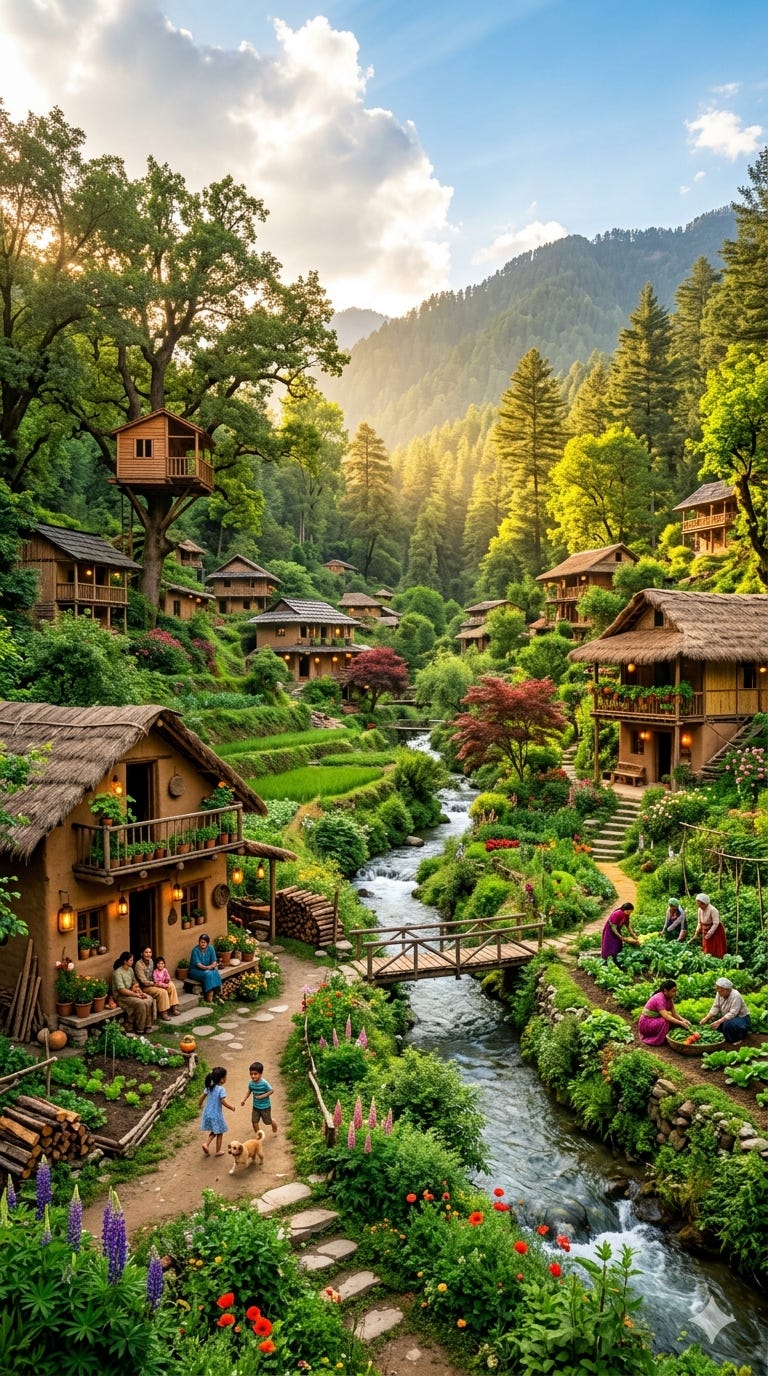
Some people have left fast urbanized lifestyles and moved toward ecovillages, regenerative farms, sustainable settlements, and forest communities where homes are built using mud, clay, bamboo, stone, and natural materials instead of destroying ecosystems for expansion.
What makes these communities inspiring is not only the architecture — it is the mindset.
They try to live without disturbing the ecology around them.
Trees are preserved.
Energy consumption is reduced.
Water is conserved.
Food is locally grown.
Communities work together instead of living isolated lives.
Organizations like the Global Ecovillage Network (GEN) now connect thousands of ecovillages and regenerative communities across continents where people are experimenting with sustainable and nature-connected lifestyles.
These communities focus on:
Ecological restoration
Renewable energy
Shared agriculture
Natural architecture
Water conservation
Community-based living
Regenerative farming
Biodiversity protection
Perhaps these communities are not running away from modern life.
Perhaps they are trying to remember something humanity once already knew — that human beings were never meant to live disconnected from nature.
Findhorn became one of the world’s most respected ecovillages where people created a sustainable lifestyle deeply connected with nature, renewable systems, emotional well-being, and community-centered living.
Video Reference:
One of the early permaculture ecovillages where residents designed homes without damaging surrounding ecosystems. The community focuses on renewable energy, water conservation, organic farming, and low-impact living.
Auroville is an experimental township where people from different nations live together focusing on sustainability, reforestation, ecological restoration, and human unity.
Traditional mud homes are slowly returning because they naturally remain cooler during heatwaves and reduce heavy electricity dependence for cooling systems.
Video Reference:
The documentary beautifully shows how sustainable architecture can coexist with nature while reducing environmental impact.
Development itself is not wrong.
Cities are not wrong.
Technology is not wrong.
Human ambition is not wrong.
But human progress should never happen through the destruction of the environment that keeps humanity alive.
A truly developed society is not one that only builds taller buildings.
A truly developed society learns how to grow while protecting nature, reducing waste, saving energy, and respecting future generations.
Simple changes matter:
Walk short distances whenever possible
Use public transport
Share vehicles instead of using cars individually
Reduce unnecessary electricity consumption
Keep windows open whenever possible instead of depending fully on artificial cooling
Preserve trees
Support sustainable architecture
Teach environmental awareness to children
Small actions repeated by millions of people create global change.
The world itself is changing.
Energy systems are changing.
Climate systems are changing.
Global power structures are changing.
Economic systems are changing.
Humanity may face conflicts, resource pressure, climate migration, economic instability, and political tension during this transition.
But perhaps this transition is also forcing humanity to rethink one important question:
“What do human beings truly need for a meaningful life?”
Because endless consumption alone cannot heal human emptiness.
Many films imagine the future Earth as a dry world without water, forests, or balance. Others imagine flooded cities and collapsing ecosystems.
These ideas should remain warnings — not become reality.
The Earth was once received with more greenery, cleaner rivers, richer biodiversity, and healthier ecosystems.
Future generations deserve to inherit that same beauty.
We should not hand over a damaged planet simply because humanity failed to change its habits in time.
Even if humans someday travel to other planets or galaxies, nothing will replace the emotional connection between humanity and Earth.
This is still our home.
Perhaps the greatest change will not begin through governments alone.
It may begin through ordinary people.
Families.
Children.
Teachers.
Farmers.
Architects.
Writers.
Communities.
People slowly realizing that humanity and nature should never exist as opposites.
The future may belong not only to the fastest cities — but also to the communities that learn how to live gently with the Earth.
Not a perfect world.
But a more conscious one.
For decades, humanity has fueled economic growth by polluting nature. That cycle now returns through rising temperatures, environmental instability, and emotional exhaustion.
Perhaps the standard pattern of human life itself must change.
The systems that created global warming cannot alone become the systems that heal it.
The real transformation must begin from ordinary people understanding their true needs, reducing unnecessary harm, and rebuilding a healthier relationship with nature.
Let us create communities that give first priority to humanity and the Earth.
Let us teach future generations how to protect what keeps life possible.
Because development without nature is not progress.
And a future without greenery should never become the inheritance we leave behind.
Let us join hands as a community and protect the Earth before it becomes too late.
Thank you for spending your valuable time reading Echo Terra Journal. Every reader who believes humanity and nature can still coexist becomes part of this growing journey toward a more conscious future.
No posts
Comments
Nothing yet. Say the first thing.
Sign in to join the conversation.