
When it comes to math, it looks like we humans have too small a context window compared to AI, so we’re the ones drawing the short straw. @vlkodotnet
As part of the promo for its new Astra model, OpenAI published an article about solving 10 mathematical problems that humanity had been stuck on for a long time. And mathematicians are not exactly thrilled about it. There are many angles here. It’s great that AI helped with these problems, but the question of verifying the results remains. Progress this fast may lead students to conclude there’s no point competing with AI and to skip mathematics as a field of study altogether. Especially since we still don’t know whether AI can create entirely new areas of mathematics, not just solve existing problems.
You’ve surely wondered, as I did, where the actual bottleneck is. Is it that math simply isn’t popular enough for someone to spend time on every open problem? Fortunately, we have an answer. The problem is the biological limit of the context our brain can process. Some individuals have phenomenal memory, but generally a person can only hold a limited amount of information in working memory. That’s why we lean on paper and write things down as we go. AI doesn’t have this limitation. A 1M context window fits an enormous amount of information, and mathematics is an exact science with strong feedback. Luckily, there’s still room for the ordinary human. AI is excellent at combining existing concepts, but so far it can’t invent a new concept it has never encountered. Either way, mathematics is another field facing a revolution, just like software development did.
Now that we know we won’t beat AI on memory, why not use its potential? Surprisingly, AI adoption isn’t where you’d assume based on what we read and hear on the internet. Only 5–10% of people use AI the way I describe in this newsletter. Another 20% use it occasionally, and 70% have access to AI but don’t use it. On top of that, there are two kinds of heavy users. The first throws the input from a Jira task at the AI, lets it chew through it, and commits the result. The second enriches the input with important context, checks the output, adds a human loop, maybe a small manual tweak, tries to understand whether the solution is correct, and only then commits. Guess which type introduces all sorts of odd libraries and inconsistencies that will drag the project down later?

What can we do to avoid becoming the first type? Build understanding. And the best tool for that is AI itself. Instead of skimming the diff, have the AI generate an explanatory document of the changes after each task. Generate a mini-environment that interactively creates various simulations of the system (got a message bus? then why not build an interactive page presenting existing messages and how they’re handled?). Or create a shared place where you put all of it. Because for us humans, it matters that we know how things work.
Did you think passkeys would solve all your security problems? At least on Windows, you were wrong. If malware gets onto your machine with full privileges, the sandbox the passkey application runs in offers no protection against it. Pass-ta-keys uses various techniques to pose as a new device and sync your passkeys down from the cloud. The defense is to use TPM or hardware tokens.
Chrome is introducing device-bound session credentials (DBSC), which should protect against session cookie theft. With this technique, the cookie is signed with a unique cryptographic key stored in a hardware security module.
Google is presenting HEIR, a compiler that enables AI inference over encrypted data without decrypting it. The catch is that you need an AI model converted to work with it.

Finally, there’s news about a massive supply chain attack on LiteLLM that leaked terabytes of sensitive credentials from more than 2,500 organizations. It took 40 minutes.
Gemini has become Google’s fastest-growing product to reach 1 billion users.

uBlock Origin has given up the fight with Facebook over ad blocking. The recommendation is to stop using Facebook.

Docker Sandbox is a way to run an AI agent without letting it change anything on your machine. In sandbox mode, the agent can install packages and run its own docker containers, and you clean it all up with a single command.

OpenSandbox is something similar, and on top of that it ships an SDK for your favorite language, such as Python, JavaScript, Kotlin, Go, and C#.

Claude has started labeling AI-generated content. For documents it will use the C2PA standard, and for text it will embed detectable patterns. Unfortunately, Claude will do this even when it’s translating your text, reviewing it, summarizing it, and so on. A rather sad solution to the problem, because Claude was particularly useful for translations.

With AI models, I don’t even know where to start. Qwen 3.8 2.4T landed on Hugging Face.
Grok 4.6 improved its intelligence and its ability to work over longer stretches. According to SpaceXAI it beats GPT 5.6 Sol in some areas. It still doesn’t match its quality at tool use, but the pricing is a nice surprise.

Gemini 3.7 Flash arrives mainly as the engine powering AI features on the new Pixel 11 phones.
GLM 5.3 brings improvements in coding and in the ability to detect software vulnerabilities. Otherwise it’s essentially the same model as GLM 5.2, put through intensive post-training.
DeepSeek V4 Pro 0813 is out, both the open-weight and the large version.
Meta released Muse Glimmer, an open-weight 30-billion-parameter model distilled from its large Muse Spark. It’s multilingual, multimodal, and should also fit into your computer’s memory. For Meta, it’s the first freely available model since the release of its last Llama.
Needle 2 is a tiny 14 MB model with 45 million parameters that should be able to power agentic functionality on a Raspberry Pi 5 or cheap ESP32-S3 boards. Don’t expect any text output from it, but if you send it a list of possible actions and a description of what to do, it will produce a list of function calls.
Cerebras and OpenAI are introducing GPT 5.6 Sol Ultrafast Mode. Cerebras technology lets even a model as large as GPT 5.6 run at 14× the speed, roughly 750 tokens per second. The article doesn’t mention what it will cost.

DeepSeek is introducing its harness, called DeepSeek Harness. Everything is a plugin and every run is tracked.
Claude published the text of its system prompts for each of its models.
The seventh preview of .NET 11 brings opening password-protected zip files, improvements to dotnet test, labeled break and continue for better loop control, built-in localization of validation, and much more.
ASP.NET Core 10 brings passkey support. You’ll find a guide on how to implement them here.

Google introduced its new Pixel 11 phones. They should have a better and more powerful processor, better handling of camera data, and a higher price, because they didn’t escape the RAMageddon either.

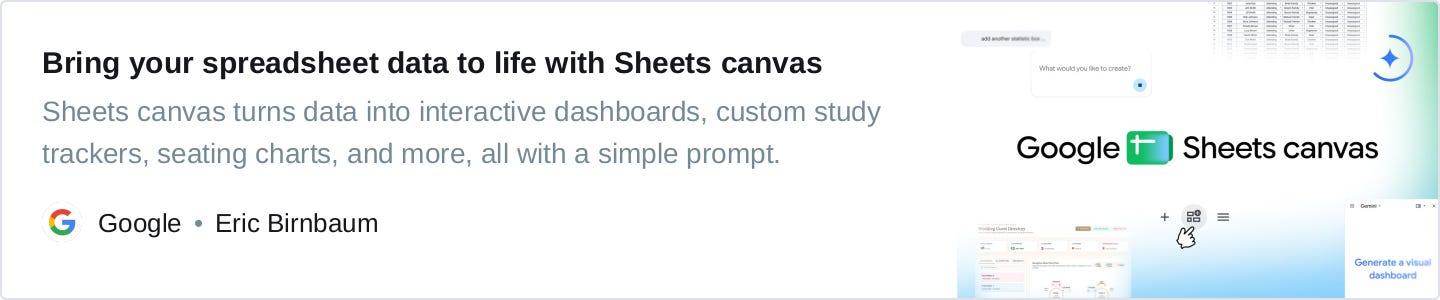
Google introduced Sheets canvas, which can generate interactive dashboards on top of any Google Sheets table.
Last week I introduced DeltaDB, and now comes Delta, the first application built on DeltaDB. It enables interactive collaboration between multiple people or agents on a single project.
Hugh Howey, author of the post-apocalyptic Silo series, is building Neo, a tool for writing books. It’s essentially a blank page, but you can pull up a menu with chapters, notes, a list of characters, and so on.
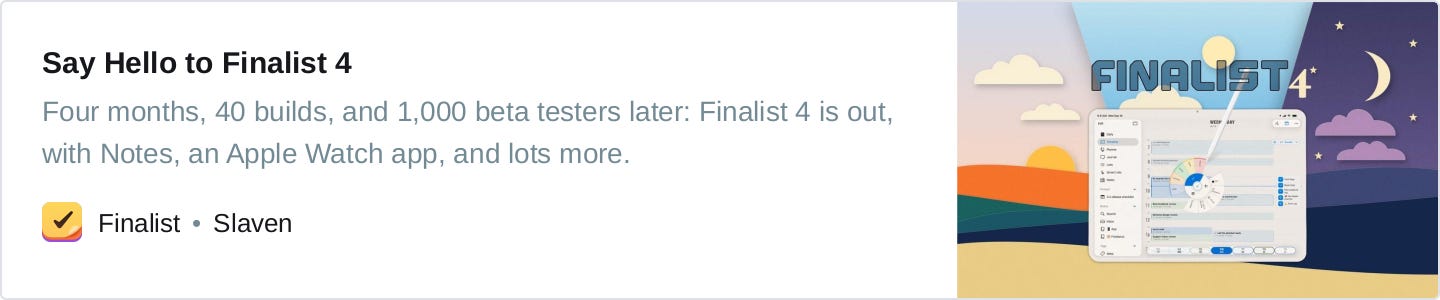
Finalist 4 is a todo app with calendar integration that looks incredibly good and genuinely useful. I currently use NewTwos, but Finalist 4 has a nicer take on the current-day view. Unfortunately, the app is iOS only.
Stowaway shows you, based on your location, not only the planes flying overhead but also the satellites.

Want to play a board game but have no one to play with? Board Game Arena is exactly the place for you. You sign up and can play any game the platform offers. For free you can play most of the well-known games, but you’ll wait until a seat at the table opens up. Pay, and you also get the premium games and skip the waiting.


No posts
Comments
Nothing yet. Say the first thing.
Sign in to join the conversation.