
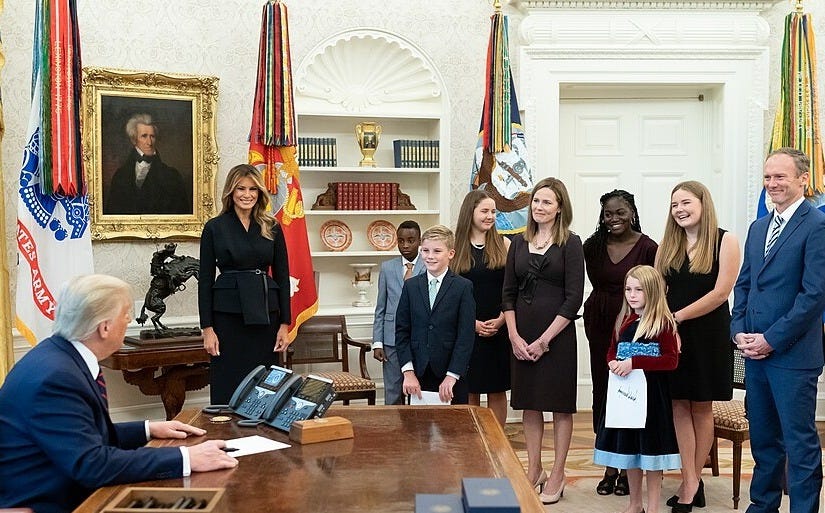
FOR A FLASHING SECOND, I thought Justice Amy Coney Barrett would break from her conservative colleagues and take a more humanistic stance on the issue of immigration.
Boy, was I wrong.
In an extraordinarily cruel decision, even by the standards of this court, the six conservative justices voted to clear the way to end Temporary Protected Status for hundreds of thousands of Haitian and Syrian immigrants, allowing the Trump administration to immediately begin their deportation while litigation continues.
It was not an unexpected result. But I find Barrett’s participation jarring, starting with the simple fact that two of her seven children are adopted from Haiti, a country whose poverty and suffering she knows firsthand. The irony cannot be lost on her that she’s enabling the massive deportation of immigrants to the very hell from which she plucked her own children.
Let me say this as the mother of two daughters adopted from China: there’s inevitably a bond to your children’s homeland and its people. I see that with virtually every parent who’s adopted internationally. That’s why I’m struggling to understand Barrett’s seeming indifference to the fate of Haitians who are here in this country legally.
So how does she bring herself to justify this ruling? By accepting a lie. Barrett, a mother of two Black kids, must know a thing or two about racism. Yet, she signed onto a ruling that hinged on denying blatant racism. To say that she’s being dishonest doesn’t begin to describe it.
Justice Samuel Alito wrote for the majority, and it was a doozy. His conclusion was that discrimination was not behind the administration’s move to deport some 350,000 Haitians in this country:
None of the cited statements by either the President or the Secretary [of Homeland Security Kristi Noem] was overtly racial, and in substance all expressed policy views that could rest on race-neutral justifications.
Race, he concluded, was “not a motivating factor” in ending Haitians’ protected status. Hence, their equal protection claim is meritless.
Justice Elena Kagan didn’t let Alito get away with it. In her marvelously sardonic dissent (joined by Justices Sonia Sotomayor and Ketanji Brown Jackson), she pointed out that the majority chose to omit Trump’s actual remarks: “The evidence is there, plain to see, in the President’s statements, which the majority (and for that matter, his own lawyers) cannot even bear to repeat.”
“So here are some of those statements,” wrote Kagan, who then proceeded to list some of Trump’s comments:
Haitians are “eating the dogs ... They’re eating the cats.”
Haitians in this country “probably have AIDS.”
Haiti is a “shithole country” that’s “filthy, dirty, [and] disgusting.”
Haitian immigration is “like a death wish for our country.”
Haitians are “poisoning the blood” of America.
Kagan also noted that Trump once asked, “Why is it we only take people from shithole countries? Why cannot we have some people from Norway [and] Sweden?” Her rejoinder: “Haitians are Black,” adding, “Norwegians and Swedes not so much.” (And let’s not forget that white South Africans now make up almost all refugees allowed into the U.S.)
“The references – of filth, disease, and primitiveness – are shot through with racial stereotypes and tropes,” wrote Kagan, making it clear “that race entered into the President’s resolve to remove Haitians from this country.”
Kagan hit the nail on the head – and I bet Barrett knows it.
Of all the conservative justices on the court, Barrett seems more grounded in reality – which she demonstrated during oral arguments about the abortion pill, mifepristone. (I was so impressed by her questions that I wondered if she’s a secret feminist.)
I don’t think Barrett is a mean-spirited person. At some level, she must feel a responsibility to the Haitian community. Indeed, she’s indicated that in the past. “Haiti is, you know, one of the poorest countries in the Western Hemisphere,” she said at Notre Dame Law School in 2019. “And it’s close enough to the United States that we could go as a family and be involved in Haiti as the children got older.”
And how can she not see her own children in the plight of Marlene Gail Noble, one of the plaintiffs in the case? Abandoned as an infant in Haiti, Noble came to this country in 1993 at the age of two for medical treatment. She was later adopted by a Pennsylvania couple who somehow failed to file the paperwork for her U.S. citizenship. Now in her mid-thirties, Noble now faces deportation to an impoverished, crime-ridden nation.
But for the grace of being adopted by more vigilant parents, two of Barrett’s own children could be facing a similar fate. I’d like to know how she plans to explain that to her kids.
It’s hard for me to fathom how she decided to sign on to this heartless, mendacious decision. It’s possible she agonized over it, though she leaves no clues. Unlike Justice Clarence Thomas, she wrote no concurrence.
I can only surmise she believes that she was acting on some kind of higher principle, perhaps taking pride that she can coolly make a decision without letting her personal experience get in the way.
If that’s the case, it’s simply dishonest – and profoundly sad.
Related posts:
Is Amy Coney Barrett a Radical Feminist?
Sotomayor Apologized to Kavanaugh. Was That Necessary?
Who am I? A journalist with 25 years of experience, I’m a former opinion columnist at Bloomberg Law and The American Lawyer. And yes, I’m a recovered lawyer. Click here if you’re curious to learn more.
Comments
Nothing yet. Say the first thing.
Sign in to join the conversation.