
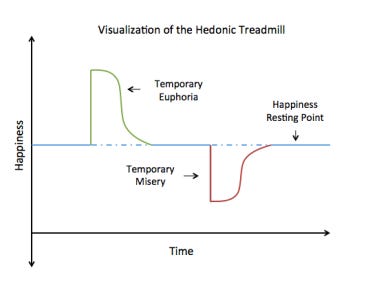
I felt a little gaslit about parenthood for a long time. I looked at how my friends with children managed their lives and was completely shocked: everything was so bad. Like, friends who hadn’t slept uninterrupted in 8 years due to the continued arrival of more children. New diagnoses, new childhood regressions of all kinds of things, gross things, challenging things, regular old exhausting things. It seemed insane to undertake so much suffering on purpose, deliberately swinging my life from “mostly good” to “mostly hard and overwhelming.”
I’ll admit it: it didn’t make sense. But I’ve always been pretty good at assuming my perception wasn’t more important than the reality of the wider world, so I did it - I became a parent. There had to be something in it that people weren’t showing me.
Guys, I was right. I was really, really bad at parenting: I had no instincts, my kid needed things but I couldn’t always figure out which things, I felt utterly unmoored from my prior life, I felt hypervigilant about doing a good job as a parent, I was so underslept and overworried that even objectively nice things were caked with a thick, sticky layer of stress icing.
Parents will say (and did say!) yeah, all that’s normal. The few I really opened up to mostly seemed to want me to chill out a little, try to enjoy it. Every part of me rebelled: it’s not enjoyable! It’s a job, not an easy or fulfilling job, just a job where you’re a terrible person if you don’t figure out how to succeed. There’s no winning here.
A lot of people talk about finding their footing after newborn life passes - in hindsight, my child was easiest to care for in those lovely 4-10 months old age after newborn and before mobility. But my brain didn’t settle. I’m not good at settling in, so I managed, and raged, and cried, and tried again every day. Until my kid turned 4 years old.
That’s a lot of years to feel utterly disconnected from everything important to me, to feel like I was failing in every direction. But that’s how long it took me.
There were glimmers of change before then, and I saw evidence in the moms around me that it was possible: my friends had second, third, and even fourth kids. They’d seen what this looked like and invited the additional chaos of bigger families, more pets, more activities and trips and jobs into their lives. So I knew that other people were able to do it.
but for the first few years, for me, every punch was a KO for me - RSV? KOed. Preschool asks you to leave? KOed. Childhood allergies? KOed. My own illnesses, disappointments, travel, and all kinds of other interruptions to routine? KO, KO, KO.
Two things happened when my son turned four, and neither of them had to do with him: I finally found consistent childcare that inspired confidence (still less than 15 hours a week, but so valuable), and I quit alcohol permanently.
disclaimer here: I don’t want to stolen-valor anybody with a serious drinking problem/pretend things were harder than they were. For me, I was on the high side of social drinking (1-2 drinks most days), verging into the definition of alcoholism of 14 drinks a week for a woman, but I didn’t binge drink really ever because more than 3 drinks in an evening made me so sick. What I realized, though, was exactly one drink put me in a depressive mood for at least 48 hours, and drinking at my rate meant that I never left that depressive mood. It took a long time to realize, and even a couple of dry January’s weren’t enough for me to realize zero alcohol was right for me.
What changed was super subtle, because everything else about having a kid stayed hard. What changed was that the terrible things became neutral things.
Some moms are faster about this. They go through a few hard weeks in the early part of parenthood and then they can look at the new normal and say, “baby poop? normal. Lots of screaming? normal. Illness and doctors visits and uncertainty? normal, normal, normal.”
I had a friend who had her first child after watching her sisters muddle through the early years with a bunch of nieces and nephews. She had her own baby only a short time after the devastating and unexpected loss of her own father. She told me that when her child arrived, she was bracing for all the challenges, thinking it’d be hard all the time, but instead, she was bowled over by the joy. All the challenge moved into the normal category for her, because her daughter brought so much joy. I am so glad her story exists in the world, even if my own brain didn’t process early parenthood that way. I want everyone I love to be bowled over by joy while in seasons of physical challenge and discomfort.
My average day has the same things in it these days, but without any alcohol and with a few breaks where I have confidence in my son’s caregivers, my brain can look at the same kind of day and feel totally different than before.
Take today. If this exact day was happening a couple years ago, I’d be thinking, “ugh, my period is so bad and painful and I just barely have recovered from this cold. My mother in law is sick so no help this afternoon, and it’s so cold outside so we’re cooped up. My son woke up early and is really hyper, my kitchen is a mess and my fridge is a mess and I haven’t tidied up the pile of boxes in the laundry room. What if he doesn’t nap today, oh no, how will I ever get a break.”
Those things were true. They are still true, but look at how I think today.
I’m so glad I have my energy back after that cold and that the ibuprofen is doing its job this morning. I was able to play trains and make bread this morning, and this evening I’m going to eat some dark chocolate while watching a show snuggled up with my husband. I have an interesting writing assignment to work on this morning while my son is at school, and it’ll be nice to rest if my son ends up napping, to get some more energy for the rest of the day.
It’s the same day. What matters has changed. The hard stuff, the stuff I assumed would always be hard, has faded to the periphery, has become the stuff of every day.
The change started in the kitchen. For the first couple years, I’d emerge from the haze of helping a toddler figure himself out and look at our kitchen and have no idea what to do next - I’d need an hour just to figure out what to cook or clean or prepare.
But as my kid got older, I felt like the kitchen became an extension of my body. Any time my arms weren’t actively engaged in making a car track or changing a diaper or passing along a tray of snacks, I could be setting up tomorrow’s coffee or cooking some food that would be ready for us for the next needed meal. I was even making a few freezer meals. It was just what my arms did, after a thousand repetitions. I even had a little mental space while I did those things, and that daydream moment became a source of pleasure, a moment for my brain to live in other realities than the daily routine.
I have positive things to share with new moms: you too will find neutral again, and I know because I didn’t think I would find neutral ever again for four years.
You may need a long time like me, but for the majority of Moms, it doesn’t take this long. I was stubborn and didn’t try therapy or SSRIs as early as probably would have been prudent, and I didn’t figure out that my alcohol tolerance is actually 0 because I didn’t think my drinking was “bad enough” to quit so intensely.
You can pull levers and make big changes faster than I did, to work toward seeing the life you have now as not hard and bad, but neutral.
I will never be the Mom that pretends to like cleaning when I don’t, who pretends to be chill about illness when I’m not. But I can indeed slurp the tiny dregs of gratitude from a lot of circumstances now: an illness is less bad than another illness in the past, and I’m grateful. Cleaning the kitchen with a podcast is indeed more relaxing than trying to teach pro-social play skills to a reactive toddler. I don’t have to blow smoke in my own face to literally be grateful that a hard day isn’t as hard as my hardest days.
On the hardest days, I just remind myself that the needle swings back to neutral. Maybe not as fast as my challenge-avoidant heart would like, but it does.
And after years of thinking that I never even crossed the midline into happiness, I recognize happiness more now: I see the beautiful sunrise in the place we really scrimped to afford to live, and I taste the exquisite flavor of homemade bread or a really top-notch soup, and I feel how good my body feels after a yoga routine in the evening or early, early morning, and I see that those are nudges over the line, little blips of euphoria.
I don’t experience a lot of manic joy any more, sustained over-the-neutrality-line journeys. I’ll admit that, because the honesty of it grounds me.
But there’ve been those moments too, and they’re more visible without the haze of booze pushing all my emotions downward. My son’s joy when we went on his first train trip. Going to see one of my favorite bands with a new mom friend, who actually loved the same band 20 years ago in high school, on the most perfect spring evening. Nestling into any couch holding one of my friend’s babies and letting my friend rest. The dopamine rushes aren’t all day every day, but they show up.
Pre-kid, I experienced a lot of “grade inflation” when it comes to nice things and times. My life was always pretty free of challenge and pain, so even incredible experiences felt kinda meh, kinda neutral.
I prefer my life now, however surprised I am to arrive here.
I prefer a life where every single sliver of pleasure and positivity is hard-won and treasured. I prefer a life where I’m content in neutrality and hopeful through the true crises.
It’s a weird place to arrive after years of being the actual Most Negative Nancy.
But it’s beautiful here.
Last note: If you haven’t read Dopamine Nation by Anna Lembke, it illustrates much more insightfully than I can what it means to embrace neutrality, not happiness, as one’s homeostatic location. I think about that book once a week or more, and I read it many years ago.
No posts
Comments
Nothing yet. Say the first thing.
Sign in to join the conversation.