
This week I’m heading to my first Lean Enterprise Summit to help spearhead a new focus with LEI on Tech and AI. This is really exciting but also really daunting. Lean has a legendary history in the real world, and a shadow contingent in tech circles like IT Revolution, but the core of the management practice has often failed to take advantage of the best that tech has to offer.
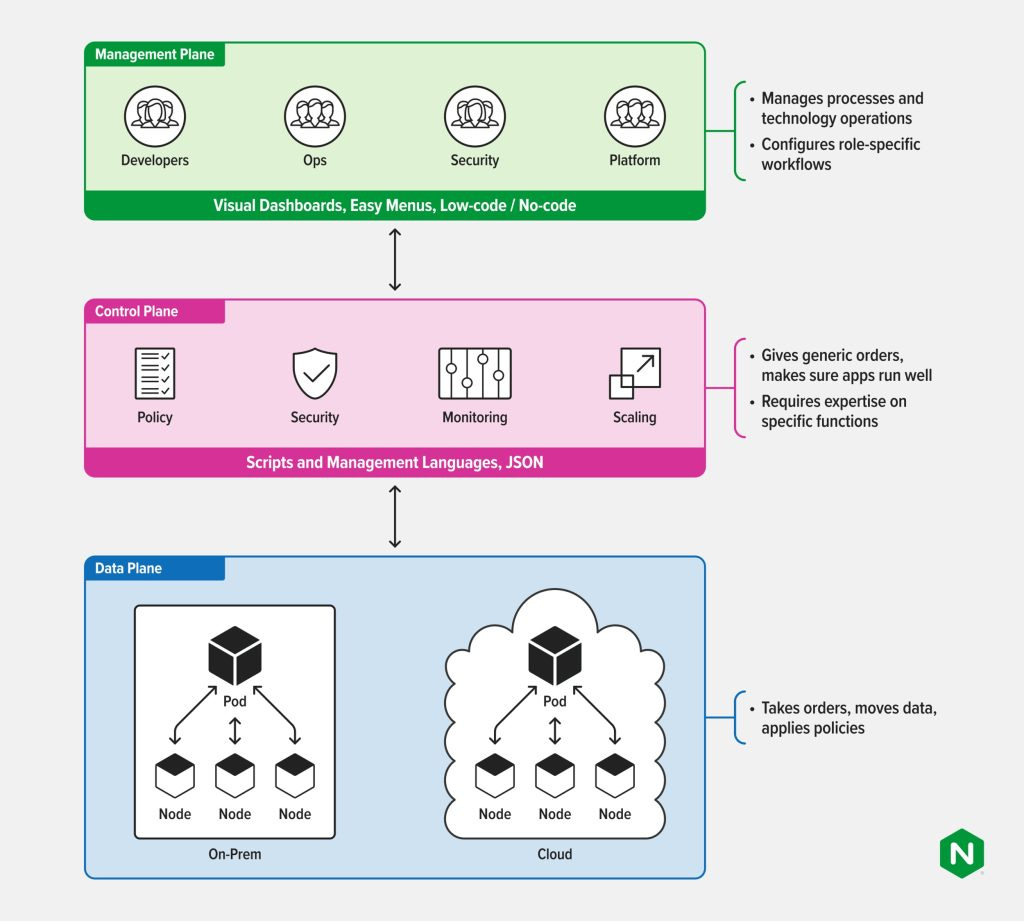
In the analogy of the three plane view of an organization as a network: Lean has been strong in the management plane (leading the work), and the data plane (doing the work) - but less visible in the control plane, the coordination, signaling, organization, and information flow that connects management to data - leadership to the work.
Lean tech has been around since the 1990s. The fundamentals haven’t changed. Why are we just now establishing a dedicated focus to it?
Despite all the benefits, the clarity of the principles, the existing foundation of lean, and countless case studies, it’s still very challenging for most people to grasp and assemble the ingredients, recipes, techniques and tools of lean in tech. ‘Tech’ being the knowledge work, software development, IT, and digital contexts that are woven into everything we now do. The promise of automation has skyrocketed, and with it we either amplify the good or the bad. It’s critical now more than ever to build lean into our tech investments and activities to ensure we amplify the good.
It’s challenging to grasp because tech makes it deceptively easy to build, and the invisibility of critical tooling makes it hard to see the supporting machinery that makes it easy to build the right way. When you walk the floor of a factory, you can see precision applied to quality controls, the visual aids, the safety mechanisms, and the tools of improvement, all readily at hand. That may seem like a stark difference to tech, where artifacts and code sit hidden behind an array of interfaces, but the real value and challenge in either domain is invisible. The information flow, learning, value, leadership, communication, continuous improvement behaviours are largely unseen. The supporting tooling and guardrails should be enabling performance and quality but when they do their job well they remain hidden. When we focus just on the movement of an item of work, we miss the fact that what enables that movement and supporting its quality are systems, principles and processes that we can easily ignore.
It may seem that tech is fundamentally different from physical manufacturing, healthcare, or construction, but all these domains just operate along a spectrum that identifies a focus of our efforts. In tech, we may easily think of building new things, a developmental focus on change, and increasing variation, but we also need the opposite end of the spectrum - operational focus - in different areas. We need self-healing systems informed by anomaly detection, stability and scalability - just as much as we need the next new thing.

Lean doesn’t inform just one end of the spectrum - value, clarity, learning, pull and flow apply everywhere. We want more variation in discovering new innovations, and less variation in operational management.
What truly matters is identical between the two domains: Time is real, value is real, cost is real. The time horizons may vary, the attribution of value may vary, and the unit economics may vary, but these differences aren’t nearly significant enough to establish a distinction.
Waste changes from physical scrap to cognitive load and toil. Tech focuses on “Cost of Delay” while manufacturing focuses on “Unit Cost.” There’s a difference of focus from “Conformance to Spec” to “Fitness for Purpose.” - again, along a spectrum that also applies to tech. To succeed, information flow must be elevated to the level manufacturing dedicates to material flow.
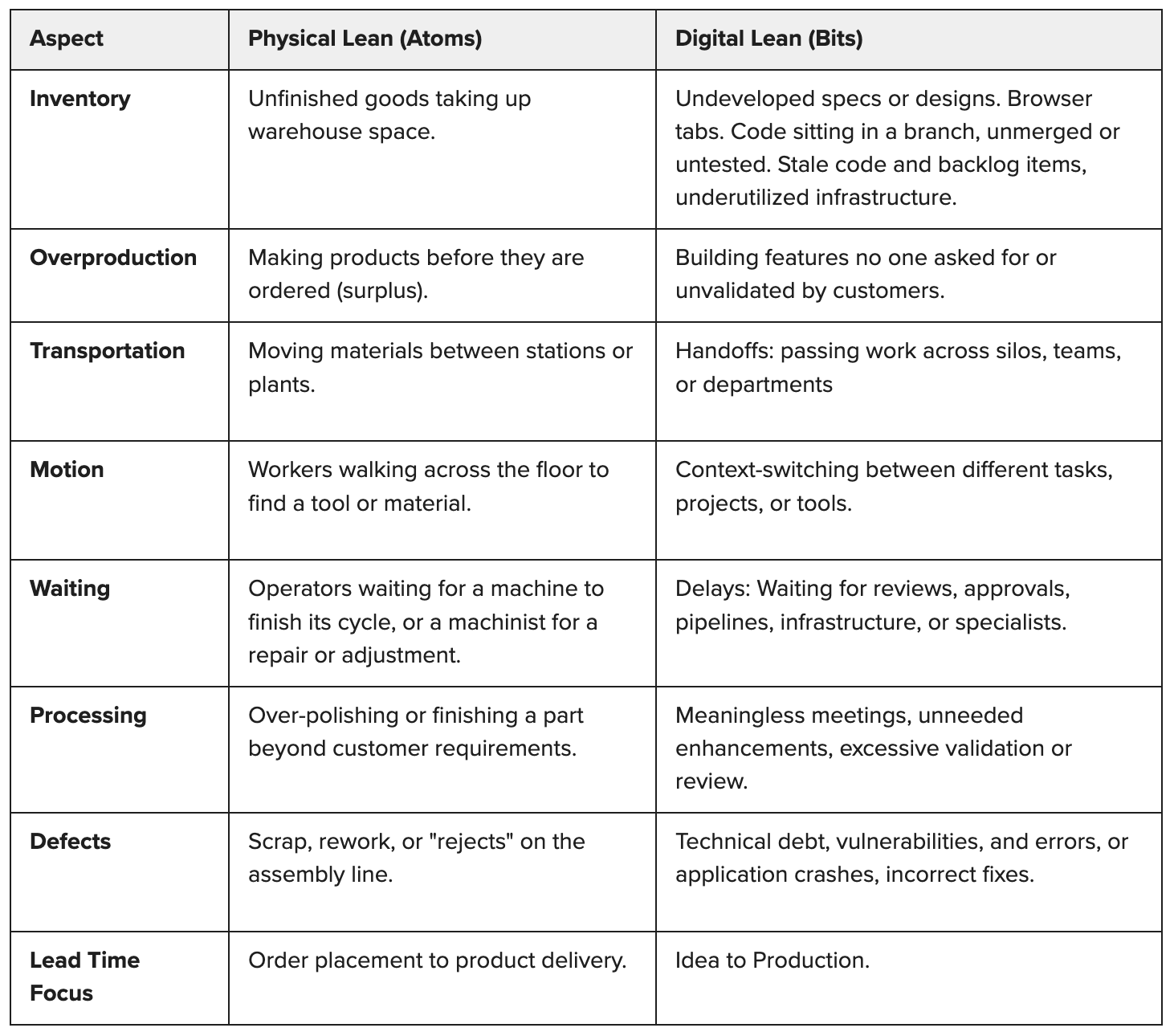
These are distinctions without meaningful difference. Most flows and aspects of work are the same: Vision to strategy. Prospect to customer. Incident to resolution. Idea to production. Order to onboarded. Value, flow, feedback, and learning are critical and identical to both contexts.
Customer Value: Every action should be adding or supporting value to the customer or user.
The Pull System: Never start work until there is a clear “pull” from the next step in the chain. In a factory, it’s a bin; in digital, it’s a prioritized queue.
Continuous Flow: Aim for “Single Piece Flow.” Don’t batch 1,000 widgets; don’t batch 50 features into one deployment. Flow of activity, artifacts, and information.
Jidoka (Autonomation): Build quality into the process. In a factory, the machine stops if it detects an error; in digital, the CI/CD pipeline fails if the tests don’t pass.
Pursuit of Perfection: Innovation and continuous improvement rely on systems supporting rapid feedback and learning.
These are the parts easily missed in tech, and perhaps taken for granted in the world of atoms:
Organizing Around the Customer: Because digital work seems technically important, we incorrectly organize teams by technology, component, or function, rather than customer needs. The best tech companies treat every dependency as a customer, fulfilled by self-service.
Early and Rapid Testing: Because code seems cheap we tend to dive right in, but “building quality in” requires extensive automation and testing techniques that few invest in. Acceptance testing, contract testing, and testing assumptions are all too rare.
Flow Measurement: Measuring age, cycle time, lead time, work item profile, work in progress (WIP), and throughput help balance load and capacity. It empowers data-driven insight, fast adaptation, and continuous improvement. It facilitates forecasting and avoids painful estimation and compromised commitment.
Visualizing the Value Stream: The iterative, spiralling nature of digital work and rework seems to negate a simple depiction of flow - but by aiming to represent even the complex we begin to simplify and improve.
Reducing WIP and Focus on Finishing: It’s easy to start work when we can assign a task, but WIP is tremendously expensive and hard to manage. Being blocked just amplifies the problem - we start something new.
Full Kit: In digital contexts, we often start work not knowing how it might be delivered. We lack testing to tell us when we’re off track. Digital infrastructure is often manually configured, unreliable, poorly managed and seen as secondary to features. It often blocks work and creates rework or confusion.
Information Flow: Low-value meetings are a failure of information flow and empowerment, yet our staff’s calendars are packed to the gills. Repeated syncs, big-room planning, and discussions without decision plague many tech organizations. We fail to invest in getting the right signal to the right person in the right position to act.
Loose Coupling: The most innovative early manufacturers leveraged electricity to decouple their stations previously tethered by pulleys - to organize in service of flow. The digital equivalents leverage patterns that break coupling and increase adaptation, resiliency, and scale.
Gemba (The Real Place): Managers and supporting staff must go to where the work happens. In physical, it’s the shop floor; in digital, it’s tracing an idea’s path to production or replaying incident response. Mapping the value stream is even more important when the work isn’t easy to trace. Increasingly management activities are supported by AI, allowing humans to lead and teach more intentionally, supported by data.
Kaizen (Continuous Improvement): Small, daily changes and experiments by everyone, everywhere. Big transformations and reorganization is a last resort. Ask “how do we fix this friction today?”
Respect for People: Lean assumes the person doing the work is the expert. Whether they are turning a wrench or writing a script, they should own the improvement process and critical decisions they are closest to.
Standardized Work: Defining the “best way we know today” to perform a task so that any deviation is immediately visible as an opportunity to learn, and cognitive load is optimized.
Faster Feedback Loops: Reducing WIP allows you to find mistakes in minutes rather than months.
Increased Agility: Less “Inventory” (physical or digital) means you can pivot your strategy without losing millions in “sunk” work.
Higher Quality: By focusing on “Built-in Quality,” you stop “inspecting” quality at the end and start “creating” it at every step.
Employee Engagement: Workers feel empowered when they have the tools to solve their own bottlenecks.
The “frontier” of Lean today lies in the integration of these two worlds. Digital twins, digital agents, robotics, game engines, 3D printing, augmented reality, and smart devices have all come to blur the lines between the physical and digital. As AI enters the workspace, the need for Lean thinking becomes even more urgent. Luckily with lean we have the models, mindsets, methods, and metrics to amplify the good. We need principles to ensure that technology augments human capability rather than sideline it.
Whether you are moving atoms or bits, the core remains the same: Respect the person, enable flow, and never stop learning.
I’d love to hear from you: Is lean a specific focus in your organization? Is it taken for granted? Is it a relic?
Comments
Nothing yet. Say the first thing.
Sign in to join the conversation.