
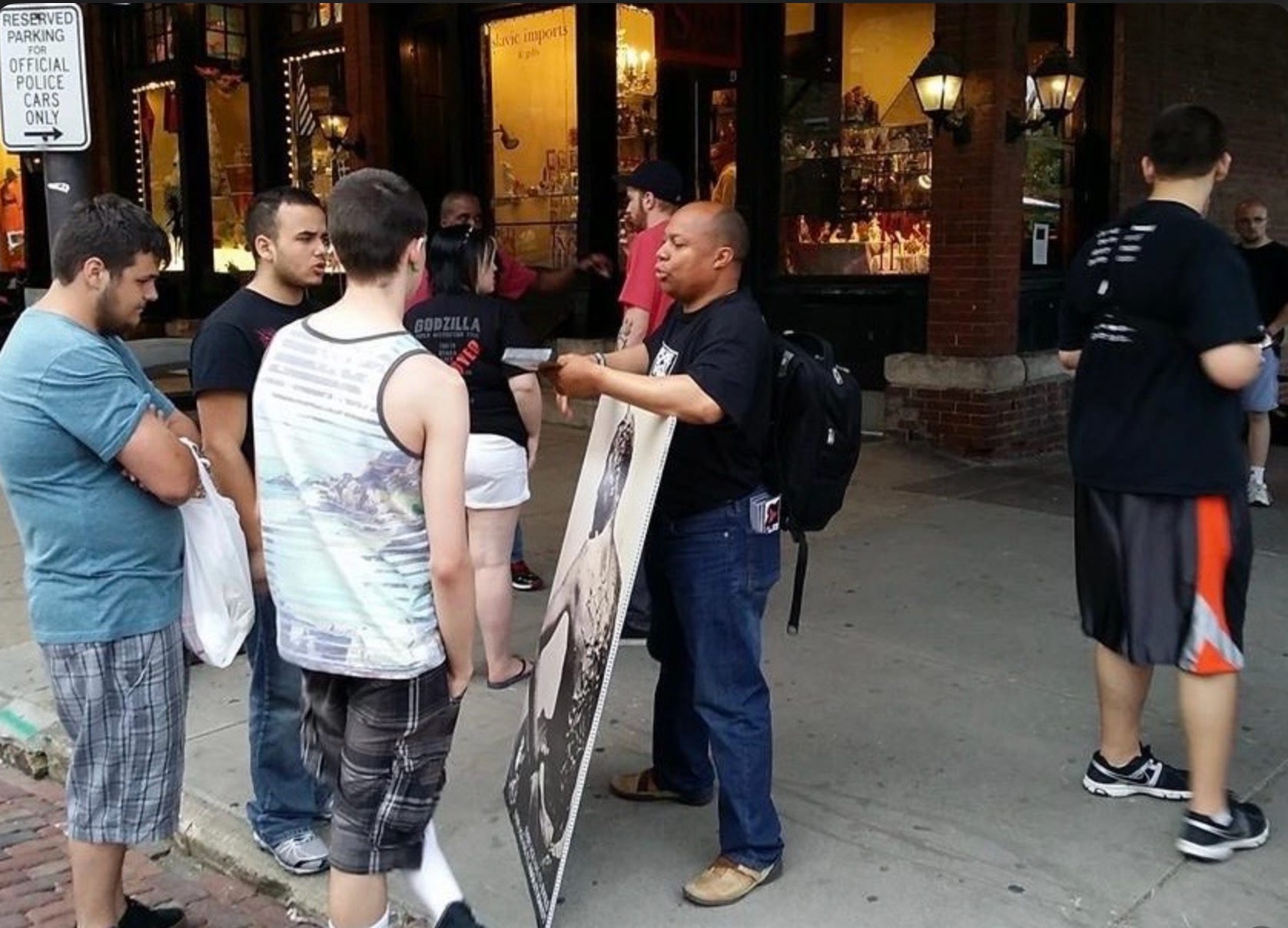
The Air Force paid me to sit at kitchen tables and talk somebody’s son into signing away the next four years of his life. For a season, I was the best in the country at it. Years after that, I got ordained and stopped asking men for anything.
So I know what makes an eighteen-year-old put his name and even his life on the line. And it was never comfort. I offered them something hard and worth their lives, and they signed for it.
As a pastor, I started saying a sentence that has been circulating in serious churches for a generation. It comes in different phrases, but it arrives in two tidy halves. The mission is not to transform the culture; it is to transform people, one soul at a time. Get the individual right, the thinking goes, and the world outside can look after itself.
I said it and I believed it, and I need to be precise about what it did for me, because I doubt I am the only one.
It felt like discipline, but underneath the theology, it was doing quieter work. It actually took me off the hook. My discipleship could stop at the church doors and still be called faithful. The example I owed the men in my care could be limited to a building on a Sunday. I could preach the whole counsel of God at eleven in the morning and be nowhere at all on Tuesday afternoon, and the sentence would tell me that was integrity.
Recently, I’ve gone back outside. I was out there once, years ago, then spent a long time in the comfort of the building, and now I’ve returned. People who’ve read me for years noticed the shift and keep asking the same question.
No, and nothing I have written here requires it. Whether the church is about to fill the earth or about to be driven underground, the command does not change, and obedience shows up in the world either way.
But notice something about the question itself. Nobody asked about my view of the end times while I was sitting still. I held the same positions for years, and not one person wrote to check my eschatology. Stand outside of an abortion clinic, address a political issue, challenge a public policy, and suddenly my millennial view is of urgent concern. The question did not arrive because my doctrine changed. It arrived because I started showing up.
That should tell us something uncomfortable. For a lot of us, our view of the end has quietly become the reason we’re allowed to stay home.
So go back and read the Great Commission slowly. It’s a command, not a weather report. Christ said, “Go and make disciples,” and He did not add “only if the numbers look good.” He gave an order and a promise to be with us to the very end, and He never once tied my obedience to my confidence about which way the century is trending. A soldier who stops fighting because the news is bad has not discovered a better theology. He has found an excuse and dressed it up in a respectable word.
And here is the part that settles it for me. Suppose the pessimists are right. Suppose it all gets darker, the church gets smaller, and the culture gets harder than anything we have seen. Every bit of that makes the corner more urgent, not less. The clinic is still open in that world. Right? The frightened girl still walks through the door. The man in the cell has still never once heard that Christ died for him. None of that depends on whether we are winning.
I did not go to the clinic because I thought we were winning. I went because a woman was walking in.
So let me say this as plainly as I can. If your view of the end times is the reason you are not out there, then it is not really your theology doing the work. It is an excuse, and you went looking for a doctrine big enough to stand behind. No honest reading of Scripture keeps a Christian home from the hurting and the lost. Tell me the millennium requires you to stay inside, and you have told me nothing about the millennium and everything about yourself.
I also know what the label question is often for. Pin the right word on a man and you no longer have to weigh anything he actually said. I am not going to help with that. Call me whatever you need to call me, but it will not change where I have to be next Tuesday.
And here it is. Where were you last Tuesday?
Not what you believe. Not what you preached. Where you were, and what it cost you to be there.
I’ve stood outside of clinics. I walked into a jail. I preached on a corner where nobody invited me and nobody was obligated to stay. None of that was in the sentence I had been repeating. All of it turned out to be the sentence’s rebuttal, and here is what I learned and have not been able to unlearn.
The ground does not stay empty. If pastors will not model the going, someone else goes. He’s already on his way. He has the clinic, the jail, the corner, the phone, and the feed; he is willing to do what we said was not our mission, and his aims are neither biblical nor altruistic. He will not be reasoned out of territory by men who refused to enter it.
I told myself I was guarding the Gospel from politics. What I was actually doing was ceding ground and calling my absence a conviction.
Give it its due first. There is a cliff on that side of the road, and the guardrail is not decorative. Some men believe legislation regenerates, that a majority is the same thing as a harvest. Under that assumption, the church becomes a political operation with a worship service attached, and the Gospel becomes a means to an end that is not Christ. Congregations have made that trade. The access was always worth less than what they surrendered for it. So when a pastor says the mission is people and not culture, he usually means that no law ever made a man love God. That is true, and it cannot be said too often.
Take the first half first. The sentence took a real distinction and built a wall out of it.
Culture is not standing beside people competing for the church’s attention. Culture is what people make, the residue of what men actually worship, laid down over time in their marriages, their courts, their music, and their treatment of the weak. You cannot change people and leave the culture untouched. Culture is not the target. Culture is the wake.
Paul understood this. His enemies understood it faster. In Ephesus, he ran no campaign against Artemis and petitioned no city council. He preached Christ, and men who made their living selling magic burned their scrolls in the street, fifty thousand pieces of silver going up in one afternoon (Acts 19:19). Then the shrine trade sagged far enough that a man named Demetrius called a meeting and started a riot. Notice who read the situation correctly. Not the church. The idol maker. My theology in those years would have puzzled him, and he would have known better.
Now the second half, and it’s the worse of the two. Transforming people is not the mission either. Therapy transforms people. Islam transforms people. I transformed people for a paycheck at those kitchen tables, and none of it saved anybody. What Christ commanded was to make disciples, baptizing them, “teaching them to observe all that I have commanded you” (Matthew 28:19–20). That clause has no interior boundary. You cannot teach a man to obey Christ concerning his wife, his money, his mouth, and his neighbor’s blood, and then inform him that his obedience stops at his own skin.
A young man walks in carrying strength he did not ask for and a suspicion that it’s for something. The suspicion is correct. God gave it to him on purpose. He wants the purpose. He is looking for a frontier, a fight worth having, and some believable account of why his life should be spent rather than merely extended.
A theology that stops at his own skin has nothing to say to him, nothing at all. It offers him self-improvement, available at his gym for a better price, and inner peace, which he did not request and does not want yet, because he is twenty and he can feel his own capacity burning a hole in him.
We did not lose young men by asking too much of them. We lost them by asking almost nothing, then acting surprised when they went looking for a fight worth having.
We handed the church a passive sentence, excused our own example, retired to the safety of the building, and then acted shocked at the absence of men in the public square. And a large slice of evangelicals is genuinely bewildered that the pied pipers are drawing crowds of young men who want to do something that matters, marching them out under a new banner. We are not bewildered because the answer is mysterious. We are bewildered because the answer is us.
They found their fight. The movements collecting our sons are not offering better theology. They are offering a story in which his strength has a purpose, and his enemy has a name. Counterfeit only circulates where the real thing has been withdrawn. And I recognize the pitch, because it used to be mine. It was the same offer I made at those kitchen tables, something hard and worth a man’s life, and they are making it better than we are.
The fringe also flatters, and I will not pretend otherwise. It tells a young man his grievances are righteous and his failures belong to somebody else, and flattery could have pulled some men out of a church that did everything right. No pulpit answers for another man’s rebellion. But the silence is ours. A Gospel with nothing to say about the world a man walks into on Monday gets replaced by something that does. The replacement is here; it is well-funded, and it is recruiting.
Stop repeating the sentence. Not because the men who say it are enemies, but because it now does the opposite of what it was built to do. If you want the guardrail, and you should, say it the way it should have been said from the start: the mission is to make disciples of Jesus Christ. Culture is not the target; it is the wake. That keeps the guardrail the old sentence was reaching for, and it aims past a merely transformed man to a disciple, which was always the point.
Then look at your calendar instead of your doctrinal statement. The calendar is the real confession. Find the last time you were somewhere uncomfortable on behalf of somebody who could not repay you. If you cannot find one this year, you have your answer, and it is not a theological problem.
Then take a young man with you. Not to a class. To the place. Let him watch what it costs you, because the cost is the curriculum, and there is no way to deliver it. He will learn what a man’s faith requires by watching a man. The only open question is which man.
I preached a Gospel that let me stay inside. It felt like faithfulness. My absence was teaching the whole time.
This is the moment to stand with Sola Veritas.
I publish here regularly to give you biblical clarity in a collapsing world. But clarity alone isn’t enough — we need conviction, courage, and action.
Join the Sola Veritas Inner Circle for deeper conversation, honest reflection, and formation that goes beyond the news cycle.
Free keeps you thinking. Paid takes you deeper.
If you want to wear what you believe, visit the Sola Veritas Store for hoodies, jackets, mugs, and more. Every purchase fuels the mission and spreads the message.
Comments
Nothing yet. Say the first thing.
Sign in to join the conversation.