
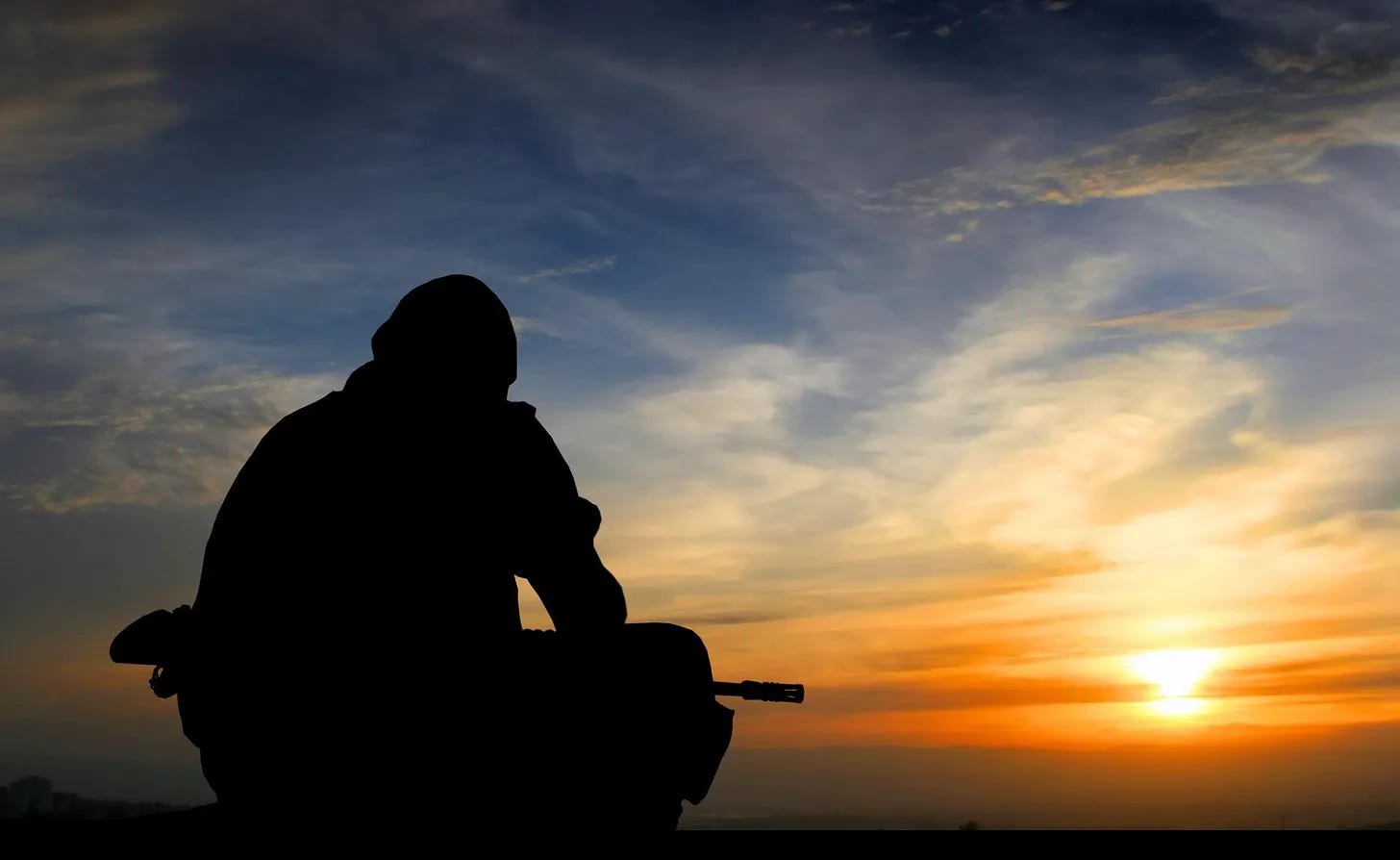
There’s something that the military teaches young men that it doesn’t spend nearly as much time teaching men how to undo.
How to fight.
These days there’s a great deal of talk about war. One thing I have noticed is that those calling for war have often never served. I have served. Now, that doesn’t mean that what I’m about to say is right. But it does mean I know a little about the cost that slogans can never teach.
Basic Military Training, the entry point for every one of us who has served, is the starting point where the military takes ordinary men unaccustomed to the chaos of war and prepares them for battle. Long before it sends them, it changes them.
I know because it changed me.
What I didn’t understand at the time was how difficult it would be for me to change back.
Basic training is strategic. It is designed to test your ability to endure the most stressful environment possible with one goal in mind. Performance. This is the place for you to encounter the chaos that brings about the fog of war long before you are asked to risk your life.
The stress for me during basic was real. I felt it. As an older recruit to the service and one who had completed a couple of years of college behind him, I was selected as the academic officer. This meant ensuring others could recite the previous day’s training from memory on command in front of any drill instructor. The additional responsibility only increased my stress. I was now responsible not only for my performance, but also for ensuring others performed well. Get the wrong answer, and we all paid a price.
The days began with morning physical training (PT) and then academic classes where we learned the history of the Air Force, the code of conduct, and the Uniform Code of Military Justice (UCMJ).
If we were being grilled by a drill instructor and were unable to recite UCMJ Article 92 from memory, group punishment followed, and as far as the group was concerned, I shared in the failure.
Every activity, filled with detailed instruction, was designed to bring you to the brink of what you could endure. Making your bed. Shining your boots. None of it was about the bed or the boots. It was about whether you could hold your nerves together while someone hunted for the one thing you’d done wrong. And there was always one thing. Miss it, and you’d find yourself in the middle of two drill instructors screaming at the top of their lungs, each one holding court in your earholes while you clawed for the right answer that got you out of the mess you were in.
I quickly recognized that men responded differently under these conditions, and all of it was purposeful. Every aspect of our training was designed to challenge us both physically and mentally.
The goal of the training was to train our nervous system to respond to a threat.
Here’s what I noticed. When you’re pushed to the end of your physical and mental capabilities, things change. This condition mimics the fog of war. For most, vision narrows, time expands as seconds feel like minutes, and your mind switches from analytics to survival mode.
I’ve been there more times than I care to admit. The cost is real too.
It is at this point that mistakes happen. Often these conditions produce regretful decisions. Justifications follow, and what seemed right in the moment is filled with confusion.
The problem with the fog isn’t what you can’t see in the moment; it’s what you do see when the fog lifts.
The war was real. The enemy mattered, and the ground we defended was absolutely worth it. Sit with that before anything else, because the lament that follows is worthless if the fight was foolish. It was not foolish.
The inflection point came at MLK50. Leading voices stood before evangelical audiences and lamented their own whiteness. White guilt saturated the room. Eric Mason described certain black leaders as “not qualified” for leadership in multi-ethnic churches because they were, in his words, “black on the outside but Angloid on the inside.”
And in the same breath, the men who heard these alarms assured us that concern over critical race theory inside the Church was a phantom, a boogeyman conjured by the oppressor class to guard its own comfort. That was the move that made the fight necessary. Name the problem, and you became the proof of it. The concern was ruled out of bounds before anyone could weigh it.
Darrell Harrison and I had been addressing these issues from the beginning of our work together on the Just Thinking podcast in December of 2017. Nine months before the Statement on Social Justice and the Gospel was published, we were already hammering the encroachment of wokeness into conservative Christian culture, week after week, on the podcast. As our audience grew, Darrell began contributing and writing for the Statement. When it went public on September 4, 2018, I was among the first to sign it.
The popularity of the podcast began opening doors. In 2019, Darrell and I were asked to deliver a live episode of the Just Thinking Podcast during GTY’s Truth Matters Conference for John MacArthur at Grace Community Church. Darrell had joined the staff at Grace to You earlier that year. Then, in January 2020, Darrell Harrison and I stood before 4,500 people in the main hall of the G3 National Conference and delivered another live edition of the Just Thinking Podcast.
Having secured a strong hold on the reformed Baptist world, we admittedly felt quite accomplished. It wasn’t a mountain we set out to conquer, but nonetheless, we were at the top of it. Then came the event that took us farther than we ever anticipated. In May of 2020, George Floyd died, and the ground we had stood firmly on was now shaking beneath the entire nation all at once. By December, I joined the staff at G3 Ministries and moved my family to Georgia. Now, with Darrell on the west and me on the east, we believed we sat atop the evangelical world. Two ministries we had long admired from afar were now our daily work.
Looking back, I can now see something that was unclear to me at the time. Our combativeness had been rewarded. It wasn’t that we were picking the fights. We weren’t. There were real convictions, and we shared those with our audience. If you were to ask us, the fight showed up at our doorstep, and we had an obligation to punch back. So we did. The more effectively we punched, the more opportunities opened.
There was no moment that either of us decided that controversy was the path to influence. However, what we learned, and unfortunately taught others, was that combativeness had consequences beyond the argument.
Prior to our journey, there was no path carved out that would have made our experience possible. However, it was the result of the work, our exposure, and its reach.
Unbeknownst to us at the time, Darrell and I had created a blueprint for others to follow. We didn’t plan the success we experienced, both on the podcast and in the doors it opened. What we saw as providence, others saw as a platform for creating their own following, complete with conference invitations, book deals, and evangelicalism’s approval.
The training is the thing no one warns you about. Basic Military Training builds a man to survive the worst conditions imaginable, and it does this by teaching him to shut off fear and narrow his sight to the threat in front of him. That reflex saves lives on a battlefield. Over time, the reflex does not know when the battle is over. It continues to run. The vision stays narrow long after the ground has gone quiet, and the man built for war goes looking for one.
And I was here for it. The fight against the social justice movement was real, and for a season it had a real front.
Next came the prosperity preachers, identity politics, “gay Christianity” and Revoice. What followed next was the rise of female pastors, egalitarianism, and church abuse.
Then it was COVID restrictions, government authority over worship, and civil disobedience.
We found pro-life vs. abolitionism, seeker-friendly churches, and church pragmatism.
The normative principle of worship and integrationism.
Classical theism and eternal functional subordination (EFS).
We battled continuationism vs. cessationism.
Then dispensationalism and Israel and the church.
Federal vision.
Theonomy and sphere sovereignty.
The Sabbath.
Soft-complementarianism
Soft patriarchy.
Weekly vs. monthly communion.
Organs in worship.
Celebrity conference culture.
The war became increasingly unclear; I just assumed with every new disagreement came a new battlefield.
And with every battle, needful as it seemed at the time, something was happening to me that I could not clearly see.
When the front collapsed, when it seemed the argument had been won, the readiness did not power down. We had been built to find the enemy, so we found him again and again. A new front opened closer to home. The movement that had trained to fight one enemy proved it could not stop fighting at all. Eventually, the particular enemy had become almost beside the point. The reflex had outlived the war that once justified it.
To power down was to disarm in what still felt like enemy territory. So we kept the rifle up.
The battlefront did not shrink. It metastasized. What began as a defense of the sufficiency of Scripture hardened into a permanent posture, and the posture spun off ministries of its own, whole platforms built for the single purpose of finding error and naming it. The watchmen multiplied. The wall grew crowded with men scanning the horizon, and there is always something on the horizon when scanning is all you do.
Initially, I felt energized; a new day brought with it a new dragon to slay. I grew more impressed with my own ability to verbally discharge this foe. Social media was the playground where we kept score on who dispatched the enemy with the right verbal twist that would vanquish it.
As time passed, the relentless pace wore on my soul. In addition to the weight of work and responsibilities at home, my mind couldn’t rest as I kept my finger on the pulse of the next hot-button issue.
Finally, the damage became evident in my own inability to sense that my heart needed the work, the examination, that I had dispatched to the digital villains I deposed.
This is the posture of battle I chose.
If I haven’t been clear up to this point, I want to say that the battles were necessary. Doctrine does matter. I’d never argue that Christians should lay down their arms in the face of error. Some have accused me of taking that posture. It’s far from the truth. Personal conviction here isn’t enough. Scripture is clear that we are in a battle. We are indeed at war.
What I’ve been wrestling with as I watch the landscape of evangelicalism is whether we’ve conveniently misunderstood where the fiercest fighting is supposed to take place.
Paul told the church at Corinth that although we walk in the flesh, “we are not waging war according to the flesh.” The weapons of our warfare are not of the flesh. The question, then, isn’t simply whether the battle is legitimate.
It is whether we are fighting Christ’s battles with Christ’s weapons.
All the while, there remains another enemy much closer to home — the sin that still wages war within us.
I have become convinced that we learned how to fight one war while neglecting another.
This is the war I want to talk about next.
Comments
Nothing yet. Say the first thing.
Sign in to join the conversation.