
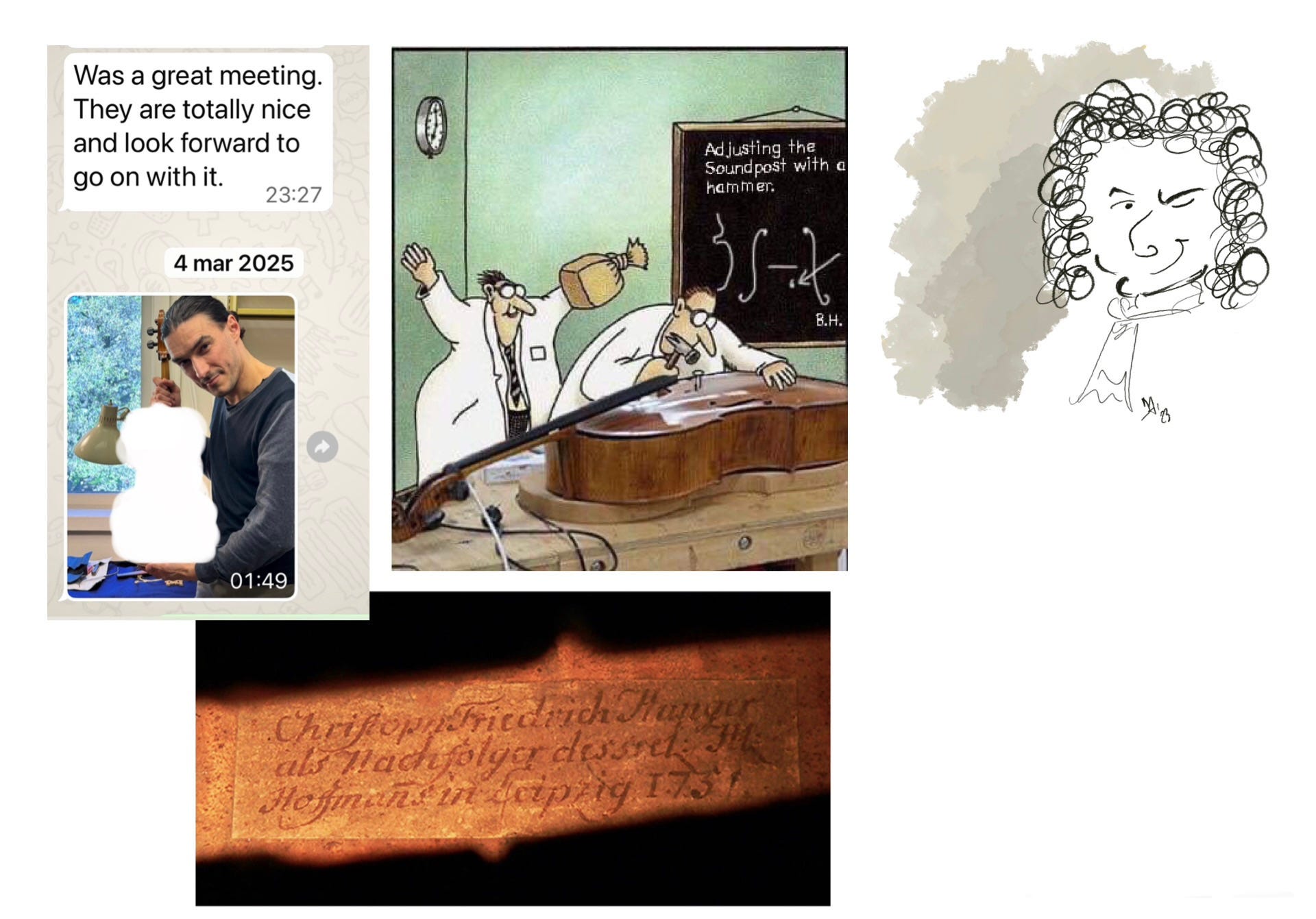
No, wait. It can’t be so short! Let me tell you a bit about what’s happening!
As you may know, there are only 3 surviving da Spalla cellos by J. C. Hofmann in the world: one is in Brussels, one other in Leipzig, and another in Berkeley. The first two are easily accessible (at least if you live in Europe), while the Berkeley one had the fame of being not accessible at all, like you cannot make contact with them, they won’t answer, etc… but where this fame came from?
At the beginning of last year, I received a WhatsApp from Sergey Malov, asking me to get in touch with the Berkeley people and see if he could go there, see the instrument and talk to them. I thought it a lost cause, but Alessandro pushed me in trying anyway. Guess what? They instantly replied that Mr Malov was welcome to go there and see the instrument (and this was clue number 1, Sergey with the Hoffmann in his hands). Not only this, but after his visit we were contacted by the curator, Carla Shapreau, and we had a long video call with her, confirming their extreme kindness, enthusiasm and accessibility!
However, the instrument needed some restoration (second clue), which included taking the top off to make a post patch. The Berkeley instrument came to US in the 50s with a letter attesting that it was part of C. P. E. Bach’s legacy. It could easily be a commercial trick, and unfortunately there is not mention of such instrument in the inventories of Bach’s home, however we know that Hoffmann and Bach were very close to each other and that Hoffmann made such instruments on Bach’s specific commission (3rd clue).
So, finally, here are our plans for this week:
we’re flying to San Francisco to see the original Hoffmann under restoration, while the top is off!! 🤩🤩🤩
And what about the 4th clue?
We’ll be also going to Vermillion, a small town in the most southern corner of South Dakota, where there’s one of the most important musical instruments museums in the world! In there, they have many remarkable instruments (see here the list of the collection), and between them one viola that was made by C. F. Hunger, an apprentice of Hoffmann who took over his workshop when he retired. This viola has a label from 1731., exactly like those of the two Hoffmanns of Berkeley and Leipzig.
On our way back we’ll be also going to Bamberg to visit our friend and customer Martin Timphus, and we’ll attend to his first concert playing the Violoncello da Spalla! Many exciting things to report in our next newsletters, so keep following us!
We’ll be publishing short updates in our notes, while this newsletter will be paused while we’re away. You can expect to receive the next issue in your mailbox by the 15th of June.
A full six pages article on the history of Violoncello da Spalla and the challenges of making them. This article testifies of the growing interest on the Violoncello da Spalla! It will not remain a lonely star, but will be followed in the next year or so by other insights focusing on the artistic life of a da spalla player and on original surviving instruments. We’re finally on the spotlight!
One of our duties regarding this Berkeley Hoffmann’s project is to provide suitable strings. Both versions of setup: the one preferred by Malov, who will most probably play at the inaugural concert, and a baroque setup for future performances. The Salz collection in Berkeley is not a museum collection, but it is meant to be played by the university students. They have a baroque orchestra there, so we can expect more than one exciting performance, and possibly even more research projects.
I honestly thought that providing Aquila strings was a matter of a phone call, because I know Mimmo Peruffo’s passion for research and his generosity. However, it involved much more than that. I didn’t imagine that the modern set was a burden for the company, because it contained as much silver in value than half of the price of the set itself! in other words, the silver price decuplicate in the last few months, and the set was not sustainable any more. So, we jumped in our car and went to Aquila’s factory. They already had our instrument to work on improvements on the two red trebles, but the project grew bigger and… we’ll write details in a future newsletter. By now, a snippet of our experience there, and we are bringing to Berkeley a new red set and a gut one.

Comments
Nothing yet. Say the first thing.
Sign in to join the conversation.