
I’ve got a tendency to make vague yet complicated plans for big personal opportunities or milestones—days like today, which is both my 40th birthday and the release of David Cronenberg’s The Shrouds—but fail to follow through on them out of feelings best summarized as fear and modesty. People who’ve met me (or have a parasocial relationship with me) might find this unbelievable. I certainly can be brash and confident, but there’s only some ways I feel comfortable drawing attention to myself. (It also feels unbelievably crass to try and draw attention to myself as this administration refuses court orders to return innocent, legal immigrants to the United States; yesterday, a Latinx man who was born in Georgia was detained in Florida, and the judge is pulling the same “I can’t do anything” routine. ) I’ll elaborate on the desire to be seen yet not seen another time, ’cause tempus fugit—or as I like to say, tempus fuggit. I’m very behind on a feature, so I will use this post to draw your attention to a couple of things. The first is John Semley’s really lovely feature about The Shrouds and my book. As he explains in the article, Semley generally agreed with Robin Wood’s assessment of Cronenberg until he read my book and saw The Shrouds. I don’t write criticism to get people on my side, but rather to consider different readings of a particular work, so Semley’s essay was extremely heartening. Also: if you’re in New York City or its environs, please consider coming out to Film at Lincoln Center to see the film (and me intro it!) on Saturday. I’ll be signing and selling books rather than old issues of Film Comment.
Now, onto the really good stuff: more of my interview with Carol Spier, Cronenberg’s longtime production designer. They first worked together on Fast Company, aka the Cronenberg movie nobody ever wants to talk about. I loved speaking with her not only because she’s collaborated with Cronenberg for so long, but because she’s the one who’s made the worlds of his films look the way they do. As a production designer, Spier had to satisfy Cronenberg’s needs, but those of cinematographers (making a skylight in the restaurant in Eastern Promises) and actors (creating a hospital door for Maria Bello to slam in A History of Violence), all while also working within the confines of frequently small budgets and according to. (Spier also made a model of the expressway that runs through Toronto so Cronenberg could block out shots and action in Crash.) Her influences on his films cannot be understated.
At the start of your professional life, when you were working at an architecture firm doing interior design, you spent your free time designing sets for amateur theater troops. What initially drew you to the theater?
Well, I had always been fascinated by theater and by what was happening on stage. And I'd been to a lot of local theater when I was a teenager in Medicine Hat, Alberta. It was obviously very local talent. And I thought, yeah, I’d really like to be involved in that. But it was kind of cliquey, the people who were involved in it, so I never got into theater until after I finished university. One of my friends happened to get a grant to do lunchtime theater—it was during those times when there were a lot of government grants, and everybody got one because they couldn't get a job. And I thought, oh, I'll come and help, I'll work for free. So, I helped at night and I went during my lunch hours and helped run the sets. I thought, wow, this is fun. It's more fun than sitting at a drafting board.
You also apprenticed at a Winnipeg summer theater. What sort of skills did you learn there?
I learned more hands-on skills because I had a design background. So, it was just a matter of applying my knowledge to theater sets, which are like film sets, but are slightly different. I was still at the firm, and volunteered time during the summer. So, I just would go and help for free on the weekends and whenever I could get away. As I said, it was the hands-on stuff—scenic painting, prop building, building set dressing, and some work with the costume designers, learning how to cut the patterns for the costumes and all that. It was a great stepping board.
The set of Dead Ringers was designed in a way that allowed maximum flexibility for shooting split screen. But it’s also kind of a parody of good design or what people think is high design. The extreme end of ultra-stylish, but something that’s uncomfortable to exist in. Was that sense of comedy in your thinking? Or was that even something that you’re thinking of? Cronenberg has said that all of his films are comedies.
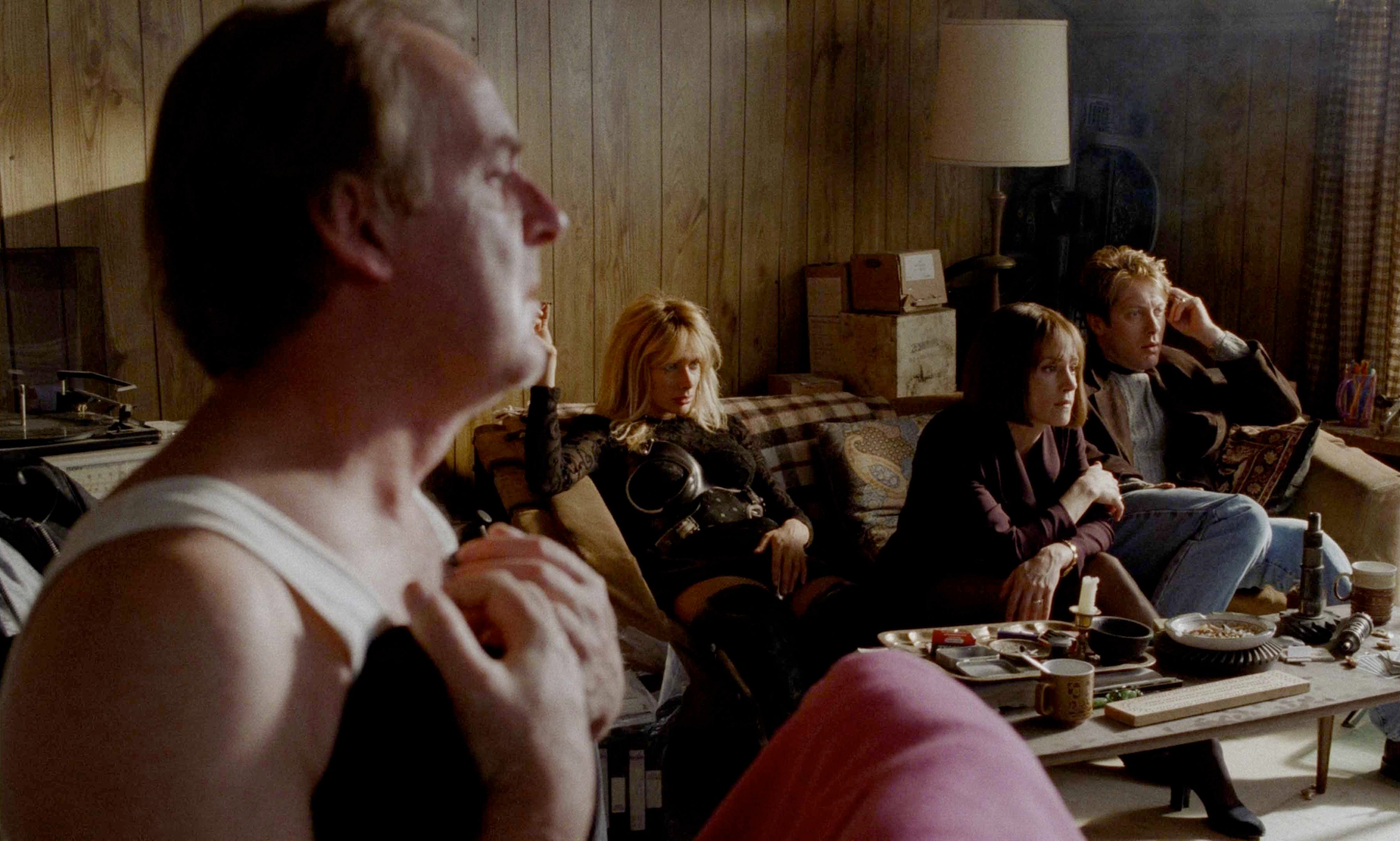
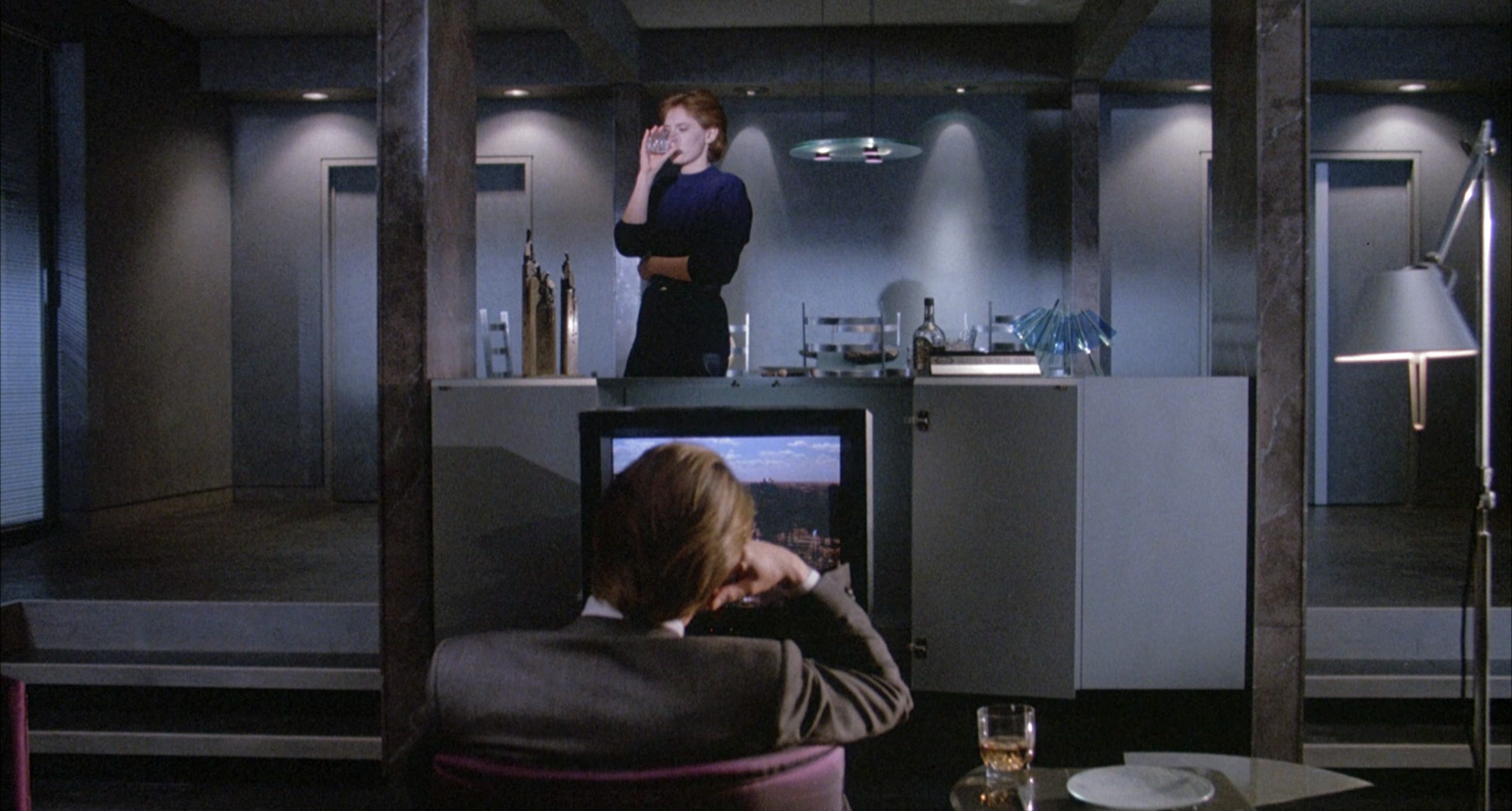
I don’t think we really thought about comedic sense. Mainly it was we wanted it to be that look, that coldness. Everything was hard lines and very stark, not cluttered. Everything was very plain and a little bit surreal, because it’s a very surreal story. So there wasn’t any thought about comedy in the design of the sets when we were doing it. You know, the things that happened while we were building that set were sort of a comedy, a comedy of errors, maybe.
I mean, I’ve always told David he should do a comedy. And it would be an incredible dark comedy if he did one. He has an amazing sense of humor. He’s amazing with puns. There’s comedy that you see as you’re reading it. But you probably don’t see it so much until the actors start to get involved.
During the tax shelter era, Cronenberg used to have a much more experimental approach to filming, where he would write and shoot scenes, and then discard them in the edit. Now he does one or two takes of a scene from very specific setups. Was your working relationship different during that time, or has it remained mostly the same?
It’s probably stayed the same. Scanners was done during that tax shelter time, and David was literally writing the script while we were shooting. There were days during a break, while they were setting up the lighting for a shot, that he’d be at a table with a typewriter, typing up the scene for the next day, and I’d be standing over him trying to figure out, okay, where are we going to shoot tomorrow? What do I need to find for tomorrow? But other than that, he did do a lot of takes then. So if you had a breakaway prop, you had to prep twenty-six of them. Now you only need maybe six. David knows now what he wants, and I think he’s editing it in his mind as he’s going along. So he knows he doesn’t need to do it twenty-six times, he can do it two times. And he knows when he has it. So it’s kind of nice to see. Also, you know your day’s not going to be so long.
Cronenberg famously doesn’t storyboard, but rather relies on actors’ movements on the actual sets, how they’re playing the scene, to adjust the shots and blocking. So for certain things, like the Gardiner Expressway in Crash or the church in eXistenZ, you created models to help Cronenberg figure out those things, and just give a basic sense of the space and its limitations. Do you still use models when working with him?
I haven’t for the last couple of films, mainly because we didn’t have enough time to build the models. Usually the models are built after we’ve designed the set so that we can put them together. So now with SketchUp and other programs, I can give him a model on screen so he can walk through the set on the computer. I still think that having a physical model in front of you is better because more people can be looking at it at the same time, and not having to be looking over people’s shoulders. And you can change things quickly in a model as you’re walking through it in a model. Oh, this column’s in the way. Okay, let’s rip it out and see if it works better. Yeah, I mean, you can do it, but it’s a little slower. I mean, I love computers for that and it has certainly helped a lot. There’s still some of the older methods—maybe it’s because I’m so old and like the old methods better. I still think the old hand drawings look better than the computer drawings.
I wanted to build a model of the Japanese apartment in The Shrouds because it would have been a great model to build, but we didn’t have time to do it. So it was, again, a walkthrough on the computer. Some art departments are getting smaller too, so I don’t have as many people to actually get involved in them.
Was it fun for you to be able to play around with, for example, the Arabic art tradition of geometric patterns and tile work in Naked Lunch?
Oh yeah, it’s great. I mean, I love that. I have a library in the other room, books of all the research that we’ve done, and I have a whole section of Islamic architecture and Chinese architecture. It’s fascinating. Just taking Burrough’s room that he was writing in, which was really just a plain ordinary room, maybe a little bit of tile on the floor, and then adding more detail to it to make it a little more interesting and a little more cinematic. And to fit within, as you said, within that ratio, the screen, you’re keeping that in mind too, so that when they take a shot they’re not cutting off the top of everything all the time.
Right. The eighteen-hour day is not fun. Do you have a favorite memory of that time? There was so much money, but the conditions were insane.
It’s funny because there wasn’t that much money, but we never seemed to be lacking. What we needed, we would always get. David was always, and still is, very accommodating. If you think you can’t give him what the script says and what he wants because of a fiscal problem or just a time problem, he’s very accommodating in saying, okay, well, let’s see if we can shoot it another way. Or if we’re having problems with a location or a set—so, okay, maybe we can combine it into another location. He’s good that way. And that’s one of the things that is great working with him because he works with you. He’s demanding. Don’t get me wrong, he is demanding, especially when it comes to small props and things that he really focuses on. But, he’s very accommodating and he knows, probably because of that time. Most of his films have been low budget, except for a couple. So you always have to take that into consideration.
What’s an example of a prop that he was particularly focused on?
There’s one in just about every single film.
Oh, I’m sure.
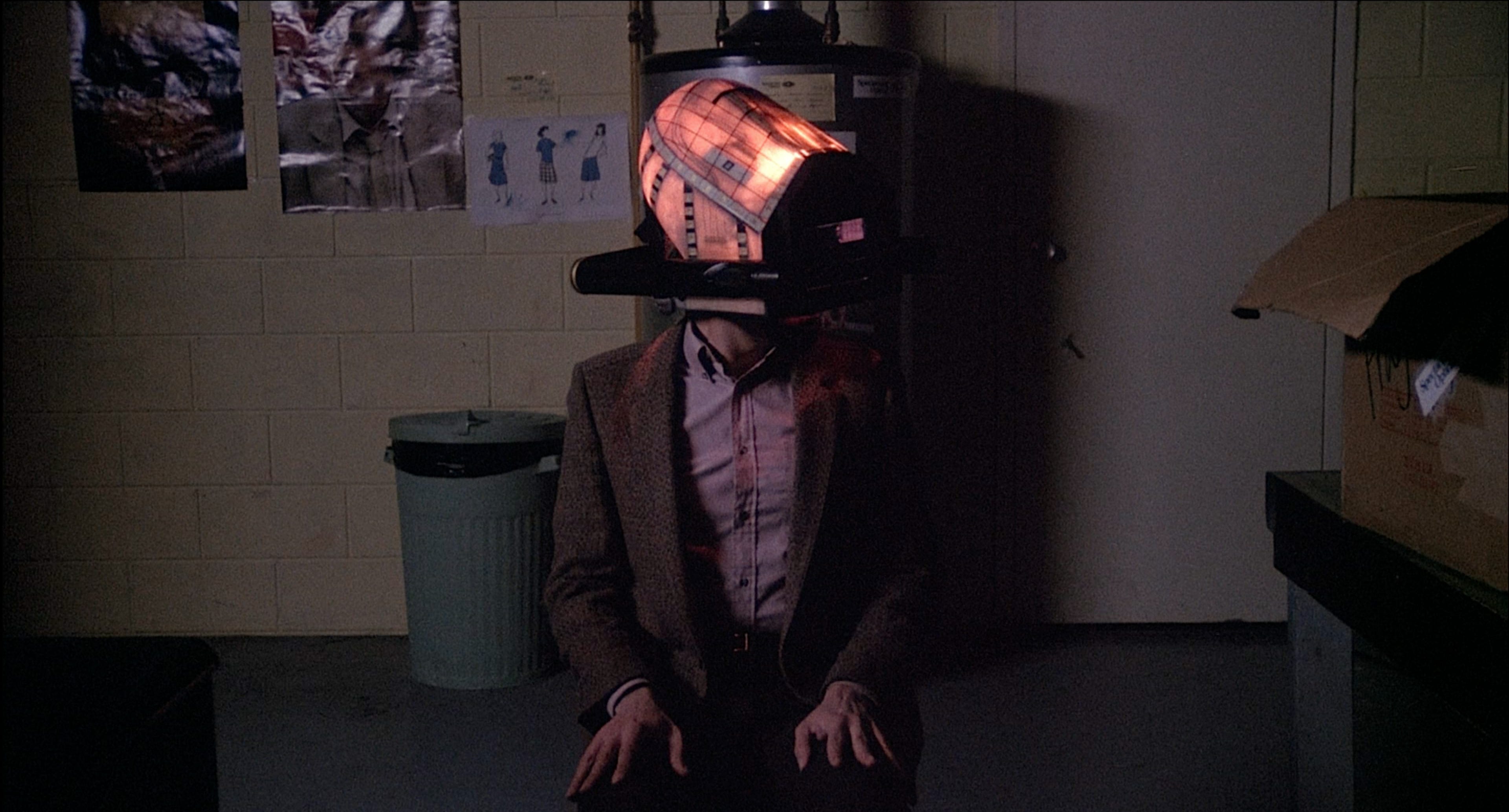
In Videodrome, the helmet was one that he spent a lot of time on. We spent a lot of designing that and building it and making it work. And unfortunately, it was a little heavy for the poor actor, but he didn’t complain too much. Gosh, I’d have to, I have to go back to every single film to remember every one, but a lot of them, like the gun and in eXistenZ, that was not particularly anything that I was directly involved in. That was more the special effects guys and more Chris Wallas’s group that built and designed it, and made it work on set. But there's always something in every single film, whether, and he's also very technically interested in things that are happening. In The Shrouds, it was the Tesla car. We had to make it work, even do things that the Tesla company said, oh, sorry, we can't do that.
What were you trying to do to the Tesla? Why didn’t it work?
It was just what was playing back on the screen. They wanted stuff to play back on that. I don’t know if you’ve been in a Tesla, but it’s got a pretty big screen on the inside of it. Our poor props person was meeting with the Tesla guys and they were trying to figure it out. They’d say, no, that’s not possible. And she tried to explain to David what they were saying and that they couldn’t do that. I mean, we’ve managed to do it. What they couldn’t do is just green screen on the Tesla screen. But because David wanted to have as many practical effects as possible.
What sorts of things were you looking at for The Shrouds? Did the personal nature of the film influence your approach?
Oh, definitely. Everything that we did. It was based on things that David had experienced. David wrote things that were based on people that he knew and locations that he knew—like the Japanese apartment was based on a specific apartment that he’d been to, that I also had been to. Well, I knew we weren’t going to be able to shoot there because it was too small, and it would have been hard to light through the windows. So we built it. I suppose I spent more time talking to David about things like, “Okay, what’s this character been through?”
How do you go about choosing illustrators for concept illustrations or to work with props? Some of that comes from the SFX teams. But then there are things like the tools in Dead Ringers.
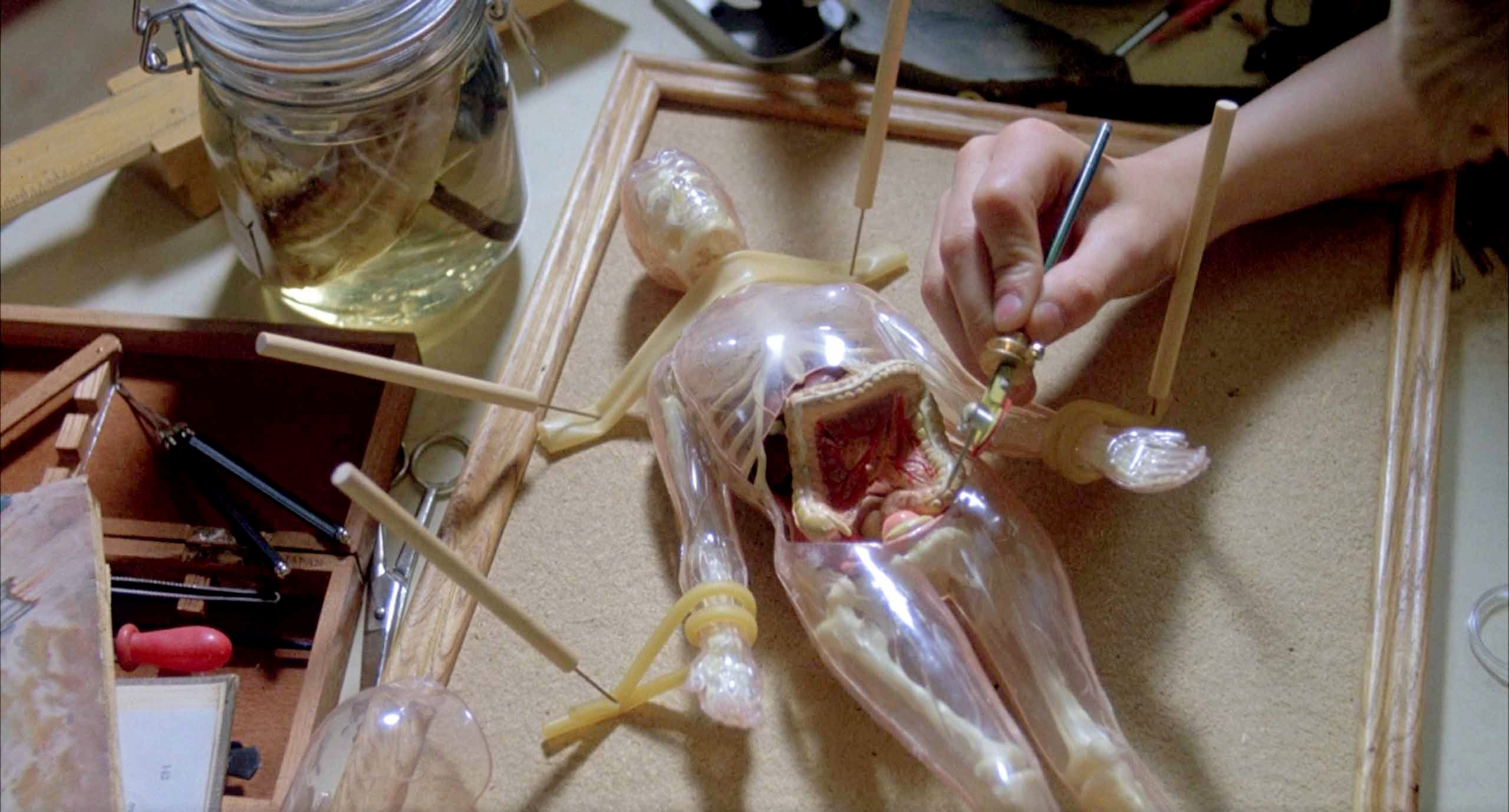
For Dead Ringers, we started out by researching real medical instruments and trying to find ones that were the most horrifying looking. God, I wouldn’t want that touching me! And interestingly enough, some of the dental instruments were some of the most—because, you know, they’re going in your mouth. We searched parts of the body and muscle tissue. Bits of muscle, bits of bone. Then we tried to incorporate the parts of the human body into the instruments. We gave it to a jewelry designer/builder who kind of did it up. We did some sketches in the art department, putting together the different things and then pretty much left it in the jeweler’s hands to build and to make.
You've gotten input from actors on sets, probably most famously from Viggo Mortensen. He bought stuff during trips to visit his parents to the sets of A History of Violence. He did the same thing for Eastern Promises, where he went to Russia and he brought giant suitcases of stuff back. But I’ve found a few interviews where you’ve mentioned other actors, like Ian Holm. But I could imagine somebody maybe like Peter Weller, who’s super Method, also getting involved in this process.
I think Viggo is probably the only one that really gets involved that way. I mean, other than maybe small things about—you know, Ian Holm was just such a gentleman to work with. I mean, he was just a lovely, lovely man, but he didn’t really, you know, have any demands or asks or anything like that. He just worked with what he had. I mean, the props people probably have more to do with that, because they’re dealing with the things that the actors are handling. “Does this lighter work for you properly? Or would you like this lighter or that lighter?” They’re personal things. But Viggo’s the only one that’s ever called me up in my office and said, “Can you meet me in ten minutes? I got a bag full of stuff to show you.” And now having done two movies with him as the director, he’s still the same. On the last film in Mexico, [The Dead Don’t Hurt, 2023], I can't tell you the number of things that he had shipped from his home to use. “Oh, we can't get it.” “Oh, I think I got one at home.” And then I do the same thing. “Oh, I've got one of those at home.” It was low budget, too. Trying to find something in Mexico that was supposed to be early 1860s Western United States was hard.
I saw the documentary about A History of Violence [Acts of Violence, directed by Carolyn Zeifman, Cronenberg’s wife] and so I know about Fish Friday, which seems to attest to what a great person he is to work with.
Yeah, well, he’s an avid fisherman too. He does a lot of fishing. He’s gone fishing near my house here outside of Toronto. Some of the things he brought back to put in Tom’s diner were like a couple of posters of fish from the area that fishermen go out to catch. There were also things around the check-out area that were fish-related. It was a thing on A History of Violence. And this was one. I don't know if you can see [holds up big mouth bass cup], it's a fish pencil holder that I still have.
That’s amazing. With A Dangerous Method, you were dealing with real people and real places. How much did that inform your approach to pre-production? Did that change to the research process at all?
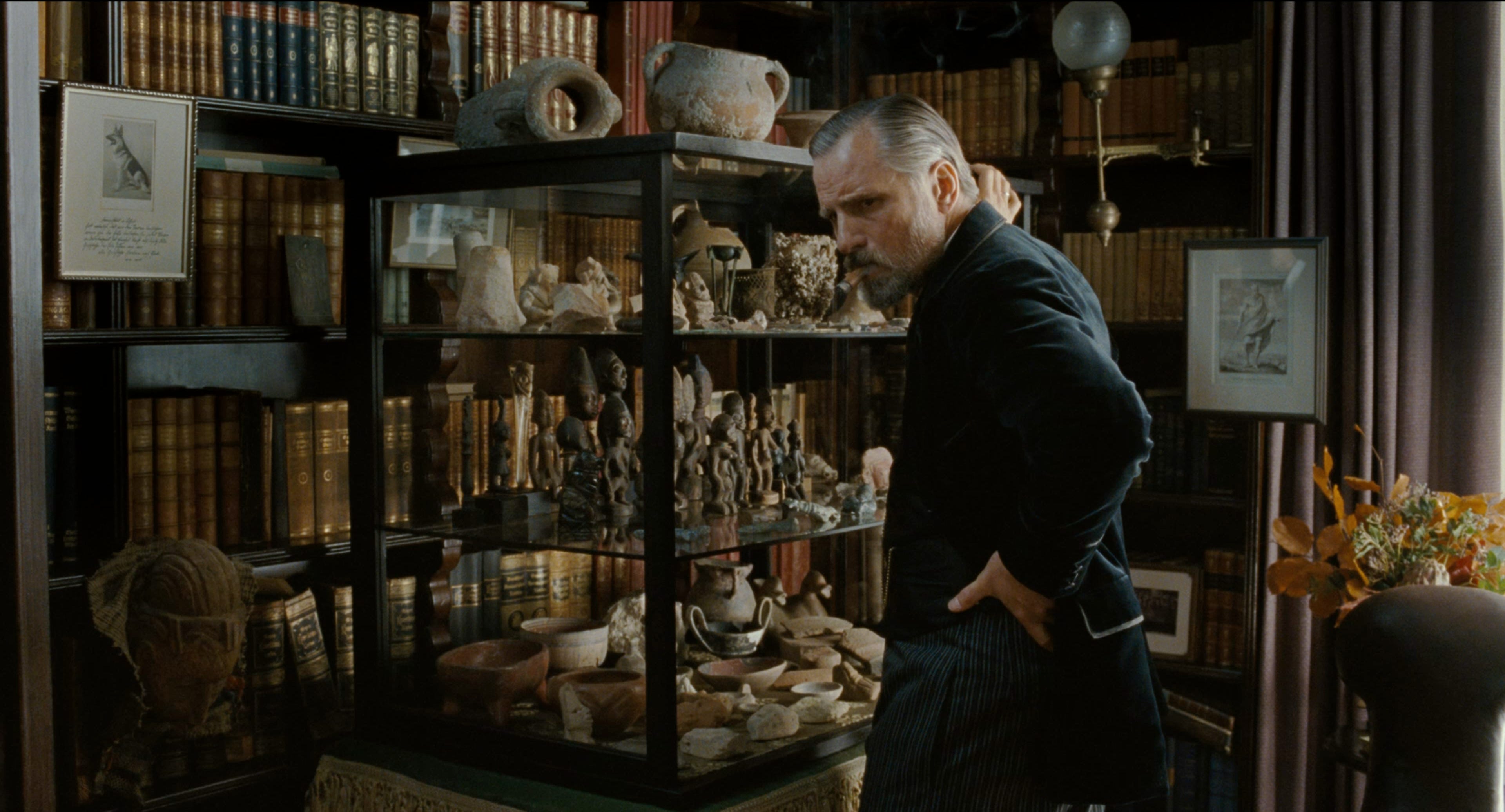
David, a few other people, and I went out to scout locations the year before they shot. So, again, it was another financial thing. They didn’t have all the money together. We went to Freud’s house in Vienna, the coffeehouse where he hung out, and Jung’s house. We were able to get into Jung’s house where he lived. So while we were there, I couldn’t actually measure anything because we weren’t supposed to, but I took a ton of photographs, some without them knowing that I took them.
Those are the best photographs.
And I would sort of gage, well, that door’s about three feet wide. Then I could use those couple of measurements that I had in my head to figure out what the rest. So, when we came back, we were able to pretty much duplicate his office. And the same with Freud. At Freud’s, I was able to take a few measurements because it’s actually a tourist place. We spent a lot of time looking at that and also looking at what kinds of books he had on the shelf and what artifacts were around. And so, we had, again, a ton of photographs.
Did the phallic sculptures on Freud’s desk come from Viggo? Or were those things that you tracked down?
No, no, no. Those are actually some of the things that Freud did have on his desk, these pre-Columbian art things, and some of them were a little phallic. We had the set dressers find those. But there was, on his desk, a cigar box. And that cigar box was Viggo’s grandfather’s. It actually had a partially smoked cigar in it that his grandfather had smoked. So, that cigar box on that humidor became a very important prop on the desk. And, the props guys were, you know, charged with looking after it with their life. That’s why it didn’t disappear.
Tracing this fifty-plus year arc of Cronenberg’s career for this book has also made me realize how different things are. There are so many social, technological, and economic differences that define each era. Your father was an electrician who was an amateur photographer. Your mother was a hairdresser who also painted. And we're entering an era where that's kind of become the norm again, right? The cost of living is very high, and it's very difficult to support yourself solely on creative pursuits—unless you're a graphic designer, or making content for a company. What do you make of this change? How do you anticipate that this will or won’t change the look and feel of film?
I think right now what we’re all worried about is AI and how that’s going to change film. I mean, the actors are worried about it. I mean, they’ll probably need a production designer to design things, but they won’t need them as much as before. The building of sets will not be like it was. It certainly has impacted it already—you build the set partially up and then they create the rest later. And the big thing is: are you still going to be involved in what that’s going to look like, or are you off on another film, and somebody else comes in and designs it? I’m sort of in the last stages of my career now. I mean, I want to retire. I just keep getting phone calls from people that I can’t say no to. But it’s definitely changing and it’s changing film. I mean, it must concern you too. “I’ve got to write a book tomorrow. Let’s see what can I find on my computer.”
No posts
Comments
Nothing yet. Say the first thing.
Sign in to join the conversation.