
In 2006, the music industry’s perceived nightmare was a teenager with a LimeWire account. Sure, they could steal the product, but they couldn’t steal the experience.
The show, the stage, the room full of people who all knew the words; that was the thing piracy couldn’t touch.
Twenty years later, the industry built its recovery on that logic. Streaming neutralized piracy but handed the profits to everyone except the artists who made the music. Then live music tried to create an alternative to streaming’s broken economics by being the one thing an algorithm couldn’t replicate. That argument held. For a while, it held.
But in the last few weeks, three stories landed that together describe what happens when that argument stops holding. When the same consolidation forces that swallowed recorded music and streaming now reach the final frontier. An AI company used a copyright settlement deal to seize the behavioural data of millions of live music fans. A federal judge ruled that Spotify’s users had already waived their right to challenge a secret payola scheme when they accepted the terms-of-service agreement. And across the US, major stadium-level artists are canceling tour dates because fans can’t afford, or no longer care enough, to show up.
Artists have spent 20+ years saying that the music industry is broken and is going in the wrong direction. It was never broken. It is working exactly as designed.
We need to understand precisely about what happened with Suno and Songkick, because the actual facts are more alarming than the framing.
At the time, observers noted that acquiring a concert app seemed like a strange prize for an AI music company. Now we know it was actually about the database.
On April 30, 2026, emails went out to Songkick users confirming that all personal data including account details, artist preferences, location information, concert-tracking history, alert settings etc. had been transferred to Suno, now named the “controller responsible for that data going forward.”
And that’s just scratching the surface. Songkick was deeply integrated with Spotify, meaning what transferred isn’t just what we mentioned above. It’s years of concert-tracking behaviour cross-referenced against streaming habits.
They now know which artists fans follow, which tours they searched for, which cities they attend shows in and what they love enough to actually buy a ticket for.
That psychographic depth is precisely what AI training pipelines are built to exploit.
The recent job listing Suno posted for a General Manager of Songkick confirms this direction. The listing calls for someone to
“Develop and execute an integration roadmap that connects Songkick’s live music graph with Suno’s artist and creation ecosystem; and to champion a vision for what it means to move a fan from ‘creating’ music on Suno to driving live experiences on Songkick.”
They report directly to Suno’s Chief Music Officer, Paul Sinclair, who was also the former EVP of Atlantic Records.
That sentence describes a closed loop. A fan ‘creates’ music on Suno using AI clones of licensed mega-artists, then gets “driven” to live experiences curated through Songkick. The independent artist who didn’t sign a licensing deal with Suno, the emerging musician outside any AI training dataset, the band playing local venues; none of them exist inside that funnel. The architecture being built excludes independent artists, by design.
And while all this is happening, Suno is being labelled an illegal “pirate studio” by Believe CEO Denis Ladegaillerie, who announced in late April that Believe and TuneCore are blocking distribution of all tracks made on unlicensed AI platforms, naming Suno explicitly.
But, Suno has 2 million paid subscribers, $300 million in annual recurring revenue, and a $2.45 billion valuation.
The Warner settlement, which looked like a legal consequence, was actually a business deal in disguise that gave Suno the infrastructure to build a surveillance pipeline into live music.
The same week, a court ruling landed that deserves to be read alongside.
On April 30, 2026, Judge John G. Koeltl of the Southern District of New York ruled that the class action lawsuit accusing Spotify of operating a “modern payola” scheme must be sent to private arbitration.
The class allegations were dismissed with prejudice.
The case, filed in November 2025 by subscriber Genevieve Capolongo, accused Spotify of deceiving users through Discovery Mode; a program where artists and labels pay for algorithmic promotion in exchange for a 30% royalty reduction with no public disclosure that the recommendations are paid placements. By 2023, more than 50% of artists earning between $50,000 and $500,000 annually had participated, generating €61.4 million ($71.4 million) in gross profit for Spotify in a single year.
The Artist Rights Alliance called it “exploitative.” The U.S. House Judiciary Committee warned in 2021 that it could trigger a “race to the bottom.”
Spotify’s defence was not to challenge the facts. It was to argue that users had waived the right to sue inside a terms-of-service agreement that almost no one reads. The judge agreed & the case now moves to the National Arbitration and Mediation organization. That means no public courtroom, no jury, no class accountability, no precedent any future challenger can use. Every document filed, every finding reached, stays behind closed doors permanently.
Thanks for reading Vinyl Culture’s Newsletter! This post is public so feel free to share it.
Payola was banned from American radio in the 1950s because it was a deception. Telling audiences one thing while doing another. Discovery Mode runs the same mechanism at a scale radio never approached, on a platform that controls 31.7% of global streaming market share. This is a reusable template & every other platform with a terms-of-service agreement is watching.
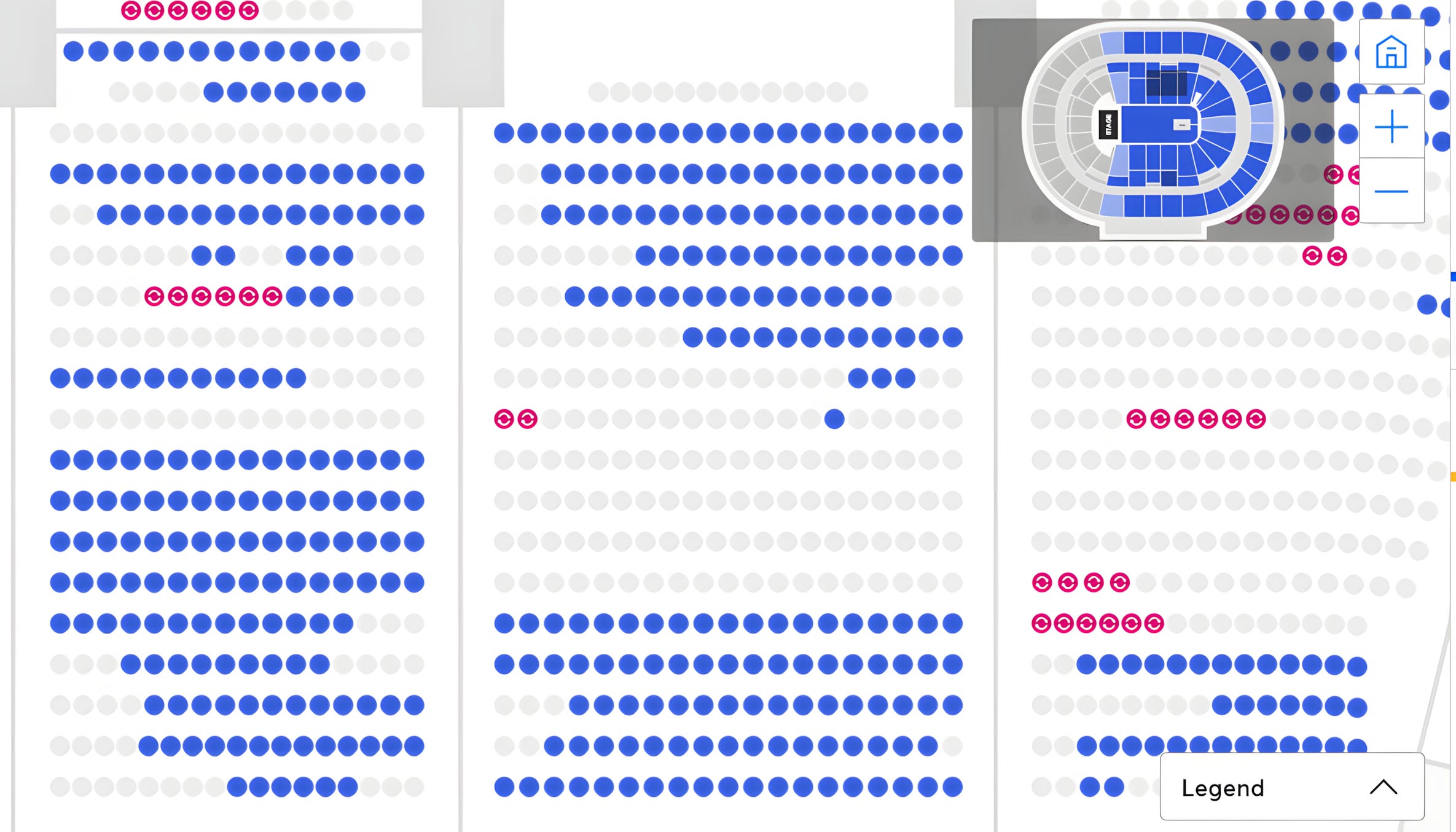
The average concert ticket in 2026 costs around $132, up up 41% from 2019. When prices rise faster than fan loyalty, you get blue dots.
The “Blue Dot Fever” is what concert-goers named the blue clusters of unsold seats on Ticketmaster’s venue maps when a tour is failing.
In 2026, those maps have gone viral. Post Malone and Jelly Roll delayed the stadium leg of their big co-headline tour. Meghan Trainor canceled her entire “Get In Girl” North American run. Zayn Malik scrapped the U.S. dates for his “The Konnakol tour,” writing on Instagram that
“What we are trying to do and what’s possible isn’t really lining up.”
The Pussycat Dolls canceled all but one North American show on their re-union tour, offering no further public explanation.
Live Nation swiftly issued a defensive statement, saying
“Of all the shows Live Nation has on the books this year, less than 1% have been cancelled. That’s not ‘Blue Dot Fever,’ it’s a normal touring year.”
This is the kind of reassurance you’d expect from a company that also serves as the promoter, the venue operator, and the ticketing platform for most of those shows.
Its headline numbers are carried by a narrow tier of stadium blockbusters and legacy residencies that are structurally immune to what’s happening below them. The “Blue Dot Fever” is landing one level below. Mid-level arena acts whose streaming numbers looked like demand and turned out not to be.
Nathan Green, CEO of New Level Radio, put it plainly,
“Artists are getting booked into rooms too big for where they sit today.”
For independent artists, those economics are already catastrophic and have been for a long time. The National Independent Venue Association’s 2025 “State of Live” study found that 64% of independent venues were not profitable in 2024. That figure reached 81% in New York and 80% in Ohio. According to some, the standard 30-date support slot at $750–$1,500 per night in buyouts typically still loses $5,000 to $15,000 after touring costs.
This was supposed to be the safe harbour. Streaming was captured. Publishing was being automated. And people said that the stage couldn’t be replaced by an algorithm. But this process has been going on for a long time.
A decade of algorithmic playlists trained fans to consume music passively and follow platform recommendations rather than artists. And when people don’t have a real connection with artists, the “blue dot fever” strikes.
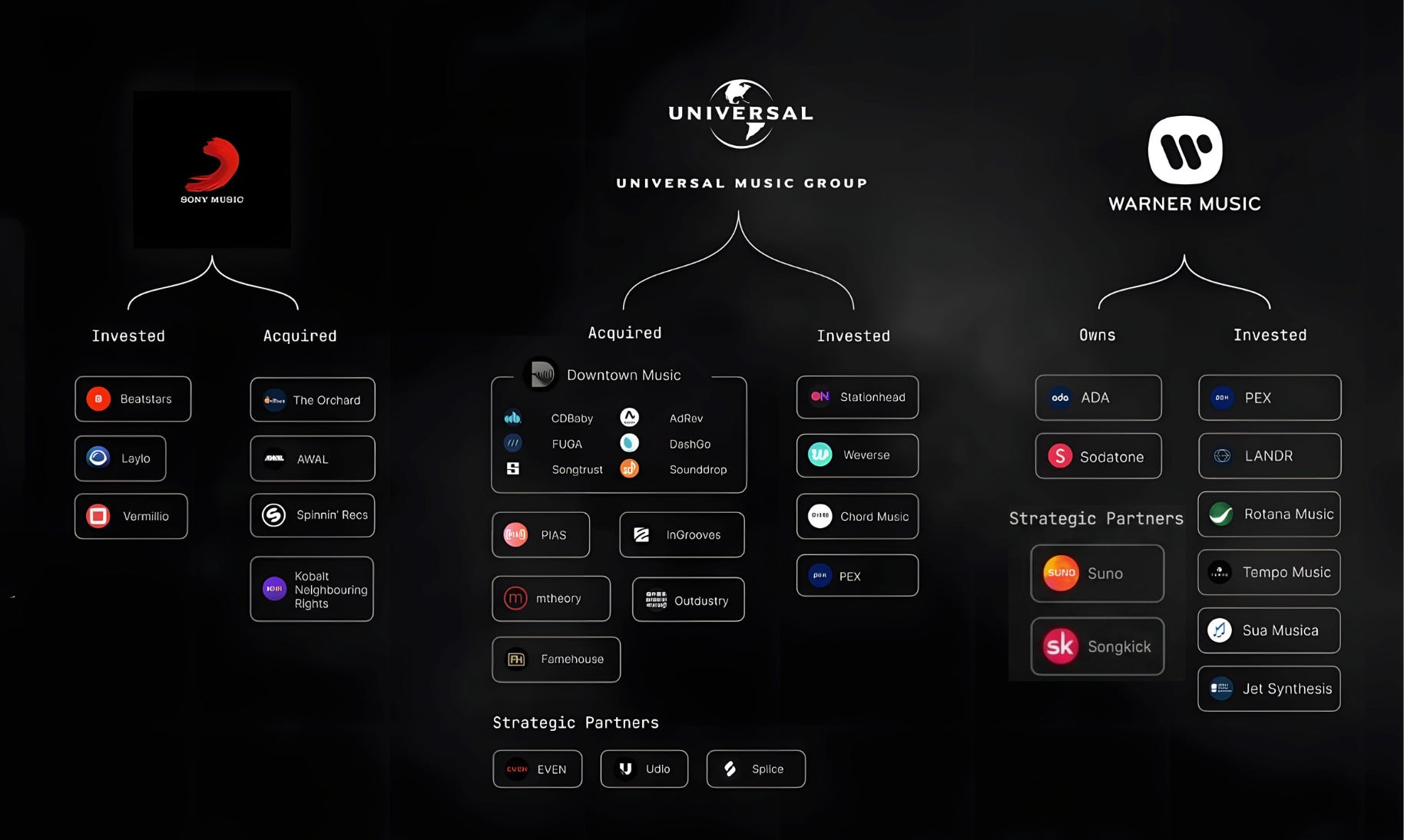
Live Nation’s numbers confirm that the “Blue Dot Fever” is not killing the industry evenly. It is killing it selectively. By tier, by label status, by how deep inside the corporate stack an artist sits. And Suno’s funnel makes that selection self-reinforcing.
The GM job listing describes a product that only works for artists already licensed into Suno’s training data. The independent artist in that 200-capacity venue doesn’t appear in the AI remix revenue pool, doesn’t surface in the Songkick recommendation & doesn’t land on the editorial playlist. The mechanisms that used to operate separately (music production, streaming discovery, live music promotion, ticket sales etc.) are being wired into one single pipeline. And that pipeline only has a handful of owners.
What we are watching is not disruption. It’s replacement.
A parallel music industry is being assembled, populated with AI-licensed content from the same three conglomerates that already control 70% of global recorded music revenue, insulated from legal challenge by arbitration clauses, and now reaching into live music through a concert database that fans handed over without realising.
The teenager with the LimeWire account was the perceived villain of the music industry in early 2000s. The villain of 2026 is the architecture itself. It has your Spotify data, your concert history, and your implicit consent buried somewhere on page 147 of a document no one reads…
🫵🏼 What do YOU think? If Suno’s funnel succeeds, is there any realistic path left for an independent artist to build an audience outside the corporate stack? Has that window already closed? Let us know…
💬 If this one got under your skin; drop a like, share your thoughts below & share this investigation with every artist and music fan you know. The future of human creativity depends on holding these companies accountable. Consider supporting artists directly through platforms like Bandcamp, where musicians set their own prices and keep a fair share of revenue.
🤝🏼 Join us at Vinyl Culture as we continue exploring ways to preserve and evolve an authentic music culture in an age dominated by algorithms and corporate interests. We are building something that will revolutionize the music industry by creating an Artist-centred and Community-driven platform, leveraging both the offline & online medium. We will empower artists by allowing them to share their art and creativity directly with the fans. More on this soon…
8️⃣0️⃣0️⃣0️⃣+ SUBSCRIBERS have now joined our mission to protect The Soul of Music in the age of algorithmic manipulation & AI. Thanks a lot to each & every one of you!! 🫵🏼 🤝🏼🙌🏻 Together, we can make a difference.
No posts
Comments
Nothing yet. Say the first thing.
Sign in to join the conversation.