
PICTURE THIS 🙌🏼
You buy a ticket to see your favourite band in Buenos Aires. The stadium’s majority owner is Live Nation. The promoter is Live Nation. The ticket platform is Ticketmaster, a Live Nation subsidiary. The fees you pay go to Live Nation. The artist management company your favourite band uses is, you guessed it, Live Nation.
And just like that, EVERY CENT you spent has filtered through a single corporate artery. LIVE NATION.
This is not a hypothetical. This is the live music industry in 2026. And it’s moving faster than regulators, artists, or fans can keep up with.
In just the first two months of 2026, Live Nation executed a series of global land-grabs that would make a private equity firm blush.
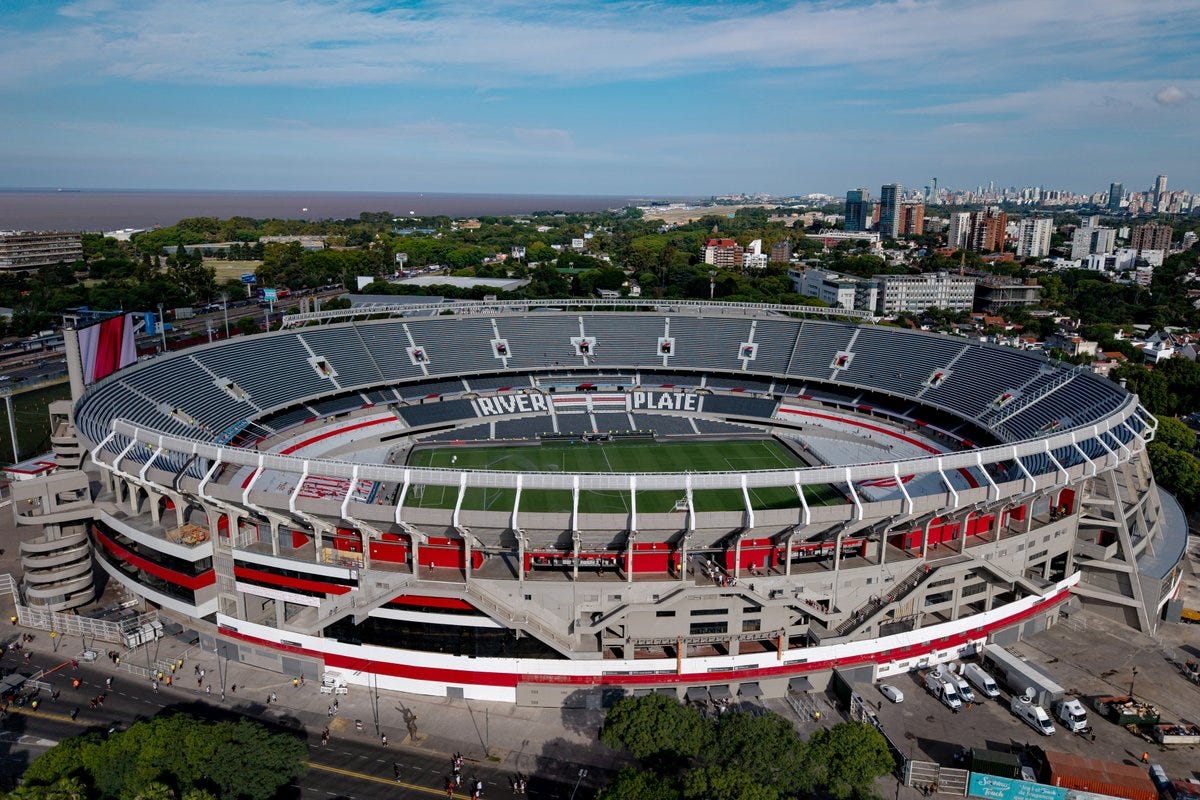
In January, Live Nation locked in a 10-year deal worth a reported $110 million with Club Atlético River Plate for exclusive concert presentation rights and naming rights at Estadio Más Monumental in Buenos Aires which is South America’s largest stadium. Beginning January 1, 2027, Live Nation will control which acts play there, who promotes them, and how tickets are sold.
Two of the biggest Argentine promoters, DF Entertainment (which Live Nation acquired back in 2018) and Dale Play Live, are folded into the arrangement as a neat vertical stack.
That same month, Live Nation announced a majority investment (of 51%) in Bizarro Peru, one of Lima’s leading concert promoters, further cementing its grip on South America’s fifth-largest city. CEO Michael Rapino was candid about the calculus saying,
“Lima, Peru is the fifth largest city in South America and an increasingly important destination for artists touring the continent.”
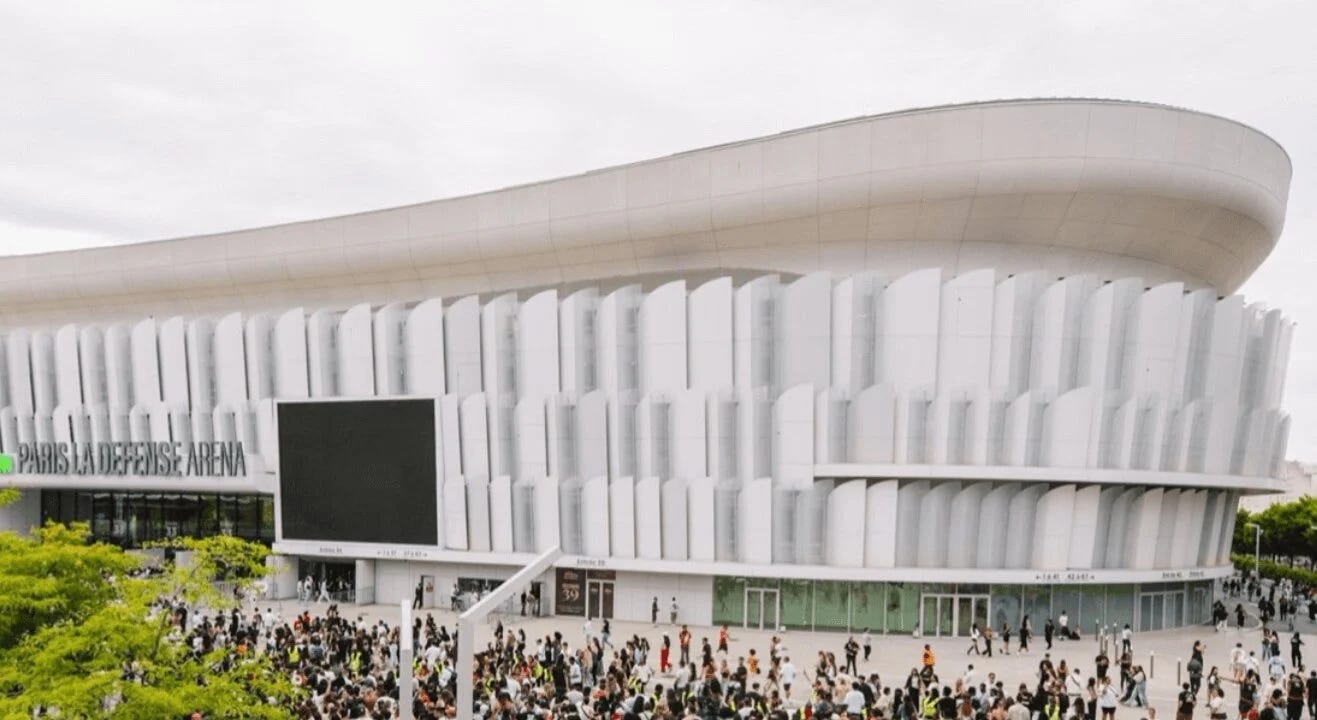
Then came Europe. In early January, Live Nation announced the acquisition of Paris La Défense Arena from holding company Ovalto, pending approval from the French Competition Authority. This is the largest indoor venue in Europe, capable of holding 45,000 people for concerts.
This deal makes Live Nation the dominant player in Paris’ live entertainment scene, sitting alongside Accor Arena and LDLC Arena.
By February, Live Nation had turned its gaze to Milan, announcing the acquisition of ForumNet Group from Bastogi S.p.A. The deal sweeps up three key venues, namely, Unipol Forum (capacity up to 15,800), Teatro Repower (capacity up to 1,700), and the open-air Carroponte (capacity up to 12,000).
Italy’s live music industry was worth €4.5 billion in 2024 and Live Nation just planted its flag at its beating heart.
Beyond South America and Europe, Live Nation's late 2025 expansion swept across three more continents in rapid succession. The company acquired a majority stake in Santiago, Chile's Movistar Arena (15,000 seats), took over operations of Bangkok, Thailand's Impact Arena (12,000 seats), and is part of a consortium building Lagos' first world-class arena; a $100 million, 12,000-seat venue backed alongside the Nigerian Sovereign Investment Authority.
These acquisitions aren’t the acts of a company tightening its belt. They are the moves of a machine generating historic cash.
Live Nation posted full-year 2025 revenues of $25.2 billion, up 9% from $23.2 billion in 2024. A record 159 million people attended Live Nation-promoted shows across 55,000 concerts globally; up 8 million year-over-year.
For the first time in the company’s history, more fans attended Live Nation concerts outside the United States than inside it.
Adjusted operating income hit $2.37 billion, up 10%. The company claims it invested nearly $15 billion in artists and shows during 2025, using that figure as a shield against critics who call them out. Whether that framing holds up depends entirely on which artists you ask and whether they had any choice in the matter.
Thanks for reading Vinyl Culture’s Newsletter! This post is public so feel free to share it.
While the revenue machine hums, Ticketmaster continues to accumulate scandals like a tour bus collects miles.
In the latest incident, Mexico’s Federal Consumer Protection Agency, Profeco, announced in February 2026 that it has initiated proceedings to impose a fine of over 5 million Mexican pesos (approximately $277,800) on Ticketmaster México because of alleged infractions during pre-sale and general sale periods for upcoming BTS concerts at GNP Seguros Stadium in Mexico City, including queue irregularities and instances where tickets appeared in the re-sale market almost instantaneously after going on sale.
The complaints flooding Profeco weren’t small in number as the agency confirmed thousands of consumer grievances, a picture that has become grimly familiar wherever Ticketmaster operates.
This is a recurring pattern. Ticketmaster creates the problem, absorbs the fine, and moves on, because there is nowhere else to go. That’s what a monopoly looks like from the inside.

The walls may be closing in, maybe. That is the central uncertainty of the live music industry in 2026.
Jury selection for the U.S. Department of Justice’s antitrust trial against Live Nation and Ticketmaster began on March 2, 2026. The DOJ, which filed the lawsuit in May 2024 alongside 30 state and district attorneys general, alleges
“monopolization and other unlawful conduct that thwarts competition in markets across the live entertainment industry.”
The trial follows a federal judge’s February 2026 ruling denying Live Nation’s motion for summary judgment.
But like always, there is a political wildcard. With the ouster of DOJ antitrust chief Gail Slater in early 2026 over internal disagreements, concern has grown that the federal case could end in a soft settlement.
Although, State attorneys general are not waiting to find out. California AG Rob Bonta and Connecticut AG William Tong confirmed in February that they are prepared to pursue the case independently, even without federal participation. Tong put it plainly,
“Any resolution that is politically motivated or impacted... is not likely to fly with Connecticut or California either.”
New York AG Letitia James echoed the sentiment, having filed her own suit against Live Nation in May 2024, accusing the company of using its monopoly to “rig the live events industry” and drive up costs for consumers, venues, and artists alike.
The question that lives underneath all the legal filings and acquisition announcements is
What happens to the musicians?
For major label acts with established draw, Live Nation’s consolidation is a mixed bag with guaranteed stadium slots in exchange for dependence on a single gatekeeper.
But for independent artists and those outside the major label system, the picture is significantly darker. The DOJ has explicitly documented how
“Live Nation restricts artists’ access to venues unless those artists also agree to use their promotion services, and how it has strategically acquired a number of smaller and regional promoters that it had internally identified as threats.”
This is the flywheel where Live Nation captures ticket revenue, uses it to lock artists into exclusive deals, and uses that artist roster to force venues into long-term ticketing contracts; and the cycle repeats.
And this is happening at the worst possible moment. Streaming has already compressed artist revenue to near-zero for most musicians. Spotify pays fractions of a cent per stream, and the economics only work at massive scales.
Live performance was supposed to be the one income stream that technology hadn’t yet hollowed out. It is the one place where an independent artist could still earn real money from real fans in real rooms.
As Live Nation absorbs more of those rooms, that last lifeline is narrowing alarmingly.
There is a subtler consequence that doesn’t show up in court filings, one that may matter more in the long run…
What happens to MUSIC itself when its live pipeline is controlled by a corporation optimising for predictable returns?
Live Nation will, by its own commercial logic, programme acts that fill the most seats with the least risk. That means established names, proven formulas, and global stars; not regional scenes, experimental genres, or the kind of slow-burn artists who need a few years of small venue touring to develop a real audience.
The executive director of the National Independent Venue Association, Stephen Parker, described independent venues as "not competing & barely surviving," citing a study showing that 64% of independent venues, promoters, and festivals in the United States were unable to turn a profit in 2024.
The independent festivals, local promoters, and grassroots venues that historically incubated new sounds are being squeezed out or absorbed. When the intermediaries who once took a chance on the unknown disappear, so does the mechanism by which the unknown becomes the known.
Music has always grown through friction, through scenes, through local audiences encountering something strange in a small room.
None of that is commercially legible to a $25.2 billion corporation with share-holders to answer to. The result isn’t silence; it’s something worse! The homogenisation of global music culture.
The trial that began on March 2, 2026 might be the one of the most important proceedings in the history of the music industry. Its outcome could determine whether the music ecosystem that has already been damaged by fifteen years of Ticketmaster antics and a decade of streaming extraction can be repaired. State attorneys general are fighting even as the federal wind shifts. Artists, independent promoters, and fans are watching intently.
The question is no longer whether Live Nation has a monopoly.
The question is whether anyone has the will to do something about it before the last independent stages go dark.
Music has always survived big, greedy corporations but it has never faced something this large, this sly, and this good at making a cage look like the stage.
🫵🏼 What do YOU think? Is there still a path back for independent live music? Is your city's live music scene already feeling this? When was the last time you discovered a new artist at a small, independent venue?
💬 Share your thoughts below & share this investigation with every artist and music fan you know. The future of human creativity depends on holding these companies accountable. Consider supporting artists directly through platforms like Bandcamp, where musicians set their own prices and keep a fair share of revenue.
🤝🏼 Join us at Vinyl Culture as we continue exploring ways to preserve and evolve an authentic music culture in an age dominated by algorithms and corporate interests. We are building something that will revolutionize the music industry by creating an Artist-centred and Community-driven platform, leveraging both the offline & online medium. We will empower artists by allowing them to share their art and creativity directly with the fans. More on this soon…
6️⃣0️⃣0️⃣0️⃣+ SUBSCRIBERS have now joined our mission to protect The Soul of Music in the age of algorithmic manipulation & AI. Thanks a lot to each & every one of you!! 🫵🏼 🤝🏼🙌🏻 Together, we can make a difference.
No posts
Comments
Nothing yet. Say the first thing.
Sign in to join the conversation.