
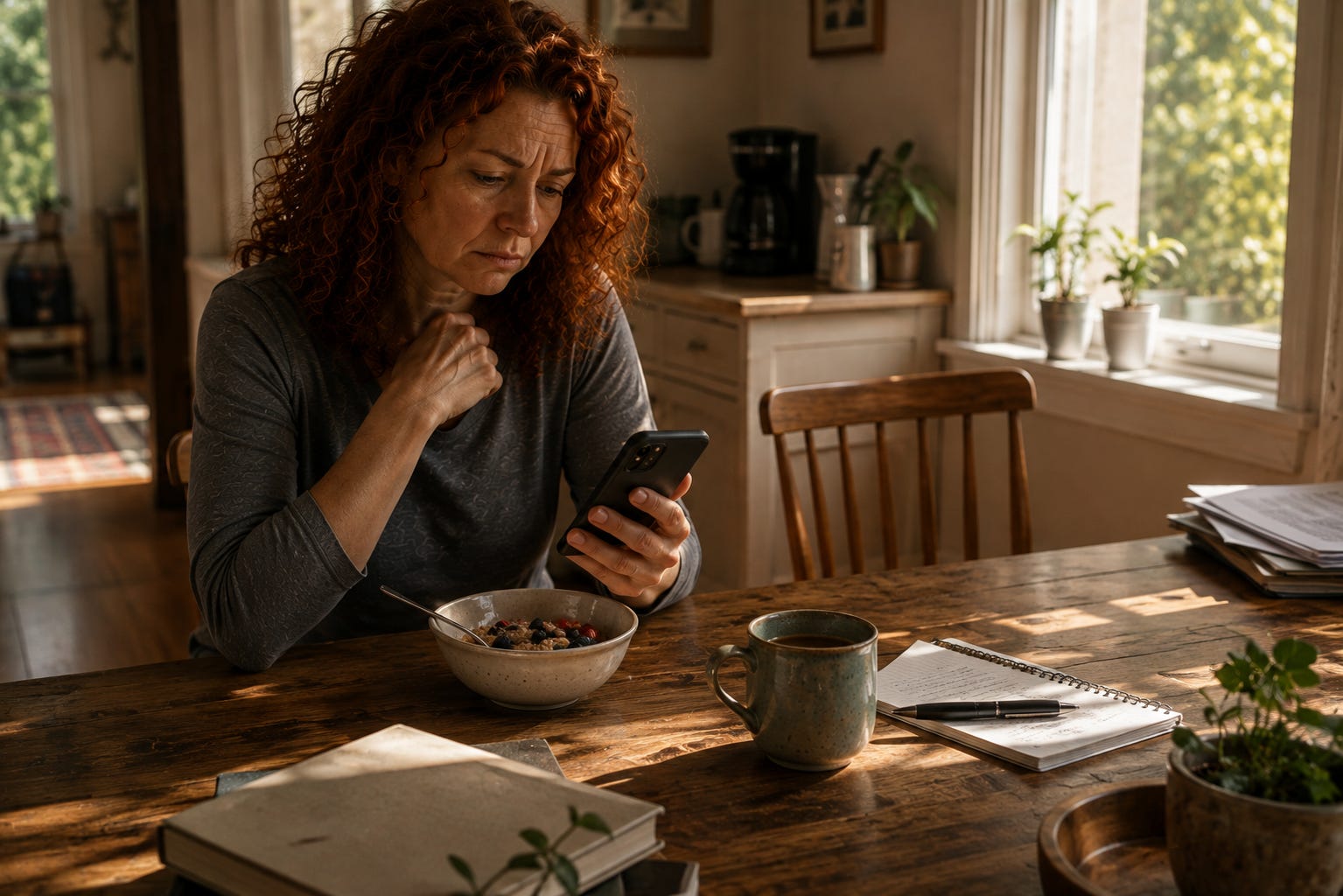
The hinge is the switch point: a problem can begin as something noticed and then, almost invisibly, become the whole apparent reality. The practice is not to stay permanently in a detached “observer” position, but to become familiar with that change of relationship.
SONG: WHEN THE STORY CROSSED THE ROOM
Naomi was halfway through breakfast when the message arrived.
Can you please send the revised document through before lunch?
Eight words.
Perfectly ordinary.
She read them once.
Then again.
Nothing dramatic had happened yet.
Phone in hand.
Coffee beside her.
Bracken asleep under the table.
Morning light on the floor.
A message on a screen.
Then the chest tightened.
Small.
Almost nothing.
Naomi read the message a third time.
Before lunch.
Thought:
I haven’t even finished the first section.
Another:
There’s no way.
Then:
Why did I leave this so late?
Then:
I always do this.
Her coffee suddenly tasted wrong.
She put it down.
Thought:
I cannot deal with today.
And somewhere between the message and that sentence, the room had changed.
Not literally.
The table was still there.
The window.
Dog.
Coffee.
But none of them registered.
There was only the problem.
By nine o’clock Naomi had opened six documents and worked on none.
She checked the original email.
Read the instructions again.
Closed them.
Walked to the kitchen.
Opened the refrigerator.
Forgot why.
Returned to the laptop.
Thought:
This is impossible.
Her chest tightened further.
Then:
I need to calm down.
Then:
Why am I still doing this?
And finally:
After everything I’ve seen, how can I still get swallowed by something this stupid?
Tears arrived.
Now it wasn’t merely a deadline.
It was Naomi.
Her inability.
Her nervous system.
Her history.
Her awakening.
Her whole life appeared to have been summoned by one sentence:
before lunch.
At ten thirty she drove to Elias’s house.
The laptop came with her, unopened.
Elias was in the garden.
“I need help.”
He looked at the laptop.
“Technical?”
“No.”
“Pity. I’m excellent with computers.”
“You are terrible with computers.”
“I know.”
They went inside.
Clara was already there, reading beside the window.
Naomi sat.
Bracken immediately came over and leaned against her knee.
“I got an email.”
Elias waited.
“That’s it?”
“No.”
She showed him.
He read:
Can you please send the revised document through before lunch?
Then gave the phone back.
“What’s the problem?”
Naomi stared at him.
“I haven’t finished it.”
“Okay.”
“I’m behind.”
“Yes.”
“I can’t get started.”
“Yes.”
“I’ve been panicking for two hours.”
“Yes.”
“And now you’re going to ask what’s actually here.”
“No.”
“Good.”
“I was going to ask when the email became a catastrophe.”
Naomi frowned.
“It is a catastrophe.”
Clara looked up.
“Is it?”
Naomi turned toward her.
“I can’t finish it.”
“That may be true.”
“I’ll disappoint them.”
“Possibly.”
“I’ll look incompetent.”
“Maybe.”
Naomi became irritated.
“You’re both being incredibly unhelpful.”
Elias smiled.
“Excellent. Now we’re getting somewhere.”
He pulled a chair closer.
“Let’s make a distinction.”
“I don’t want another framework.”
“It’s a very small one.”
“That’s what you always say.”
Elias held up one hand.
“Sometimes you can go to an experience.”
Naomi waited.
“Meaning?”
“A problem appears, and there’s enough space to look.”
He pointed to her phone.
“Message.”
Then to her chest.
“Tightening.”
“Thought.”
“Deadline.”
“Fear.”
“You can go towards what is happening.”
Naomi nodded slowly.
“And the other?”
“Sometimes the experience seems to come to you.”
“What does that mean?”
“The problem stops being something noticed and becomes the whole apparent world.”
Clara closed her book.
“Like being hit by a wave.”
“Yes.”
Elias looked at Naomi.
“This morning, the email began as something you could read.”
“Yes.”
“At some point, it stopped being a message.”
“It became my entire life.”
“Exactly.”
Naomi thought about it.
She could almost reconstruct the sequence.
Message.
Tightness.
Thought:
I haven’t finished.
Then:
I’m in trouble.
Then:
I can’t cope.
Then:
I always do this.
Then:
Nothing has changed.
Then:
Maybe I’m never going to wake up properly.
She laughed suddenly.
“That escalated.”
“Quite efficiently,” Clara said.
“One email became the entire awakening journey.”
Elias nodded.
“And somewhere in there, you stopped going to the experience.”
“And it came to me.”
“Yes.”
Naomi frowned again.
“So ‘go to’ means I should stay as the observer.”
“No.”
“Why not?”
“Can you find an observer?”
She sighed.
“Right.”
“The metaphor isn’t about creating distance by inventing a witness.”
“What then?”
“Relationship.”
He tapped the table.
“If there is a thought:
I can’t finish this by noon,
can that thought be seen as a thought?”
“Yes.”
“If the chest tightens, can that be felt as tightness?”
“Yes.”
“If fear appears, can that be felt?”
“Yes.”
“That’s ‘go to.’”
“And ‘come to’?”
“The thought is no longer experienced as:
There is a thought that I can’t cope.
It becomes:
I can’t cope.
Not:
There is fear.
But:
Something terrible is happening.
The description becomes reality.”
Naomi was quiet.
Clara said, “The story crosses the room.”
Naomi looked at her.
“What?”
“It begins over there.”
She pointed toward Naomi’s phone.
“A sentence.”
Then pointed toward Naomi’s chest.
“A reaction.”
“Then?”
“And suddenly there’s nowhere in the room that isn’t inside the story.”
Naomi nodded.
“That’s exactly it.”
Elias asked, “What was the switch point this morning?”
“I don’t know.”
“Good.”
Naomi gave him a look.
“It happened too fast.”
“Probably.”
“I saw the email. Then I was just gone.”
“Gone where?”
“Into it.”
“That’s the interesting bit.”
They sat quietly.
Naomi tried to remember.
The message.
The first contraction.
Then an image.
She had seen herself explaining why the work wasn’t finished.
Then an imagined expression on the recipient’s face.
Disapproval.
Then shame.
“There was an image.”
“What image?”
“Me being judged.”
“What happened in the body?”
“Chest. Stomach.”
“Then?”
“I think the body reaction made the thought feel true.”
Elias nodded.
There.
Not a single thought creating everything.
A sequence.
Words.
Image.
Sensation.
Prediction.
More sensation.
Then the whole event became:
Reality.
Daniel arrived late.
“What did I miss?”
Naomi said, “Apparently my problems travel.”
Daniel looked at Elias.
“Have you finally lost her?”
“Go-to and come-to,” Clara said.
Daniel sat down.
“Explain.”
Naomi did.
Daniel immediately understood.
“I do that with health stuff.”
“How?”
“I notice a sensation.”
“Go-to?”
“Yes. At first.”
“Then?”
“Thought says, ‘What if this is serious?’”
“And?”
“I check it.”
“And?”
“Then I’m imagining hospitals.”
Clara laughed.
“Fast traveller.”
“Very.”
Daniel continued.
“And once I’m in it, the thought doesn’t feel like thought anymore.”
Elias nodded.
“That may be the key.”
They began collecting examples.
Clara:
A friend doesn’t answer a message.
At first:
No reply.
Then:
Maybe she’s busy.
Then:
Maybe I upset her.
Then chest contraction.
Then:
She’s pulling away.
Then:
People always leave.
What began as an unanswered message becomes a world in which abandonment is happening.
Daniel:
A manager writes:
Can we talk tomorrow?
At first:
words on screen.
Then:
What about?
Then stomach drop.
Then memory of one mistake.
Then imagined criticism.
Then:
I’m going to lose my job.
Tomorrow has arrived today.
Naomi:
A morning of overload.
At first:
noise,
unfinished task,
tiredness.
Then:
I can’t do this.
Then:
Something is wrong with me.
Then:
Awakening hasn’t changed anything.
The event becomes identity.
Daniel said, “So the goal is to catch it before the switch.”
Elias shook his head.
“Careful.”
“Why?”
“Because then we’ve created another performance.”
Daniel looked disappointed.
“What’s wrong with noticing early?”
“Nothing. Early noticing can be very useful.”
“Then?”
“The problem is turning it into:
I must catch every thought before it captures me.”
Naomi laughed.
“Another full-time job.”
“Yes.”
Clara added, “And when you don’t catch it, failure.”
“Exactly.”
Elias looked at them.
“Sometimes the switch will be noticed immediately.”
“Yes.”
“Sometimes twenty minutes later.”
“Yes.”
“Sometimes the next day.”
“Yes.”
“Seeing it afterward is still seeing.”
Naomi asked, “What do I do when I notice I’ve already been swallowed?”
“Do?”
“Yes.”
“First, maybe recognise:
The story has become the room.”
“And then?”
“Look around.”
She literally looked around.
Window.
Clara.
Daniel.
Bracken.
Mug.
Laptop.
Elias.
“That feels almost too simple.”
“It should.”
He continued.
“Not to distract yourself from the problem.”
“Right.”
“Just to include what the story excluded.”
That landed.
When the deadline story had filled the room, Naomi had not literally lost the room.
Attention had narrowed.
The problem became foreground, background, future and identity all at once.
Going to the experience again meant re-including:
the sound of the room,
the body,
the actual message,
the actual time,
the available options.
Not escaping the problem.
Restoring proportion.
Elias asked Naomi to open the laptop.
She hesitated.
“There’s the resistance.”
“Good.”
“I don’t want to.”
“Okay.”
He said nothing else.
After a while Naomi opened it.
The unfinished document appeared.
Chest contraction.
Thought:
Too much.
She said it aloud.
“Too much.”
Elias asked, “Is that a thought or a fact?”
Naomi considered.
“Both, maybe.”
“How?”
“The whole thing is too much to finish by noon.”
“That may be factual.”
“And I’m also reacting to seeing the whole document.”
“Yes.”
“What is manageable?”
She looked.
The first incomplete section.
Still too big.
One paragraph.
Maybe.
She read it.
A sentence was unfinished.
Naomi finished the sentence.
Then stopped.
Daniel said, “Did you defeat the story?”
“No.”
“Did you become present?”
“No.”
“Did the deadline vanish?”
“No.”
“What happened?”
Naomi smiled.
“I went to one sentence instead of letting the whole document come at me.”
Elias nodded.
This became useful over the following months.
Not as a formal practice.
More like recognising a familiar movement.
Sometimes Naomi caught it early.
A message arrived.
Chest tightened.
Thought began:
They’re annoyed with me.
And something noticed:
Ah. The story is starting to cross the room.
Not:
Stop.
Not:
Bad thought.
Just recognition.
Then she might reread the actual message.
Sometimes it really was criticism.
Fine.
Then the problem could be approached directly.
Sometimes it wasn’t.
Either way, the imagined world did not need to be confused with the event.
Other times she missed the switch completely.
A disagreement with her brother consumed an entire afternoon.
She replayed every sentence.
Imagined future conversations.
Constructed his motivations.
Defended herself against arguments he had not made.
At dinner she suddenly noticed she had been mentally speaking to him for three hours.
“Oh.”
The story had come to her so completely that there had been no apparent outside.
She laughed.
Not because the hurt disappeared.
It didn’t.
But the movement became visible.
She could now go to it.
What had actually happened?
Brother said one sentence.
Naomi heard criticism.
Chest contraction.
Anger.
Memory of previous conversations.
Prediction.
Defence.
Whole family history.
Three hours.
The pain remained.
But the universe shrank back to size.
Clara developed her own phrase.
When overwhelmed by a story she would say:
“I’ve moved into the sentence.”
Daniel preferred:
“The movie has gone full-screen.”
Naomi liked:
“The story crossed the room.”
Elias disliked all of them equally.
Which meant they continued using them.
One evening they discussed presence.
Daniel said, “Isn’t ‘go-to’ basically being present?”
“Maybe,” Elias said.
“But that’s the goal, right?”
“No.”
Daniel looked frustrated.
“Then what is?”
“Why does there need to be a goal?”
“Because otherwise we’ll keep getting swallowed.”
“Probably.”
“So?”
Elias leaned back.
“Presence can become another state to maintain.”
Naomi immediately understood.
Stay present.
Stay grounded.
Stay observing.
Catch the switch.
Don’t get lost.
Now life becomes an endless vigilance operation.
Elias said, “What if being swallowed is also what is happening?”
Daniel sighed.
“That sounds like we’re back where we started.”
“Not quite.”
“How?”
“When the story comes to you, it may completely dominate experience.”
“Yes.”
“Later, that domination can be recognised.”
“Yes.”
“That recognition is not evidence of failure. It is the next event.”
Naomi said, “So presence doesn’t have to win.”
“Exactly.”
That was harder.
They all wanted the good side of the metaphor.
Go-to = awake.
Come-to = identified.
Go-to = spacious.
Come-to = lost.
Go-to = success.
Come-to = failure.
But that simply rebuilt the seeker.
What if both movements belonged?
Sometimes experience could be approached openly.
Sometimes the nervous system would contract and the story would become reality.
Then, perhaps, reopening.
Then contraction again.
The point was not to freeze the first condition permanently.
It was to see the movement more clearly.
Months later Naomi received another message.
Do you have five minutes to talk?
Her stomach dropped immediately.
No gradual sequence this time.
Straight into it.
What have I done?
Heart faster.
Image of criticism.
A complete future constructed in seconds.
Then something else.
Not a calm observer.
Not a spiritual insight.
Just familiarity.
Oh. It came to me.
She stood still.
Phone in hand.
Heart still beating.
Fear still there.
The story did not disappear.
But now it could be approached.
What was actual?
A message.
Do you have five minutes to talk?
Everything else had been added.
She replied:
Sure. Call me.
Five minutes later the person called to ask where she had bought the lamp in her office.
Naomi laughed for nearly a minute after hanging up.
Not because thought had been stupid.
Thought had done what conditioned thought does.
Incomplete information.
Prediction.
Protection.
Memory.
Body response.
A world appeared.
Then vanished.
At Elias’s house she told the story.
Daniel said, “So you’ve mastered it.”
“No.”
“Caught the switch.”
“After it happened.”
“But quickly.”
“This time.”
Clara smiled.
“And next time?”
“Maybe three hours.”
Elias nodded approvingly.
Naomi looked at him.
“That’s the first time you’ve approved of anything.”
“I approve of lamps.”
Bracken was sleeping beside the window.
Naomi watched his side rise and fall.
“What I like about this metaphor,” she said, “is that it doesn’t require proving thoughts false.”
Elias nodded.
“A story may be accurate.”
“The boss may actually be angry.”
“Yes.”
“The relationship may actually be ending.”
“Yes.”
“The deadline may actually be impossible.”
“Yes.”
“So go-to isn’t saying everything is just thought.”
“No.”
“It means meeting what is actually here before the story becomes everything.”
“Good.”
“And come-to isn’t wrong.”
“No.”
“It’s just what happens when the distinction collapses.”
“Yes.”
Naomi smiled.
“Ahhh.”
Daniel groaned.
“Not another ‘Ahhh, okay then.’”
“Ahhh… okay, then.”
The metaphor describes a change in relationship.
Not two different kinds of experience.
Not good consciousness and bad consciousness.
Not awake and asleep.
The same event can move from one relationship to another very quickly.
1. GO TO
Something arises.
A difficult thought.
A sensation.
A memory.
An email.
Fear.
Anger.
There is enough space to approach it.
What is actually happening?
Words.
Image.
Chest contraction.
Prediction.
Urge.
The problem can be examined as an event within experiencing.
This does not mean detached.
The sensation may be intense.
The grief may be enormous.
The fear may be real.
“Go-to” simply means the event has not completely become the world it describes.
2. COME TO
Then the relationship may flip.
The thought:
Maybe they’re angry with me
becomes:
They are angry with me.
Then:
I’m in trouble.
Then:
I always ruin things.
The story is no longer seen as story.
It becomes apparent reality.
The event has “come to” you.
Or, as Clara puts it:
The story crossed the room.
3. The switch point
The switch can be extremely fast.
Possible sequence:
message,
interpretation,
body contraction,
mental image,
memory,
prediction,
more contraction,
certainty.
Somewhere within this sequence:
a possibility
becomes:
reality.
That transition is worth becoming familiar with.
Not controlling.
Recognising.
4. Bodily sensation often participates in the switch
A thought might initially have little authority.
Then:
stomach drops.
Chest tightens.
Heart accelerates.
Jaw contracts.
The bodily response can be interpreted as:
See? Something is wrong.
Now the thought feels more believable because the organism is responding to it.
The response becomes apparent evidence for the story that triggered the response.
A loop forms.
5. Images can be especially powerful
Many switches occur before verbal thought becomes obvious.
An image appears:
being criticised,
being abandoned,
getting sick,
failing,
being embarrassed.
The body responds to the imagined event.
Then thought explains the bodily response.
It can all happen in seconds.
So when investigating, include imagery.
Not only words.
6. The switch is not always into falsehood
This is important.
The concern may be accurate.
The deadline may actually be impossible.
Someone may genuinely be angry.
A relationship may really be ending.
The point is not:
It’s all just a story.
The point is:
What is known, and what has been added?
Events first.
Stories second.
Then practical response becomes clearer.
7. Going to is not dissociation
“Go-to” does not mean:
stand back,
detach,
become an observer,
rise above emotion.
Quite the opposite.
Go directly toward:
the heat,
the tightness,
the fear,
the actual words,
the actual circumstance.
Less conceptual distance.
More intimacy.
8. No witness is required
Be careful not to create:
I am the one observing the thought.
Can that observer be found?
The metaphor describes a functional difference, not a metaphysical observer.
There can be thought recognised as thought without needing an owner of recognition.
9. Coming-to is not failure
Sometimes the story will consume everything.
That is not evidence that awakening has disappeared.
The nervous system can become overwhelmed.
Old conditioning can dominate.
Fear can narrow attention.
The switch may only be noticed hours later.
That later noticing is sufficient.
No spiritual penalty applies.
10. Beware the vigilance project
Once the switch point is understood, a new demand can appear:
Catch it!
Stay present!
Don’t let the story take over!
Now ordinary life becomes surveillance.
A new self appears:
the one responsible for maintaining presence.
This is simply another layer of seeking.
11. Presence is not something to maintain
“Presence” can be useful language.
But if it means a state that must never be lost, it becomes another promised future.
Experiencing is already happening whether:
story is transparent,
story is convincing,
attention is wide,
attention is narrow.
The change is in relationship, not the creation of a permanent superior state.
12. When the story has already taken over
Do not begin by fighting it.
Perhaps simply recognise:
The movie has gone full-screen.
Then notice what the story excluded.
Sound.
Room.
Body.
The exact words.
Current time.
Available information.
Practical possibilities.
Not as a grounding trick to make the story disappear.
Simply restoring the larger context.
13. Shrinking the world back to size
A powerful story expands.
One unanswered email becomes:
my career.
One disagreement becomes:
my relationship.
One bad morning becomes:
my whole life.
One moment of identification becomes:
my failed awakening.
Going to the experience can shrink the event back to its actual scale.
Not by minimising it.
By distinguishing what is here from what thought has built around it.
14. One manageable movement
When a whole problem comes toward the organism, it may be unmanageable.
The whole document.
The whole relationship.
The whole week.
The whole awakening journey.
Going to it may reveal:
one sentence,
one phone call,
one sensation,
one boundary,
one decision that is actually available now.
Action can then happen without requiring the entire story to be solved.
15. The awakening version
A particularly subtle come-to pattern is:
There is selfing.
Then:
I’ve become identified again.
Then:
I shouldn’t still be doing this.
Then:
Maybe awakening hasn’t happened.
A few seconds of contraction becomes a metaphysical verdict.
Recognise the escalation.
The thought:
I am not awake
is itself another event.
No final conclusion required.
16. Deepening Inquiry
Take a recent incident where something swallowed the whole field.
Reconstruct it slowly.
What happened first?
Exact words.
Image.
Sensation.
Memory.
Prediction.
Urge.
At what point did:
something might happen
become:
this is happening?
At what point did:
there is a thought
become:
this is reality?
At what point did:
a difficulty is here
become:
something is wrong with me?
Do not search for one perfect switch point.
The movement itself is the discovery.
17. Another Deepening Inquiry
When a story is powerful, ask:
What does the story prevent me from noticing right now?
Not because the excluded things are more spiritual.
Simply notice.
The chair.
Breath.
Traffic.
Other possibilities.
Unknown information.
Then return to the problem.
Has anything changed in the relationship?
18. Clean Formulation
“Go-to” describes an experience that can be approached as an event: thought, sensation, image, prediction, circumstance. “Come-to” describes the moment when the event becomes the whole apparent reality and the story is temporarily lived as fact. The useful discovery is the switch between the two. The aim is not permanent presence or constant vigilance, and being swallowed is not failure. Sometimes the switch is recognised immediately, sometimes hours later. In either case the story can once again be approached, its actual elements distinguished from the world built around them, and the next practical movement allowed to emerge.
Comments
Nothing yet. Say the first thing.
Sign in to join the conversation.