
Autism is not a disease or sickness to be cured.
It is a different neurodevelopmental pattern—a different way of perceiving, processing, communicating and responding from what is considered neurotypical.
Those differences can include strengths as well as genuine difficulties, especially in environments designed around neurotypical expectations.
How much of the distress comes from autistic functioning itself, and how much from expecting this organism to function like a neurotypical one?
SONG: AHHH… OKAY, THEN 2
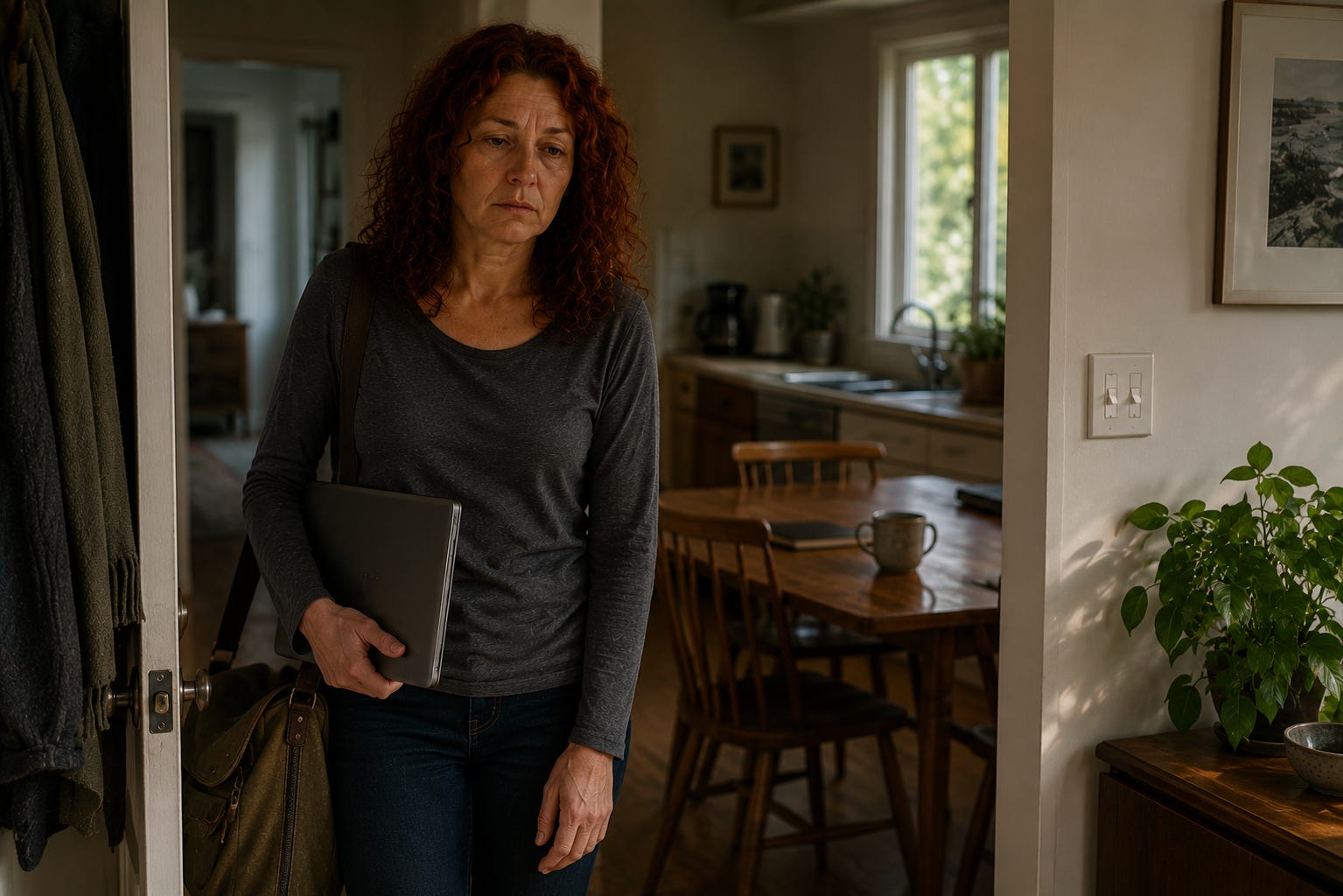
Naomi arrived at Elias’s house with swollen eyes, an unopened laptop, and the expression of someone who had already had too much day.
It was only ten in the morning.
She dropped her bag beside the chair.
“I don’t want to investigate anything.”
Elias was making tea.
“Then don’t.”
“I mean it.”
“So do I.”
“I don’t want to notice sensations. I don’t want to look at thoughts. I don’t want to distinguish events from stories. I don’t want another bloody Inquiry.”
“Okay.”
Naomi frowned.
“That sounds like a trick.”
“It isn’t.”
He put the kettle down.
“When the nervous system is overloaded, Inquiry can become one more demand.”
Naomi looked as though she might cry again.
“That’s exactly what it feels like. Everything is another demand.”
Bracken came slowly across the room and rested his head against her leg.
She put one hand on his neck.
For a while nobody spoke.
Clara was sitting near the window reading. She glanced up, then returned to the page.
Elias asked, “What happened this morning?”
Naomi shook her head.
“Too much.”
“What does ‘too much’ mean?”
She sighed.
“You’re investigating.”
“No. I’m asking what happened.”
That distinction stopped her.
She looked at the floor.
“The neighbour started using a leaf blower at seven.”
“Okay.”
“The light in the kitchen felt horrible.”
“Okay.”
“I couldn’t find the shirt I wanted.”
“Yes.”
“I had three emails I knew needed answers.”
“Yes.”
“The website wouldn’t accept my password.”
“Yes.”
“I hadn’t eaten.”
“Yes.”
“And then somebody sent me a message saying, ‘Just checking whether you’ve had a chance to look at this,’ which made me want to throw the phone through the window.”
Clara looked up.
“Reasonable.”
Naomi laughed once despite herself.
Then tears came.
“I know none of those things is catastrophic.”
Elias said, “Who said they had to be catastrophic?”
“That’s the point. Other people deal with things like this.”
“Some do.”
“I should be able to.”
“There.”
Naomi closed her eyes.
“What?”
“That sentence.”
“I knew you were investigating.”
“No. I’m distinguishing the leaf blower from ‘I should be able to cope with the leaf blower.’”
Naomi looked at him.
“The first one is noisy.”
“Yes.”
“The second one hurts.”
“Yes.”
She sat down.
Bracken settled against her foot.
Naomi said, “But then I get the awakening version too.”
“What’s that?”
“I’ve spent all this time looking at self and thought and suffering and control. Surely something should be easier.”
“Perhaps some things are.”
“Not this.”
“Apparently.”
“That feels like failure.”
Elias nodded.
“There it is.”
Naomi became angry.
“Don’t say it like that. I’m not creating the overload with a story.”
“I didn’t say you were.”
“Because sometimes it feels like that’s what all of this teaching implies. Just see through the story and everything is fine.”
“No.”
“Good.”
“The nervous system is overloaded.”
“Yes.”
“The sound is too much.”
“Yes.”
“The tasks are too much.”
“Yes.”
“Executive capacity is reduced.”
“Yes.”
“The body may need less input, fewer demands, food, rest, predictability, time.”
“Yes.”
“None of that is imaginary.”
Naomi’s shoulders dropped slightly.
Elias continued.
“But another event may also happen.”
“What?”
“Thought takes the overload and says something about Naomi.”
She looked away.
The old verdict was familiar.
Not:
The room is loud.
But:
I am too sensitive.
Not:
There are too many demands at once.
But:
I can’t cope with ordinary life.
Not:
Starting this task is difficult right now.
But:
I am lazy.
Not:
The nervous system needs less input.
But:
Something is wrong with me.
Naomi had heard variations of those sentences for most of her life.
Sometimes from other people.
Eventually from herself.
Long before she knew anything about autism, she knew she was supposed to manage things that seemed to cost her far more than they cost other people.
Bright rooms.
Crowded rooms.
Sudden changes.
Several people talking.
Unclear expectations.
Tasks that appeared simple from the outside and somehow became enormous on the inside.
She learned to hide the effort.
She learned to smile.
She learned to push through.
She learned that exhaustion should happen in private.
She learned to call the performance normal and the cost personal failure.
Then came awakening.
And, without noticing, she had simply updated the verdict.
Now it said:
An awake person shouldn’t resist this.
An awake person would just respond.
An awake person wouldn’t turn overload into suffering.
If there is no self, why does this still feel so personal?
Same courtroom.
New law books.
Naomi wiped her face.
“So awakening isn’t going to make me neurotypical.”
“No.”
“That’s disappointing.”
Clara lowered her book.
“Thank goodness.”
Naomi looked at her.
“What?”
“Imagine finally waking up and discovering everybody becomes neurotypical.”
Naomi laughed.
“That sounds dreadful.”
“I know.”
Elias smiled.
“Awakening isn’t neurological homogenisation.”
Naomi laughed harder now.
“Put that on a T-shirt.”
“But seriously,” Elias continued, “why would seeing through a separate owner remove the characteristics of the organism?”
Naomi thought.
“It shouldn’t.”
“Would it change your height?”
“No.”
“Your eyesight?”
“No.”
“Whether loud repetitive noise can overwhelm you?”
“No.”
“Whether too many competing tasks can shut things down?”
“Probably not.”
“So what was the bargain?”
Naomi knew immediately.
If I wake up, ordinary life will stop hurting like this.
She said it aloud.
Elias nodded.
“And when ordinary life does hurt?”
“It means I haven’t woken up.”
“There’s the trap.”
Clara closed the book.
“Maybe awakening became another attempt to become the kind of person the room was designed for.”
Nobody spoke.
Naomi looked at her.
“What do you mean?”
Clara gestured around them.
“Imagine you spend your whole life in rooms built for somebody else’s nervous system.”
Lighting chosen by somebody else.
Work rhythms chosen by somebody else.
Noise treated as irrelevant.
Social rules assumed rather than explained.
Productivity measured according to somebody else’s energy pattern.
Then you struggle.
And everybody asks:
What’s wrong with you?
Naomi felt something shift.
Clara continued.
“So you spend years trying to change yourself to fit the room.”
Naomi nodded.
“Then awakening comes along.”
“And I use that to change myself too.”
“Yes.”
The silence after that was different.
Not peaceful exactly.
But something had been exposed.
Naomi had imagined awakening would finally produce the person capable of living effortlessly in the room.
Perhaps the room also needed examining.
Elias said, “What if there are two questions?”
Naomi waited.
“One is:
Is there a defective Naomi?”
“And the other?”
What conditions would make this easier for this organism?
Naomi stared at him.
“That feels almost embarrassingly practical.”
“Yes.”
“I thought awakening was supposed to be deeper than that.”
“Why?”
She didn’t know.
He continued.
“If the light hurts, lower the light.”
“Yes.”
“If three tasks together create paralysis, make one task visible.”
“Yes.”
“If hunger makes everything worse, eat.”
“Yes.”
“If noise is overwhelming, reduce the noise where possible.”
“Yes.”
“If communication needs to be clearer, ask for clarity.”
“Yes.”
“If rest is needed—”
“Rest.”
“None of that requires a philosophical conclusion about self.”
Naomi looked down at Bracken.
“And none of it requires calling myself defective first.”
“Exactly.”
The laptop was still unopened.
Naomi looked at it.
Immediately the body contracted.
Elias noticed.
“What happened?”
“Don’t.”
“Okay.”
She continued looking at the laptop.
After a moment she said, “It feels enormous.”
“The laptop?”
“The things inside it.”
“How many things are inside it right now?”
“About twelve million.”
Clara said, “Can we release eleven million nine hundred ninety-nine thousand nine hundred ninety-nine of them?”
Naomi smiled.
“There are three emails I need to deal with.”
“Need today?” Elias asked.
“One does.”
“And the other two?”
“Not really.”
“Okay.”
Naomi opened the laptop.
The inbox appeared.
Her face tightened again.
“Too much.”
Elias said nothing.
She closed the inbox and opened one message directly from the notification.
Read it.
It was longer than she remembered.
She felt the urge to shut the whole computer.
Then something occurred to her.
“I don’t actually need to answer all of this.”
“No?”
“Half of it is them explaining why they need an answer.”
She typed three lines.
Read them.
Deleted one.
Pressed send.
Nothing happened.
No spiritual opening.
No sudden capacity.
But one demand was gone.
Naomi breathed out.
“Ahhh.”
Clara smiled.
“Okay, then.”
Naomi opened the second email.
“This one can wait until tomorrow.”
She flagged it.
The third could simply be deleted.
She deleted it.
“That felt good.”
Elias asked, “Did you overcome the resistance?”
Naomi started to answer.
Then stopped.
The question was subtler than it first sounded.
“No.”
“Did you defeat executive dysfunction?”
“No.”
“Did awakening make the task easy?”
“No.”
“What happened?”
Naomi looked at the screen.
“One manageable movement became possible.”
“Yes.”
“And then another.”
“Yes.”
“The resistance was still there.”
“Yes.”
“But action happened with it.”
“Yes.”
Naomi looked down at Bracken.
“Ahhh… okay, then.”
Over the following weeks, Naomi became fascinated by the difference between making herself function and changing the conditions under which functioning happened.
Previously, when a task felt impossible, she applied force.
Come on.
Just do it.
Everybody else manages this.
Stop being ridiculous.
You’re procrastinating.
Push.
The pushing sometimes worked.
It also consumed enormous energy.
Now she experimented.
Not as an awakening practice.
More like engineering.
What is making this difficult?
Too many visible options?
Reduce them.
An unclear first step?
Define one.
Noise?
Headphones.
Hunger?
Food.
Several people requiring answers?
One conversation at a time.
Task too large?
Make the next physical movement absurdly small.
Sometimes it helped.
Sometimes nothing helped.
That mattered too.
There were days when no clever rearrangement created capacity.
On those days the old judgment still arrived:
You should be able to do more.
But it was increasingly recognisable as a verdict, not an observation.
One afternoon Daniel came over while Naomi was lying on Elias’s rug beside Bracken.
“You all right?”
“Overloaded.”
Daniel sat down.
“What are you doing about it?”
“Lying here.”
“Is it working?”
Naomi considered.
“What would working mean?”
“Feeling better.”
“Then not particularly.”
Daniel laughed.
“So why are you doing it?”
“Because standing up feels worse.”
That was enough.
No hidden agenda.
No attempt to convert lying on the floor into healing.
No:
I am allowing the nervous system to regulate.
No:
This is radical acceptance.
Just floor.
Dog.
Exhaustion.
After ten minutes she sat up.
Not because she had successfully rested.
Sitting up simply became available.
That evening Daniel said, “I still struggle with the idea that resistance can remain.”
Naomi nodded.
“So do I.”
“If there’s no separate self, what is resisting?”
“Maybe resistance doesn’t require a resister.”
Daniel looked at her.
She continued.
“A demand appears.”
The body contracts.
A thought says:
No.
Attention turns away.
An urge to escape.
Another thought:
I can’t do this.
Where is the separate thing called resistance?
It is a name for the whole pattern.
Daniel said, “So we don’t need to destroy it.”
“Can you?”
“No.”
“Then that helps.”
A more difficult test came later.
Naomi had agreed to attend a birthday dinner.
The restaurant was crowded.
Music played overhead.
A child repeatedly scraped a chair against the floor.
Someone behind Naomi laughed in sharp bursts.
The lighting was bright.
Three conversations crossed the table.
After twenty minutes Naomi could no longer follow what anyone was saying.
Her face had begun arranging itself into the polite expression she had practised for decades.
Smile.
Nod.
Answer.
Do not make anyone uncomfortable.
Then thought said:
You should be able to stay.
Another:
Don’t make everything about autism.
Another:
Maybe if you were less identified, this wouldn’t matter.
That one almost worked.
She nearly stayed because awakening apparently required remaining in sensory overload with equanimity.
Then she saw the absurdity.
No separate self could be found.
But the organism was still receiving far more input than it could comfortably process.
Naomi leaned towards her friend.
“I need to go outside for ten minutes.”
“Are you okay?”
“Too much noise.”
“Of course.”
That was all.
Outside, the night air felt cool.
Naomi leaned against the wall.
No triumph.
No shame.
No grand act of self-acceptance.
Conditions changed.
The nervous system responded.
Later she went back inside for another half-hour.
Then left early.
The next morning, the old story appeared:
You couldn’t even manage one dinner.
And something else appeared almost alongside it:
The dinner was too much.
Notice the difference.
One sentence described Naomi.
The other described the fit between organism and conditions.
The first demanded repair of a person.
The second suggested information.
She took this to Elias.
“So is everything environmental?”
“No.”
“Everything conditioning?”
“No.”
“Everything neurological?”
“No.”
“Then what’s the explanation?”
“I don’t know.”
She laughed.
“You’re very consistent.”
“Does an explanation help?”
“Sometimes.”
“Then use one.”
“And when it doesn’t?”
“Don’t worship it.”
Naomi smiled.
That was another shift.
Autism could itself become an identity explaining everything.
Awakening could explain everything.
Trauma could explain everything.
Conditioning could explain everything.
The nervous system could explain everything.
Each model had uses.
None had to become the whole.
Events first.
Stories second.
Even helpful stories remained stories.
Months later, Naomi had another morning that would once have become a catastrophe.
Poor sleep.
Unexpected phone call.
A change of plans.
Noise outside.
Three tasks unfinished.
Tears arrived before breakfast.
She stood at the kitchen bench.
Thought said:
I can’t deal with today.
Another:
Why is this still happening?
Then:
I thought awakening was supposed to—
The sentence stopped.
Not because Naomi corrected it.
It simply sounded increasingly irrelevant.
Awakening had not promised the disappearance of this nervous system.
The nervous system did not have to justify its shape.
There were things to do.
Some would be done.
Some wouldn’t.
The immediate question was not:
How do I become someone capable of handling today?
It was:
What would make the next movement possible?
Naomi looked around.
The overhead light.
Too bright.
She turned it off.
The kettle.
Too loud.
She decided not to make tea.
The phone.
Three notifications.
She turned it face down.
Hunger.
She ate half a banana.
The first task was still too large.
She wrote on a piece of paper:
Open document.
Then laughed.
It seemed ridiculous.
She opened the document.
Nothing magical happened.
But the next movement had happened.
Then another.
At eleven thirty, she stopped.
There was still work unfinished.
There was still resistance.
There were still traces of tears.
There was also a cup of coffee that had eventually been made.
Sunlight through the window.
Bracken asleep nearby.
A paragraph completed.
Naomi breathed out.
“Ahhh…”
The old phrase arrived naturally now.
Not as resignation.
Not:
I surrender to an inferior life.
Not:
Everything is perfect.
Just:
Ahhh… okay, then.
This is the shape of the room.
This is the shape of the organism.
This is what is happening.
Now—
what is possible from here?
The central distinction is not between:
autistic experiencing and awakened experiencing.
Nor between:
resistance and acceptance.
The more useful distinction is between the actual event and the conclusions built around it.
Awakening does not require an organism to stop being the organism it is.
1. Overload is an event before it is an identity
Overload may include:
sensory intensity,
difficulty filtering competing input,
reduced capacity for language or decision,
irritability,
tears,
physical agitation,
shutdown,
an urge to escape,
difficulty initiating tasks.
These are experiences.
Then thought may add:
I can’t cope.
I’m too sensitive.
I’m defective.
Normal people manage this.
Something is wrong with me.
The story does not create the overload.
But it can add suffering to it.
2. The room may be part of the problem
A powerful cultural assumption says:
When a person cannot function comfortably in a situation, change the person.
But sometimes the useful question is:
What about the conditions?
Too bright?
Too loud?
Too many simultaneous demands?
Too much uncertainty?
Too much social processing?
Too little recovery time?
The organism and environment are not independent opponents.
Experiencing emerges through their relationship.
Changing the room can change the experience.
3. Awakening does not make neurodivergence disappear
A non-personal recognition does not imply that:
sensory processing becomes typical,
executive difficulties vanish,
social processing becomes effortless,
fatigue disappears,
overload becomes impossible.
The self-story may loosen while neurological patterns continue.
There is no contradiction.
The absence of a separate owner does not imply the absence of particular conditioning and biology.
4. Awakening can become another masking demand
Before:
Act normal.
Later:
Act awake.
Before:
Don’t show overload.
Later:
Don’t identify with overload.
Before:
Don’t resist.
Later:
An awake person wouldn’t resist.
The content changes.
The demand to perform remains.
This is worth seeing clearly.
Awakened behaviour can become another mask.
5. “I need to wake up” may increase the load
When already overloaded, thought may add:
I need to get this.
I need to surrender.
I need to be present.
I need to investigate.
I need to wake up.
Each instruction is another demand presented to a system already reporting too many demands.
Inquiry itself can become maladaptive in that moment.
Sometimes the more appropriate movement is:
less Inquiry,
less input,
less language,
less demand.
6. Inquiry is not compulsory
There is no requirement to investigate every difficult experience while it is happening.
Inquiry can happen later.
Or not.
Sometimes:
eat.
Leave the room.
Turn off the light.
Cancel something.
Lie down.
Use headphones.
Ask for clarification.
Reduce the task.
Nothing about those responses is spiritually inferior.
7. “What is wrong with me?” versus “What conditions are present?”
Compare the two questions.
What is wrong with me?
Attention moves towards identity.
Defect.
Diagnosis as condemnation.
Biography.
Comparison.
What conditions are present?
Attention moves towards information.
Noise.
Sleep.
Hunger.
Task complexity.
Uncertainty.
Social demand.
Pain.
These may lead to completely different responses.
8. From judgment to information
Overload can become information.
Not:
I failed at the restaurant.
But:
That combination of noise, lighting and overlapping conversation exceeded comfortable capacity.
Not:
I am incapable of working.
But:
Five simultaneous tasks made initiation difficult.
The second description does not deny disability or difficulty.
It removes the unnecessary moral verdict.
9. Resistance may be information too
Resistance is usually treated as an enemy:
Something in me refuses to do what should be done.
But ask:
What conditions accompany resistance?
Unclear task?
Too large?
Too many steps?
Fear of interruption?
Expected discomfort?
Low energy?
Sensory load?
Demand itself producing contraction?
Sometimes resistance is not a wall requiring force.
It is information about the current fit between organism and demand.
10. Can action happen while resistance remains?
This is a crucial discovery.
The body does not need to feel:
motivated,
confident,
calm,
accepting,
ready
before action occurs.
Resistance may remain while:
the document opens,
one sentence is written,
one email is deleted,
one dish is washed,
one phone call is made.
Then another movement may or may not become possible.
Action does not prove resistance has been defeated.
It simply happened alongside it.
11. Make the movement smaller
When a task is represented as a whole, it may become enormous.
Answer email may actually contain:
open inbox,
locate message,
read request,
understand request,
decide response,
find required information,
compose answer,
review tone,
send.
The phrase answer the email hides many conditions.
Sometimes the next movement is simply:
Open the message.
Not as a productivity trick.
As a more accurate description of what can happen next.
12. Awakening is not improved productivity
This deserves saying plainly.
Awakening is not valuable because it makes the organism:
more efficient,
more socially typical,
less inconvenient,
better at work,
more tolerant of overstimulation.
If those become the measures, awakening has simply been recruited into the old project of self-improvement.
The investigation concerns misidentification, not optimisation.
Practical adaptations may improve life.
That is worthwhile in its own right.
13. “Nothing is wrong” does not mean “nothing needs changing”
If the room is too loud, leave.
If demands are unrealistic, renegotiate them.
If support is needed, seek support.
If a boundary is needed, make one.
If functioning is impaired, practical or professional help may be useful.
Nothing is wrong with Naomi does not mean:
Every circumstance must remain exactly as it is.
It removes the moral indictment.
It does not prohibit adaptation.
14. Difference need not become defect
There is a difference between:
This organism has limitations and needs
and:
This organism is wrong.
The first can support intelligent adaptation.
The second produces shame.
Awakening may not remove limitations.
It may loosen the imagined defective owner who is blamed for having them.
15. Do not turn autism into the new absolute explanation
The word autism can be deeply useful.
It can bring recognition.
Language.
Accommodation.
Self-understanding.
But, like every concept, it does not contain the whole experiencing.
Not every difficult Tuesday needs a single explanation.
Sometimes the organism is:
autistic,
and hungry,
and sleep-deprived,
and grieving,
and irritated,
and facing a badly designed task,
and listening to a leaf blower.
Conditions all the way down.
No one explanatory story has to own the event.
16. The Second Layer
When overload happens, ask:
What is difficult?
Then separately:
What does thought say this difficulty means about me?
Example:
Event
Too much sound.
Tight body.
Three unfinished tasks.
Tears.
Difficulty beginning.
Verdict
I am useless.
I should be able to do this.
Nothing has changed.
I need to wake up.
The event may still be difficult after the verdict is seen.
That is important.
Seeing the story does not promise immediate relief.
It simply stops confusing two different things.
17. What changes after awakening?
Perhaps not:
what arises.
But increasingly:
how it is interpreted.
Overload can be overload.
Resistance can be resistance.
Tears can be tears.
A shutdown can be a shutdown.
A practical limitation can be a practical limitation.
They no longer need to become:
proof of a defective self.
And they no longer need to become:
proof that awakening failed.
18. Deepening Inquiry
When overload occurs, begin gently.
Not:
Where is the self?
First:
What is the organism dealing with right now?
Noise?
Light?
Hunger?
Uncertainty?
Fatigue?
Multiple demands?
Social effort?
Pain?
Then:
What is sensation and what is verdict?
Where is there actual pressure, heat, agitation or tiredness?
Where is thought saying:
This shouldn’t be happening?
Then:
Does “I need to wake up” reduce the demands—or become one more demand?
Then:
What is awakening imagined to remove that may simply belong to the functioning of this organism?
And perhaps the most useful immediate question:
What conditions would make the next movement more manageable?
Not the whole day.
Not the whole life.
The next movement.
19. Deeper Still
Without the story of a defective Naomi, what is overload asking for?
Perhaps:
less.
quiet.
clarity.
food.
movement.
darkness.
predictability.
distance.
help.
time.
nothing.
There need not always be an answer.
Overload may simply be overload.
But notice how different this question is from:
How do I fix myself?
20. Clean Formulation
Awakening does not transform an autistic organism into a neurotypical one, nor does it guarantee the disappearance of sensory overload, executive difficulty, resistance, tears or exhaustion. Those experiences may arise because of the organism and the conditions in which it is functioning. The additional suffering often comes when these events become evidence of a defective self or failed awakening. The shift is not from difficulty to permanent ease, but from judgment towards clearer seeing: overload as overload, resistance as information, practical needs as practical needs. Instead of asking “What is wrong with me?” the living question becomes: What is happening, what conditions are shaping it, and what small movement is possible from here?
Comments
Nothing yet. Say the first thing.
Sign in to join the conversation.