
Welcome to The Content Report, a newsletter by Vince Mancini. I’ve been writing about movies, culture, and food since the late aughts. Now I’m delivering it straight to you, with none of the autoplay videos, takeover ads, or chumboxes of the ad-ruined internet. Support my work and help me bring back the cool internet by subscribing, sharing, commenting, and keeping it real.
—
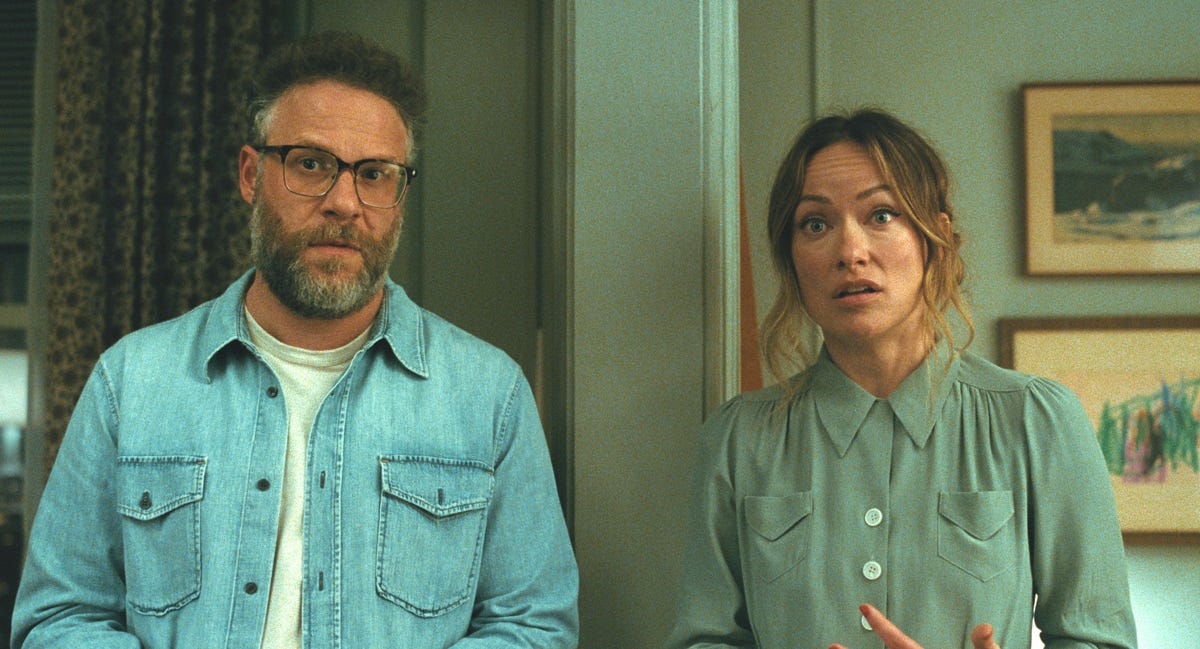
With two features under her belt before this one, it used to be hard to pinpoint Olivia Wilde’s brand as a director. She’d debuted with Booksmart (2019), a critically-acclaimed pseudo-teen comedy that probably stands as the high water mark of late 20-teens girlboss neoliberalism (just remember Beanie Feldstein saying “Malala” and try not to cringe). Wilde followed that up with Don’t Worry Darling, a failed period piece psychological thriller about gaslighting, remembered more for Wilde’s affair with her star, Harry Styles, than for the content of the film. (Shame it didn’t last, they could’ve become the world’s most fakest-soundingly named power couple).
It’s perhaps a little unfair, then, to open a discussion of The Invite, Wilde’s latest, wildly successful directorial effort by contextualizing it with her personal life — the Styles affair, Wilde getting served divorce papers while onstage at CinemaCon, and from Ted Lasso no less.
Unfortunately it’s also inevitable, essentially impossible not to bring up a director’s high-profile divorce in the context of a film that is, in large part, a divorce movie. (To her credit, Wilde seems to know this, and hasn’t shied away from acknowledging the parallels to her personal life during the press tour). The Invite is also a pretty great one; mature, sharply-written, consistently hilarious, and, dare I say it, sweet.
There are a million attempts at “sophisticated relationship dramedy for adults” that feel like plays, and most of them leave me grumbling “ugh, this feels like a play.”
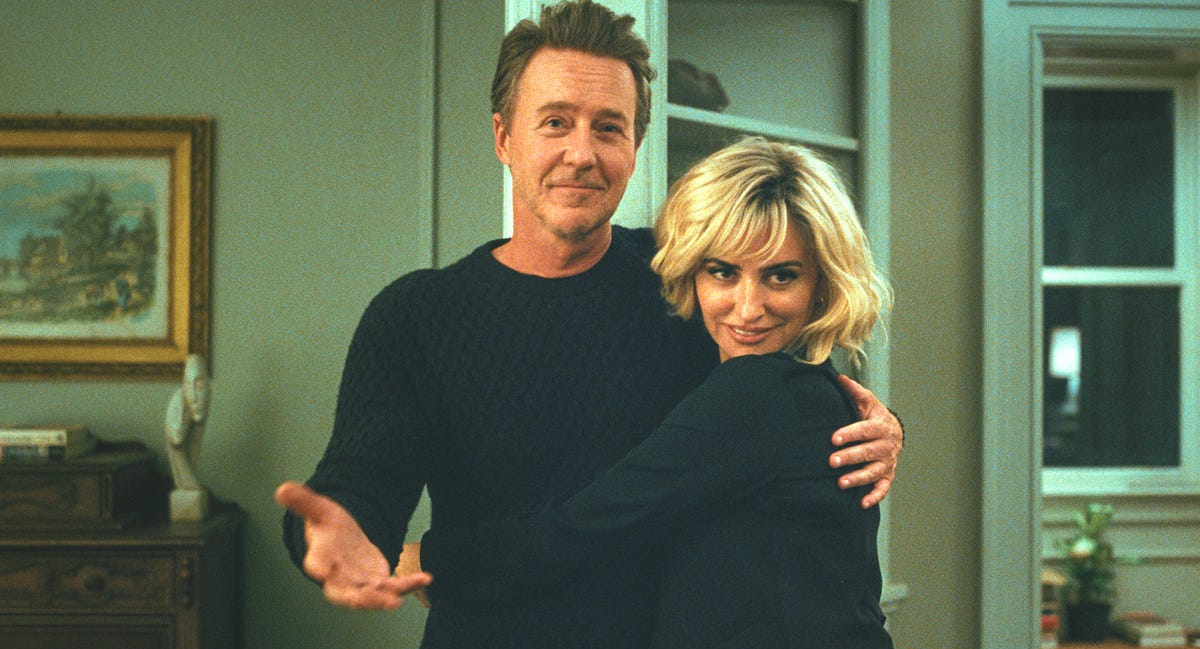
That’s not to disparage the theater, it’s just that relationship movies that feel like plays usually manage to capture all of a play’s limitations with few of its competitive advantages — you normally get all of the stage’s limited scenery, and none of its manic energy or the magic of actors interacting live in front of a live audience. The Invite, which Wilde noted at the post-film Q&A was shot sequentially (very rare for a film of this scale, where you usually shoot all the scenes that happen in a particular location, then switch locations, regardless of the order of the story) crackles with live theater energy. Hard to say whether that’s a function of the sharp script, by Rashida Jones and Will McCormack, the deft performances, the sequential shooting, or Wilde’s compositions, but the bigger point is that they’re all working together, creating something that feels like more than the sum of its parts. Smart adult comedies are notoriously hard, but The Invite makes them feel easy.
If there’s a “trick” to The Invite, it’s that it’s a break-up comedy masquerading as a sex comedy. Sexual tension is most of what makes relationships interesting (the lack thereof is why virtually every storyline about pre-pubescent children in love, from Moonrise Kingdom to Jojo Rabbit, bores me to tears). Generally what makes The Invite work so well is that it creates the imminent sense that the characters might be about to fuck, and then maintains that energy for basically the whole film. You could do a lot worse.
Everything about The Invite, from the title to the trailer on down (actually a remake of The People Upstairs, a 2020 Spanish film by Cesc Gay, based on his own play) telegraphs that it’s a film about swinging. It’s mostly not, but it’s the illusion that’s important.
We open with an Oscar Wilde quote, “One should always be in love. That is the reason one should never marry."
It’s a good quote, and the real heads among us already knew that Oscar Wilde is the person from whom Olivia Wilde, neé Olivia Jane Cockburn, took her surname (she is descended from a family of writers with a porny-sounding names, just not the Wildes).
In any case, San Francisco yuppies Joe (Seth Rogen) and Angela (Wilde) are trapped in a bickering marriage — he a musician-turned-depressed-music teacher, she an art student-turned hovering homemaker — that becomes extra fractious thanks to an impending dinner party with their upstairs neighbors, Pina and Hawk, played by Penelope Cruz and Edward Norton. Pina and Hawk have been doing loud construction and louder sex, much to the annoyance of Joe, and the not-so-secret envy of Angela, who can only dream that schlumpy Joe might one day dick her down as good as silver fox Hawk dicks down spicy Pina.
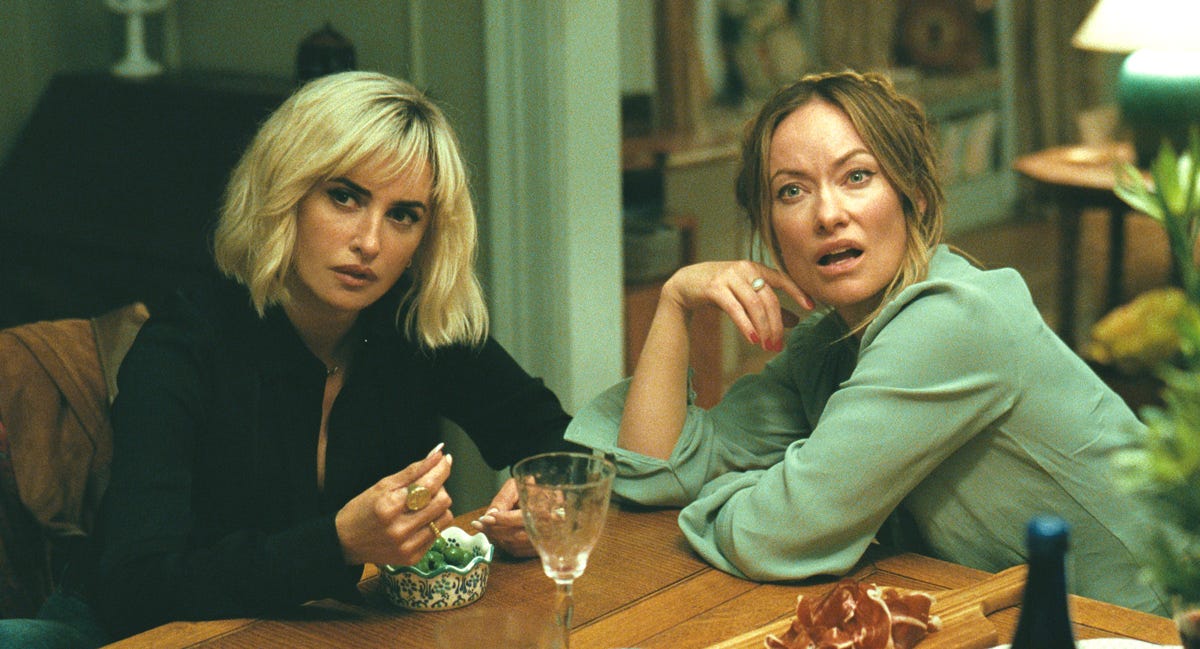
And so Angela is doing everything she can to make sure her dinner party is perfect, while Joe, with a bad back and exhausted from biking home from work (hey! I used to live on that street!) wants nothing to do with the whole charade, and is further convinced that his wife never even told him about it. (Sometimes it do be like that tho).
Where there’s already the tension of Angela putting on a show while Joe does everything he can to sabotage her yuppie dinner party (arguments over wine, jamón, etc.), The Invite amps things up even further by turning it into a “hey we saw you from the across the hall and decided we really like your vibe” situation. That’s right, I think you all know what I’m talm bout. Group sex! Throuples! Polyamory! Will the urban elder millennials succeed in bringing back key parties?
One thing The Invite does particularly well (beyond the built-in sexual tension, which is really its fastball), is to make Joe and Angela about equally at fault for their failing relationship without making them entirely insufferable. They aren’t relatable, exactly — Joe is a depressive, negative stoner who pisses and moans about everything; Angela is a pompous tryhard — but at least they don’t feel like some annoying screenwriter’s idealized notion of sophisticated intellectuals (cough Marriage Story! cough cough).
It sounds weird to say, but break-up comedies are a form of wish-fulfillment. The characters shout the kinds of things at each other that most people in relationships have occasionally wanted to shout at their partners, but don’t, because in real life it would mean instantaneous divorce. There’s a catharsis in hearing characters just say all the things we normally withhold. That seems easy enough for a script to accomplish on the face of it, but there’s also a peacocking tendency among so many (usually older male) screenwriters that often leads them to render these interactions in hopelessly flowery and/or groaningly over-intellectualized terms (“let’s not get into another turgid discussion of categorical imperatives” is a terrible line from Vicky Cristina Barcelona that echoes around my head from time to time). There’s also the Aaron Sorkin version, where a hyper-competent male character spends most of a film successfully mansplaining to all the ignorant chicks around him (as my old podcast co-host Bret used to say, in the first draft of an Aaron Sorkin script, the female lead is just named “My Ex-Wife”).
That McCormack/Jones/Wilde are able to successfully avoid these common pitfalls is a big part of what makes The Invite such a rare treat.
Comments
Nothing yet. Say the first thing.
Sign in to join the conversation.