
Welcome to The Content Report, a newsletter by Vince Mancini. I’ve been writing about movies, culture, and food since the late aughts. Now I’m delivering it straight to you, with none of the autoplay videos, takeover ads, or chumboxes of the ad-ruined internet. Support my work and help me bring back the cool internet by subscribing, sharing, commenting, and keeping it real.
—

How many years ago now was it, that I first became aware of the “spice bag?”
Probably at least two, but less than five. Google is a poor historian these days, but from what I remember, there was a video featuring a sort of bellicose-looking Irish lad (track suit, skin fade?) narrating his takeaway purchase (late night, from the looks of it), of a “spice bag.”
The dish, of which I’d never heard at that point in my life, seemed to consist entirely of one unbroken pile of beige things — fat, soggy french fries (aka chips) and possibly other fried stuff — all dumped from a wax paper bag gone translucent from the oil, and then gleefully doused in a gloopy sauce which was also a shade of beige. The sauce seemed to be some hybrid of gravy and curry (“coory”).
I wish I could locate the first of these videos that I saw, my gateway spice bag review, because I was instantly hooked. I sent the reel to a few group chats. Everyone on them probably sent it to a few more.
The appeal was obvious. Aside from the funny narrator, with a charming accent and every tenth word introducing exotic regional slang, the spice bag review genre contained a promise, the possibility that some other country out there might have even greasier, even more bastardized forms of pseudo-ethnic takeout food than even the good ol’ US and A. We’re Americans. We’re well aware that we’re the butt of jokes and we know that we deserve them, but nothing makes you feel a little better about being the butt of jokes than having someone else to crack on. The spice bag, a slovenly beige pile with a name that doesn’t even sound like food, seemed to offer that.
And so, when I went on a family vacation to Ireland this past week, predictably, one of the first questions someone back home asked was “So, you gonna try the spice bag?”
That text was from Pod Yourself producer Brent Flyberg for those in the know. And to state the obvious, yes, of course I was going to try the fucking spice bag.
Luckily for me, I was spoiled for choice. So far as I could tell, the spice bag is everywhere in Ireland now, eager to take dollars from novelty-seeking idiot tourists like me. I wasn’t exactly Ferdinand Magellan here. “Spice bag” was added to the Oxford English Dictionary last year, and according to the Irish Times, locals have been enjoying them for the better part of 20 years now:
While no one can pinpoint the exact date spice bags began to appear on menus, the consensus is that it was sometime between 2006 and 2010. In 2016, RTÉ reporter Liam Geraghty embarked on a quest to discover who invented Ireland’s most-ordered takeaway item, and his journey brought him to the Sunflower Chinese takeaway in Templeogue where it is said the spice bag was born when staff came up with a post-work fusion snack. Others argue that its roots may lie in Galway or Cork, but wherever it began, its spread was rapid.
By the time I got there this past week, I saw spice bags advertised everywhere, from Kebab/pizza shops to gentrified-looking food trucks to the kinds of tourist bars where you can get all the classics from the unofficial brochure — Guinness, Irish stew, cottage pies, probably something leprechaun-themed. (We did end up in one of those, but I ordered the stew there, I’m not a philistine).
I hadn’t known at the time that the spice bag originated from Templeogue, but I wanted to sample it in as close to its original form as I could. Which is to say, from an at least nominally Chinese place, preferably late at night. “Late night” turned out to be around 9 pm for washed over-40s with kids like us. Probably would’ve been even earlier if not for the jetlag, Spaniards we are not.
Our spice bag journey took us, rather organically, after a day of doing other touristy stuff like visiting the Guinness Store and taking pictures of our kids on bridges, to a place called Xi’an Street Food 2 in southeast inner Dublin. We ordered our spice bag alongside a few other entrees that were themselves essentially forms of spice bag: the Mongolian lamb served with chips, the kids chicken tenders. The latter of those was served in a non-spicy, peanutty sauce with lightly fried rice. It was like Thai chicken satay meets tempura-fried chicken tenders and it was delicious. I would’ve ordered it myself (and got to finish half of it as it was).
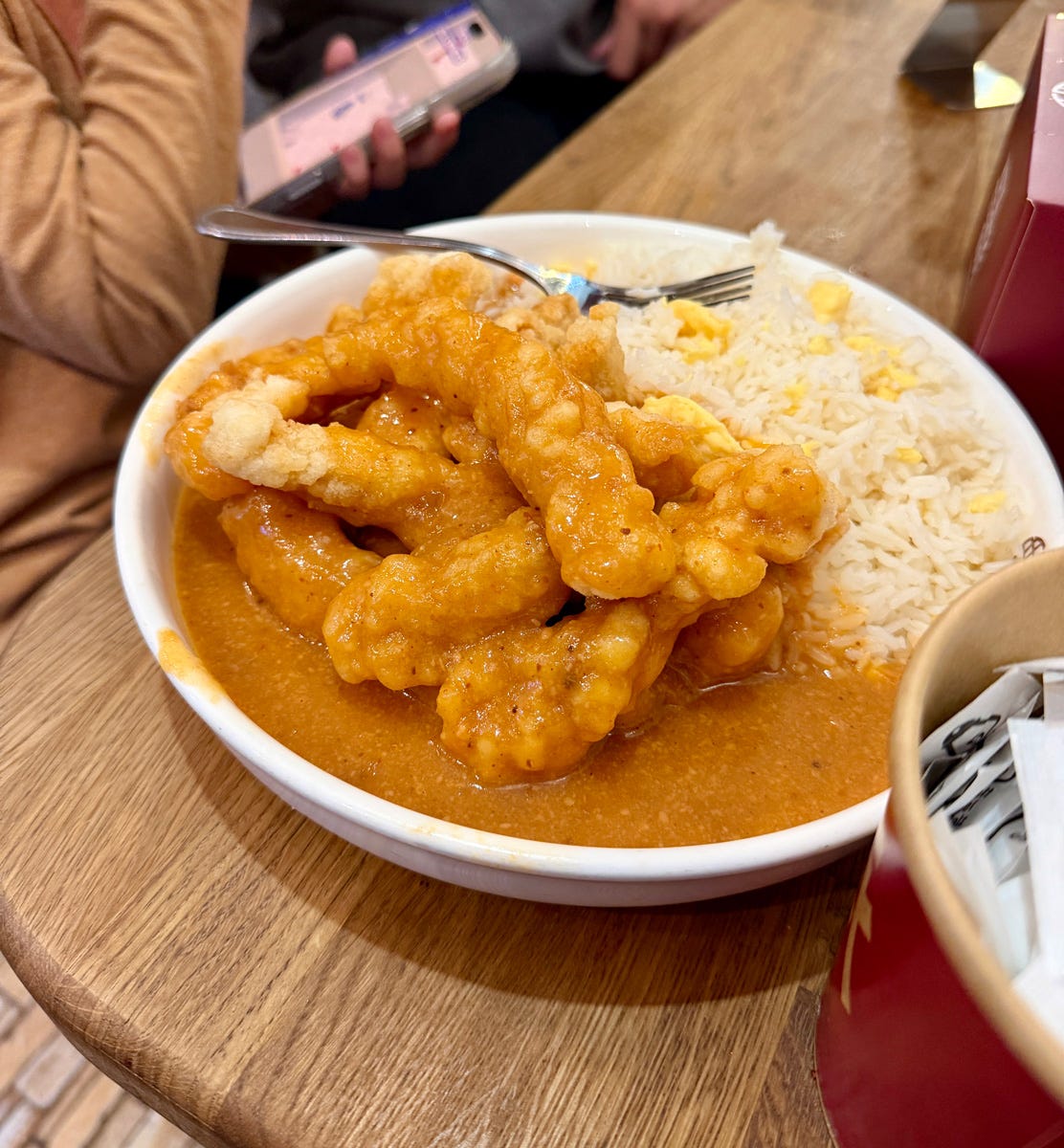
Clearly Xi’an Street Food is a step or two above your typical grody late night takeaway spot, and possibly inauthentic as a result. Acknowledging that, my first bite of genuine spice bag was enough to immediately dispel any notion of them as objects of ridicule.
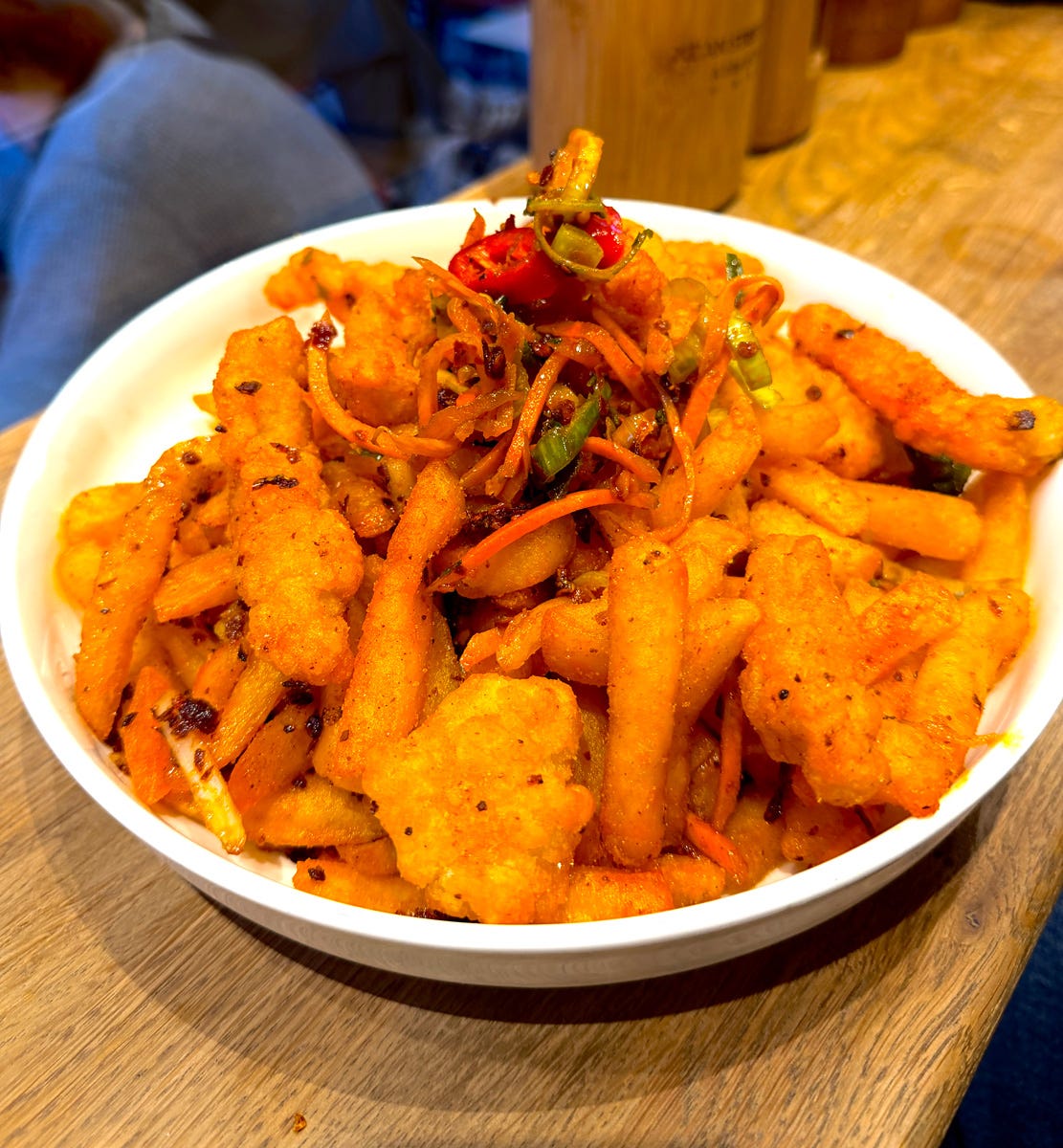
It had chips and fried chicken pieces, wok-fried with a piquant spice blend that tasted like salt, pepper, sugar, MSG, and curry blend, with some sauteed chilis and Chinese aromatics on top — scallions, julienned ginger. It wasn’t crazy spicy, by my standards (certainly milder than your average Mexican or Thai food), but still just spicy enough to have me taking three dumps before 10 am the next day. Worth it. If I lived in Dublin I’d probably order one of these two or three times a week and have to double my blood pressure medication.
When I worked in the kitchen of a Chinese place in San Diego during my first restaurant job in college (no longer there, but it was in Hillcrest, just down the street from Khyber Pass, an Afghani restaurant that was one of my all-time favorite places to eat) my favorite dish to watch the old guy cook was called “Firecracker Calamari.”
To prep it, he would take the body meat of medium-sized squids and cut it into medium-sized rectangles, then score the outsides in a little cross-hatch pattern. Those squid pieces would then get lightly dusted in dry corn starch. Then he would heat a big wok full of oil on the big industrial wok burner (we had deep fryers too, of course, but they weren’t powerful enough for this) until the oil was almost smoking. Then he’d drop the calamari pieces in, but only for about 30 seconds. After this flash fry, he’d scoop them out with the wire skimmer.
The calamari rectangles would curl up with the cross-hatch scoring facing outwards, looking like a tiny version of the hard foam roller I use to stretch out my back. From there he’d let the oil heat back up again, and then drop the calamari back in another time. He did this two our three times, then dumped the oil. Then he’d sauté ginger, garlic, scallions, and sliced jalapeños in the super-hot wok before adding the twice or thrice-fried calamari back in, and dusting it all with salt, white pepper, and MSG. A few shakes in the wok and it went on the plate. It was as fun to eat as it was to watch him make, I never got tired of it.
I mention it partly because it’s fun to remember, but also because the spice bag mostly struck me as a potatoes-and-chicken riff on that firecracker calamari, albeit with a curry powder addition and curry-gravy accompaniment. In person, the spice bag didn’t strike me as inauthentic (whatever that even means). It struck me as the usual story of immigrants applying their standard cooking techniques to locally-abundant ingredients, while adding a few minor tweaks to pander to the local palate. Basically, what all fast casual ethnic cuisines do.
What is a spice bag, after all, if not a Chinese-Irish take on “carne asada fries,” the SoCal Mex hybrid I ate a lot of in college? Technically I preferred the carne asada chips, shout out to Roberto’s in Miramar — but you can still either in some of Fresno’s most beloved taco joints, and probably half of American Mexican places everywhere.
Is there anything as casually inventive and naturally culturally inclusive as fast-casual takeout food? It’s one of the few things in the world that consistently makes me feel optimistic about humanity. Short order cooks are the glue that holds societies together. And has anything in the world improved as much in the last 20 years as food? Technology sucks, I dread every computer or iPhone update like a root canal; politics are terrible, every person in power seems to more resemble our worst national caricature; movies were inarguably better in the aughts, the 90s, the 70s; every new business feels like a half-baked grift. But food? Food has come a long way, baby.
When I was growing up, I don’t think my parents even knew there were other ways to prepare vegetables besides steaming, which was standard then in American food writ-large. I still have nightmares about their crunchy, stinky broccoli. They would broil their salmon beyond recognition and stink up the entire house, I’ve only just started to be able to eat salmon again in the last ten years.
Optimism aside, what is the world coming to if you can’t even crack on the Irish for “spice bags?” Next you’ll tell me that the English don’t have bad teeth, or that Spaniards aren’t lazy. Great for tastebuds, terrible for jokes.
On our way out of the country, we stayed in a modestly-priced hotel in a distinctly down-market area of Limerick (otherwise a great, charming town, as all the towns in Ireland we visited were). After so many days traveling we were all out of clean laundry, so I took a big bag down to the Circle K down the street, which had an outdoor laundry station attached to it (would the exotic wonders ever cease??). Next to that was a much smaller, far less urbane Chinese takeaway selling what was probably closer to the “standard” spice bag I’d originally been inclined to ridicule. There, they offered spice bags (“spicy bags,” technically) with the option to order with “chicken balls” (five or ten).
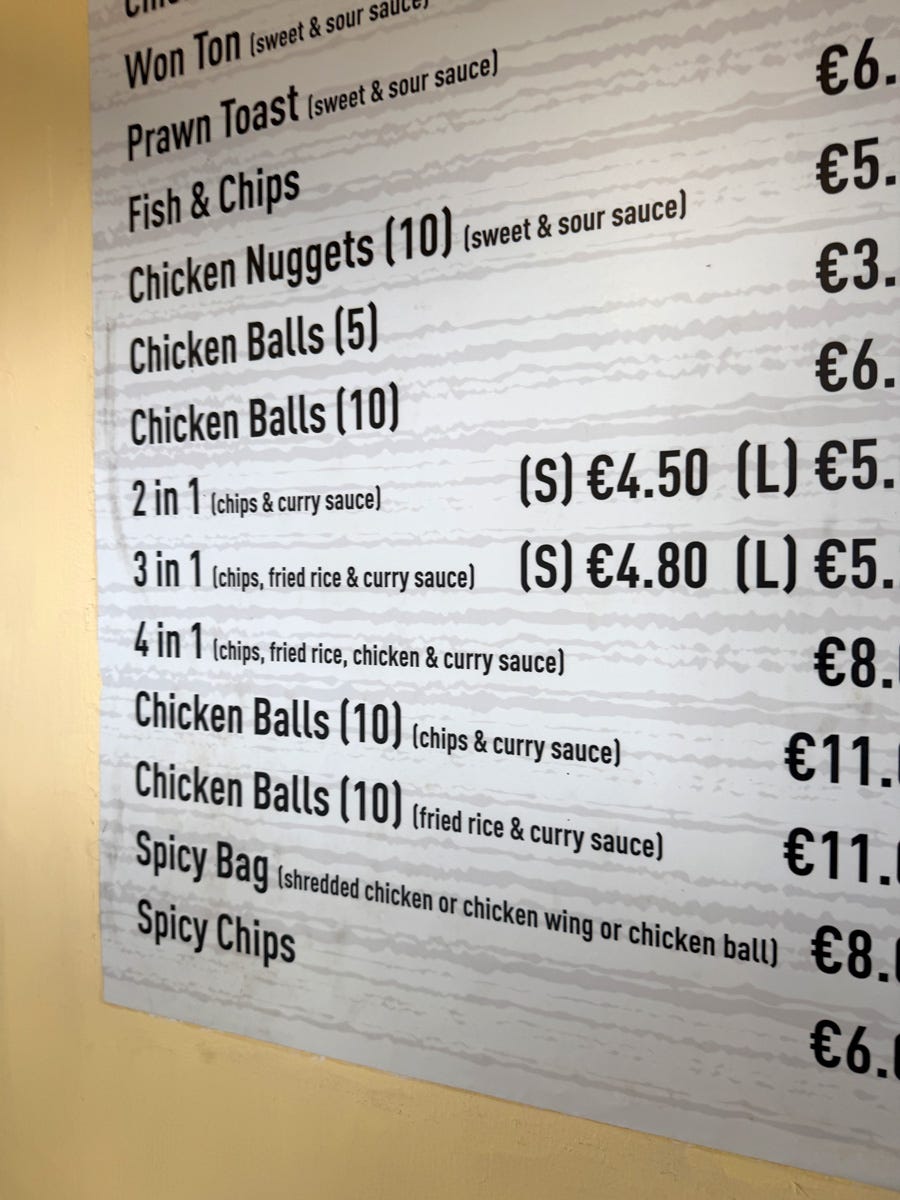
If I can no longer laugh at “spice bags,” at least they still had “chicken balls.” “Chicken balls?!” Absurd. It sounds dumb and terrible and we’re all good and sophisticated for laughing at them.
I didn’t order anything there. It was probably delicious.
While “the full Irish breakfast” sounds like a euphemism for your mother’s nether regions, it’s actually a perfectly cromulent food term. Much like “the full English” and American breakfast (I guess we don’t actually have a specific term for this, but we all know what it is), “Full Irish Breakfast” denotes a pretty specific thing.
From my cursory research of being a person on the internet, I’ve gleaned that that specific thing includes: two rashers (Irish back bacon, sadly I’ve already made a your mom joke above), two sausages, two fried eggs, white pudding, black pudding, a hash brown, fried mushrooms, and some coarse Irish bread. Sometimes, but not always, it includes grilled tomatoes (toe-mah-toes) — as English and Australian breakfasts do — as well as the classic English baked beans. Although Irish internet person Garron Noone claims beans are a Protestant imposition, and I trust him because he’s funny.
The English, Irish, and Americans all take great pride in our breakfasts. All beige-colored-food-based cultures do, and why not? It’s what we do best.
And so I thought I would add my own take here on a genuine full Irish breakfast as a USA-based person. There’s nothing more hack than arguing about your preferred form of bacon or potatoes on the internet, but I’m also nothing if not a hack, so I say let’s do it.
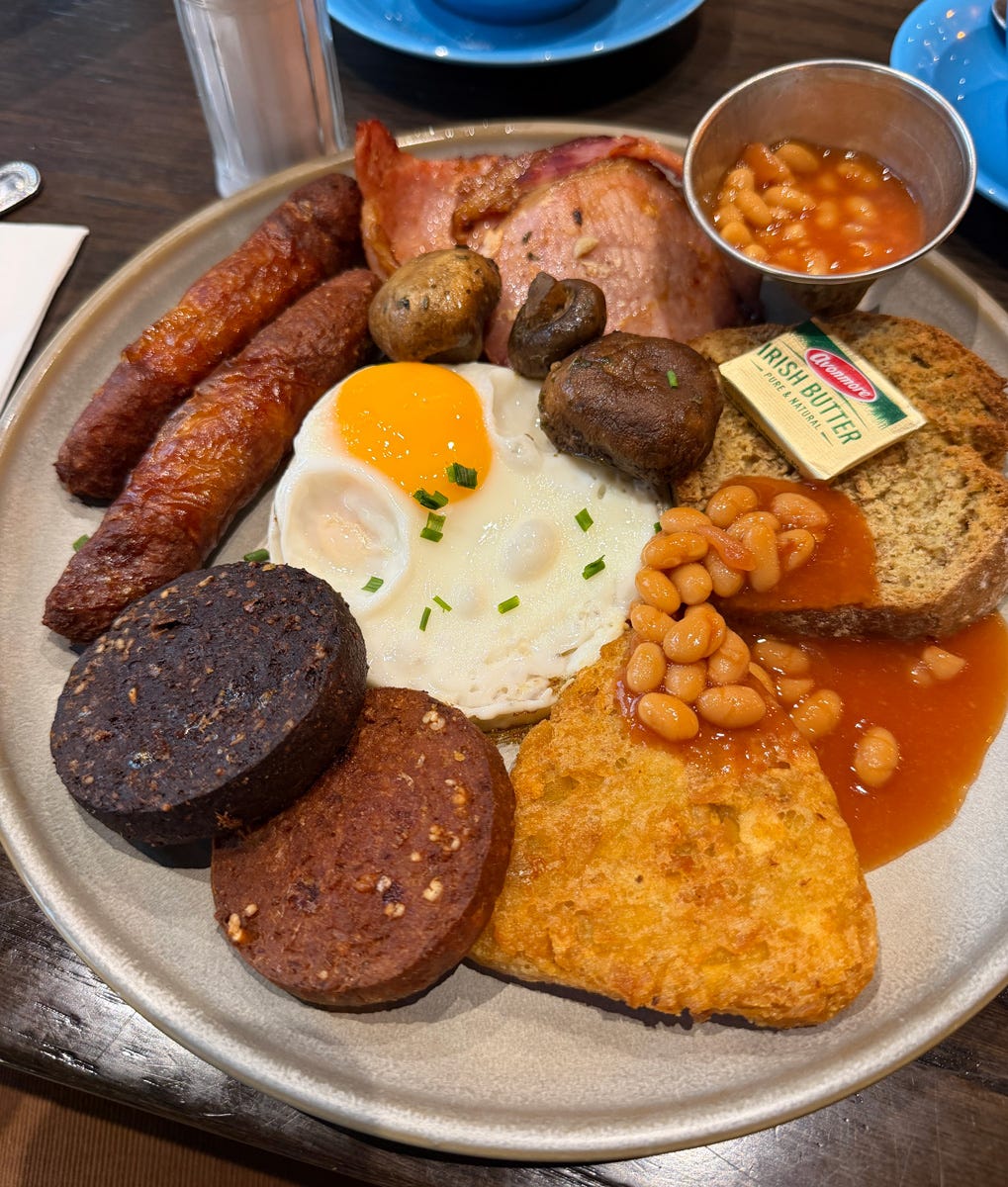
Here’s a nice, fairly representative Full Irish that I had at the Buttery in Limerick. I believe it was my third Irish Breakfast I had on the trip. Don’t judge me, how dare you.
Comments
Nothing yet. Say the first thing.
Sign in to join the conversation.