
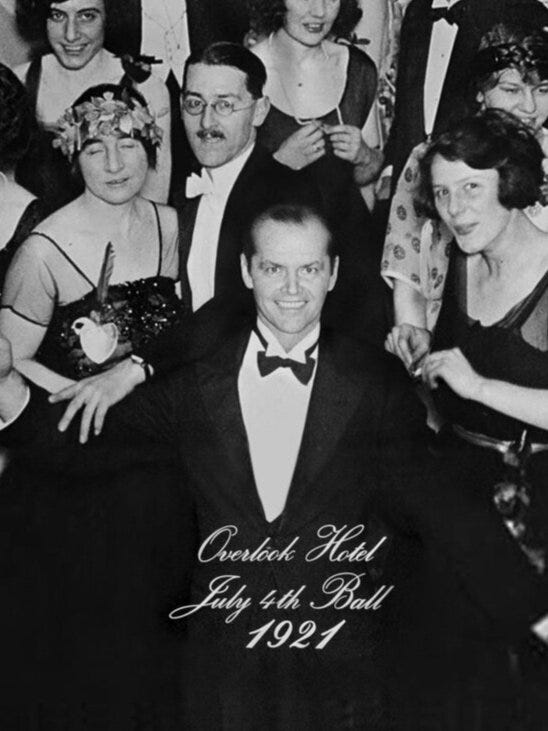
When I was in my early twenties, I lived in a huge house with several other friends and the house number was 1921. We had some really great times. I named the house Kronstadt after the city in Russia where there was an anarchist and small C communist, pro-democracy uprising in the year 1921, chiefly among sailors, that was violently repressed by the Bolsheviks. I should have named the house the Overlook, after the hotel in the Shining, but I was radicalized and so I did dumb stuff like name my home after a worse-than-quixotic anti-state uprising. This makes it seems like we were all serious activists; aside from one of us, we were not. But all of us were artists or musicians who, to varying degrees, through zines, or college, or whatever, had replaced philosophy, ethics, religion, spirituality, with radical politics. It didn’t work that well, which was clear by the time we were all about 29-30.
There is a love affair on the far left with loss and losing as a sign of moral righteousness or purity. The obsession with the televised death of Black people at the hands of the police, the idea that the unsheltered homeless in open drug scenes are some kind of serious political constituency or “land back” movement, the idea that the Iranian regime is on the “right” side of history. The conviction that the “subaltern” or “marginalized communities” are a substitute-proletariat, hagiographies of Trotsky or the Spanish Civil War.
One could cheaply argue that this love affair with defeat comes from Christianity: if the Messiah was tortured to death by mere mortals, then there must be something righteous about total loss in the face of human callousness. In reality, actual Christians have understood this “loss” to be illusory, and that the ascendancy of Christ to His throne in heaven created the necessary cosmological conditions for human beings to know a power they had not known before: the unyielding empowerment of a personal relationship with the God of Grace. I say that as Jew.
It is post-Christian or secularized “Christian” society that has inherited Nietzsche’s slave morality: the idea that those who are weak are virtuous precisely because of their weakness. It is hard to decide just how dangerous this really all is, though I’ll selfishly admit that it’s all terribly unfun and boring. Is the re-paganization of a bunch of artists and professors really a threat to so much we hold dear? I guess I probably think it is if I bothered writing this. Or maybe I’m just bothered that I finally understand why people say “youth is wasted on the young.” Hilariously, I didn’t think that would happen to me.
No posts
Comments
Nothing yet. Say the first thing.
Sign in to join the conversation.