
So last week I posted a Note.
Feeling pretty good about it too. Hit publish, lock the phone, go make coffee like a man who doesn’t check notifications every four minutes.
Come back twenty minutes later.
Zero.
A flat, disrespectful, personally offensive ZERO.
Fine. Whatever. Maybe it’s a timing thing. I check again before bed like a crackhead checking a slot machine that already ate my money.
Still zero.
And look, we’ve all built the same little conspiracy theory in that moment. The algorithm’s broken. Substack hates me specifically. Mercury’s in retrograde. My niche is cursed. Anything other than the boring possibility that this happens to almost everybody and there’s an actual reason for it.
Turns out there is a reason. I just needed something with more patience than me to go find it. I collaborated with Orel to find it.
Orel runs WriteStack, a tool built around helping Substack writers actually stay consistent with Notes instead of posting in bursts and going quiet. He's the one who dug this analysis: growth numbers on 1,340 Substack creators, each with at least ten tracked Notes over at least a month, 570,000+ Notes between them, ranked by free subscribers gained per week, then close-read down to the two extremes, the fastest-growing 150 creators against the slowest-growing 148.
Here’s the number that kicked the whole thing off.
25 vs 0 — Median free subscribers gained per week: top decile of creators vs. bottom decile.
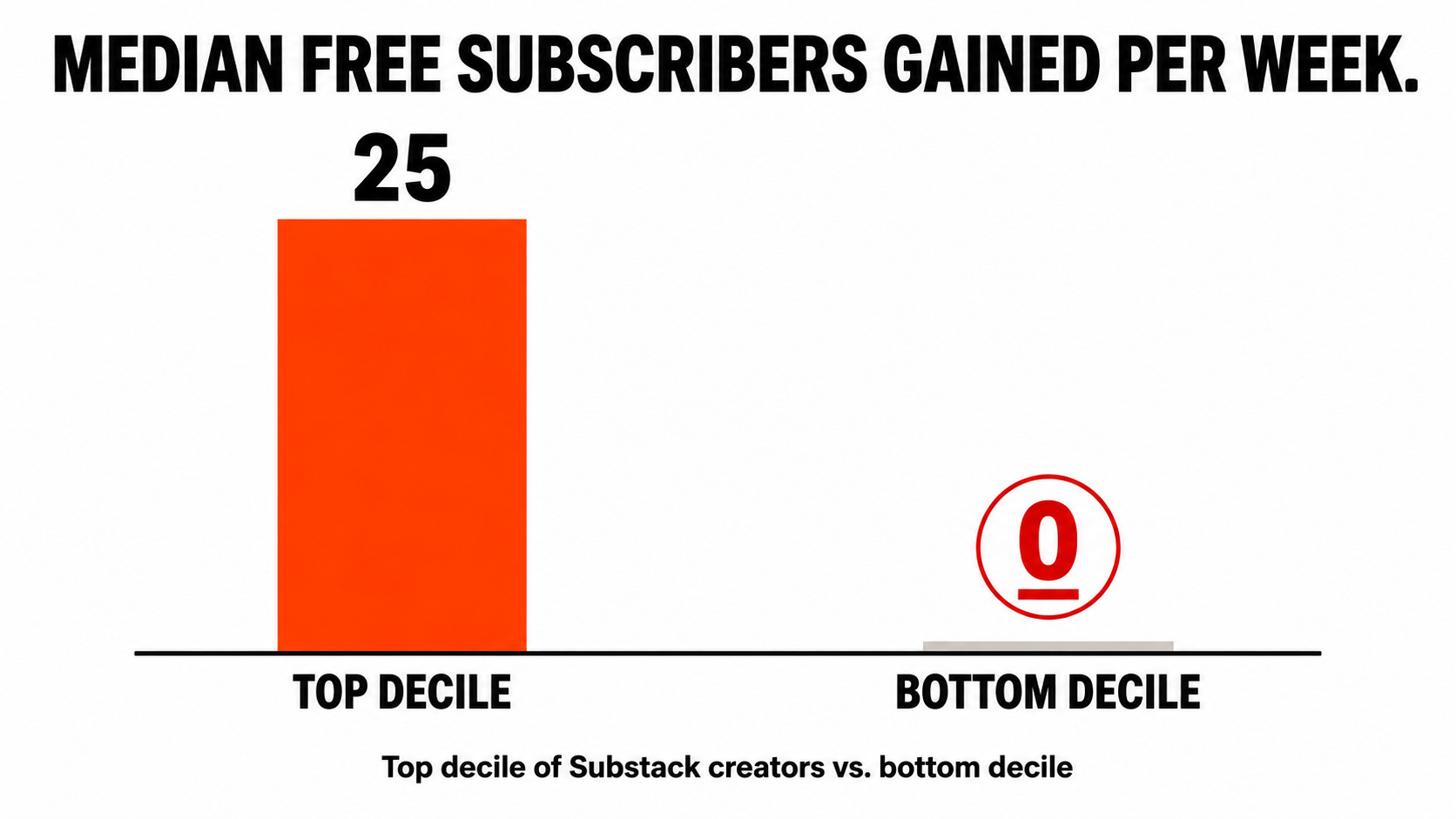
The top decile of creators in the dataset gains a median of 25 free subscribers a week from their Notes. The bottom decile gains a median of big ZERO. Literally zero: half the creators in the slowest-growing tenth didn’t convert a single free subscriber from any Note in their entire tracked history.
Quick note on how this was measured, because it’s worth knowing before you trust anything below: growth is free subscriptions attributed to a Note, using Substack’s own attribution data, summed per creator and divided by weeks active. Free subscriber counts are private, so every number in this post is either a cohort aggregate or explicitly rounded, nothing tied to an identifiable account. Public numbers like reactions and restacks are shown as measured.
So here’s what came back. Five things. Five ways to quietly torch your own growth without ever noticing you’re doing it. I’m calling them the Substack Cardinal Sins.
The first thing that showed up reading both piles side by side wasn’t tone, or topic, or hook style. It was silence. Slow-growing creators aren’t writing worse Notes that people read and scroll past. Most of the time, nobody sees the Note at all.
Across the ~3,500 Notes in the close-read sample, 50.2% of Notes from the slowest-growing cohort got zero reactions. Zero, exactly, no rounding. In the fastest-growing cohort, that number was 2.5%.
And it’s not one unlucky post dragging the average down: 45% of slow-growth creators, 66 of 148, had more than half their sampled Notes land with zero engagement. Eleven of them had every single Note in the sample come back at zero.
Here’s the part that got me. Once a Note does get seen, the conversion math isn’t different between the two groups. In the fast-growing cohort, reactions and free-subscriber conversion on the same Note correlate at r = 0.53, and 39.3% of their Notes converted at least one free subscriber, versus 1.7% for slow-growers. The problem was never really the writing. Most slow-growth Notes just never took off the runway.
Substack’s Notes feed works like any other social feed, deciding what to show based on recent signals, meaning have you gotten engagement lately, are you posting often enough to register at all. An account that posts sporadically and gets ignored stays stuck in a low-reach loop, because the feed has no current reason to show it to anyone new.
The check: pull your last 15-20 Notes and count how many got zero reactions. More than a third, and the fix isn’t a better hook on the next one. It’s rebuilding reach, which is exactly what sins #2 and #3 are about.
I always figured posting more would just spread everyone’s attention thinner. So all 1,340 creators got split into four groups by how many Notes they post per week, with median growth measured in each.
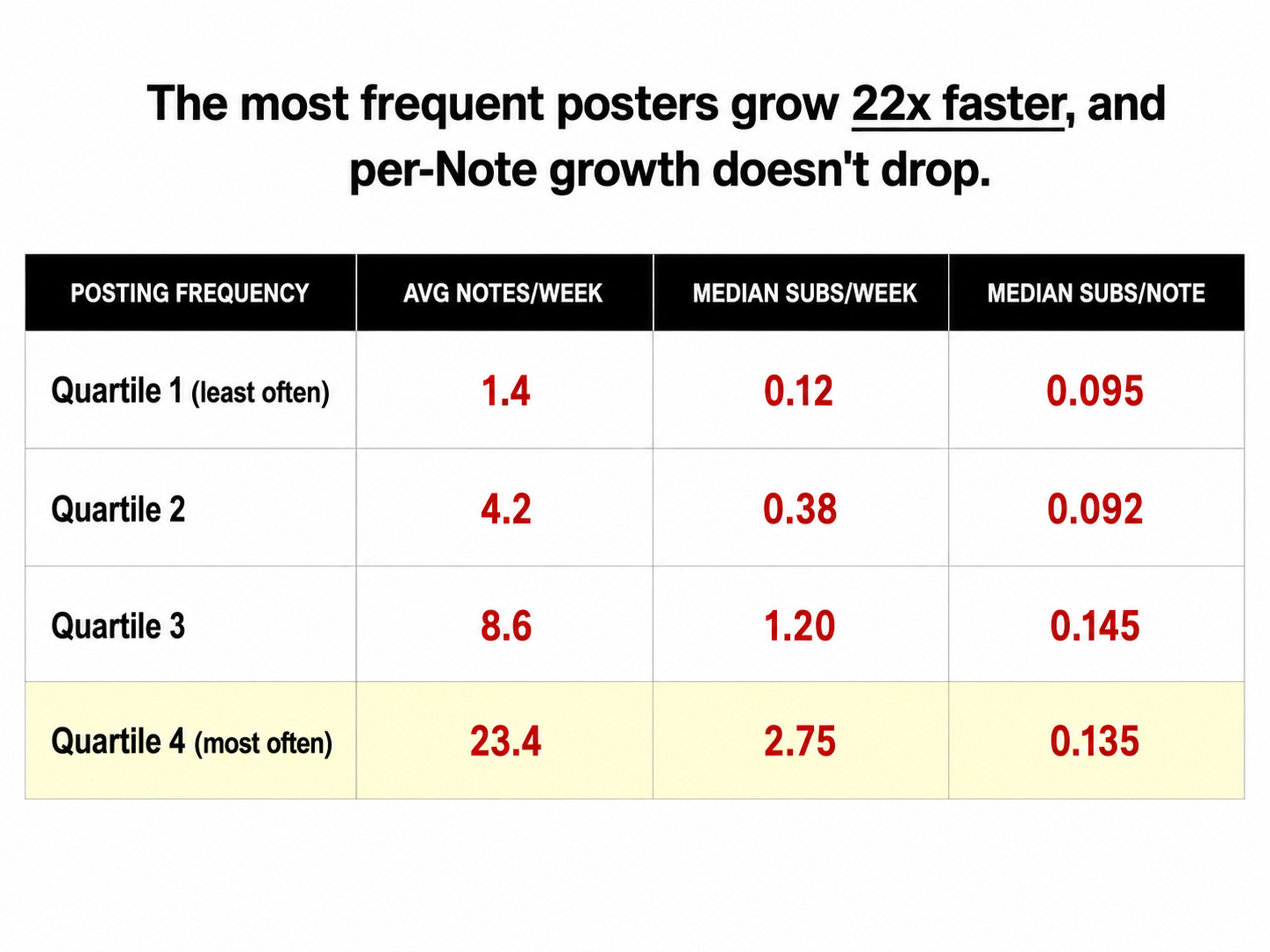
The most-frequent posters grow 22 times faster in median terms than the least-frequent ones. Look at that last column too: subscribers gained per Note doesn’t drop as frequency rises. It’s basically flat from quartile 1 to 2, then it climbs in quartiles 3 and 4. Posting more isn’t spending down some fixed pool of goodwill. Each additional Note is roughly as effective as the last, and the more of them exist, the more chances the feed has to surface one.
Rhythm matters on top of raw volume too. The analysis also measured how evenly spaced each creator’s Notes are, the coefficient of variation in the gap between posts, where lower means steadier. The steadiest quarter of creators grows at a median of 1.33 subs/week. The burstiest quarter grows at 0.53-0.55, less than half, even when their average posting gap looks similar on paper. Post daily for two weeks, vanish for a month, and you reset whatever reach you’d built.
The cadence rule: aim for at least one Note a day, most days, rather than a burst of ten in one sitting followed by a week of silence. If daily isn’t realistic, pick a frequency you can sustain for months without a multi-week gap.
This is, not coincidentally, the exact problem WriteStack was built to solve: queuing Notes in advance so your rhythm stays steady even on the days you don’t sit down to write. More on that at the end.
One tactical difference showed up clearly and repeatedly: outbound links. Notes containing a link, to a newsletter, an external site, anywhere off-platform, averaged 4.95 reactions. Notes without one averaged 22.89. A 4.6x difference. Slow-growing creators used links in their Notes at nearly double the rate of fast-growing ones, 11.0% vs. 5.7%.
The likely why: this is the same pattern every social feed shows. Platforms suppress content that tries to route attention off-platform, because keeping people on-platform is the whole business model. A Note that links out competes with Substack’s own goal for that feed slot, and it gets treated accordingly.
The workaround: write the Note as a complete, standalone piece of value. If you want to point people to your newsletter or an external post, put the link in the first comment, or your bio, not the Note body. Let the Note earn its own reach first. Route the conversion after.
Sin #2 showed that posting more grows faster on average. But “on average” hides a real exception, and it’s an important one. 34 of the 430 creators (7.9%) who post more than 10 Notes a week are still growing at under 0.3 subscribers a week. High output alone guarantees nothing.
Reading those stuck-despite-volume Notes next to the rest of the high-frequency group, a pattern showed up fast. They write in abstractions. Motivational language, generic advice, sentences that could belong to almost any account in almost any niche, often closing on a hollow rhetorical question:
“Your team doesn’t study your vision deck. They study your reaction when things go sideways. Behavioral consistency under pressure is the only credential that can’t be faked. [...] Your blind spot has a name. Do you want to know it?” — from a stuck-despite-volume account, 15+ Notes/week
Compare that with the small opposite group that turned up: 10 of the 1,340 creators (0.75%) post fewer than 2 Notes a week and still grow more than 5 subscribers a week. Their Notes trade almost entirely in specifics, a number, an age, a named tool, a concrete claim you could fact-check.
“I’m convinced mathematics is taught wrong. Its beauty is buried under technical jargon and lifeless formulas. It should be: clear, visual, practical. My mission is to get you fluent in the math that will still be useful in 50 years.” — from a low-volume, high-growth account
One creator in the fast-growing cohort posted a single Note that did more for their subscriber count, by itself, than most creators in the slow-growth cohort saw across their entire tracked history combined. It wasn’t a hot take or a viral hook. It was a direct pitch, who this newsletter is for, and why. Specificity, not frequency, did the work.
The rewrite prompt: before posting, find the vaguest sentence in your Note and replace it with a specific number, date, name, or claim. If nothing in the Note could be fact-checked, it’s too abstract to convert anyone.
On top of the behavioral findings above, there’s a smaller but consistent structural gap between the two cohorts. Fast-growing creators write Notes that run a little longer, break into more paragraphs, and lean more first-person.
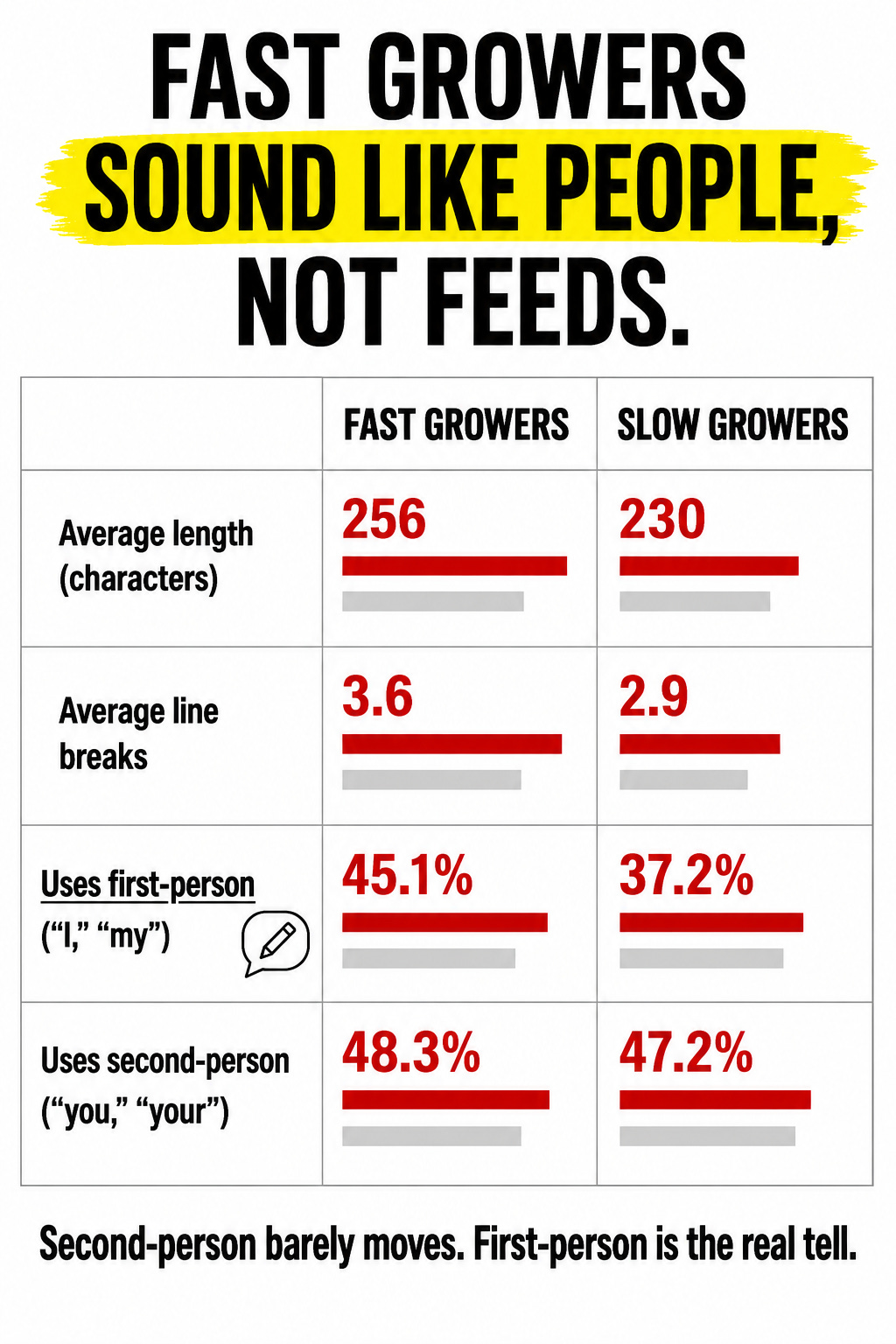
None of these gaps are dramatic on their own, and second-person usage barely moves at all between the two groups, which is worth flagging since “talk to the reader” is advice you hear constantly. The more reliable signal is first-person: fast growers write from their own specific experience noticeably more than slow growers do. It’s the same specificity finding from sin #4, just showing up again over here.
The swap: read your last Note back and count how many sentences start with “you should” or a general claim. Rewrite one or two as “I” statements grounded in something you did or noticed. It reads like a real account with a real person behind it, not a general-purpose feed of advice.
The checklist version, if you want to run it against your own account:
Check your reach. Look at your last 15-20 Notes. If more than a third got zero reactions, your problem is reach, not writing quality.
Check your cadence. Are you posting most days, or in bursts followed by silence?
Check for links in the Note body. Move them to the first comment or your bio instead.
Check for abstraction. Find the vaguest line in your last few Notes and see if it could borrow a number, name, or date instead.
Check your pitch. If you haven’t posted a plain, direct “here’s who this is for and why” Note recently, that’s often the single highest-converting thing you can write.
Reach and cadence are the two that hit me hardest, mostly because neither is about being clever. They’re about showing up on a schedule I can hold, which is exactly the kind of problem I built the Substack Growth Engine to walk through. If sin #4 is more your gap, the Notes Engine Pack is a set of done-for-you Note frameworks built on the same idea the data keeps proving: a real number beats a general opinion, every time.
Every figure in this post comes out of that single analysis. 1,340 creators, 570,000+ Notes tracked between them, roughly 3,500 read line by line by a machine that never once got bored or decided its niche was cursed. And if sin #2 described you a little too accurately, WriteStack is a tool built specifically to keep your Notes queued and consistent even on the days you don’t feel like writing. Worth a look.
Somebody reading this has a Note sitting in drafts they’ve talked themselves out of posting because it feels too plain. Post the plain one. The data’s pretty clear on which one works.
Dataset, for the record: 1,340 Substack creators with at least 10 tracked Notes over at least 4 weeks, covering 570,000+ Notes total. Growth metric: free subscriptions attributed per Note, summed per creator and divided by weeks active. Close-read sample: roughly 3,500 Notes from the 150 fastest-growing and 148 slowest-growing creators, plus targeted outlier cohorts. All subscriber figures are shown only as cohort aggregates or explicit ranges, never attached to an identifiable account. Public engagement figures (reactions, restacks) are shown as measured.
Comments
Nothing yet. Say the first thing.
Sign in to join the conversation.