
Here’s something nobody tells you about the passive income dream.
It doesn’t start as a lie.
It starts as something kind of beautiful. The idea that you could build something once -- put in the work, put in the research, put in the late nights -- and then watch money come in quietly while you’re asleep. Royalties hitting your account while you’re dreaming about something else. A business that doesn’t need you to show up every single day.
That idea got me into Amazon Kindle Publishing (KDP).
And look, I actually wanted to be an author. That part was real. I wanted to create something, put my name on it, see it out in the world. But somewhere between ‘I want to write a book’ and ‘I’m going to publish on Amazon,’ something shifted. I found the keyword research tools. I started looking at what was trending. And suddenly I wasn’t asking ‘what do I want to write?’ I was asking ‘what’s selling?’
Different question. Completely different answer.
So I found a niche that looked solid on paper -- good search volume, low competition. I hired a ghostwriter to write the book, put a pen name on the cover, and launched in a category I had zero genuine interest in. The model works, by the way -- people build real catalogues and real income with KDP. You just have to actually care about what you’re building. That part I skipped entirely. (Oopsie daisy!)
Three months and $2,000 later, I still wasn’t profitable. No email list. No brand. Nothing that was actually mine. Just a book I didn’t write, in a category I didn’t belong in, selling to people I’d never meet.
That’s when the thought I’d been avoiding finally showed up:
What am I actually doing here?
Dido Torchi had a different version of the same dream. Different path in. Same reckoning at the end.
For him, the idea of freedom looked very similar -- but the execution was much different. He had the dream of becoming a 7-figure founder who didn’t have to rely on the corporate path.
That’s exactly why he enrolled in his college’s Engineering Entrepreneurship Program his senior year and launched a business with some of his friends. The excitement of getting it off the ground that first year was palpable -- designing and building the product, creating a business plan, going door to door to get their first sales.
But it quickly became more of a backdrop after they all launched their engineering careers. Something they were maintaining on the side, rather than being completely passionate about. And even maintenance felt heavy for the 3 years until they finally let it go due to failed funding.
The most defining moment -- the one that told him it wasn’t going to work out -- was coming home after a day of door-to-door sales and bursting into tears. He had quit his job months before thinking the business was going to save him. Turned out, it just showed him how much he had hated his life for it.
That’s when he came to the question:
“Am I the one running the business or is the business running me?”
Welcome back to Monday Models -- where I pull apart what is actually working in the solopreneur world, and sometimes what is not.
I’m joined today by Dido Torchi -- a transformation coach who helps you redirect your energy before burnout does it for you.
We built wrong things from different directions. We are both here to help you skip a few of the expensive lessons we had to learn the hard way.
This is not a hustle-bashing post. It’s not a ‘slow down and smell the roses’ post. It’s something more specific than either of those.
It’s about a pattern we both noticed -- in ourselves, and in everyone around us. High-achievers tend to build the wrong things. And then they defend them. And the reason why is more interesting than ‘they picked the wrong niche.’
(The cycle that keeps high-achievers building the wrong things)
Let me ask you something slightly uncomfortable.
When you picture yourself six months from now -- after the new thing takes off, after the income streams start stacking -- what are you actually picturing?
Is it freedom? The time? The money in the account?
Or is it the identity?
Because here is a pattern I started noticing in myself, and I’ve since seen in enough other people to know it’s not unique to me:
A lot of us are not building businesses. We are building introduction lines.
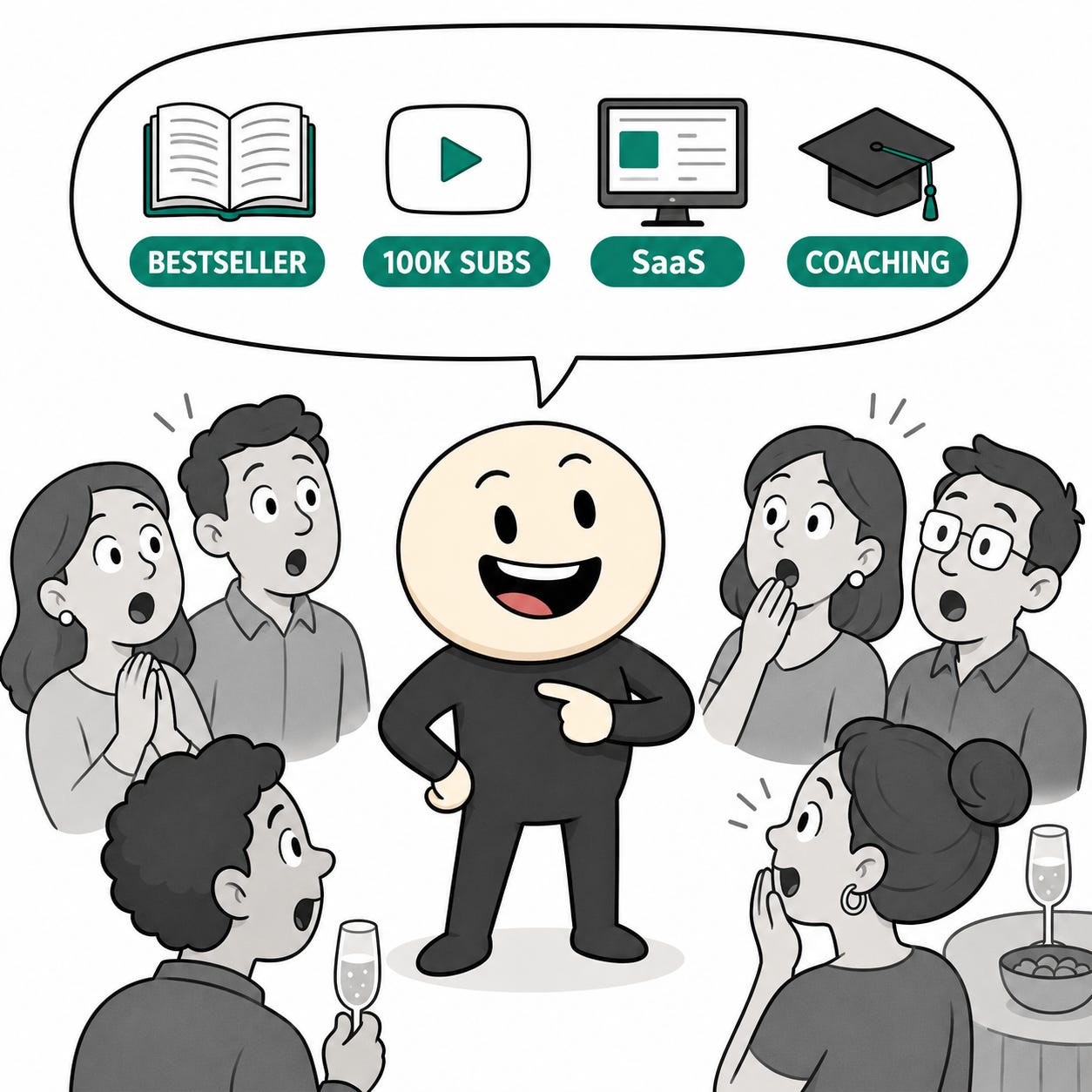
You know the feeling. You’re at a party, someone asks what you do, and the person who says ‘I work a 9-5 job’ sounds one way. But the person who says ‘Oh, I’ve got a couple of bestsellers on Amazon, a YouTube channel sitting at 100K subscribers, a SaaS tool I’m building on the side, and a six-figure coaching business in full swing’ -- they get a completely different reaction. Raised eyebrows. ‘Wow, how do you manage all that?’ A kind of quiet respect that the standard answer doesn’t produce.
And I want to be really careful here, because ambition isn’t a character flaw. Building multiple things isn’t bad. But I’m asking you to be honest with yourself about the actual engine behind it.
Because when ego is the engine, your decisions start looking a specific way.
You choose KDP because ‘self-published author’ sounds impressive and ‘passive royalties while you sleep’ sounds incredible. But then you don’t write the book you actually care about -- you run keyword research and find a trending niche. You pick the topic the market wants, not the topic you have any genuine relationship with. And you tell yourself it is strategic. It is optimised. It is smart.
What it actually is: you’re chasing the outcome (income, identity) while avoiding the alignment question entirely.
So the book goes up. The ads start running. And three months later, when you’re $2,000 deep and still not profitable, you don’t quit. That would be admitting you picked wrong. Instead you buy the course. You redesign the cover. You learn about ACoS and optimise your bid strategy. You find every possible reason the problem is the execution, not the container.
Then KDP doesn’t work, and you need a new vehicle. You haven’t figured out what went wrong -- you just can’t sit still without something to point to. So next I went for YouTube automation. Built twelve channels. I actually thought scale would solve the problem that alignment created.
It didn’t.
What nobody tells you about building the wrong thing is that you don’t just build it -- you defend it. Every time I wanted to quit, I told myself I just needed to be more patient. The sunk cost becomes the reason to stay. The loop tightens. And every time you defend it, you go a little further from the honest question you should have been asking from the start.
And the honest question is this:
Is the thing I’m chasing a real pull toward something? Or is it the feeling I want to have when people ask me about it?
I’m not saying your answer is wrong. I’m saying you need to know what it is.
Dido watched the same trap spring from the inside. Four years of it.
So, as I mentioned before, I had stayed with this side business model for 4 years. And the majority of the time, I felt like I was forcing myself to even maintain it. There were months that went by that I couldn’t even focus on it, and this only made me feel guilty inside. I felt that I needed to always be on in order to maintain the exterior image of being an entrepreneur, a dream I had always had when I was younger.
The thing is I didn’t really feel connected to the business from the start of it. My co-founders and I went into creating the product very fast without a lot of ideation. The execution was there. But the passion was not.
The thing is, I just didn’t understand that it was actually a lack of passion when I was going through the motions. I thought it was normal to hate doing work for your business, because all the successful people talk about working hard for years on a vision until you can start enjoying it. This misconception was the main reason why I didn’t want to let go of it, even when it wasn’t working.
But eventually, in year 3 of having little to no sales, the feeling shifted towards the sunk cost fallacy. I thought I was in too deep to make a pivot, and I didn’t want to risk losing the progress and hard work that I had put into it. The attachment was both a fear of losing what I had already built along with a fear of the unknown of starting over again to try something else.
And stopping completely, by choice, would have meant that I would have to admit failure. And as a high achiever, my pride would not let me do that. My identity was glued to the title of an entrepreneur, and I needed to see it succeed in order to feel validated. Of course, that never came, because the design was built externally without much of a thought for what mattered internally.
-> Reader Takeaway: The 2-Question Escape Check
Before you commit more to something you’re already in -- or before you start the next new thing:
Question 1: Is my excitement about what I’m moving toward, or what I’m moving away from? (Be honest. Both feel the same from the inside.)
Question 2: Would I still build this if nobody could ever be impressed by it -- if it never came up in conversation, if no one ever knew?
If the answer to both leans toward escape and external validation -- you’re not building a business. You’re building an identity prop. Which is okay to admit. It’s the first step to building something real.
(Why you can be productive inside the wrong fit for years without noticing)
So here’s what happened with YouTube.
I built twelve channels. Different niches. AI-generated scripts, outsourced editors, automated uploads. I had the whole operation running. On paper it looked like a machine. In reality it looked like a part-time job I had not signed up for.
And the thing about YouTube automation that I didn’t fully understand until I was already deep in it: the model requires you to be there. All the time. Managing editors. Reviewing scripts. Checking analytics. There’s nothing passive about it. The name lies to you -- ‘automation’ suggests a system running without you, but what it actually is, is a system that cannot run without you noticing every problem immediately.
That model and a full-time day job don’t coexist. Not sustainably. Not without one eating the other.
And then four of my channels got demonetized in the same week.
My first reaction, and I want to be really honest about this: was relief. Not devastation. Not even frustration. Just this quiet, almost embarrassing sense of: oh. okay. maybe I do not have to do this anymore.
That reaction was trying to tell me something. I wasn’t listening.
My ghostwriting journey has the same story in a different chapter. Good clients. Decent money. Work I was capable of. But every new client felt like reporting to a new boss, and I already had one of those at my day job. I had built a second job to escape the first one. Which isn’t exactly the freedom playbook I was looking for.
And here is the part that took me the longest to understand about misalignment:
It doesn’t announce itself as a failure. It just shows up as everything looking fine and nothing feeling right.
I was executing. I had content calendars and spreadsheets and SOPs. I made detailed plans to grow both of these things. Spent real time on them. But the plans never got followed through. I would sit down on a Saturday morning for ‘content day,’ open the spreadsheet, feel absolutely nothing, and find something else to do.
I spent a long time telling myself I was undisciplined. That other people were outworking me. That I just needed better systems or more accountability or a different course.
But here’s what finally broke through that story: I noticed that the moment I sat down to write for my newsletter, I lost track of time. I was not checking the clock. I was not negotiating with myself about whether to start. I just started. And an hour would pass without me noticing.
That’s not a discipline difference. That’s an alignment difference.
Laziness isn’t selective. If you’re lazy, you’re lazy about everything. But if you show up easily for some things and drag yourself to others -- that’s not a personal failing. That’s information about which container fits.
The other thing I had to learn the hard way, across multiple failed models, is that the business has to fit inside your life. Not the other way around.
YouTube automation sounds great until you are managing multiple channels and it is a second full-time job. The model that works isn’t the one with the best income potential on paper. It’s the one you can actually sustain without burning out or resenting it.
That sounds obvious. But I promise you -- when you’re inside the passive income dream, when you’re convinced the problem is just execution and not fit -- it doesn’t feel obvious at all.
For Dido, the misalignment stayed invisible for years. It didn’t look like failure. It looked like a full calendar.
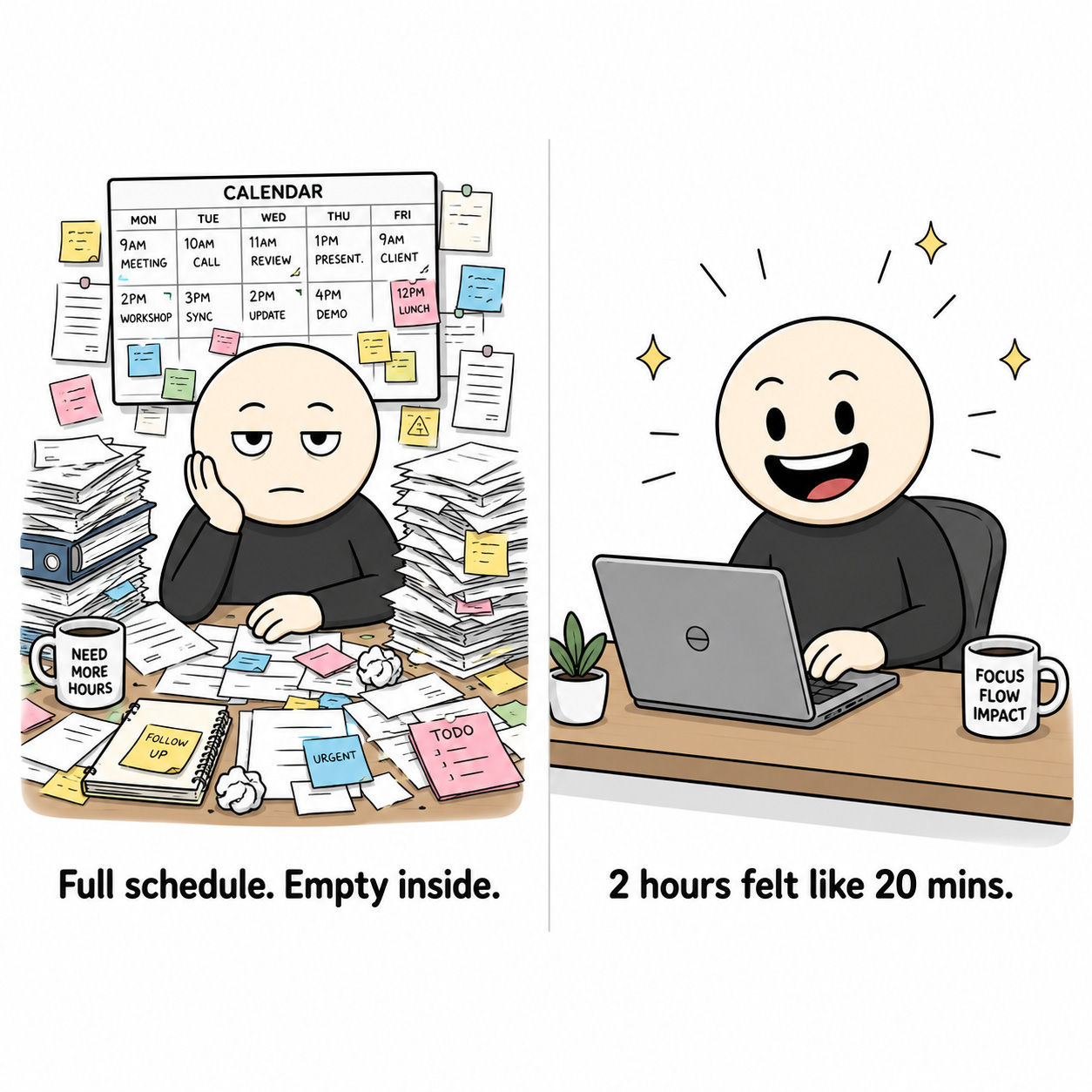
During the latter years of the side business, I noticed something. And that was that I was staying busy with it in order to escape other parts of my life that I didn’t enjoy at the time (career). It became more of something to avoid that sinking feeling that I was doing something wrong.
Eventually, somewhere along the way I was doing things only to maintain what was already there. The passion to innovate had been lost. My days looked like physically building out the product with co-founders on weekends, and handling customer quotes/doing door to door sales during the week after work. Although I did enjoy the door to door part, mostly everything was a blur during this time, and I was just going through the motions.
The issue that makes this more convoluted is how it ties into ego. Looking busy is not only a way to escape, it also looks good on the outside to others. My friends thought that I was living the life since I barely had any free time. I leaned into that and seeking external validation fueled a lot of the late nights working on the business. The more tired I was, the better, because I could brag to friends about how hard of a worker I was.
It wasn’t until the 4th year of the business that I finally became aware of what this cycle was doing to me. This was the period after I quit my job and tried to go all in on it. Once I wasn’t trying to escape something else (career), I realized just how much I hated doing all of this. In the end, my co-founders and I did not get enough funding to scale it properly, which is when we finally decided to let it go. This was when I was finally free to self-reflect and realize that the whole design of the business was misaligned and causing all of these issues to occur.
-> Reader Takeaway: 3 Alignment Signals (watch for these)
Do you protect your best hours for this -- or does it get what’s left over after everything else? (Scraps of energy on a tired Thursday night are not the same as showing up fresh on a Saturday morning.)
Do you talk about it without being asked? Not to promote it -- just because it is on your mind and it is actually interesting to you? (If you’ve got to remember to mention it, that’s a signal.)
On a hard day -- the kind where you are tired and it would be genuinely easy to skip -- do you show up anyway? And when you do, does it feel better or worse after? All hard work is hard. Misaligned hard work feels hollow even when you do it perfectly.
None of these are pass or fail. They are diagnostic. If your answers are mostly ‘scraps of energy, never mention it, feels worse after’ -- that’s the information you need. Pay attention to it earlier than we did.
(Shifting from ‘is this working?’ to ‘is this me?’)
Substack was different from day one. And I’m still not entirely sure I can explain why. Which is, I think, the point.
With KDP, I could explain everything. Market data. Keyword volume. Royalty margins. Competition level. I had a spreadsheet, I had arguments, I had a plan. I had answered every ‘but why this?’ question before anyone even asked.
With Substack, I just started. Because I had something to say and I wanted to say it to people who were going through the same thing. That was the whole logic. Not a passive income play. Not a scalable content machine. Just: I’ve been making expensive mistakes for a few years and maybe some of that is worth sharing honestly.
I started protecting time for it without planning to. Saturday evenings just started being newsletter time. It wasn’t on a calendar. There wasn’t a system. It just started happening. I’d be at the gym and find myself thinking about what I wanted to write that night. I’d get home, eat, and before I’d consciously decided anything, I’d be at my desk.
That is the difference between dragging something and carrying it. When you’re dragging it, you need to remind yourself. You need to build systems to force the behaviour. When you’re carrying it, it kind of just goes where you go.
650+ subscribers in six months. Not viral by any standards, but here’s what that number actually represents: 650 people who found something worth reading in what I was putting out, without me having a big audience or a big following to start with.
More importantly -- and this is the part I couldn’t have predicted when I was running Amazon ads -- it feels like mine.
Not the subscriber count or the income potential. The actual writing. The specific way I think through ideas and put them on a page. The conversations in the comments. The weeks when I don’t feel inspired but I write anyway and it comes out fine.
This is the first thing I’ve built where a hard day makes me want to show up more, not look for an exit.
And I know now that that specific feeling -- the difference between dragging and carrying -- is the only early-stage signal that actually matters. Not the revenue or the growth rate. Just: does this still have your attention when it would be completely easy to stop?
For me, with this -- YES!!! That’s enough to keep going.
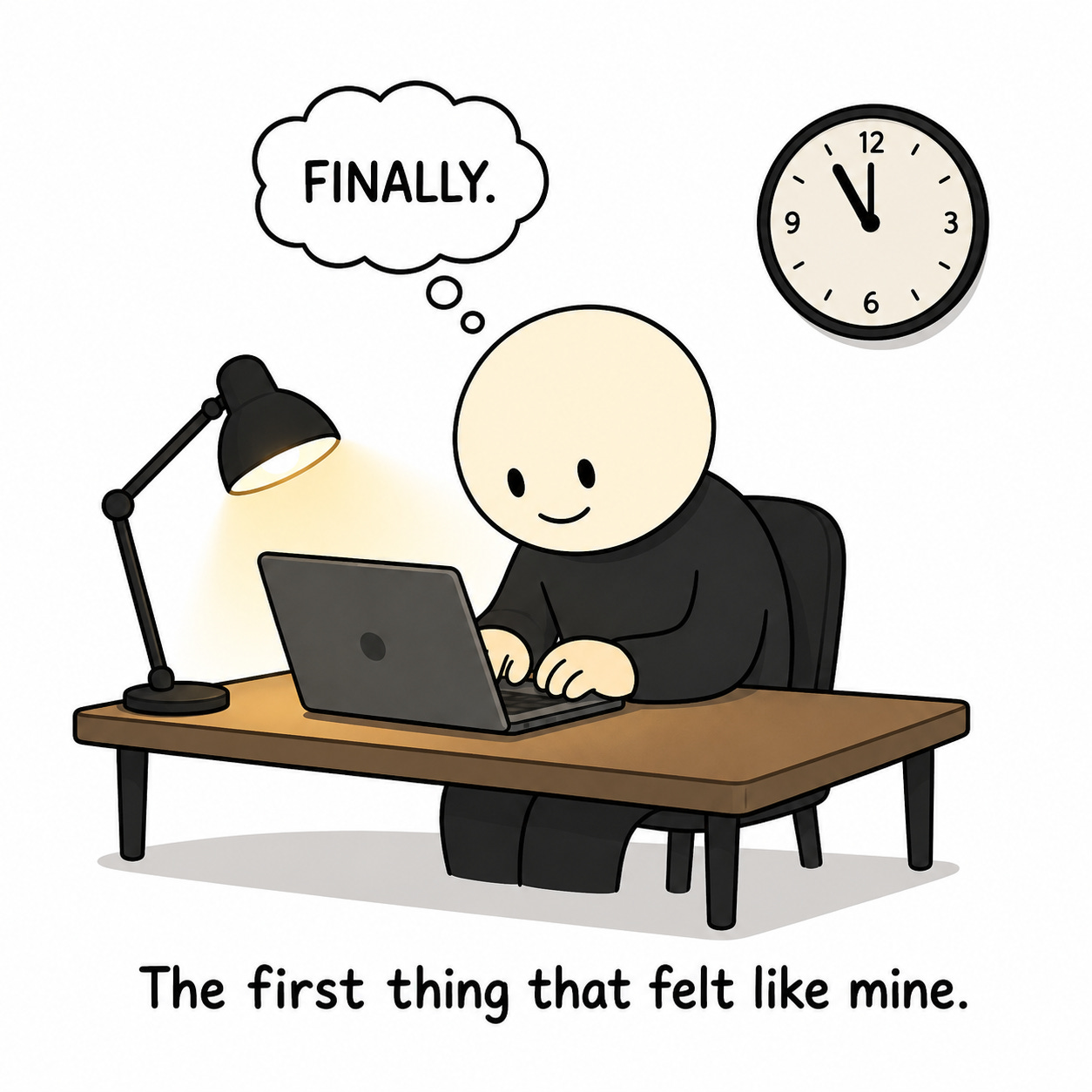
There were a few months after I had let go of my side business that I was in an in-between space not knowing what to do with that feeling of emptiness. I initially went into a state of panic trying to fill it up with anything I could find: panic applying to jobs, putting on music, eating a lot of junk food, etc.
During this time, I read a few psychology books as well, as I was desperate to understand why this was happening, and that I couldn’t get a grip on myself. Turns out, it was my resistance to the unknown that was truly causing this feeling of anguish. I was so familiar with fight or flight that I couldn’t get myself to slow down -- even when I had nothing else going on in my life.
The shift for me came pretty dramatically. It was through a transformational 14-mile walk in the rain. To summarize, it was the first time in my life that I chose to accept the pain I was in instead of run away from it. Seeing the pain as something that shows evidence of who I am rather than evidence that I am not enough.
For you, the shift doesn’t have to be as dramatic, as you can do the same but build it up slowly through smaller steps. The question was no longer ‘what can I do to maintain this life for others?’ but more of ‘what is the life that I always wanted but never had the courage to go after?’
Before, I had truly only been living for external validation. There wasn’t much thought that went into the design of my first side business. My co-founders and I built a product as fast as we could, shipped it out, and went straight to selling. The idea looked good on paper, but we never gave a second thought about what the actual future of it would look like.
After, I asked myself the second question, and I started to think about what would actually fulfill me in a business. Not what would make me the most rich. Not what would give me the most validation. Not even what would give me status. And I chose coaching specifically for many reasons.
One, a lot of people in my life have told me that I am a good listener and empathetic person and I seem to always be the person to go to for advice. Two, being able to connect with people on a deep level is something that I have a lot of fun doing, and energizes me as well. And three, the specific coaching (to help high achievers stop running into burnout by designing a life they don’t have to escape from), gives me a solid purpose to help the people who used to be in my exact position years ago.
Looking back at this, my first side business didn’t check any of those 3 boxes -- not aligning with my strengths, my values, or something I genuinely enjoyed (other than the door to door sales aspect -- the only part of the business where I got to connect with people).
And now that I have done more than half a year of coaching, I am super happy with the decision. It has grounded me and feels a lot more sustainable. Meanwhile building out a community to funnel it through Substack has been super fun as well.
-> Reader Takeaway: The 3-Project Audit
A quick exercise you can do in 10 minutes:
Write down your last 3 projects or side hustles.
For each: Was I excited to start this, or relieved to escape something else?
For each: Am I talking about this to inspire others, or to convince myself?
If the pattern is mostly escape and self-convincing -- that’s the hangover. The audit doesn’t fix it. But it makes it undeniable.
Here’s what we kept coming back to while writing this.
We didn’t escape the hustle hangover because we found better strategies. We didn’t optimize our way out. We didn’t find the right niche, the right model, the right course.
We escaped by finally asking a different question.
For Vinayak, it started with noticing the difference between what he was running toward versus what he was running away from. The new thing always felt exciting until it didn’t. And the gap between launch day energy and three-months-in reality kept showing up in every model, every channel, every client. The signal wasn’t failure. It was that nothing ever felt like his.
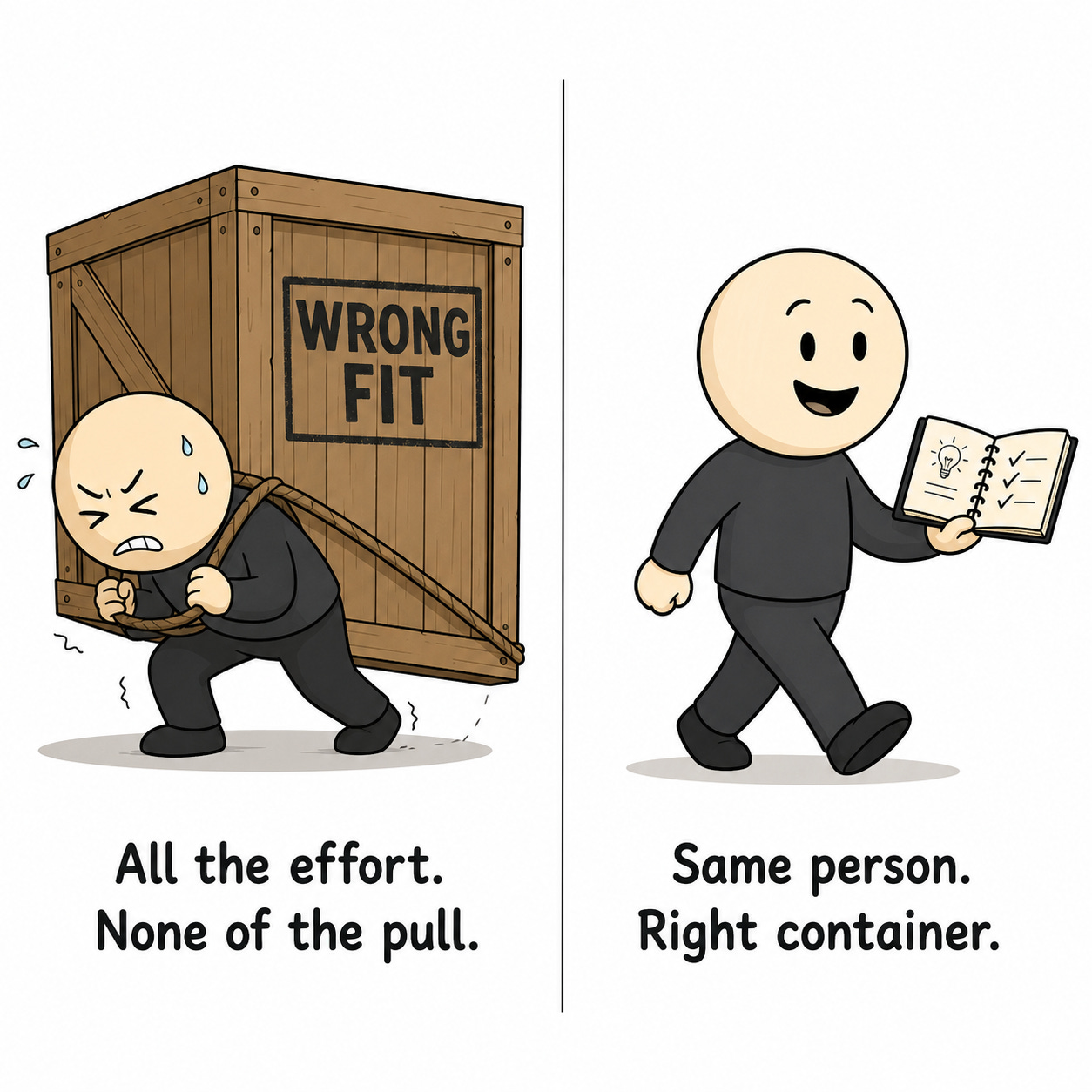
For Dido, it took a 14-mile walk in the rain to stop running entirely. Not from the business, but from the question he’d been avoiding for four years. Not ‘how do I make this work?’ but ‘does this actually fit who I am?’ Once he asked it honestly, the answer was obvious. It had probably always been obvious. He just hadn’t been willing to look at it.
Different entry points. Same destination.
The hustle hangover isn’t a willpower problem. It isn’t a discipline problem. It isn’t even really a strategy problem. It’s a design problem. You can be incredibly hardworking, incredibly smart, and incredibly committed, and still be building something that was never going to fit, because you never asked whether it should.
You cannot hustle your way into alignment.
So here’s the question we’ll leave you with, and we mean it as a real one, not a rhetorical one:
What would you build if you asked ‘is this me?’ before ‘is this working?’
Sit with that one. Really sit with it.
The answer is in there. It’s probably been trying to get your attention for a while.
Dido is a transformation coach that helps high achievers prevent burnout by designing a life they don’t have to escape from. His publication is called Trials, Tribulations, & Torches, where he writes about how to re-direct your energy before burnout does it for you.
Vinayak writes about building income streams alongside a 9-5 -- without burning out or giving up the life you actually want. His newsletter is The Sustainable Solopreneur.
What’s the hustle you’re most glad you walked away from or the one you stayed in too long? Drop it in the comments. We’re both reading every one.
Comments
Nothing yet. Say the first thing.
Sign in to join the conversation.