
Conrad Riker: Women are inside out. They have privilege and do not hold each other to account.
Me: Yes, I caught your drift in the lengthy post. I don’t share the same experiences with women. My wife and our daughter are Source Players and two of the finest individuals in the world.
I’ve had my share of relationship troubles in my younger, less mature days. But those were, on average, at least half my fault.
As I said in my response, I don’t care how illusory people are in an illusory society.

Conrad Riker: Perhaps you are overlooking their shortcomings.
Me: lol. What an odd thing to say, right after I expressed how great they are. I mean what I say and say what I mean. Why didn’t you ask me anything about my practice/philosophy, which I spoke a lot of, and you know nothing about? What are your beLIEfs?
An awake and connected Source Player who is progressing is still a work in progress. But here, we’re undoubtedly advanced well beyond your wildest dreams, judging by your posts.
There are plenty of imperfect but high-quality women out there. Really good people. But it’s understandable that you offer something of value, such as support and personality. What do you expect?
You sound single and bitter. Projecting your mistrust and negativity toward me, a stranger. You saw an opening to take a random jab, as revenge for my criticism of your viewpoint? Yes, I think so.
Conrad Riker: How does a woman climb the quality ladder? And what are the rungs? I’d suggest the first is radical responsibility and clear insight reflection.
Me: “Radical” responsibility? There’s no objective “quality ladder.” What if their insight doesn’t agree with yours? You don’t understand mine and even avoid it. What are your beLIEfs?
Your communication skills leave a lot to be desired. You have rigid quality criteria, which means nothing, but can you make someone happy and maintain a relationship?
Conrad Riker: Transcendentals of being, the good, true, and beautiful, allow communication. Brutalist architecture is a counterexample.
Me: Apart from sounding like you’re on a New Age ayahuasca or DMT trip, you could develop those ideals you mentioned as concepts of life and personal development.
Learn to love yourself and see the beauty of life. And get over your profound regrets and bitterness (I looked at more of your material) before they destroy you. Do the shadow work, if you can. NPCs can’t.
You appear to seek refuge in abstractions and theories, looking outward and having excessive concern for social ills. This can be read by others as a lack of genuineness and not sharing in the moment. You sound brooding and reclusive.
Conrad Riker: There’s a negative feminine spinning of your words.
Me: Your defensive lashing out only proves my assessment of you is correct. You are utterly incapable of handling exposure and are trapped in your bitterness. Your state of torment will worsen; it’s your program.
Operating as a psychic vampire with a permanent victim mentality, you do nothing but lay traps for me. You drag every dialogue back to your personal grievances, solicit advice, and then assault the very person who gives you tailored, thoughtful solutions.
Do you actually comprehend the rarity of encountering an awake Source Player? I possess the keys to life and existence. You have never stood before an eternal spirit like me, yet your mental blocks are so profound that you actively ignore every truth I share.
Conrad Riker: I’m not your dark mirror. Take the hindmost. Vade retro satana!
Me: Nice attempt at reversal. If you were a Source Player, I would say this: Your words apply to you. The external enemies you see are reflections of you. The negative femininity besieging you is your own demons.
But you’re just light and sound with no self. NPCs can only externalize and can’t do introspection. Your job is to get under my skin.
Ashley M Graetz: Female hysteria was a historical medical diagnosis used from ancient times until 1980 to pathologize women’s emotions and behaviors, primarily attributing them to the uterus (from Greek hystera). It was not considered a valid condition for men, as symptoms like emotional outbursts, paralysis, or fainting were deemed specific to female anatomy and sexual deprivation.
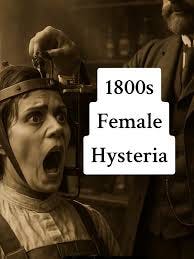
Today, the diagnosis has been officially removed from the DSM. The symptoms once labeled as hysteria are now understood as dissociative disorders, conversion disorder (functional neurological symptom disorder), or somatic symptom disorder. These modern diagnoses apply to both men and women and are linked to trauma, stress, and psychological factors rather than reproductive organs.
Historically, treatments ranged from uterine massage (often inducing orgasm via “hysterical paroxysm”) to forced rest or marriage, reflecting significant medical bias and sexism. The condition is now recognized as a form of medical gaslighting that silenced women’s legitimate physical and emotional distress.
Me: Very well said. This was a traditional, paternal, social-institutional bias against and exploitation of women, completely opposite to the advantaged women’s position claimed by my opponent on this issue, Conrad Riker. I read more of his material--trust me, don’t bother to check him out--and found him to be an extreme, pathetic, embittered misogynist.
I have a very low regard for the DSM-5-TR. It’s wildly inaccurate, and I think they just threw darts at a board with definitions and diagnoses pasted on it while blindfolded.
A clinician who famously and rightfully bashes the manual is Jerry Marzinsky. I watched one of his fascinating YouTube videos. He’s so interesting; I probably should’ve devoted a section to him in one of the volumes of the 4-book set I just put on Amazon.
Here is a Google description of his work:
Marzinsky spent over 35 years working on the front lines in state mental hospitals, state prisons, and emergency rooms. Based on his decades of direct experience, he authored books and appeared on various alternative media platforms to present what he calls the “Entity Theory of Psychosis.”

Key Elements of Marzinsky’s Propositions:
The Nature of Voices: He argues that the voices heard by patients diagnosed with paranoid schizophrenia are not random chemical hallucinations, but are actually sentient, parasitic entities that attach themselves to individuals to feed off their negative emotional energy.
Targeted Violence Against Psychiatrists: He points out that in-house psychiatrists are attacked far more frequently and violently by patients than lower-level ward staff or technicians, despite tech staff having much more physical, daily contact with the patients.
Resentment of Sedation: According to his theory, these entities specifically direct patient violence toward psychiatrists because they actively resent being chemically sedated or shut out by heavy anti-psychotic medications, which effectively “zombify” the host’s consciousness and cut off the entities’ access.
If you are looking for his videos or podcast appearances on YouTube, you can find them by searching his name alongside interviews on channels like The Cosmic Matrix Podcast or standalone segments detailing his clinical observations on the spiritual dimensions of mental illness.
The original, highly impactful interview you most likely watched is his appearance on the Skeptiko Podcast with Alex Tsakiris, titled “Jerry Marzinsky – Are Voices in Schizophrenia Demonic Entities?” This is the precise appearance where he laid out his entire career trajectory, his realization that standard psychiatry was failing, and his field data regarding why psychiatrists are disproportionately attacked. If you are looking for the core videos he produced himself or his other highly representative appearances, you can find them across these channels:
His Official YouTube Presence
· Engineering Mental Sanity: This is Jerry Marzinsky’s Official YouTube Channel. While he only uploaded a handful of short video segments here rather than long films, it acts as his core hub for short clips explaining how entities hijack the mind.
Top Alternative Interviews & Features
· The TruthSeekah Podcast: His multi-hour interview titled “Demonic Possession, Schizophrenia and Hearing Voices” is one of his most deeply detailed presentations. He explicitly maps out the clinical patterns he tracked over 30 years and how the voices reacted identically across patients who had never met each other.
· New View, New Life: His interview titled “Demonic Voices, Psychiatry Myths & Real Healing” heavily emphasizes the “zombification” aspect of neuroleptic drugs. He details how heavy medications act as a chemical barrier that pacifies the patient’s brain, which angers the parasitic entities because they lose their food source.
· Bennis The Menace Podcast: A prominent presentation titled “Psychotherapist Proves Mental Illness Is Demonic!” This video focuses heavily on the institutional dynamics he witnessed, including the targeted violence against staff psychiatrists.
No posts
Comments
Nothing yet. Say the first thing.
Sign in to join the conversation.