
There is a picture most of us carry somewhere in the back of our minds. A teacher sits beneath a tree. A few students sit close, unhurried, unwatched by any dashboard. No KPI, no quarterly review, no LLM humming in the background. Knowledge seems to pass from one life into another simply by proximity.
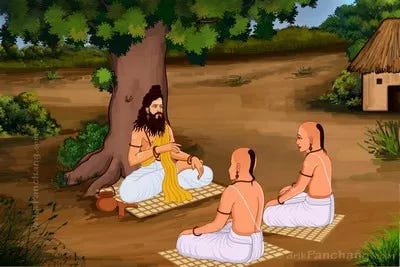
It’s a beautiful picture. And today, on Guru Purnima, in the middle of a Gen Z reckoning with institutions, an AI that can answer almost anything in seconds, and an education system groaning under its own bureaucracy — it’s worth asking honestly what that picture still means, and what it doesn’t.
A senior clinician takes the stethoscope from a student's ears, places it back on her own for a moment, then returns it. "Don't chase the sound," she says. "First understand where it belongs." Nothing in this exchange appears in a textbook. It cannot be looked up, tested for, or downloaded. The student is being taught how to listen — to a murmur, and to a patient, and eventually to her own uncertainty. This is the guru–shishya bond at its most defensible. It is also, not incidentally, the version we choose to remember every Guru Purnima, on a day built almost entirely out of gratitude and very little else.
I want to hold two things at once here, because I think both are true. I revere this tradition — genuinely believe our civilisational character survives, in no small part, because of it. And I also think reverence without scrutiny is how good things curdle. So here’s an attempt at a mature, unsentimental, multi-angle look — not to settle the question, but to actually sit with it, the way the word upanishad itself suggests: sitting close, in inquiry.
A mentor helps you do something better — pass an exam, land a role, navigate a department. It’s a real and useful relationship, organised around career and competence.
A guru enters somewhere deeper: not just what you know, but what you’re becoming. A resident doesn’t just learn how to examine a frightened child from a textbook — she learns it by watching whether her senior sits down before speaking to the parents, whether uncertainty can be admitted without shame, whether credit is given fairly after a difficult case. None of that is on any syllabus. It shapes her anyway, maybe more than the syllabus does. That’s the part the corporate mentorship language simply cannot hold.
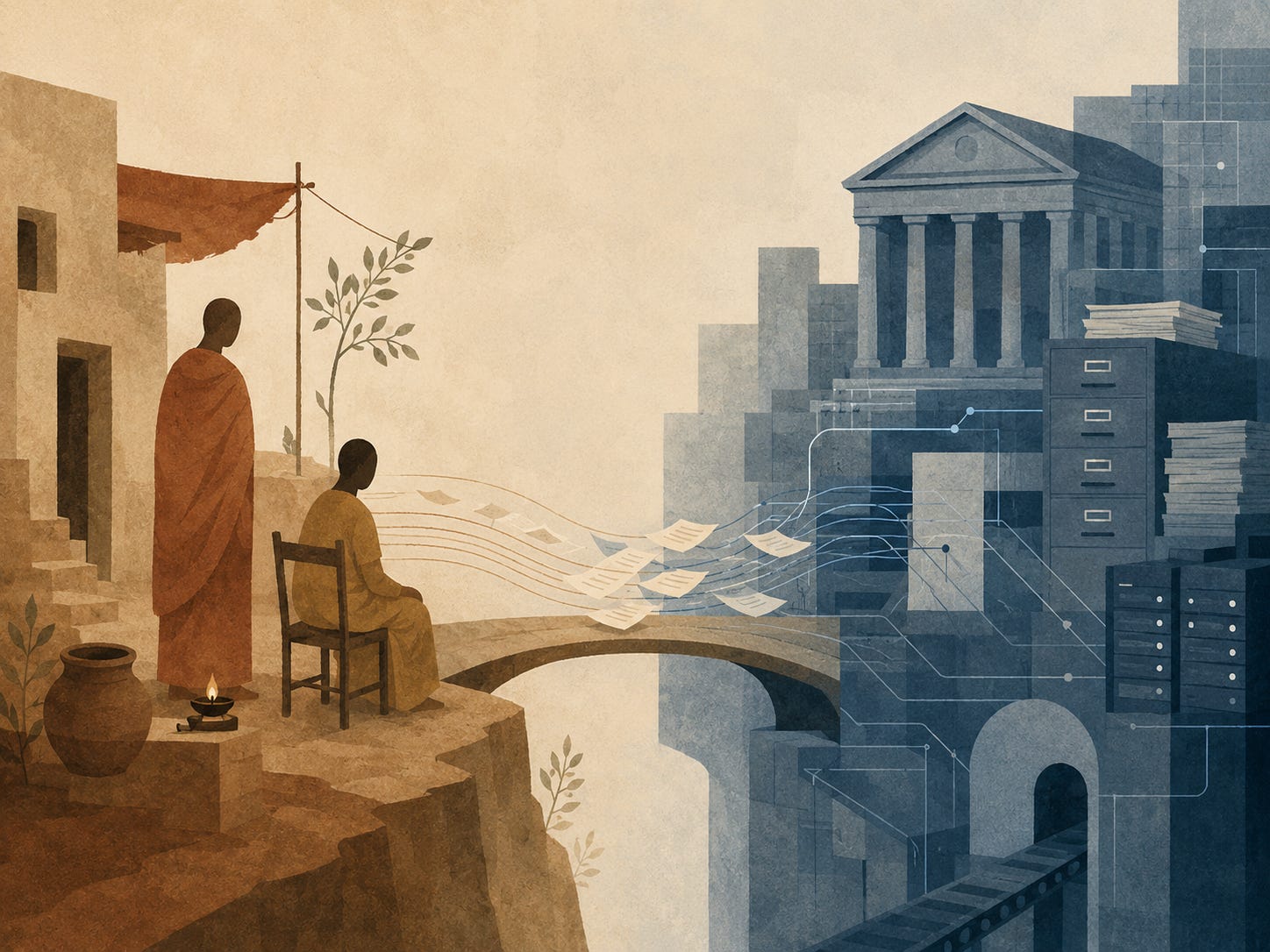
Here’s the uncomfortable, unromantic truth about why this bond has thinned in most institutions — and it isn’t that today’s teachers have less character or today’s students less reverence. It’s that the conditions for sustained attention have quietly disappeared…!
Faculty are buried under clinical load, administrative reporting, publication targets, accreditation paperwork. Mentoring gets bolted on as one more unpaid, unprotected duty. Trainees, meanwhile, are surviving exams and deadlines, not searching for transformation — not because they don’t want it, but because nobody built them the time for it.
Institutions respond the only way institutions know how: they formalise it. Assigned mentors, logged meetings, signed forms. And here’s the trap — a mentoring system can be fully compliant on paper and completely empty in practice. You cannot schedule trust for the third Friday of the month. A relationship that shapes a human being doesn’t show up in a register just because three meetings were entered into one.
If the tradition is going to survive institutions, the realist’s demand is simple: protected time, real recognition of mentorship as serious labour, and — where possible — separating the person who nurtures you from the person who has unchecked power over your career. Care and evaluation sitting in the same hands is where things quietly go wrong…!
Reverence, when it’s the only ethical foundation of a relationship, is dangerous — because it doesn’t announce itself as power. It just feels like devotion, gratitude, loyalty. Which is exactly how it can also become the vehicle for someone senior denying a junior their due credit, humiliating a resident in front of a patient’s family, or punishing a question asked at the wrong moment.
And there’s an older, harder truth underneath: this tradition has a shadow. Historically (if the contemporary academic historians are to be beileved), access to it was not universal — class, gender, wealth, and lineage probably decided who was permitted to sit beneath that tree. We don’t honour a civilisational inheritance by pretending it never excluded anyone. We honour it by widening the circle it once kept narrow.
The pessimist isn’t attacking the bond. They’re refusing to let sacredness be used as cover for harm — and that refusal is, itself, an act of respect for what the relationship could be.
Here’s where I think the idealist is simply, factually right, not just sentimentally right.
A textbook can list the features of a murmur. An LLM can generate ten empathetic ways to speak to a grieving family in under a second. Neither can carry the responsibility for that conversation. Neither can sit beside a resident at two in the morning after a death, let the silence stay exactly as long as it needs to, and help her walk back onto the ward without becoming numb or breaking.
This is tacit knowledge — judgment, timing, restraint, the sense that something is wrong before you can articulate why. It’s transmitted through apprenticeship: watching, then attempting with support, then finally acting alone. Cognitive science calls this modelling, scaffolding, fading. The Guru-Shishya tradition was doing this, quietly and precisely, long before anyone gave it that name…!
For a long time, a teacher’s authority came partly from simply knowing more. That’s over. A student can retrieve, compare, and synthesise faster than most seniors alive.
But that doesn’t make the guru obsolete — it makes them legible for the first time in decades. When information is free, judgment becomes the scarce resource. When answers are instant, knowing which question actually matters becomes the valuable skill. When a machine can produce polished, plausible language effortlessly, intellectual honesty becomes both harder to fake and more urgent to model.
The future guru doesn’t compete with the machine on memory. They become the person who helps you decide what’s worth remembering, questioning, resisting, and doing — which was arguably always the real job, just obscured by how much of the old role was information-delivery.
No single senior can now hold all the clinical judgment, research integrity, technical fluency, and emotional steadiness a young professional needs. A resident might get ethical grounding from a veteran in a rural hospital, computational thinking from a peer on another continent, and humility from a nurse who’s seen more suffering than any professor. Sometimes the student teaches the teacher — and a mature guru experiences that not as humiliation but as evidence that their authority never depended on omniscience in the first place. “Teach me” may be one of the highest things a senior can say to a junior.
This doesn’t make the bond shallower. It just means no one person should claim total ownership of another person’s becoming..!
Putting all five lenses in the same room, here’s the practical shape that emerges, not as theory but as something you could actually try to live:
Keep: sustained attention, apprenticeship, gratitude, the recognition that some things — judgment, courage, presence — can only be learned in close human proximity to someone who has them.
Release: unquestioned authority, coerced loyalty, the confusion of family language (”she’s like my daughter”) with an excuse for having no boundaries, and — quietly, but non-negotiably — the idea that the learner owes permanent dependence in exchange for what they were given.
Add, explicitly, because the old model never made this a formal value: the right to leave. A postgraduate should be able to change guides without professional retaliation. A junior should be able to decline an unethical demand without losing a recommendation. A relationship isn’t fully voluntary if leaving it threatens someone’s future. The best gurus have always understood this instinctively — they build their students toward independence from the very first day, and they measure their own success not by how devoted their students remain, but by how capable those students become of living without their approval.
Thanks for reading! This post is public so feel free to share it.
If you’re a shishya today, the honest questions aren’t just “who taught me.” They’re: Who corrected me without diminishing me? Who opened a door and didn’t demand lifelong loyalty for it? Who allowed me to become someone they hadn’t planned for?
And if you’re a guru — and most of us are, to someone, whether we’ve noticed or not — the harder questions run the other way: Did I give credit fairly? Did I make it safe for someone junior to disagree with me? Did I mistake obedience for learning? Did my student become more capable of living without my approval, or less?
The image beneath the tree is still beautiful. I don’t think its future lies in rebuilding the ashram, and I don’t think it lies in a corporate mentorship dashboard either. It lies somewhere quieter: in a guru who gives a student enough knowledge to stand, enough humility to keep learning, enough courage to disagree, and enough freedom to walk toward a place the guru will never see.
Maybe that’s the real gurudakshina — not repayment, not repetition, not permanent dependence, but carrying the knowledge forward with gratitude and judgment: repairing what was inherited, widening the circle that was once kept narrow, and becoming capable of handing the next generation something a little better than what we received.
Best wishes on Guru Purnima. To everyone who taught me to look again — thank you. And to everyone I’ll one day be responsible for — I hope I remember to let you go.
No posts
Comments
Nothing yet. Say the first thing.
Sign in to join the conversation.