
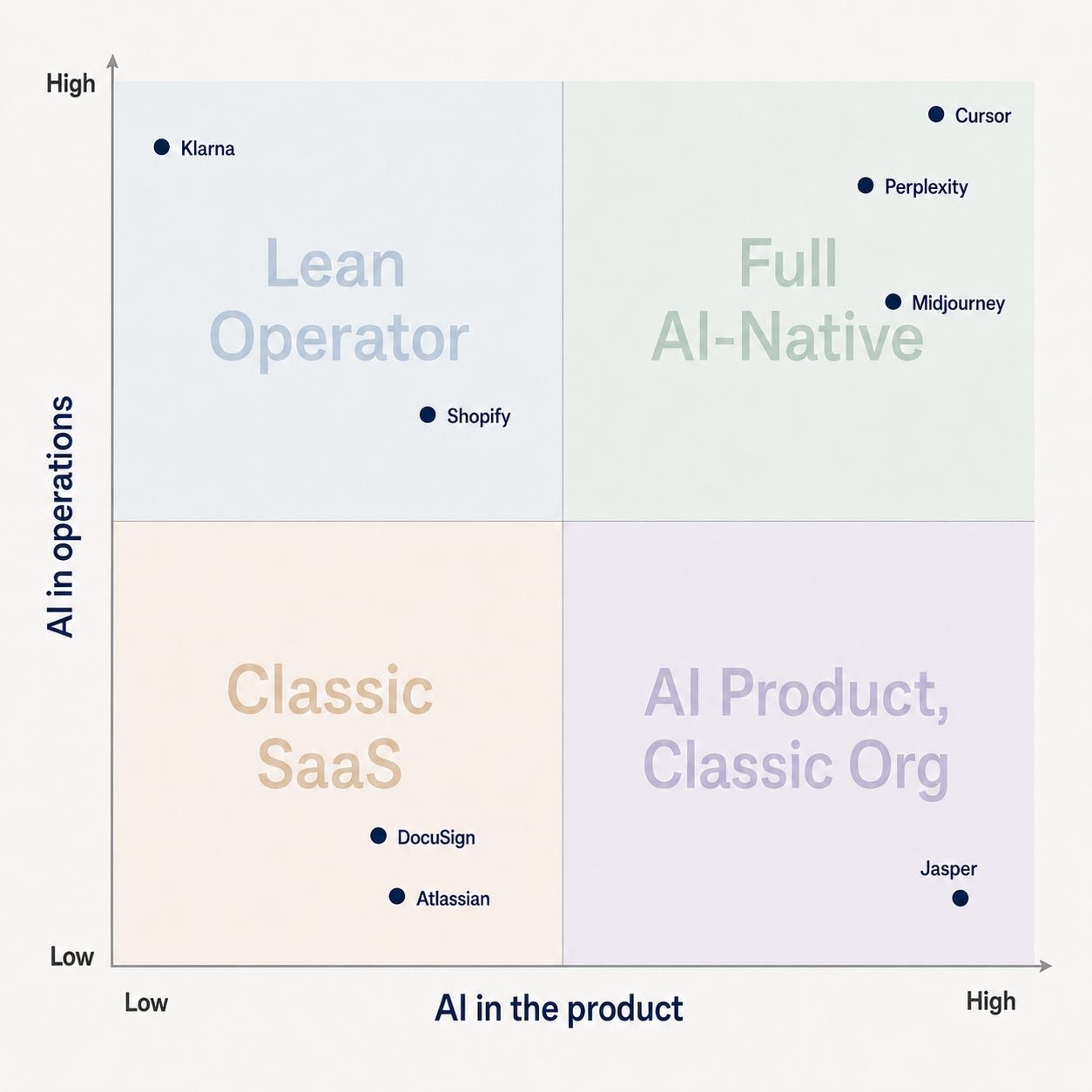
The most expensive mistake we see in AI diligence is treating “AI company” as a single thing. It is two things wearing one name. One kind sells AI to its customers and builds products that could not have existed a few years ago. The other points AI at its own work and lifts output per person.
On a pitch deck they look identical. On a P&L they behave very differently. Confuse them and you misread the business, valuing a category-creating product as if it were ordinary software, or overlooking a quiet operator that has rebuilt its cost base from the inside.
So here is the whole argument in one line: AI in the product reshapes what you sell and how you price it; AI in operations multiplies what your people can do. Those are two different axes, not two points on one line, and the most useful thing you can do with any company wearing the AI label is figure out where it lands on each.
When someone calls a business an AI company, they almost always mean one of two things, and they rarely say which.
The first is AI in the product. The customer is paying for model inference, and in return gets something software could never deliver before: a draft written, a problem reasoned through, an action taken. Every query runs a meter. Picture it that way. In classic software the meter switched off the day the code shipped, and the next customer was free. In an AI product the meter keeps running, because the product keeps doing real work for every user, every time. That one fact, that the product performs work on each use and that work has a cost, is what rewrites the economics, and it is also what makes these products worth paying for.
The second is AI in operations. The company points AI at its own work to get more done with fewer people. This never touches the price the customer sees. It lands in operating expense and headcount, which means it widens the gap between revenue and cost from the inside.
The two move in different directions on the P&L. AI in the product trades some gross margin for capability and growth, because serving each customer now carries a real cost. AI in operations lifts operating leverage, because the same revenue rides on a smaller payroll. A company can be strong on one axis and untouched by the other, which is exactly why a single “how much AI” score tells you nothing. You need two.
For twenty years, software taught investors to expect gross margins of 75 to 85 percent (ICONIQ, State of Software 2025). The reason was simple. Once the code was written and the servers were running, the next customer cost almost nothing. Cost was fixed, and revenue piled on top.
The meter changes that, and it is worth being clear about what you get in return. Inference is what lets these products do things no fixed-cost software ever could, which is a large part of why they grow as fast as they do. The trade is a different margin shape, not a broken one. When inference is part of the product, cost rises with use, so the gross margin simply looks different from classic software.
The numbers are already in. ICONIQ’s State of AI: Bi-Annual Snapshot puts the average AI-product gross margin near 52 percent, up from 41 percent two years earlier and still climbing. Put plainly: an AI product keeps about half of every dollar it bills today, where classic software kept four-fifths, and that half is funding growth a SaaS company could only envy. Inference runs about 23 percent of revenue at scaling-stage AI companies. Bessemer’s State of AI 2025 shows the range: its fastest-growing “Supernovas” run near 25 percent margin on roughly $1.13M of revenue per employee, trading early margin for a land grab, while the steadier “Shooting Stars” hold near 60 percent on about $164K per employee.
This does ask for a new discipline, and Replit is the cleanest public lesson. After it shipped a popular new agent, its gross margin reportedly swung from 36 percent to negative 14 percent in just two months in 2025, according to The Information. The feature was a hit; the pricing simply had not caught up with the cost of serving it. That is the lesson, not a verdict on the model. It is cost of goods sold, the direct cost of delivering what you sell, showing up where SaaS never had any, and it rewards the companies that price for it from day one.
There is good news in the trend. Bain Capital Ventures argues in “Gross Margin is a BS Metric” that today’s thinner margins are a passing artifact of expensive model APIs, and the data backs it. When Mixtral 8x7B arrived, the going rate for that class of model fell from about $2 to $0.24 per million tokens in a matter of days. Input costs are falling fast, even as usage climbs. The fair conclusion is that today’s margins are a snapshot, not a destiny. Which means, for a buyer, the question is not “what is the margin today,” it is “which way is it heading, and has the company priced for the answer.”
Not every AI feature earns the label. There is a real line between products that bolt a model onto a classic application, where margin drifts down toward 60 to 70 percent, and products that could not exist at all without runtime inference: open-ended generation, agents that take multi-step actions, plain-language interfaces over messy data. The second group is what people mean by “AI-native” (HBS, IBM), and it is where both the magic and the margin pressure run hottest.
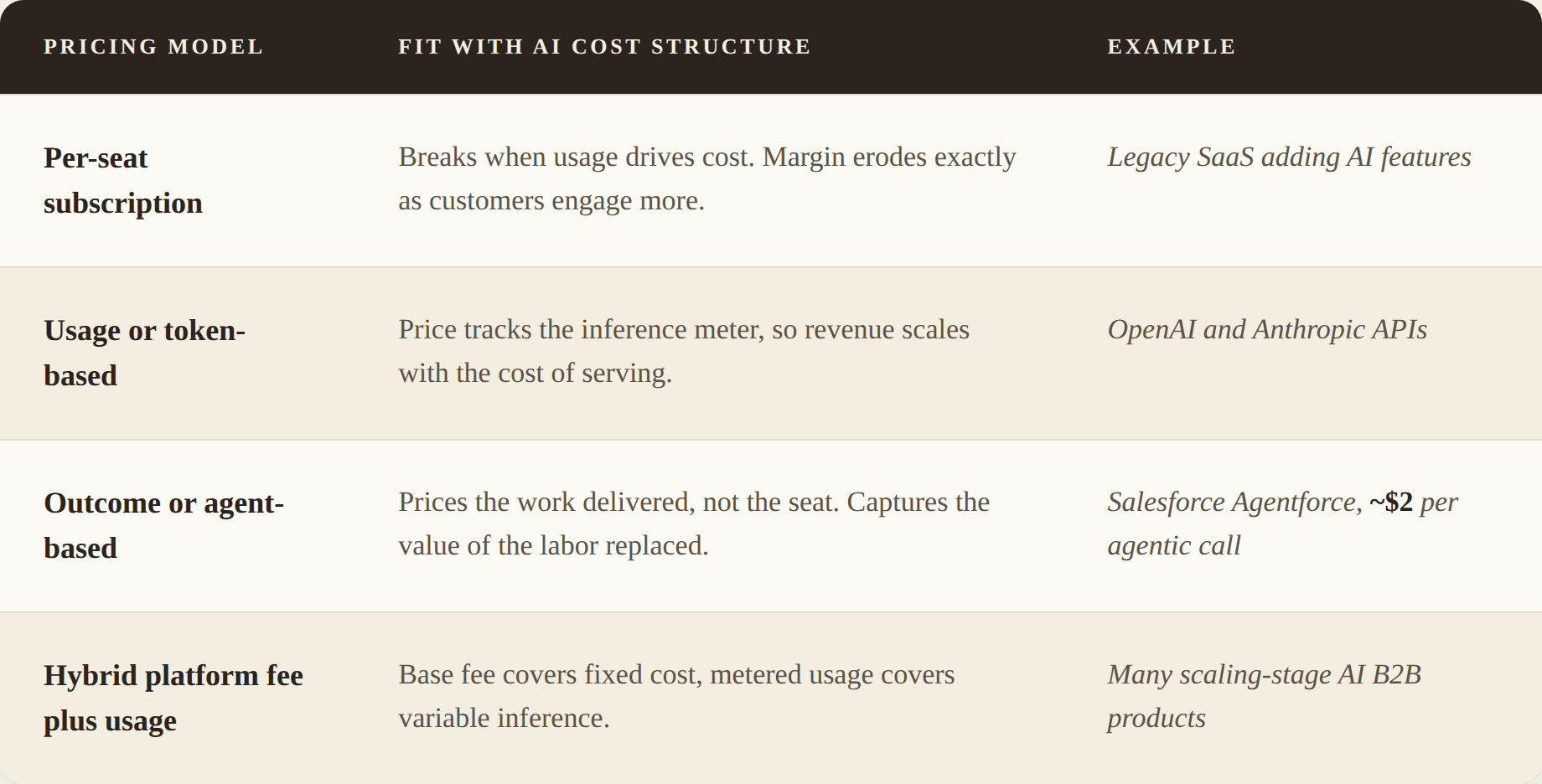
Here is the trap that catches the most companies: if usage drives your cost but seats drive your price, you lose money precisely when customers love you most. Aaron Levie of Box put the scale of it bluntly at TechCrunch Disrupt 2025: there will soon be “100x, maybe 1,000x more agents than people,” and no per-seat model survives that. Sarah Tavel of Benchmark gives the fix a name in “Sell work, not software”: price against the labor you replace, not the seats you fill.
The market is already moving. ICONIQ reports outcome-based pricing leaping from 2 percent of companies in mid-2025 to 18 percent by January 2026, the fastest pricing shift in modern software, and Salesforce at feature launch charged about $2 every time an Agentforce agent did something, a business it says has reached $800M in revenue (Q4 FY26 release). Which means a high-inference product still selling by the seat is not leaving money on the table. It is funding its customers’ usage out of its own margin.
The second axis asks something different. Not “is AI in what you sell,” but “has AI changed how you run.” Two questions hide inside that one. Is AI making your existing people faster, or has it changed the shape of the company itself?
The cleanest evidence comes from Brynjolfsson, Li and Raymond, who studied real customer-support agents and found a 14 percent jump in output on average, and 34 percent for the newest workers (Generative AI at Work). Operators feel the same pull. Shopify’s Farhan Thawar ordered 1,500 Cursor licenses, then immediately needed 1,500 more, and the fastest-growing users were not engineers but the support and revenue teams (First Round). Shopify’s CEO turned it into law: in his April 2025 memo, Tobi Lütke told the company that reflexive AI use is now the baseline, and that no team gets new headcount until it can prove AI cannot do the job. Which means, on this rung, the win shows up as the same work done by fewer hands.
The profound version is not faster typing. It is a different org chart, with fewer managers, wider spans of control, and far more revenue riding on each person.
Watch Klarna do it in public. Its F-1 filing shows headcount falling from 5,527 at the end of 2022 to 3,422 at the end of 2024, roughly two thousand jobs, credited directly to AI, with management saying the number will keep dropping. Over the same stretch, CEO Sebastian Siemiatkowski says revenue per employee climbed from about $300K to $1.3M (Charter, February 2026). Each remaining person now carries more than four times the revenue they did three years earlier. That is not a productivity tweak. That is a new operating model.
This is where the maturity frameworks earn their keep, because they grade exactly this axis. MIT CISR sorts companies into four stages and finds the bottom two lag their industry financially while the top two beat it, so depth here is not vanity, it shows up in the numbers. Gartner offers a five-level version of the same climb. And the macro picture is humbling: McKinsey finds roughly 88 percent of companies have adopted AI but only about 38 percent have scaled it past pilots, while Deloitte finds just 34 percent are genuinely rebuilding the business rather than chasing a few productivity wins. Which means most companies that call themselves AI-driven are sitting near the bottom of the ladder.
We are not here to sell a fairy tale to a room full of PE partners. Daron Acemoglu’s “The Simple Macroeconomics of AI” projects total productivity gains of at most 0.66 percent over a decade. A 2026 NBER working paper from Yotzov, Barrero, Bloom and colleagues found that about nine in ten firms report no measurable change in employment or productivity at all, which fits perfectly with most companies still stuck on the bottom rungs. And Klarna itself walked part of it back in 2025, bringing humans back for its highest-value customers when pure automation went too far. Cutting too deep carries its own cost.
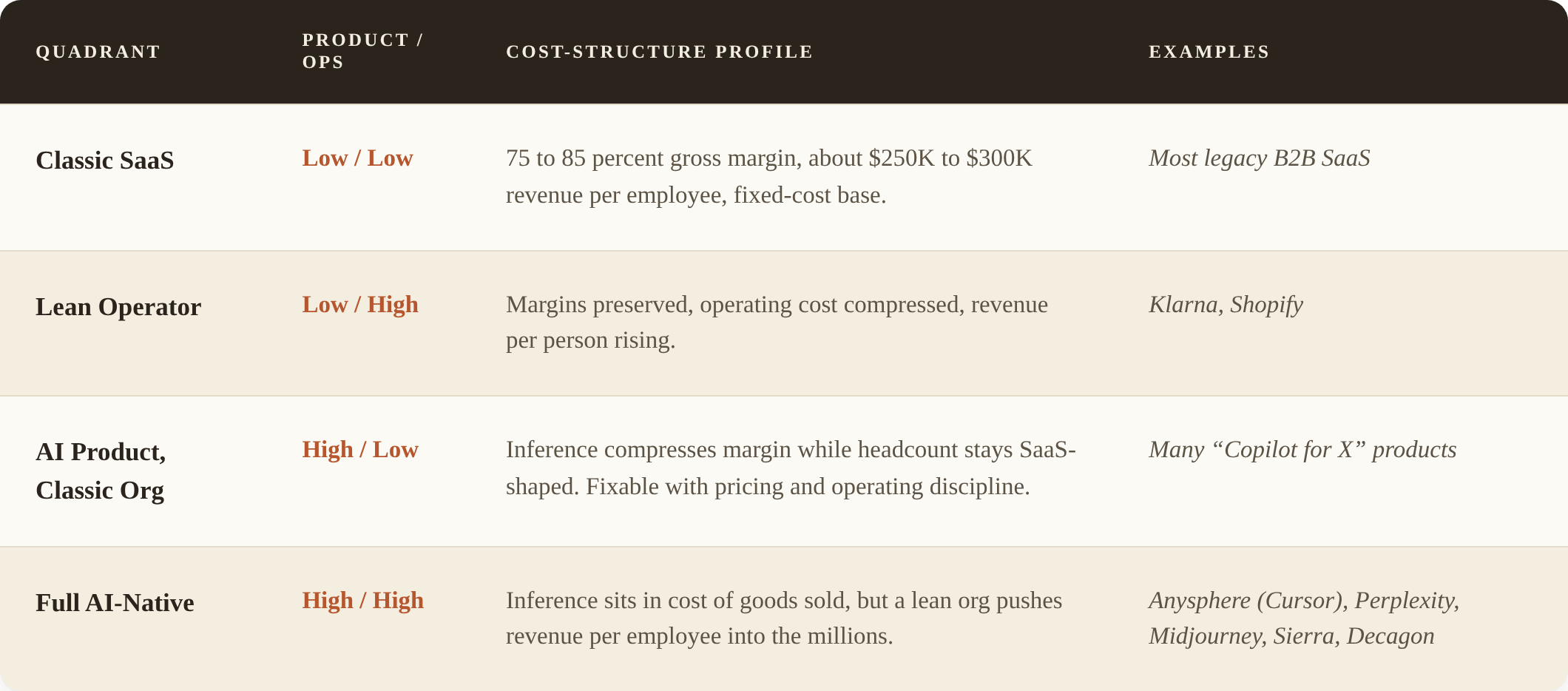
Strip away the noise and every one of these stories is the same question wearing different clothes: what cost structure do you actually have, and did you price for it? A high-product company still selling by the seat is carrying inference as cost of goods sold and charging as if it had none. A lean operator with an ordinary product can defend rich margins for years. The phrase “AI company” tells you almost nothing about which of those you are looking at. Its place on these two axes tells you almost everything.
So before you ask whether a company uses AI, ask the two questions that actually move a valuation. Does AI sit in the product, creating value and reshaping how it is priced? Does AI sit in operations, multiplying what each person can do? The label is marketing. The position is the business.
We’ll cover that impact in the next post.
ICONIQ Growth, State of AI: Bi-Annual Snapshot (Jan 2026) — https://www.iconiq.com/growth/reports/2026-state-of-ai-bi-annual-snapshot
ICONIQ Growth, State of Software 2025 — https://www.iconiq.com/growth/reports/2025-state-of-software
Bessemer Venture Partners, The State of AI 2025 — https://www.bvp.com/atlas/the-state-of-ai-2025
McKinsey, The State of AI 2025 — https://www.mckinsey.com/capabilities/quantumblack/our-insights/the-state-of-ai
Deloitte, State of AI in the Enterprise 2026 — https://www.deloitte.com/us/en/what-we-do/capabilities/applied-artificial-intelligence/content/state-of-ai-in-the-enterprise.html
MIT CISR, Enterprise AI Maturity Model (Weill, Woerner, Sebastian) — https://cisr.mit.edu/publication/2025_0801_EnterpriseAIMaturityUpdate_WoernerSebastianWeillKaganer
Gartner, AI Maturity Model & Roadmap Toolkit — https://www.gartner.com/en/chief-information-officer/research/ai-maturity-model-toolkit
Sarah Tavel (Benchmark), “AI startups: Sell work, not software” —
Bain Capital Ventures, “Gross Margin is a BS Metric” — https://baincapitalventures.com/insight/gross-margin-is-a-bs-metric/
Aaron Levie (Box), TechCrunch Disrupt 2025 — https://techcrunch.com/2025/10/29/box-ceo-aaron-levie-on-how-ai-is-changing-the-enterprise-saas-landscape/
Tobi Lütke (Shopify), “Reflexive AI usage” memo (Apr 7, 2025) —

tobi lutke@tobi
https://t.co/6i6h3sKi3x
2:28 PM · Apr 7, 2025 · 2.54M Views
304 Replies · 971 Reposts · 7.11K Likes
Farhan Thawar (Shopify) via First Round, “From Memo to Movement” (Jul 2025) — https://www.firstround.com/ai/shopify
Sebastian Siemiatkowski (Klarna), Charter Leading with AI Summit (Feb 10, 2026) — https://www.charterworks.com/what-klarna-learned-from-its-ambitious-ai-rollout/
Harvard Business School Online, “How to Architect an AI-Native Business” — https://online.hbs.edu/blog/post/ai-native
IBM, “What is AI Native?” — https://www.ibm.com/think/topics/ai-native
Klarna Group plc, Form F-1 (SEC, Mar 2025) — https://www.sec.gov/Archives/edgar/data/2003292/000162828025012824/klarnagroupplcf-1.htm
Salesforce, Q4 FY26 earnings release (Feb 25, 2026) — https://www.salesforce.com/news/press-releases/2026/02/25/fy26-q4-earnings/
The Information, “Replit’s Margins Illustrate the High Costs of Coding Agents” (2025) — https://www.theinformation.com/articles/replits-margins-illustrate-high-costs-coding-agents
Brynjolfsson, Li & Raymond, “Generative AI at Work” (NBER 31161; QJE 2025) — https://www.nber.org/papers/w31161
Acemoglu, “The Simple Macroeconomics of AI” (NBER 32487, May 2024) — https://www.nber.org/papers/w32487
Yotzov, Barrero, Bloom et al., “Firm Data on AI” (NBER WP 34836, Feb 2026) — https://www.nber.org/papers/w34836
No posts
Comments
Nothing yet. Say the first thing.
Sign in to join the conversation.