
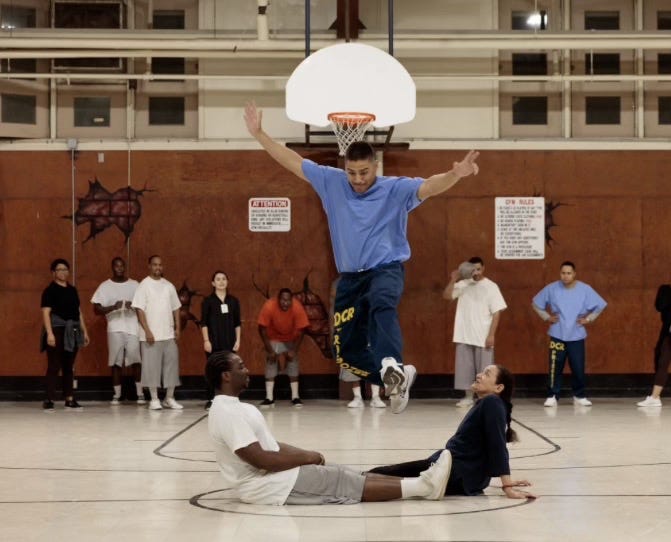
“Resilient spirit,” is said as a performer tap dances snaps his fingers to a rhythmic beat. Minutes before, another performer acted out that he was trapped under a plastic sheet as the surveilled prison phone call ran out of time. Another performer does the “revolutionary shuffle.” Two others do an 11-act dance centered around the pursuit of freedom. The event ends on the reflections of a mother who says she wants to be free by the river with her children.
All this at “Freedom Time,” a Dancing Through Prison Walls production. The performances were choreographed by incarcerated people from Michigan, New York, Puerto Rico and Palestine who sent their dances for those on the outside to perform and give insight into their experiences and thoughts.
“People inside prison are doing things such thinking and feeling and traveling internally, and they want to have their voices amplified,” said Suchi Branfman, a choreographer, curator and activist with Dancing Through Prison Walls. “That’s what we’re excited about and interested in, amplifying the voices of folks inside.”
Dancing Through Prison Walls started in 2016 in the California Rehabilitation Center (CRC) in Norco, California, as a way for activists and choreographers like Branfman to go inside and teach people in the prison how to dance as a form of expression and resistance.
The first major dance the team choreographed together was called “Sustain” about how people inside prison sustain themselves during tough times, which evolved out of conversations they had sharing their experiences.
Since its founding, they have gone through many cohorts of people at CRC, but they typically stick to teaching the same dances revolving around resistance and activism. Branfman said that at one point when they brought on a new cohort and it came time to teach the South African Boot Dance, one of the men already knew it. He told her that the previous cohort had been teaching the dance to everyone on the yard and they had been practicing in a large group.
“The amazing willingness and desire to dance is super brave when you live in a cage,” Branfman said. “It’s a radical act when you’re being surveilled and confined, so that has just been very, very powerful to witness and to be able to facilitate and to learn from.”
Changing the Culture of the Inside
For Linden Sawyer, being a part of Dancing Through Prison Walls while incarcerated at CRC helped him feel human. He had been in prison for years, starting from a level four facility where he felt there was constant violence and masculinity — until he joined the dance program, where he felt warmth, connection and encouragement.
Last year, Sawyer told Uma Nagarajan-Swenson with the All of Us or None Newspaper:
The class happened and it was incredible. I was able to take [Suchi’s] spirit, her love for change and second chances, through words that moved me. That was just like a fire inside me. It was there, despite all the darkness that was around physically and emotionally. That dancing brought a spark of life, hope, resilience, activism.
It peeled off layers of filth—you felt you were alive again.
Sawyer also told the newspaper that he was an avid salsa, cumbia and merengue dancer before he went to prison, so he missed having that in his life while incarcerated.
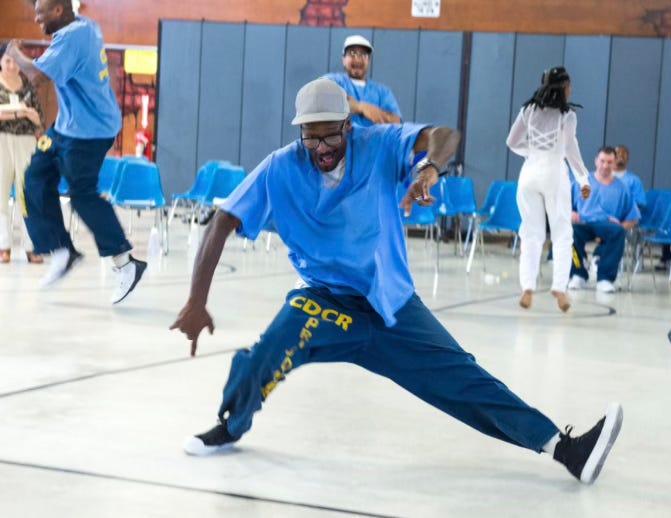
Forrest Reyes, who also participated in Dancing Through Prison Walls at CRC, also told the newspaper that the program made him feel human. In the report, he said:
It’s this whole new environment. Not everyone’s just gonna let down their shields, but they do. You see these big tough macho men like ‘wait, I can do this?’ You see the normal, more dominant behavior suddenly become timid and playful and creative.
Pivoting to Written Dances
The program went about many cohorts since its founding in 2016, but during the pandemic, everything changed. Branfman and her team were no longer able to go into the prisons. People from CRC still wanted to participate somehow, so Dancing Through Prison Walls decided to pivot. They began encouraging those in CRC to envision and write down dances and send them to the team.
“I would go to the gate on Fridays during covid and pick up a plastic shopping bag full of dances,” Branfman said. “It was beautiful.”
To help those dances come to life, Branfman began working with outside dancers to perform those dances in theaters in California. Not long after, the program started catching on and they were invited to other places such Michigan, New York and Puerto Rico. Branfman choreographed with incarcerated people there and also invited them to write dances. Those dances became “Freedom Time,” the organization’s latest performance which had its West Coast debut earlier this year.
“We hope it reinforces community,” Branfman said. “There’s a certain resiliency community. I think people really get vulnerable and brave together, whether inside a prison or out.”
In “Freedom Time,” which was at The Odyssey Theater in Santa Monica, California in early February, the acts featured included:
“un, dos, tres, cinco, seis” by Franchesca Nadal Cruz in Bayamón Correctional Complex in Puerto Rico
“The Revolutionary Shuffle” by Bartholomew in Auburn Correctional Facility in New York
“Mu’taqala/ Detainee” by Motasem Abu Hasan in Nablus, Palestine
“Lockdown Poetics” by Justin Rovillos Monson in Central Michigan Correctional Facility
“El Final/ The End” by Yarelys Rossy-Pérez in Bayamón Correctional Complex in Puerto Rico
“Breaking the Chains” by Ellis in Auburn Correctional Facility in New York
“A Bailar al Río/ To Dance by the River” by Amneris Manzano Días, Neilyann Rivera Rodríguez, and Sheyla Rosa in Bayamón Correctional Complex in Puerto Rico
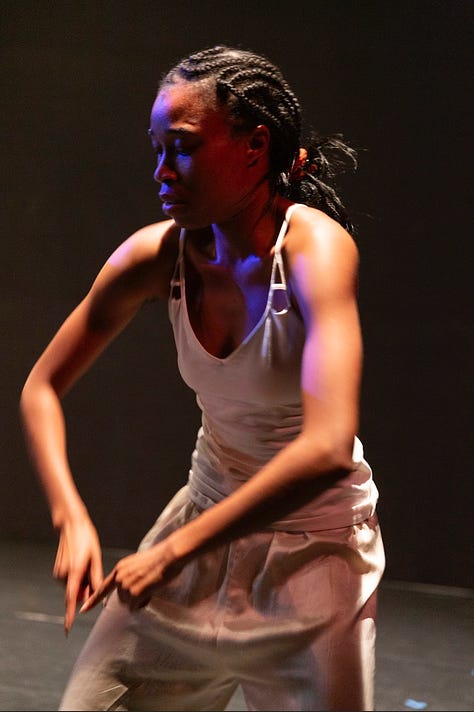
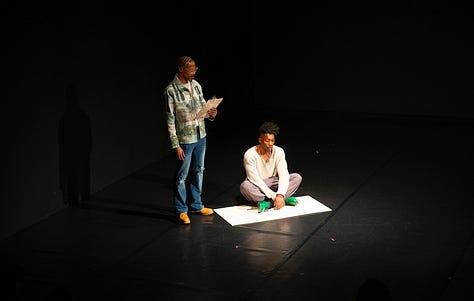
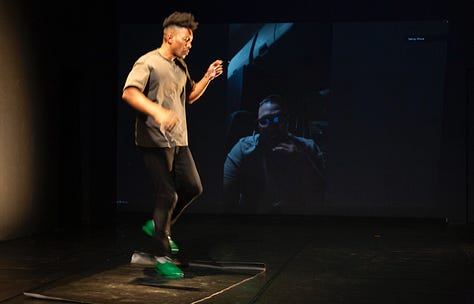


"Freedom Time" performances from Dancing Through Prison Walls of dances written by incarcerated people at the Odyssey Theater in early February (photos by Ciro Hurtado and Sarah Lyons)
An excerpt from “Breaking the Chains” by Ellis:
Dance? It is difficult with shackles on my feet. So I close my eyes and use my mind to react to the music of sacrifice . . . George and Jonathan Jackson’s background tune of a revolution as a solution to fuel my dance beyond this cage . . . Angela Davis’s voice echoes that, “Freedom is a constant struggle,” helps me hustle forward where I’m liberated beyond hatred.
I slide from side to side to recognize my dance is truth amongst the lies advertised . . . It’s there I share significance of a substance, instead of the stillness of the selfish silence that drowns out the music in my mind. I glide with the hope of love in a hate-filled space, as the atmosphere here takes shape where my dance collides with my neighbor committing suicide . . .
Even then I dance, as ink sinks into compressed wood called paper. The protector and the hater wear the same uniform. Hopes of quieting the sounds I call music, the inspirations of souls shaped in service for others, regardless color, shape, or space. I dance at my pace . . .
Choregraphic Abolitionists
While CRC is slated to close later this year, Branfman said Dancing Through Prison Walls will continue going into the facility and working with incarcerated dancers. She said her team calls themselves “choreographic abolitionists” because they hope to transform the system by working to amplify people inside’s words, voices and visions outside, as well as engage people in conversations about prison issues and what they can do about it.
They also have residencies in Santa Monica and Montalvo, California later this year as well as residency in Puerto Rico in the fall.
Dancing Through Prison Walls aligns itself with other abolitionist organizations like the California Coalition for Women Prisoners, All of Us or None of Us, Californians United for Responsible Budget, JusticeLA, Critical Resistance, Dignity and Power Now and more.
“We are inviting people to dream and find ways to work together to build a world that takes care of people rather than caging them,” Branfman said. “Our goal eventually is to shut down prisons, but moreover, to create a society that cares for community members, where the resources that we have are spent on caring for people, not putting not locking them up.”
No posts
Comments
Nothing yet. Say the first thing.
Sign in to join the conversation.