
There’s a moment most parents will experience - your kid does something that makes no sense for the 40th time that day - puts the remote in the bin, throws their spoon off the highchair as soon as you pick it up, lines the animals along the windowsill and screams when you move one, and you think: why??? Not “why” in despair (some days yes) but why this, why so incessantly, why it feels less like play and more like compulsion.
Most of the time, the answer is a schema. And once you see schemas, you can never not see them. The repetitive, obsessive, sometimes maddening behaviour stops looking random and starts looking like what it is - your child running the same experiment over and over until the result is etched into their brain. The word Schema comes from Piaget. But it was the British researcher Chris Athey, who spent years documenting the patterns in young children’s play and found the same handful of urges showing up in child after child, who made it something parents can actually use. Cathy Nutbrown advanced the work. Together they gave us a map of the strangest years of childhood.
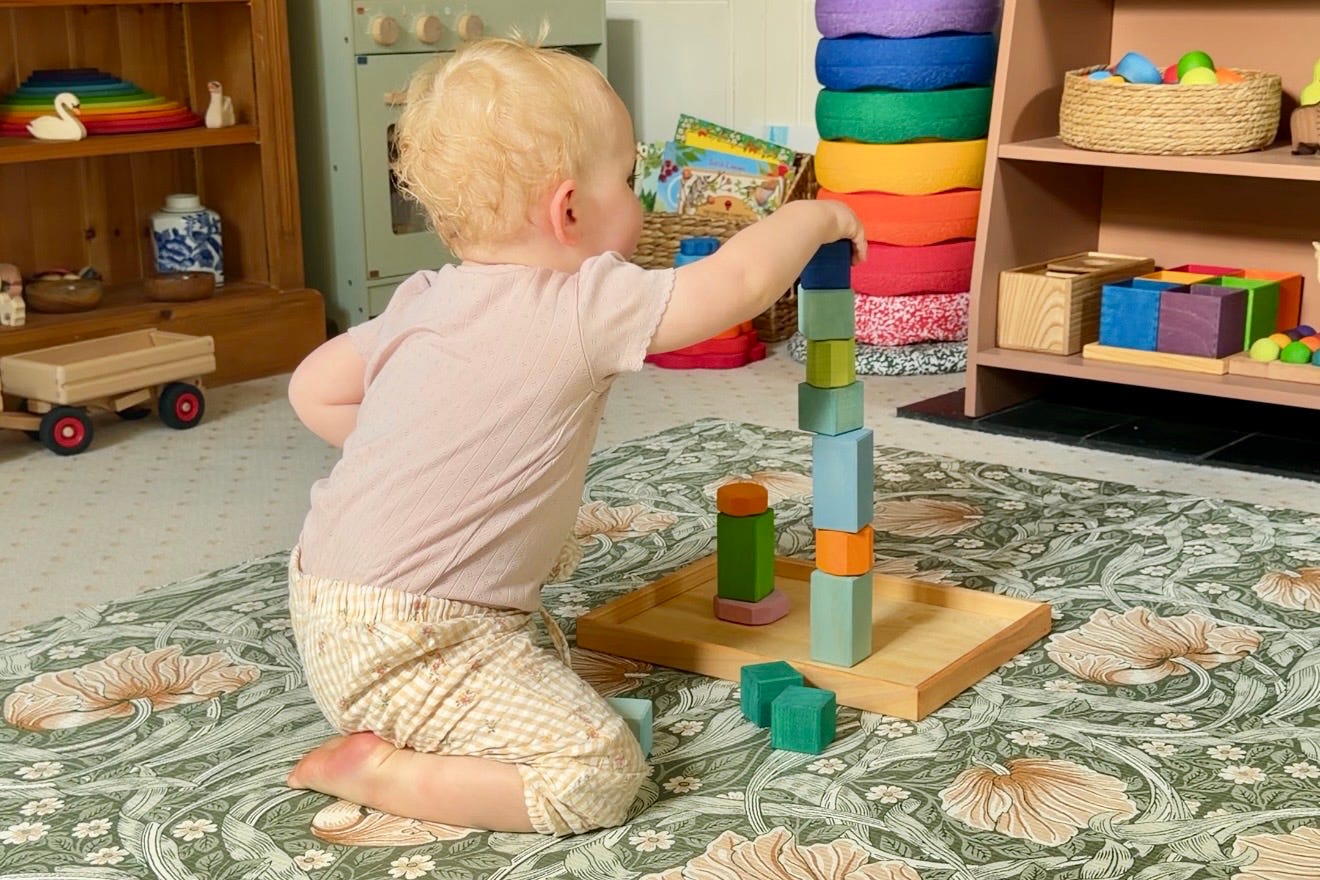
Here’s the important bit: a schema isn’t a preference, it’s an urge. A child in a trajectory schema doesn’t throw because they’re naughty and doesn’t stop because you say no. They throw because their brain is demanding data about how things move, and it will collect that data with your phone if you don’t give it something better. That’s the whole trick of this guide. You can’t switch a schema off, but you can feed it well, and a well-fed schema is the difference between a child hurling cutlery and a child absorbed for 40 minutes.
For each of the 9, I’ll give you the giveaway behaviours, what’s actually being built in the brain, the toy in an open-ended collection that feeds it best, a free way to feed it today, and the redirect line for when it’s aimed at something it shouldn’t be. One rule before we start: schemas aren’t stages and this isn’t a checklist. Your child might live in one for a year, blitz through three at once, or show some faintly and one ferociously. All normal. There’s no schedule and nothing to achieve, this is a field guide - not a race.
The oldest and often the first: an obsession with how things move through the air, and how bodies do too.
The giveaways. Throwing everything, and I mean everything, with a flat, scientific expression that tells you this is not temper. Dropping food from the highchair and leaning over to watch it land. Sweeping objects off tables. Climbing and jumping off things. Pouring water from a height. Kicking, rolling, flinging. The spoon game, where you pick it up and they drop it and you pick it up and they drop it, is pure trajectory, and they will always have more patience for it than you.
What’s being built. This is physics from first principles. Gravity, force, speed, arc, cause and effect, and the beginnings of understanding that their own action produces a predictable result out in the world. That last one is enormous. It’s the root of agency.
The toy that feeds it. Balls, obviously, but the deeper answer is a ball run or marble-style tracker, the wooden tower kind where a ball spirals down ramps. It’s trajectory you can watch, repeat and control, and it converts the urge to launch things into the urge to post-and-watch. For the body version, a Pikler-style triangle or a low ramp does the same job for climbing and jumping.
Feed it free. Rolled socks into the laundry basket from increasing distances. Pouring station at the sink. A ramp made from a leaning tray and every vehicle you own.
The redirect. Never “stop throwing”, always “not that, throw this”. Keep a soft designated throwing basket in the room and make it the answer every time. Trajectory children need a legal outlet more than any other schema, because their experiments are the ones that break things.
Comments
Nothing yet. Say the first thing.
Sign in to join the conversation.