
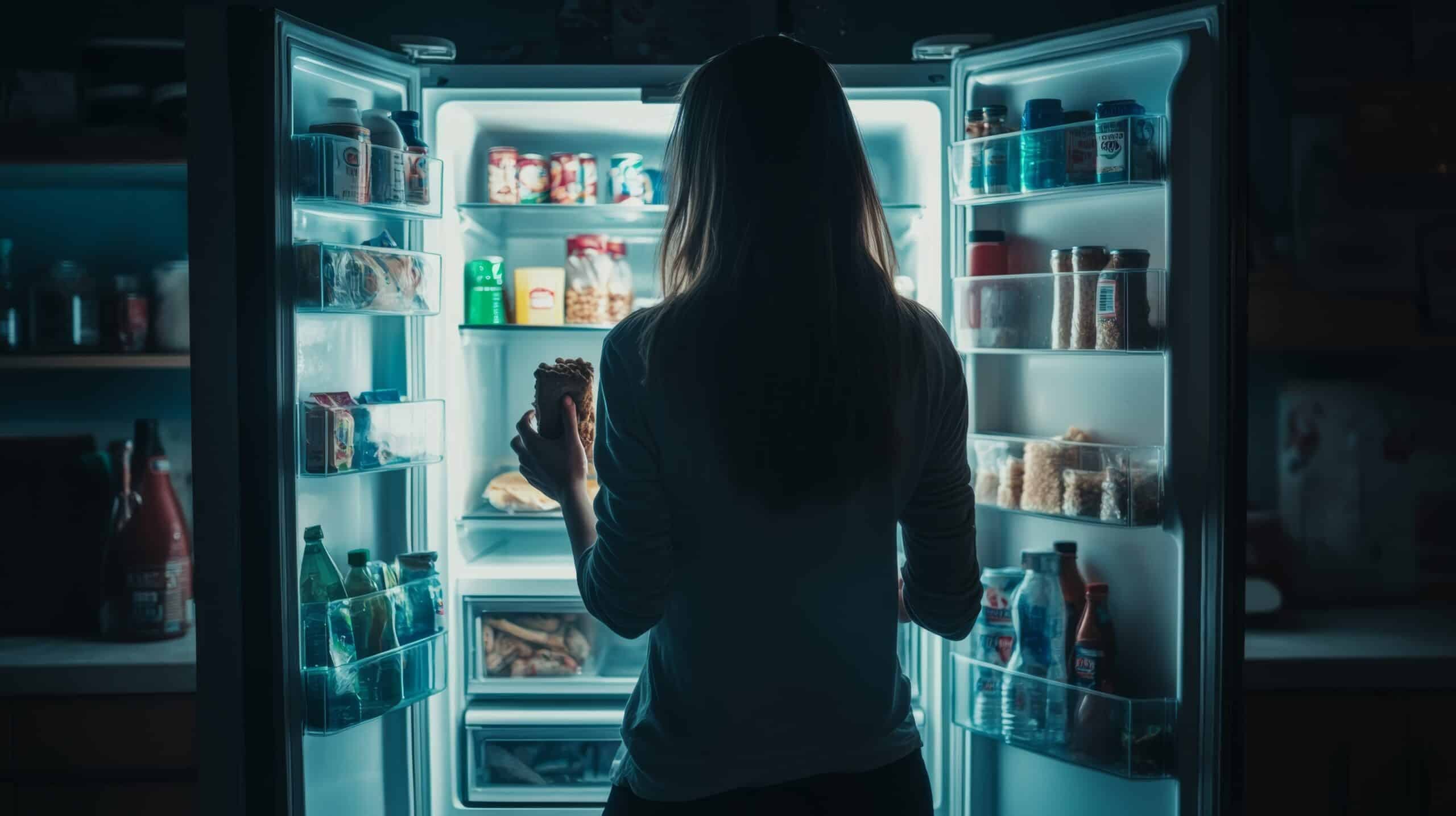
It is 8:40 on a Thursday and you have been up since six.
You open the fridge.
Half a cucumber. Three eggs. A container of something you are not going to investigate tonight. A jar of mustard, two jars of mustard actually, and a bag of salad that has gone.
You close it.
And then, about forty seconds later, you open it again — as though the second look might produce a different fridge. You know while you are doing it that it will not. You do it anyway, standing there in the light with your coat still on.
Then it is toast. Two slices, butter, eaten standing at the counter, and a second two slices about ten minutes later because the first two did not do anything.
You are in bed by ten and awake at three, and you do not connect those two events.
And in the morning — this is the part that matters — you do not think I had no options on Thursday. You think something much worse and much more permanent than that. You think: I have no discipline.
There’s nothing in.
There wasn’t. That is a true statement about a kitchen, and you converted it into a statement about yourself somewhere between the counter and the morning.
Count how many of these nights you actually have.
Not the good weeks. The real ones. Two? Three? The Thursday after the long day, the Monday when something ran over, the night one of the kids had a thing and you got in at eight.
Now hold that number against how you have been treating those nights. As exceptions. As deviations from the plan, to be absorbed and apologized for and done better next week.
They are not exceptions. Two or three nights a week, every week, is not a deviation from your schedule — it is your schedule. It is a fixed and permanent feature of a life with a job and other people in it, and it is going to keep being one for the rest of your life.
Which means the plan that covers only the good nights covers about half your week.
Here is the reading that has kept this invisible, and it is not you and it is not your calendar.
It is the habit of interpreting a logistics failure as a character failure.
Call it The Character Reading. On Thursday at 8:40 there was no protein in your house, you had been awake for fifteen hours, and the decision-making capacity available to you was approximately zero. That is a stocking problem. It happened on Saturday at the store, or three weeks ago, or never.
But because the visible moment is you standing at a counter eating toast, the explanation gets attached to the person rather than to the shelf. Every single time.
A night with no options is not a test of character. It is a stocking problem — and stocking is something you do on a Sunday, in eleven minutes, in a state where decisions are easy.
That is the whole article. Everything below is the execution.
❤️ Real Talk: You have been solving this at the worst possible moment, with the fewest possible resources, and then grading yourself on the result. Nobody performs well at 8:40 on the fifteenth hour of a Thursday. The fix is not to become someone who does — it is to make Thursday a night where no decision is required.
A twelve-item shelf with costs and keeping times, twelve dinners with exact builds and protein figures, five things that make tomorrow worse and what to do instead, and an eleven-minute Sunday sequence that installs the whole thing.
No email gate, no download, nothing held back.
Twelve items. All of them in any ordinary supermarket. Together they cost about $45 the first time and roughly $20 a month to maintain, and they make every dinner in the next section possible without a single trip to the store.
One rule that runs through all of it: check the oil. Canned fish and jarred vegetables are frequently packed in sunflower, soybean or “vegetable” oil, which is the one category this publication has consistently told you to keep out of your kitchen. Olive oil, water or brine. It is printed on the front and it takes two seconds to check.
And one rule about where it goes, which matters as much as what you buy. This shelf lives somewhere separate from your everyday food — one shelf, one basket, one corner of a cupboard, and the freezer items together in one bag rather than distributed.
The reason is not tidiness. A can of sardines mixed in among the everyday pantry is functionally invisible at 8:40, because at 8:40 you are not going to search. You are going to open one door, look once, and take whatever presents itself. The entire mechanism of this article is that something good presents itself first, and that only happens if it has its own place.
1. Canned sardines or mackerel, in olive oil
Why it earns its place: roughly 23 g of protein in a 3.75 oz can, plus omega-3s and calcium from the bones. It is the highest protein-per-second food that exists — no cooking, no thawing, no preparation of any kind.
Keeps: three years or more. Cost: $2–3. Keep four.
2. Canned tuna or salmon, in olive oil or water
Why: 25 g of protein per 5 oz can. Blander than sardines, which matters on the nights when nothing appeals.
Keeps: three years. Cost: $1.50–2.50. Keep four.
3. Canned chickpeas, white beans or black beans
Why: half a can is about 7 g of protein and 8 g of fiber, and beans are the thing that turns a protein into a dinner rather than a snack. They are also the cheapest item on this list.
Keeps: two to three years. Cost: $1. Keep four.
4. Frozen raw shrimp
Why: about 20 g of protein per 4 oz, and — this is the part people do not know — you can thaw them under a cold running tap in three minutes. No planning required. They cook in ninety seconds.
Keeps: six months. Cost: $7–9 for a 1 lb bag, which is four dinners.
5. Frozen shelled edamame
Why: roughly 17 g of protein and 8 g of fiber per cup, which is more protein than most people’s actual dinner. Three minutes in the microwave.
Keeps: eight months. Cost: $2.50–3.50.
6. Eggs
Why: 6 g each, and three is a meal. The most flexible protein there is.
Keeps: four to five weeks in the fridge, which is longer than most people think. Cost: $4–5.
7. Full-fat Greek yogurt
Why: 15–18 g of protein per ¾ cup. Full fat, not 0% — the fat is what makes it a dinner component rather than a snack, and the 0% version has less protein per spoonful anyway.
Keeps: two to three weeks unopened. Cost: $5–6 for a large tub.
8. Frozen spinach
Why: it goes into a pan frozen, it costs nothing, and it never rots in the drawer — which is where fresh spinach goes to die in this house and every other one.
And it is not a compromise. In a two-year study comparing fresh, refrigerated-for-five-days, and frozen produce, most comparisons showed no significant difference — and where differences appeared, frozen outperformed five-day-old fresh more often than the reverse [1]. A companion analysis found frozen higher in vitamin C in three of eight commodities, equivalent in five, and lower in none [2]. (Both were funded by the Frozen Food Foundation, which you should know; the practical point stands either way, because the comparison you are actually making is against nothing.)
Keeps: eight months. Cost: $2.
9. Pre-cooked grain pouches — rice, quinoa, or lentils
Why: ninety seconds in the microwave and you have the carbohydrate component, which is not optional. Lentil pouches are the best value: about 9 g of protein and 8 g of fiber.
Keeps: twelve months. Cost: $2–3. Keep three.
10. Extra virgin olive oil
Why: every dinner below is finished with it. It is the fat that makes the meal hold, and it is what carries the fat-soluble nutrients out of the vegetables and into you.
Keeps: a year unopened. Cost: $10–15 for a bottle that lasts two months.
11. Something acidic in a jar
Capers, olives, pickled onions, sun-dried tomatoes, harissa, hot sauce, a lemon.
Why: acid is the difference between “canned fish and beans” and “dinner.” It is the single cheapest upgrade in this entire article and it is the reason emergency food usually tastes like emergency food.
Keeps: months. Cost: $3–4 each.
12. Parmesan or feta
Why: 10 g of protein per ounce, salt, fat, and it makes anything taste finished. It is the difference between a bowl of beans and a dinner.
Keeps: parmesan, months in the fridge — a wedge outlasts almost everything else in there. Feta, weeks, as long as you keep it in its brine rather than draining it. Cost: $5–7.
Worth naming, because if you have these you may believe you are already covered.
Protein bars. They are protein, and on a night with genuinely nothing they beat nothing. But they are 10 to 20 grams, they do not register as dinner, and almost everyone eats something else afterward — so the practical result is a bar plus the toast rather than instead of it.
Canned soup. Typically 4 to 8 grams of protein per can and 800 to 1,200 mg of sodium. It is hot and it feels like a meal, which is exactly the problem: it occupies the dinner slot without doing the dinner’s job. If you have it, add a can of beans and a handful of frozen edamame — ninety seconds, and it becomes a real meal.
Frozen pizza “for emergencies.” It will be eaten, and not only in emergencies. That is not a moral point, it is a shelf-management one — an emergency shelf works because the items on it are things you would not otherwise touch.
Pasta and jarred sauce. The default emergency dinner in most houses, and about 12 grams of protein with 60 to 80 grams of fast carbohydrate at nine at night. Keep it if you like it — just add a can of tuna or white beans to the sauce, which takes thirty seconds and roughly triples the protein.
Grouped by what you actually have left, not by ingredient.
That is deliberate. At 8:40 you do not need recipes sorted by protein type. You need to be met at the exact capacity you have — and some nights that is eight minutes at a stove, and some nights it is genuinely nothing.
Every one clears 25 to 30 grams of protein, which is the per-meal threshold the protein article covers in full and which I am not going to re-argue here. And every one includes the reason it will not cost you the night — because the version of this list that is just fast food you make yourself is not worth your time.
The build: 4 oz frozen shrimp, thawed under a cold tap for 3 minutes · 2 tbsp olive oil · 2 cloves garlic, sliced · pinch of chili flakes · half a can of white beans, drained · squeeze of lemon · salt.
Oil and garlic in the pan, 30 seconds. Shrimp, 90 seconds a side. Beans in, warm through, lemon, done.
Time: 8 minutes, 6 hands-on.
Protein: 32 g · 26 g fat · 22 g carbs · 8 g fiber
Why it does not wreck the night: protein, fat and a slow carbohydrate together, which is the combination the dinners article lays out as the one that gets you through the night without a glucose fall at three. Beans are the part most emergency dinners skip and the part that does most of the overnight work.
The zero-energy version: skip the garlic and the chili. Shrimp, beans, oil, salt. Six minutes.
If there is one fresh thing: a handful of parsley, or half a lemon rather than the bottle.
The build: 3 eggs · a large handful of frozen spinach, straight from the bag · 1 oz feta · 1 tbsp butter or olive oil · salt, pepper.
Spinach into the hot pan first for 2 minutes to drive the water off. Eggs over the top. Feta on. Fold when it is nearly set.
Time: 7 minutes, all hands-on.
Protein: 26 g · 28 g fat · 4 g carbs · 3 g fiber
Why it does not wreck the night: this one is deliberately low-carbohydrate, so eat it with a slice of real bread or half a grain pouch if you are someone who wakes at three. Protein and fat alone is a better dinner than toast alone, but the carbohydrate is doing a job overnight.
The zero-energy version: scramble it. Do not fold anything at 8:40.
If there is one fresh thing: a chopped tomato in with the spinach.
The build: 1 can sardines in olive oil, oil and all · half a can of chopped tomatoes · half a can of chickpeas · garlic if you have it · chili flakes.
Everything into a pan. Break the sardines up with a spoon. Simmer 5 minutes.
Time: 7 minutes, 3 hands-on.
Protein: 30 g · 22 g fat · 28 g carbs · 10 g fiber
Why it does not wreck the night: the highest fiber count in this group, and the omega-3s are a genuine bonus rather than a marketing line — sardines are one of the best sources there is and this costs about $3.
The zero-energy version: skip the tomatoes. Sardines and chickpeas warmed in the pan with the sardine oil. Four minutes.
If there is one fresh thing: parsley, or a lemon.
The build: 1 pouch pre-cooked lentils · handful of frozen peas · 3 eggs fried in butter · parmesan · olive oil.
Lentils and peas into a pan with a splash of water, 3 minutes. Eggs in a second pan, or the same pan pushed to one side. Everything in a bowl, parmesan over, olive oil over that.
Time: 8 minutes, 6 hands-on.
Protein: 30 g · 26 g fat · 32 g carbs · 11 g fiber
Why it does not wreck the night: lentils are the slowest carbohydrate on the shelf, which means the glucose from this meal arrives over hours rather than in one wave. That is exactly the shape you want at nine at night.
The zero-energy version: microwave the pouch, crack the eggs into the pan, do not bother with the peas.
If there is one fresh thing: a chopped scallion, or arugula wilted underneath.
No stove. No pan. Nothing to scrub.
The build: 1 cup frozen edamame, microwaved 3 minutes · 1 pouch rice or quinoa, 90 seconds · 1 can tuna in olive oil, drained · 1 tbsp olive oil · lemon or vinegar · salt · chili flakes.
Everything into one bowl. Stir.
Time: 5 minutes, 2 hands-on.
Protein: 42 g · 24 g fat · 40 g carbs · 10 g fiber
Why it does not wreck the night: the highest-protein dinner in this entire article and it involves no cooking whatsoever. Forty-two grams at nine at night is more than most people manage at a planned dinner.
The zero-energy version: skip the grain pouch. Edamame and tuna in a bowl with oil and salt. Three minutes, 37 g of protein.
If there is one fresh thing: half an avocado.
The build: ¾ cup full-fat Greek yogurt · half a can of chickpeas, drained · 1 tbsp olive oil · lemon · salt · harissa or hot sauce · a few olives.
No heat at all. Stir the harissa through the yogurt, chickpeas on top, oil and salt over.
Time: 3 minutes.
Protein: 25 g · 20 g fat · 24 g carbs · 9 g fiber
Why it does not wreck the night: savory yogurt sounds strange for about ninety seconds and then it does not — this is roughly what half the Mediterranean eats. It is the fastest thing on this page that still clears the protein threshold.
The zero-energy version: yogurt, chickpeas, olive oil, salt. Ninety seconds.
If there is one fresh thing: cucumber, chopped in. Or mint.
The build: 1 stock cube or a sachet of miso in a bowl · boiling water · 4 oz frozen shrimp (they cook in the hot broth in 3 minutes) · a handful of frozen spinach · 1 egg, beaten and stirred in as you pour · soy sauce, chili.
Time: 6 minutes, 2 hands-on.
Protein: 28 g · 8 g fat · 6 g carbs · 2 g fiber
Why it does not wreck the night: low fat and low carbohydrate, so add a grain pouch or a slice of bread if you wake at three. What it is genuinely good for is the nights you feel too tired to eat anything solid — hot broth goes down when nothing else will, and it still delivers 28 grams.
The zero-energy version: stock, shrimp, spinach. Skip the egg.
If there is one fresh thing: scallion, or a wedge of lime.
No heat. No appliance. A bowl and a fork.
The build: 1 can sardines or tuna · half a can of chickpeas · a handful of olives · 1 tbsp olive oil · lemon or vinegar · salt and a lot of black pepper · parmesan if you have it.
Everything onto a plate. Nothing is cooked. Nothing is heated.
Time: 3 minutes.
Protein: 32 g · 28 g fat · 22 g carbs · 9 g fiber
Why it does not wreck the night: thirty-two grams of protein, assembled entirely from cans, with no stove and no washing up beyond a plate. On the worst night of the month this is the one.
The zero-energy version: the can and a fork, standing up, with olive oil poured over it. I am not going to pretend that is not sometimes the situation. It is still 25 g of protein and it beats toast by a distance.
If there is one fresh thing: a tomato, cut up, with salt.
The build: 1 cup full-fat Greek yogurt · ¼ cup almonds or walnuts · 1 tbsp olive oil · flaky salt · black pepper · honey only if you want it sweet.
Time: 2 minutes.
Protein: 26 g · 32 g fat · 12 g carbs · 4 g fiber
Why it does not wreck the night: it is the closest thing on this list to the toast — cold, soft, requires nothing — except it arrives with 26 grams of protein instead of 4. That substitution is most of the value of this entire article.
The zero-energy version: this is already it.
If there is one fresh thing: berries, or a chopped apple with cinnamon.
The build: whatever protein exists — hard-boiled eggs, deli turkey, leftover chicken, a can, cheese — plus olives, nuts, something acidic, olive oil, and bread or crackers if you want them.
Time: 4 minutes.
Protein: 25–35 g depending on what you find.
Why it does not wreck the night: this is not a recipe, it is a format, and it is the most useful thing here because it works with an almost empty kitchen. The rule is simple: find the protein first, build the plate around it, and put olive oil on something. Most people do the reverse — they find the carbohydrate first, and end up with crackers and a bit of cheese.
The zero-energy version: three items on a plate. Protein, fat, something with salt on it.
If there is one fresh thing: anything raw and crunchy.
The build: 2 tbsp olive oil · 4 oz frozen shrimp · a large handful of frozen spinach · 1 pouch of rice or lentils · garlic, chili, lemon · parmesan.
Oil and garlic. Shrimp, 90 seconds a side, out onto a plate. Spinach into the same pan for 2 minutes. Pouch straight in, break it up, 2 minutes. Shrimp back in. Lemon, parmesan, off.
Time: 9 minutes, all hands-on. One pan.
Protein: 34 g · 26 g fat · 38 g carbs · 7 g fiber
Why it does not wreck the night: protein, fat, complex carbohydrate and greens in a single pan, which is the actual formula from the dinners article assembled from a freezer and a cupboard.
The zero-energy version: skip the spinach and the shrimp-out-and-back step. Everything in at once for four minutes. It is slightly worse and nobody will ever know.
If there is one fresh thing: cherry tomatoes, halved, in with the spinach.
The build: 1 can chopped tomatoes · half a can of chickpeas or white beans · 3 eggs · olive oil · garlic, cumin, chili · feta or parmesan.
Tomatoes and beans into the pan with the spices, 4 minutes to thicken. Make three wells, crack the eggs in, lid on, 4 minutes. Cheese over.
Time: 10 minutes, 4 hands-on.
Protein: 28 g · 24 g fat · 30 g carbs · 11 g fiber
Why it does not wreck the night: the highest fiber on the page alongside dinner 3, and it is genuinely a nice dinner rather than a rescue — which matters more than it sounds like it should on a night that has already gone badly.
The zero-energy version: skip the eggs. Beans and tomatoes with a lot of feta. Six minutes.
If there is one fresh thing: cilantro, or a dollop of the Greek yogurt on top.
❤️ Real Talk: Notice what is missing from all twelve of those. There is no chopping, no recipe to follow, no ingredient you have to have bought that day, and no step where a decision is required. That is deliberate. At 8:40 the scarce resource is not time and it is not even energy — it is the capacity to decide anything at all, and every one of these was built to need none of it.
Every one of these is understandable. None of them is a character flaw. Here is what each actually costs, and the same-speed swap.
Why you reach for it: it is warm, it is fast, it requires nothing, and it is genuinely comforting. That is four real advantages and I am not going to pretend they are not there.
What it costs by morning: two slices with butter is about 4 to 6 grams of protein. You go to bed on almost nothing, glucose falls overnight with nothing to slow it, and the three a.m. waking is downstream of that. Then tomorrow starts on a bad night’s sleep, which is where Thursday costs you Friday.
The swap, same speed: dinner 9. Greek yogurt, nuts, olive oil, salt. Two minutes, cold, soft, requires nothing — and 26 grams instead of 5.
Why you reach for it: the same reasons, plus it feels like less of a decision than food does.
What it costs: typically 5 to 8 grams of protein and 25 to 35 grams of fast carbohydrate, which is the sharpest glucose rise of anything on this list at the worst hour for it.
The swap: dinner 6, the savory yogurt bowl. Three minutes, also from the fridge, five times the protein.
Why you reach for it: it is a meal, it says the right words on the box, and it takes six minutes.
What it costs: turn it over and read two numbers. Protein per serving, and sodium. The lighter and healthier the marketing, the more likely protein is somewhere between 8 and 15 grams for the whole tray, with 700 to 1,200 mg of sodium. Yours will say what yours says — check it rather than take my word.
The swap: dinner 5, the tuna and edamame bowl. Five minutes, same microwave, 42 grams.
Or keep the frozen meal and fix it: add a can of tuna or a cup of edamame to it. That is a ninety-second intervention that takes it from 12 grams to 35, and it is a better answer than throwing it out.
Why you reach for it: it is not a meal, so it does not require the decision that making a meal requires. That is the actual appeal and it is a real one.
What it costs: it is usually about 12 grams of protein and it does not register as dinner, which means you eat again at ten.
The swap: dinner 10, the plate. Same food, on a plate, sitting down, with a can of something added and olive oil over the top. Four minutes and it becomes a meal.
Why you reach for it: by 8:40 it is genuinely the path of least resistance, and it arrives.
What it costs: not the money, and not the food. The forty minutes. Ordering at 8:40 means eating at 9:20 and going to bed on a full stomach at ten, which does more damage to your sleep than the meal does to anything else.
The swap: any of the twelve above will be in front of you before the delivery driver has been assigned. And if you are going to order, order at 7:00 rather than 8:40 — the timing is the variable that matters most, and I wrote about what to actually order in the restaurant article.
❤️ Real Talk: Look at what all five of those have in common. Every one is the correct decision for a person with no capacity left, chosen from what was physically available. You did not pick badly. You picked well from a shelf that was not stocked — and that is a completely different problem with a completely different fix.
This is what turns a list into a system. Once, on a Sunday, and the shelf largely maintains itself after that.
Minutes 1–2. Open the app or write the list. Twelve items above. If you are doing this from nothing, it is about $45. If you already have half of it, it is about $20.
Minutes 3–6. Put the shelf-stable things somewhere separate from the everyday food. One shelf, one basket, one corner of a cupboard. This matters more than it sounds like it should — a can of sardines mixed in with the everyday pantry is invisible at 8:40. A dedicated shelf is not.
Minutes 7–8. Boil six eggs. They keep a week in the fridge and they are the fastest protein in the house.
Minutes 9–10. Put a copy of the twelve-item list inside the cupboard door, or the four dinners you would actually make on your phone. At 8:40 you will not remember any of this, and that is not a memory problem, it is a fatigue problem, and a list on a door solves it.
Minute 11. Restock whatever you used last week. That is the whole maintenance routine.
The wider Sunday prep — the batch cooking, the proteins, the grains — lives in the meal plan and the lunches article and I am not going to restate it. This is the eleven minutes that runs underneath all of that and catches the nights when it did not happen.
Twelve items, twelve dinners, five swaps, and an eleven-minute Sunday. That is complete, it is free, and the whole thing costs about $45 to install.
Now the honest part, and it is the reason I would rather you read this section than skip to the link.
If you are using this list once or twice a week, it is doing exactly what it should. That is the design. Two or three bad nights a week is normal and permanent and now they have a floor under them.
If you are using it four or five nights a week, you do not have an emergency problem. You have a planning problem — and no emergency list has ever fixed one of those.
Here is why that distinction is mechanical rather than motivational.
An emergency system works because the emergency is occasional and you are choosing from a stocked shelf. At five nights a week, the shelf is not a backstop any more — it is the plan. And a plan made at 8:40 in a depleted state is not a plan, because the state itself changes what you choose.
That is not a figure of speech. It has been measured.
In a double-blind study, researchers scanned people while they rated food images under three conditions: fed, fed plus an injection of the hunger hormone ghrelin, and fasted. Both the ghrelin and the fasting significantly increased the appeal of high-energy foods, along with activation in the orbitofrontal cortex — the region that assigns value during a choice [3]. Low-energy foods did not shift the same way.
A separate randomized crossover found the same thing behaviorally after a 24-hour fast: the reward value of snack foods rose, and so did explicit wanting and liking [4].
Which means arriving at your kitchen empty does not simply make you hungrier. It changes which options look appealing before you have consciously decided anything — and the toast is on the winning side of that shift every single time.
So a perfect shelf used five nights a week is a well-managed collapse. Better than an unmanaged one, and still not what you want.
The 21-Day Hormone Reset for Women is 63 meals and a structure — protein, fat, fiber and a complex carbohydrate in each, at consistent times, already decided in advance rather than at the fridge door. Week 1 is blood sugar and cortisol stabilization, which is exactly the mechanism above.
Not so you never have a bad night. So that the emergency shelf goes back to being an emergency shelf.
This article gives the bad nights a floor. The Reset reduces how many bad nights there are.
→ The 21-Day Hormone Reset for Women
$97, once — about four takeout orders, and you already know that number because you have ordered them at 8:40.
Every item, every dinner, every cost and the Sunday sequence are above. Free. Complete. Buy the shelf, cook dinner 5 on Thursday, and never spend a dollar with me — that is a genuinely good outcome.
It is for one person: your bad nights have a floor now, and you want fewer of them.
It will happen again. Probably next week, and probably in the same way — the long day, the coat still on, the fridge with nothing in it.
You will open it. You will find the half cucumber and the mustard, exactly as before.
And then you will not open it a second time.
Because there is a bag of frozen shrimp in the freezer and a can of white beans on a shelf you can see, and the whole thing takes eight minutes, and by 8:50 you are sitting down to 32 grams of protein and a bowl of something that tastes like food rather than like a rescue.
You will sleep. You will not be awake at three. Friday will start from a different place than it would have.
And none of that will feel like a triumph, which is the point. It will feel like nothing happened — which is exactly what a floor is supposed to feel like.
You were never someone with no discipline on Thursdays.
You were someone standing in front of an unstocked fridge at the fifteenth hour of a long day, making the only choice physically available, and then reading the result as a fact about your character rather than a fact about your cupboard.
Buy the twelve things.
That is the whole intervention.
[1] Li L, Pegg RB, Eitenmiller RR, Chun JY, Kerrihard AL. Selected nutrient analyses of fresh, fresh-stored, and frozen fruits and vegetables. Journal of Food Composition and Analysis. 2017;59:8-17 — two-year study of eight commodities analyzed for vitamin C, β-carotene and folate under three conditions: fresh on the day of purchase, fresh-stored for five days in a domestic refrigerator, and frozen. In the majority of comparisons there were no significant differences; where significant differences occurred, frozen produce outperformed fresh-stored more frequently than the reverse. Funded by the Frozen Food Foundation.
[2] Bouzari A, Holstege D, Barrett DM. Vitamin retention in eight fruits and vegetables: a comparison of refrigerated and frozen storage. Journal of Agricultural and Food Chemistry. 2015;63(3):957-962 — on vitamin C, frozen produce was higher in three of eight commodities, statistically equivalent in five, and lower in none. Funded by the Frozen Food Foundation.
[3] Goldstone AP, Prechtl CG, Scholtz S, Miras AD, Chhina N, Durighel G, Deliran SS, Beckmann C, Ghatei MA, Ashby DR, Waldman AD, Gaylinn BD, Thorner MO, Frost GS, Bloom SR, Bell JD. Ghrelin mimics fasting to enhance human hedonic, orbitofrontal cortex, and hippocampal responses to food. American Journal of Clinical Nutrition.2014;99(6):1319-1330 — compared with a fed, saline condition, both ghrelin administration to fed subjects and fasting significantly increased the appeal of high-energy foods and associated orbitofrontal cortex activation. The effects were not explained by changes in glucose, insulin, peptide YY or GLP-1.
[4] Cameron JD, Goldfield GS, Finlayson G, Blundell JE, Doucet É. Fasting for 24 hours heightens reward from food and food-related cues. PLOS ONE. 2014;9(1):e85970 — randomized crossover, 15 volunteers; relative to a fed state, a 24-hour fast increased the relative reinforcing value of snack foods and increased explicit wanting and liking across food categories.
Archive references. The per-meal protein threshold of 25–30 g is set out with citations in You’re Eating Protein Wrong.The overnight mechanism — why protein, complex carbohydrate, fat and minerals together prevent the 3 AM waking — is in 14 Hormone-Healing Dinners That Fix Your Sleep by Morning. Sunday batch preparation is covered in the 7-Day Meal Plan and the lunches article, and what to order when you do get takeout is in the restaurant article. All fats specified here are extra virgin olive oil, butter or ghee, consistent with the position taken in the seed oils article.
No posts
Comments
Nothing yet. Say the first thing.
Sign in to join the conversation.