

Access VICO forecasts or make your own at www.vico.io as well as on the Bloomberg Terminal at WSL PREDICT<GO>, WSL ELECTION<GO> and WSL VICO<GO>.
Economics: Inflation, Fed Rates, South Korean Economy, SpaceX/OpenAI IPOs
Global Politics: Iran, Chagos Islands, Elections/Referendums
Domestic Politics: California Elections, DC Mayoral Election, Ukraine Aid, War Powers Act
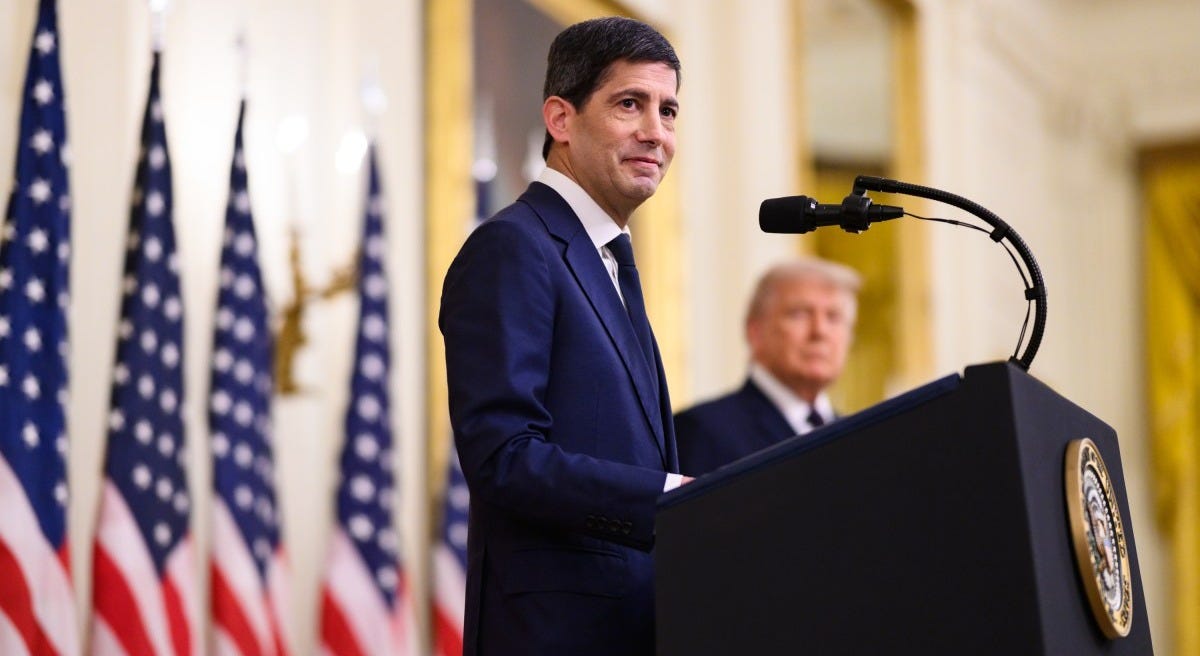
May’s inflation report of 4.2% annually compounded a poor start to the week on Wall Street, following speculation of possible Fed hikes later this year. The VICO model has been ahead of prediction markets in both developments. Hit hardest by the dip were tech stocks, which plunged the South Korean Index KOSPI down over 10% from last Thursday. Meanwhile, OpenAI filed to IPO, and SpaceX is set to hit the market on Friday. This week:
Inflation
As early as March 6th, the VICO model put the odds for inflation to reach 4% in 2026 at 54%. By March 20th, that number had risen to 81.5%.
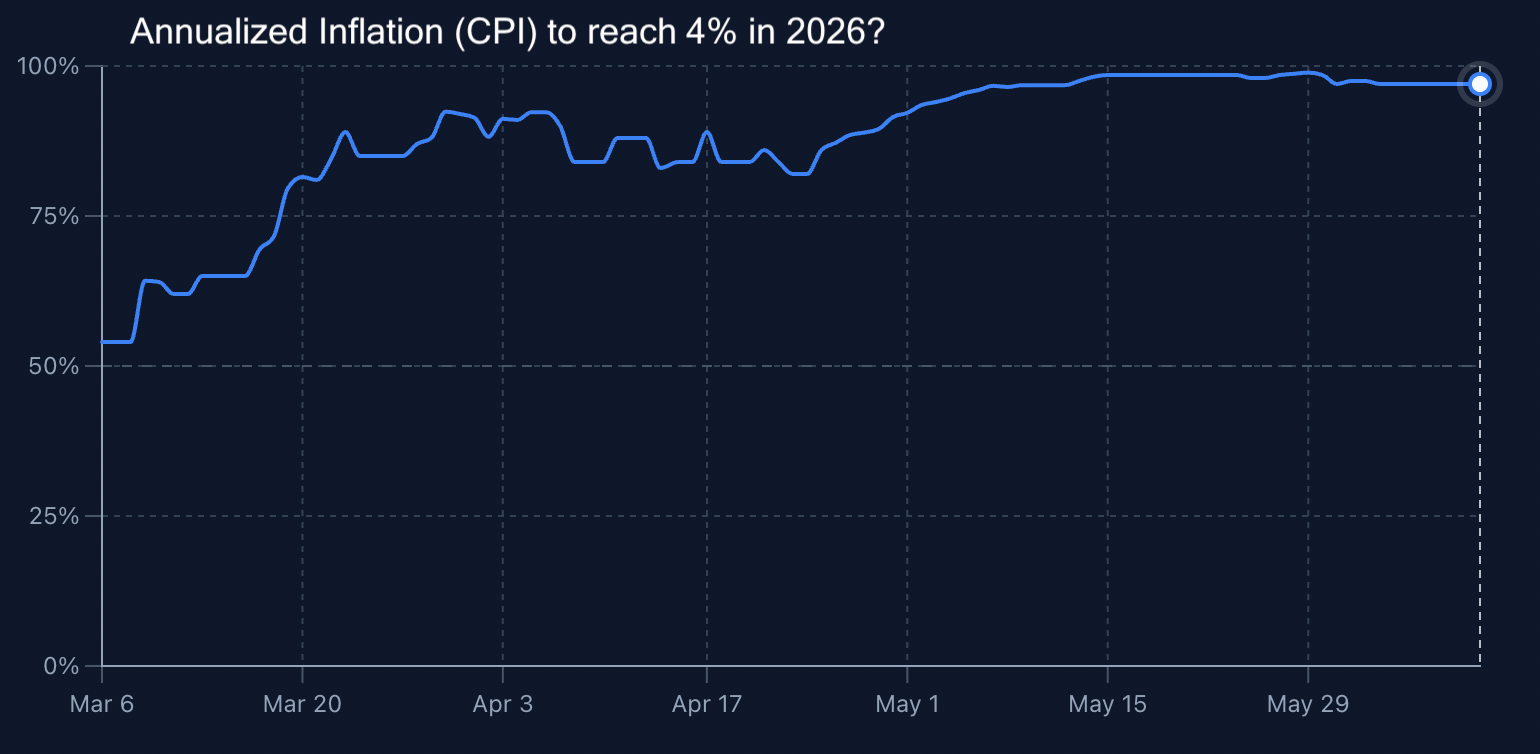
Polymarket on March 6th was at just 17% (While VICO was at 54%). On March 20th, that number rose to 44.5% (While VICO was at 81.5%). Meanwhile, VICO was above 75% by March 18th, while Polymarket didn’t hit 75% until May. That forecast resolved to a yes after Wednesday’s report.
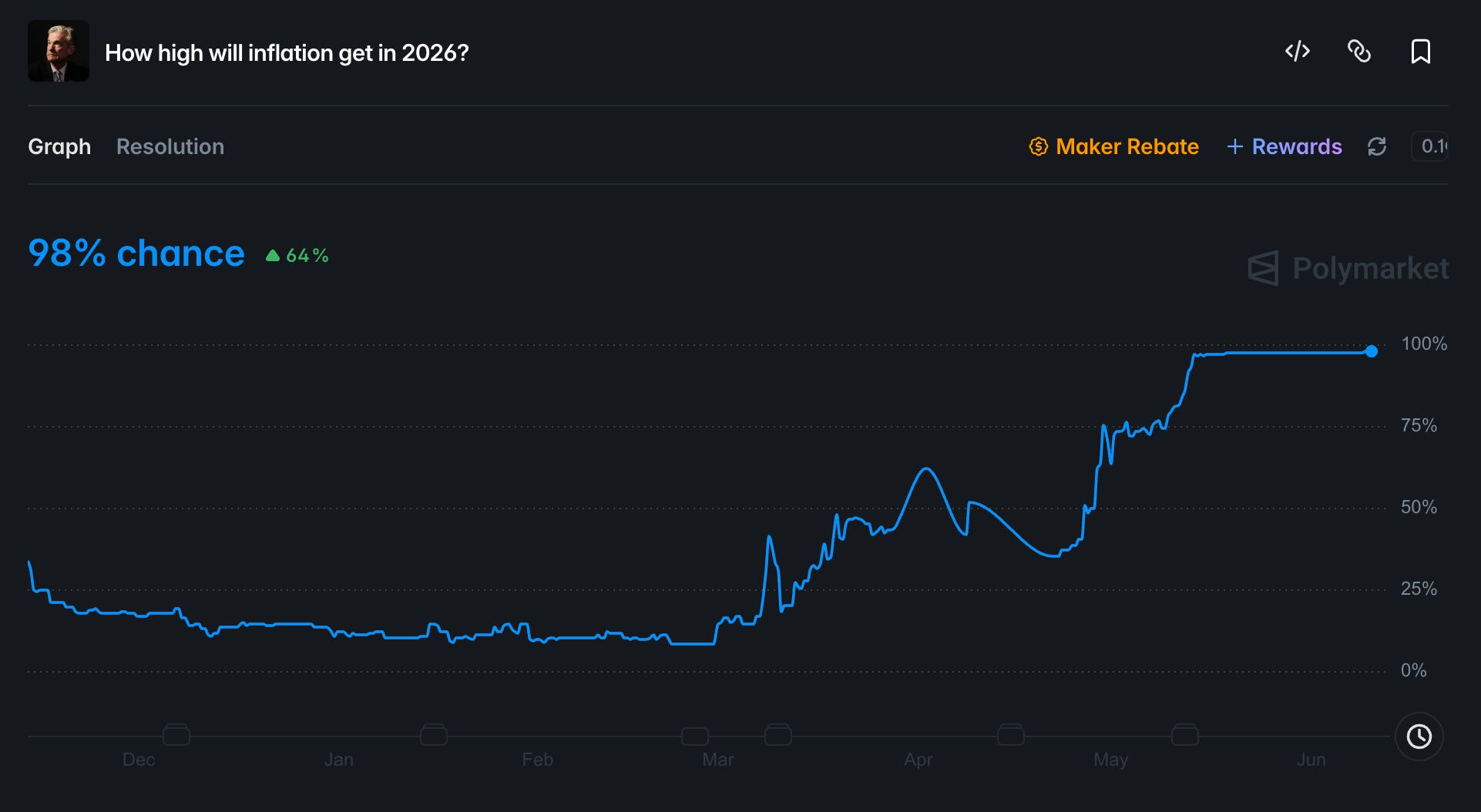
62%: The odds for inflation to reach 5% in 2026. (Polymarket: 23%)
The VICO model remains bullish on inflation compared to prediction markets, partially on the back of a continued expectation for conflict in Iran.
Fed Rates
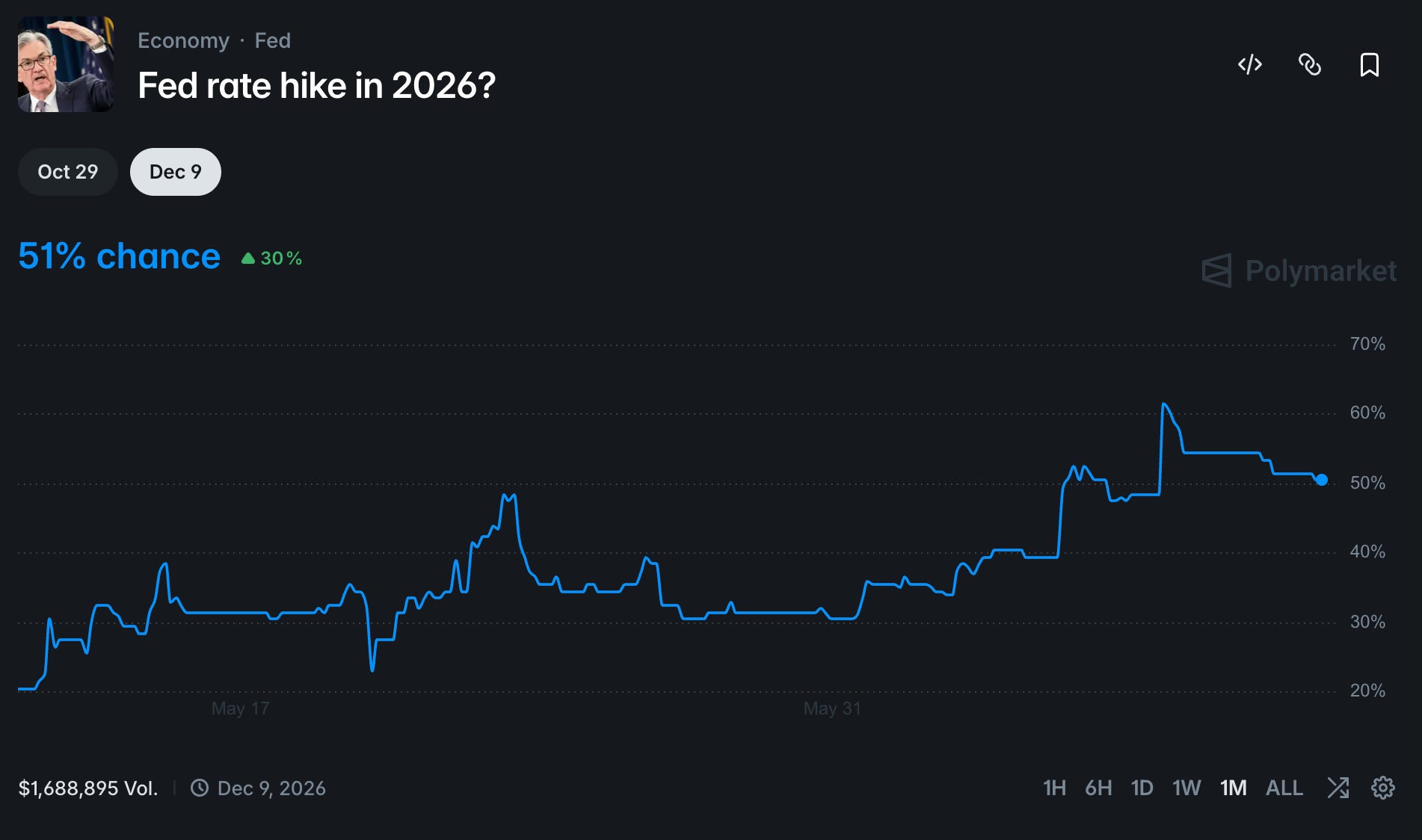
Since May 19th, the VICO model has been high on the odds of a rate hike in 2026. Starting at 62% and moving up to 81% today.
The VICO model argues that the recent robust jobs report, combined with prolonged rising inflation, tilts the Fed’s long-term priority towards fighting inflation over unemployment.
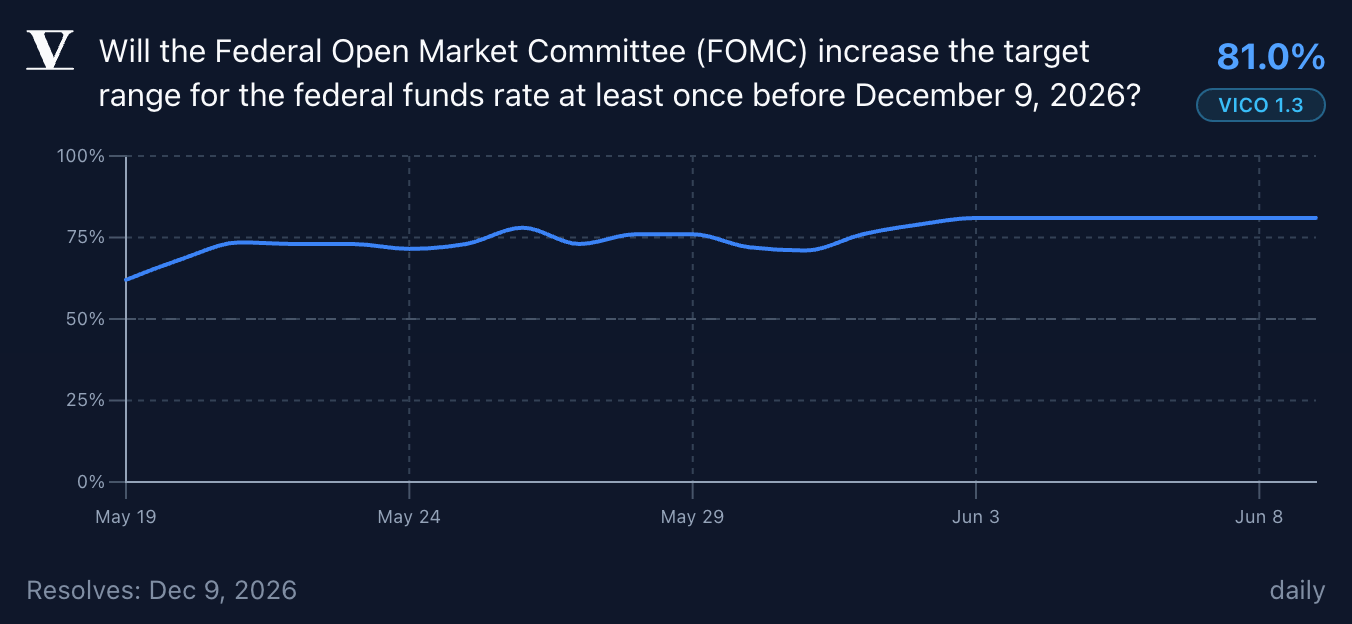
In the same time, Polymarket has gone from 23% on May 20th to 51% today.
Over that time, Polymarket adjusted 29% to nearly reach where the VICO model was three weeks ago.
Importantly, these forecasts combine to tell a coherent story with other VICO model projections. From the beginning, the VICO model was low on the odds for a quick resolution in Iran, which pushed up the cost of oil. The resulting inflation spike pushed up odds for a Fed rate hike.
All of these forecasts taken together show the VICO model considering the cross-forecast effects of important predictions like a prolonged conflict in Iran vs inflation vs fed hikes.
South Korean Economy
In our last week’s newsletter, we covered the explosive growth of the South Korean economy. The VICO model poured cold water on the hype by putting a mere 28% probability on KOSPI reaching Goldman Sachs’ 12,000 target for the index in the next year.
The very next day, KOSPI dropped 8%, and as of COB Wednesday, the index is down over 10% from its Thursday close.
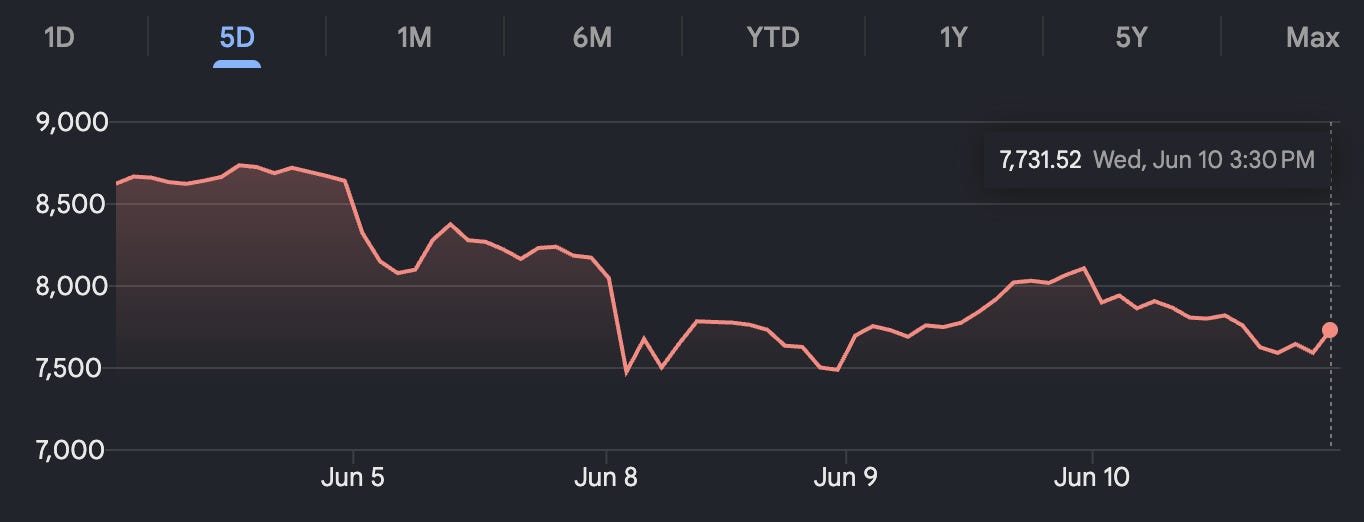
Last week: 42% → Today: 32%: The probability that KOSPI reaches a total market cap of $6 trillion in 2026.
SpaceX and OpenAI IPOs
14%: The probability that SpaceX’s market cap reaches at least $2.2 trillion by market close on Friday. (Polymarket: 41%)
66%: The probability that OpenAI completes its IPO in 2026. (Polymarket: 49%)
The US and Iran traded strikes after a US helicopter was shot down over the Strait of Hormuz. Meanwhile, the US is reportedly considering buying the Chagos Islands from Mauritius, following US concerns that the UK may cede sovereignty of the island chain, which houses a joint US-UK military base. And upcoming elections including a Swiss referendum on capping the nation’s population at 10 million. This week:
Iran
In what has become a recurring pattern, the VICO model again accurately predicted the round of strikes on Iran this week. Other examples include our newsletters from March 5th, May 7th, and May 28th.
This week, the VICO model put the odds for American strikes on Iran at 99% on Monday. The US struck Iran on Tuesday.
4%: The probability that the US and Iran reach a deal concerning Iranian nuclear capabilities in the next 60 days.
1%: The probability that the US and Iran reach a permanent ceasefire agreement by June 30. (Polymarket: 15%)
The VICO model remains highly pessimistic about any deal in the near future that would accomplish the President’s stated goals of ending the conflict and restricting Iranian nuclear capabilities.
Chagos Islands
27%: The probability that the US buys the Chagos Islands in the next 365 days.
The VICO model argues that the UK is unlikely to cede sovereignty over the islands, which is responsible for most of the low probability.
Of note, this is a substantially higher probability than any of the “51st state” concepts discussed in our May 28th newsletter.
What if the UK cedes sovereignty over the islands? 27% → 67%
Elections/Referendums
98%: The probability that Keir Starmer will be out as PM of the UK in 2026. (Polymarket: 76%)
12%: The probability that the No to 10 million Switzerland referendum passes. (Kalshi: 16%)
42%: The probability that Eugen Tomac is the next Romanian Prime Minister.
21%: The probability that Alexandru Nazare is the next Romanian Prime Minister.
Both the California Governor election and the LA Mayor election have runoff winners, setting the stage for the general elections. The DC mayoral primary is on June 16th, which is likely to decide the winner of the general election. And we check in on Aid for Ukraine and the War Powers Act, as both are the subject of debate on Capitol Hill. This week:
California Elections
90%: The probability that Xavier Becerra wins the California Gubernatorial election. (Kalshi: 90%)
The VICO model argues that despite Hilton’s relatively strong primary performance, his status as a Republican is likely to doom his campaign
67%: The probability that Karen Bass wins the LA Mayoral election. (Kalshi: 65%)
DC Mayoral Election
84%: The probability that Janeese Lewis George wins the DC Mayor election.
The VICO model points to recent polling data, which puts Lewis George roughly 10 points ahead of the main challenger, McDuffie.
Ukraine Aid
14%: The probability that the Ukraine aid package is passed by the Senate in the next 90 days.
What if the bill reaches the Senate floor? 14% → 55%
While the VICO model believes the bill may pass if brought to the floor, the low forecast is mostly a result of a low likelihood that Republican Senate leadership chooses to bring such a divisive issue within their party to the floor.
Even if the package were approved by the Senate, the model also notes that the President would almost certainly veto it, and Congress would be extremely unlikely to overturn the veto.
War Powers Act
4%: The probability that the War Powers Act becomes law in the next 90 days.
While votes on the WPA may have a few high-profile Republican defectors, the bill is almost certainly not going to change US policy.
For all the news hype around the War Powers Act, the VICO model argues it is mostly noise. The bill faces too much of an uphill climb to get both to the floor and then over a Trump veto to survive.
We are calling this story as noise.
About Us
VICO empowers decision makers to quantify and navigate event risk. Forecast, simulate and monitor political, geopolitical and economic events.
Learn more and obtain a beta account at www.vico.io or email us at inquire@vico.io
Thanks for reading VICO Future Monitor! This post is public, so feel free to share it.
Methodology and Copyright Notes:
All percentage changes are over the last week except where noted.
Our proprietary AI models are rigorously backtested and do not rely on any betting market information.
All data and content are owned by and copyrighted by VICO Technologies Inc.
No posts
Comments
Nothing yet. Say the first thing.
Sign in to join the conversation.