

In March of this year I’d never heard of Emma Grede.
And yet by April, I felt like everyone I knew in the self-employed world was heading to her book launch and had a strong opinion about how she works and what she advocates.
The chatter seemed to fill my newsfeed and conversations relentlessly for weeks.
Who was this woman, and what can I learn, given everyone seems to be so highly opinionated about her?
Because as I scrolled my socials and even went on a walk-and-talk chat with my friend and business partner Lucy Legal, I could see a pattern emerging around people’s reactions to Emma’s work:
People furiously agreeing
OR
People furiously disagreeing with her stance on work and the path to success.
And this isn’t new.
Every few months, someone says something provocative about work and ambition and the internet splits in two. Right now it just happens to be Emma Grede.
So what I’m not going to do, as many others on Substack have already dissected, is share what I think of her stance on working from home, closeness to power, a being a working mum who only sees her children “3 hours a week.”
What I want to share isn’t really about Emma. It’s about what your (and my!) response to Emma tells us about our trust in ourselves.
For those equally as clueless about who this woman as I was – a tiny recap if you’ve never come across her either, like I hadn’t until April 2026.
Grede grew up in east London, dropped out of school and college, built a multi-million dollar empire through internships and hustle starting her own talent agency in her 20s, and co-founded Skims and Good American with the Kardashians which are now multi-billion dollar brands.
Her new book is called Start With Yourself and her central argument is that women need to take power, because nobody is coming to hand it to them.
And the PR storm around the launch of said book? It’s caused quite the outpouring of hot takes.
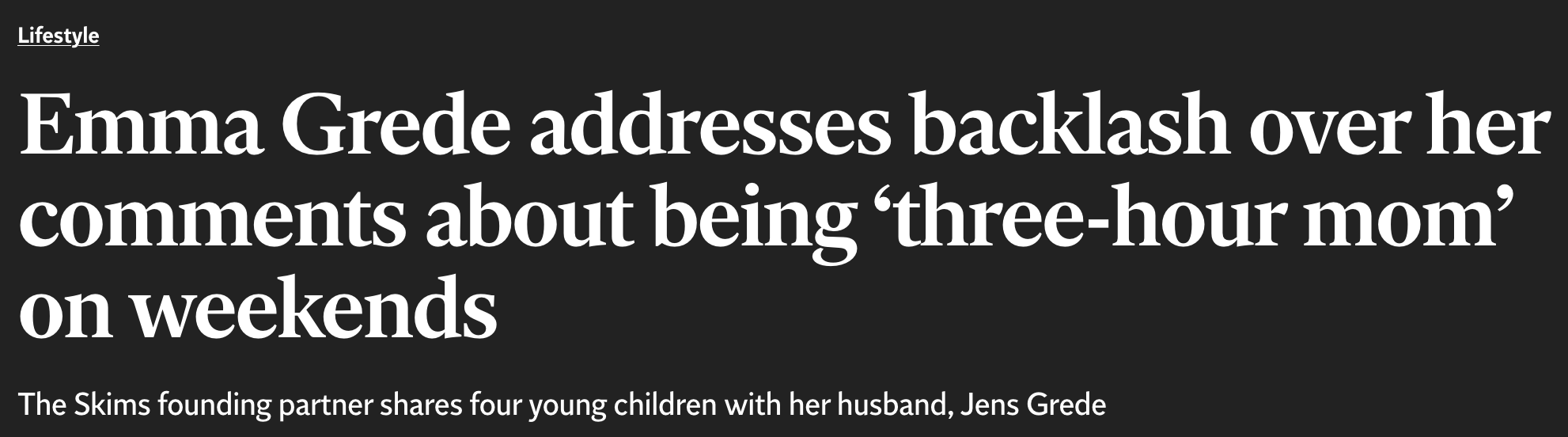
She argues work-from-home culture hinders women’s career growth due to reduced visibility, and she describes herself as a “max three-hour mum” on weekends and explains she has a team of support to help her run her business and take care of her family while she works, which she refuses to apologise for or feel bad about.
The bulk of the criticisms of Grede I could see pouring out of people in the wake of her press interviews fall into two parts:
Firstly, that she married someone who could open doors for her. Her husband’s background as a Swedish creative executive and co-founder of Saturday Group, a branding powerhouse, helped catapult her proximity to power in a way that a woman grinding alone in East London and going into an office every day to be ‘close to power’ simply could not.
Secondly, critics point out that the average person doesn’t have a team of people to do the housekeeping and tend to children the way wealthy people can. In fact, going into an office 5 days a week is actually impossible for many for a multitude of reasons (caring responsibilities, health or disabilities, cost of living and travel etc.) and stops them returning to the workforce.
Of course there is always the portion of the internet that believes in meritocracy and the American Dream that if you just work hard enough, everyone has the same opportunity to build this sort of wealth and privilege.
But the accusation is that Emma is ‘closing the door’ on working from home being a viable way for many, particularly women, to work and earn who are in more challenging situations then those who can commute and get to a traditional office, by suggesting it limits careers and stifles growth and promotion.
Emma’s path is real. It is also specific.
Advice that works for someone with her resources, connections, and context will not land the same for everyone.
The legitimate critique that just hustling harder and getting close to decision makers on your path gets you to multi-billion dollar company CEO status alone, is disingenuous and ignores the context and nuance for many.
If you want to unpack that as a concept more and why so much traditional “just work hard” advice doesn’t land or work for the many, I loved this episode of A Little Bit Fruity about Mel Robbins.
It digs into how Robbins’ advice on “just count down from 5 and get on and do it” is not the full picture and ignores most people’s lived experience – leaving us all just feeling bad that we are somehow the problem when we don’t have success despite doing all the things, when in fact it’s the system and the beliefs we’ve had installed in us. And I am not someone usually to recommend a 2hr long podcast usually, but here we are – it’s worth a 1.5x listen 😊
Back to Grede.
Because let’s hold the mirror up now.
Are you sitting comfortably after reading some of what she’s said?
Or has it made you feel annoyed or agitated in some way?
I bet you’ve got thoughts. I bet part of your brain said “OMG NO!” to the things she’s said make women successful.
When Emma says something and you feel a hot surge of “she’s wrong and out of touch”…. Just… pause.
What is that reaction telling you about YOUR beliefs? Your fears? Your own story about what success requires, and whether you deserve it?
Equally, if you swallow her advice whole and share it breathlessly without filtering it through your own life and a reality that is not the same as someone with access to celebrities (for example), that’s also a sign of something.
It’s outsourcing your authority to someone who isn’t walking in your shoes and assuming they have the blueprint and the answer to why you think you’re struggling. And that it’s a simple, ‘just work harder’ answer.
(There’s a pattern of consuming external narratives and letting them overwrite your own instincts which I wrote about in a previous Substack article about my obsession with true crime podcasts, have a read here).
Watching Emma Grede and hearing her forthright and confident advice, or advice from any expert, (including me!), requires you as the consumer to run it through your own context first.
Here are some questions to ask when you encounter a provocative take that makes you either want to a) totally reject it, or b) follow it completely as your new modus operandi in life:
Does this advice apply to my specific situation, industry, and life stage?
What am I reacting to here, and is that reaction mine or is it an old story?
Where might I have heard that old story before, in a previous role or part of my life?
What part of this (if any) is actually useful for me, right now?
This is where self-trust becomes the point (you always know I’m going to bring it back here… right?).
By asking these questions you are getting curious, being discerning, and filtering the advice for what you need.
By asking these questions you are not jumping to conclusions or ‘making it mean’ a whole bunch of stuff that the advice does not need to, which is the instinctive reaction of the protective part of your brain.
You can answer the questions by journaling, by talking it out with a coach or a friend, by talking it out to yourself in a voice note or (what I do!) writing it into a piece of content to share with your own audience to process your thinking.
But you can only do this filtering if you trust your own read on your life.
I’ve written this Substack on what happens when you get too much advice, which you might like to read too.
It’s also really worth highlighting what impact it makes on us when we watch a business owner like Emma Grede get criticised for sharing her opinions in such a clear and unapologetic way.
When we see headlines like this and trolls on social media going wild, that inner protector in us will jump to make it mean a whole bunch of things:
“It’s not safe to tell your truth.”
“You’ll be criticised for having a strong opinion.”
“Ambitious women are always put in their place, I shouldn’t keep striving for more.”
“I’ll be judged just like her if I say I want to work and put my kids in childcare.”
Please notice these are stories. Beliefs. They are not facts.
They are a version of what might happen if you too shared your opinions and beliefs with the world.
Yes, a possibility if you say what you want is that people will judge and criticise.
But what else might be true?
Maybe telling your truth would draw in more ideal people to your world?
Maybe saying what you really think will be cheered on and shared by your peers and fans?
Maybe striving for more will inspire others and make you the go-to in your field?
Maybe putting your kids in childcare is exactly what you need to be a great parent and have a better relationship with them when you get to stretch your brain through work while they’re taken care of?
In this Emma Grede storm in a self-employed tea-cup moment: What did her message stir up for you?
Whatever it was, it’s worth looking at.
Not to decide if Emma is right or wrong. But to get curious about what you believe, what you fear, and whether you’re running your business from that place or from your own self-trust. It’s all data. It’s all information.
For what it’s worth – I can take what I need from her work.
I think we can all do with taking more responsibility for what we achieve or don’t achieve in our lives and work and noticing where we outsource or pass blame, where there are things we can do and control to create the life we’re aspiring to.
And at the same time we can acknowledge there are things we have little to no control over, and let them go or refuse to accept that these limits render us totally powerless to do anything.
I also think we must acknowledge that not all advice is meant for us. And it’s not our responsibility to police how other people react to the content and influential figures we come across.
I’m often asked who my inspirations and idols are in the self-employed world. My honest answer is I don’t really have one.
I take small lessons and experience micro-impacts from a whole range of business owners who’s content I consume, and I try to notice and get curious if what they say I ‘should’ do triggers a resistance these days and lean in to questioning why that is – because there’s gold in the nuggets when I dig.
Let me know what sprang up for you, I love to hear your comments. And this is a topic that brought a lot of opinions.
If you’ve enjoyed reading this and the mirror it’s held up to the way you respond when you see other people showing up in their way like Grede, you would love my Business Mirror Audit. It’s the diagnostic that helps solopreneurs see exactly where external noise is drowning out their own instincts. Check it out and book yours in this month.

The thing draining your time isn’t your workload.
It’s the mental loop you run before every decision, every piece of content, every bold move you almost make.
Trust Club is where that loop gets shorter.
Find out more and join ⬇️
No posts
Comments
Nothing yet. Say the first thing.
Sign in to join the conversation.